
Open and Closed Class
Dr. Manohar P. Joshi
Associate Professor
Dept of English
manoharpj68@gmail.com
Walchand College of Arts and Science, Solapur
www.wcassolapur.org
Learning Outcomes
This PPT will enable the learners to
1. Know the modern concept of word classes
2. Differentiate between the parameters of open
and closed class
3. Comprehend the members under each of these
classes of words
2
Dr. Manohar P Joshi, Walchand College of
Arts and Science, Solapur
Word Classes
Old Grammar used the term Parts of Speech,
which is insufficient.
New Grammar uses the term Word Classes
which is comprehensive:
1. Open Class
2. Closed Class
Dr. Manohar P Joshi, Walchand College of
Arts and Science, Solapur
3
Open Class
Open class of words carries following
parameters-
1. These words are Infinite.
2. They are Content words.
3. They are mutually inclusive.
Dr. Manohar P Joshi, Walchand College of
Arts and Science, Solapur
4
Parameters of Open Class:1
The words belonging to open class are infinite,
since new words can be borrowed or created
and added to the stock of old words.
English is termed sponge language, as it has
been deriving words from different languages-
both European and Non-European.
Dr. Manohar P Joshi, Walchand College of
Arts and Science, Solapur
5
Parameters of Open Class:2
The words of the open class are content words.
By content words we mean that they are
independent and carry bulk of the meaning
when used in different grammatical units.
eg- a boy, the large house, has written, at one
place
Dr. Manohar P Joshi, Walchand College of
Arts and Science, Solapur
6
Parameters of Open Class:3
The words of the open class are mutually
exclusive. It means one word of a group of this
class can be replaced with another similar
word without damaging the meaning.
eg- man can be replaced with person, chap,
fellow, gentleman, guy, etc
Dr. Manohar P Joshi, Walchand College of
Arts and Science, Solapur
7
Members of Open Class
 Following are the members of the open class
of words:
1. Nouns
2. Adjectives
3. Verbs
4. Adverbs
Dr. Manohar P Joshi, Walchand College of
Arts and Science, Solapur
8
Members of Open Class
Nouns: Nouns are the words that indicate persons,
things, beings, concepts, etc. Nouns are broadly
classified into Concrete and Abstract. Concrete
nouns may be Proper, Common, Material or
Collective, as in,
Sam
city
gold
army
Dr. Manohar P Joshi, Walchand College of
Arts and Science, Solapur
9
Members of Open Class
Abstract nouns are the words that stand for
different entities which give rise to their types
as follows:
1. Ideas
2. Conditions
3. Actions
4. Branches of Knowledge
Dr. Manohar P Joshi, Walchand College of
Arts and Science, Solapur
10
Members of Open Class
Adjectives: Adjectives are the words which
qualify the meanings of nouns by indicating
their quality, quantity, number, etc. Following
are the types of adjectives:
1. Adjectives of Quality 2. Adjectives of Quantity
3. Adjectives of Number 4.Demonstrative Adjectives
5. Possessive Adjectives 6. Interrogative Adjectives
Dr. Manohar P Joshi, Walchand College of
Arts and Science, Solapur
11
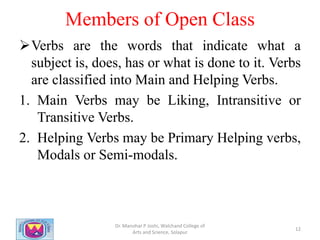
Members of Open Class
Verbs are the words that indicate what a
subject is, does, has or what is done to it. Verbs
are classified into Main and Helping Verbs.
1. Main Verbs may be Liking, Intransitive or
Transitive Verbs.
2. Helping Verbs may be Primary Helping verbs,
Modals or Semi-modals.
Dr. Manohar P Joshi, Walchand College of
Arts and Science, Solapur
12
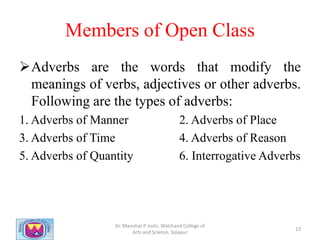
Members of Open Class
Adverbs are the words that modify the
meanings of verbs, adjectives or other adverbs.
Following are the types of adverbs:
1. Adverbs of Manner 2. Adverbs of Place
3. Adverbs of Time 4. Adverbs of Reason
5. Adverbs of Quantity 6. Interrogative Adverbs
Dr. Manohar P Joshi, Walchand College of
Arts and Science, Solapur
13
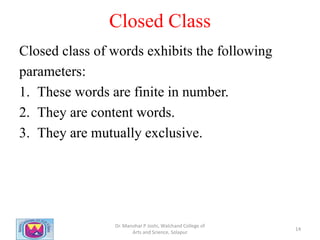
Closed Class
Closed class of words exhibits the following
parameters:
1. These words are finite in number.
2. They are content words.
3. They are mutually exclusive.
Dr. Manohar P Joshi, Walchand College of
Arts and Science, Solapur
14
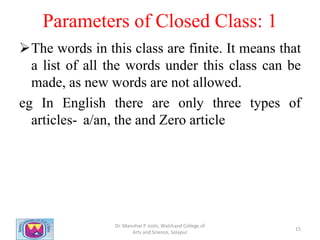
Parameters of Closed Class: 1
The words in this class are finite. It means that
a list of all the words under this class can be
made, as new words are not allowed.
eg In English there are only three types of
articles- a/an, the and Zero article
Dr. Manohar P Joshi, Walchand College of
Arts and Science, Solapur
15
Parameters of Closed Class: 2
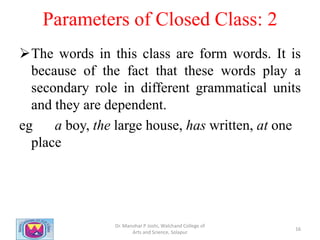
The words in this class are form words. It is
because of the fact that these words play a
secondary role in different grammatical units
and they are dependent.
eg a boy, the large house, has written, at one
place
Dr. Manohar P Joshi, Walchand College of
Arts and Science, Solapur
16
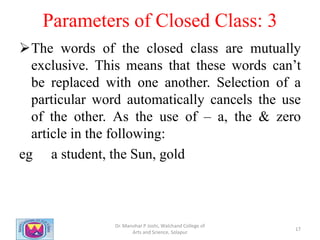
Parameters of Closed Class: 3
The words of the closed class are mutually
exclusive. This means that these words can’t
be replaced with one another. Selection of a
particular word automatically cancels the use
of the other. As the use of – a, the & zero
article in the following:
eg a student, the Sun, gold
Dr. Manohar P Joshi, Walchand College of
Arts and Science, Solapur
17
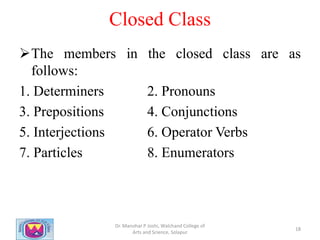
Closed Class
The members in the closed class are as
follows:
1. Determiners 2. Pronouns
3. Prepositions 4. Conjunctions
5. Interjections 6. Operator Verbs
7. Particles 8. Enumerators
Dr. Manohar P Joshi, Walchand College of
Arts and Science, Solapur
18
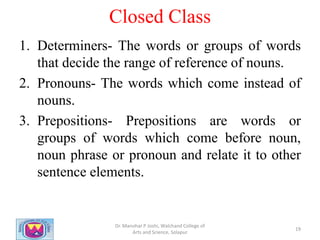
Closed Class
1. Determiners- The words or groups of words
that decide the range of reference of nouns.
2. Pronouns- The words which come instead of
nouns.
3. Prepositions- Prepositions are words or
groups of words which come before noun,
noun phrase or pronoun and relate it to other
sentence elements.
Dr. Manohar P Joshi, Walchand College of
Arts and Science, Solapur
19
Closed Class
4. Conjunctions- The words or groups of words
which connect different grammatical units like
words, phrases, clauses and sentences; and
bring about coordination or subordination.
5.Interjections: Interjections are the words which
express strong and sudden emotions and
feelings. They are identified by exclamatory
mark (!).
Dr. Manohar P Joshi, Walchand College of
Arts and Science, Solapur
20
Closed Class
6. Operator Verbs: These are the words which
introduce the verbs phrases and play a key role
in deciding tense and aspect.
7. Particles: Particles are the words which come
after the verbs and add different idiomatic
meanings to the combinations.
8. Enumerators: These are words or groups of
words which qualify nouns.
Dr. Manohar P Joshi, Walchand College of
Arts and Science, Solapur
21
References
1. Green, David. Contemporary English Grammar,
Structures and Composition, Macmillan India Ltd.
2008.
2. Leech, Geoffrey, Jan Svartvik. A Communicative
Grammar of English. 2001.
3. Quirk, Randolph, Sydney Greenbaum. A University
Grammar of English. 1993.
Dr. Manohar P Joshi, Walchand College of
Arts and Science, Solapur
22
Thank You.
Dr. Manohar P Joshi, Walchand College of
Arts and Science, Solapur
23

Open and closed class

  • 1.
    Open and ClosedClass Dr. Manohar P. Joshi Associate Professor Dept of English manoharpj68@gmail.com Walchand College of Arts and Science, Solapur www.wcassolapur.org
  • 2.
    Learning Outcomes This PPTwill enable the learners to 1. Know the modern concept of word classes 2. Differentiate between the parameters of open and closed class 3. Comprehend the members under each of these classes of words 2 Dr. Manohar P Joshi, Walchand College of Arts and Science, Solapur
  • 3.
    Word Classes Old Grammarused the term Parts of Speech, which is insufficient. New Grammar uses the term Word Classes which is comprehensive: 1. Open Class 2. Closed Class Dr. Manohar P Joshi, Walchand College of Arts and Science, Solapur 3
  • 4.
    Open Class Open classof words carries following parameters- 1. These words are Infinite. 2. They are Content words. 3. They are mutually inclusive. Dr. Manohar P Joshi, Walchand College of Arts and Science, Solapur 4
  • 5.
    Parameters of OpenClass:1 The words belonging to open class are infinite, since new words can be borrowed or created and added to the stock of old words. English is termed sponge language, as it has been deriving words from different languages- both European and Non-European. Dr. Manohar P Joshi, Walchand College of Arts and Science, Solapur 5
  • 6.
    Parameters of OpenClass:2 The words of the open class are content words. By content words we mean that they are independent and carry bulk of the meaning when used in different grammatical units. eg- a boy, the large house, has written, at one place Dr. Manohar P Joshi, Walchand College of Arts and Science, Solapur 6
  • 7.
    Parameters of OpenClass:3 The words of the open class are mutually exclusive. It means one word of a group of this class can be replaced with another similar word without damaging the meaning. eg- man can be replaced with person, chap, fellow, gentleman, guy, etc Dr. Manohar P Joshi, Walchand College of Arts and Science, Solapur 7
  • 8.
    Members of OpenClass  Following are the members of the open class of words: 1. Nouns 2. Adjectives 3. Verbs 4. Adverbs Dr. Manohar P Joshi, Walchand College of Arts and Science, Solapur 8
  • 9.
    Members of OpenClass Nouns: Nouns are the words that indicate persons, things, beings, concepts, etc. Nouns are broadly classified into Concrete and Abstract. Concrete nouns may be Proper, Common, Material or Collective, as in, Sam city gold army Dr. Manohar P Joshi, Walchand College of Arts and Science, Solapur 9
  • 10.
    Members of OpenClass Abstract nouns are the words that stand for different entities which give rise to their types as follows: 1. Ideas 2. Conditions 3. Actions 4. Branches of Knowledge Dr. Manohar P Joshi, Walchand College of Arts and Science, Solapur 10
  • 11.
    Members of OpenClass Adjectives: Adjectives are the words which qualify the meanings of nouns by indicating their quality, quantity, number, etc. Following are the types of adjectives: 1. Adjectives of Quality 2. Adjectives of Quantity 3. Adjectives of Number 4.Demonstrative Adjectives 5. Possessive Adjectives 6. Interrogative Adjectives Dr. Manohar P Joshi, Walchand College of Arts and Science, Solapur 11
  • 12.
    Members of OpenClass Verbs are the words that indicate what a subject is, does, has or what is done to it. Verbs are classified into Main and Helping Verbs. 1. Main Verbs may be Liking, Intransitive or Transitive Verbs. 2. Helping Verbs may be Primary Helping verbs, Modals or Semi-modals. Dr. Manohar P Joshi, Walchand College of Arts and Science, Solapur 12
  • 13.
    Members of OpenClass Adverbs are the words that modify the meanings of verbs, adjectives or other adverbs. Following are the types of adverbs: 1. Adverbs of Manner 2. Adverbs of Place 3. Adverbs of Time 4. Adverbs of Reason 5. Adverbs of Quantity 6. Interrogative Adverbs Dr. Manohar P Joshi, Walchand College of Arts and Science, Solapur 13
  • 14.
    Closed Class Closed classof words exhibits the following parameters: 1. These words are finite in number. 2. They are content words. 3. They are mutually exclusive. Dr. Manohar P Joshi, Walchand College of Arts and Science, Solapur 14
  • 15.
    Parameters of ClosedClass: 1 The words in this class are finite. It means that a list of all the words under this class can be made, as new words are not allowed. eg In English there are only three types of articles- a/an, the and Zero article Dr. Manohar P Joshi, Walchand College of Arts and Science, Solapur 15
  • 16.
    Parameters of ClosedClass: 2 The words in this class are form words. It is because of the fact that these words play a secondary role in different grammatical units and they are dependent. eg a boy, the large house, has written, at one place Dr. Manohar P Joshi, Walchand College of Arts and Science, Solapur 16
  • 17.
    Parameters of ClosedClass: 3 The words of the closed class are mutually exclusive. This means that these words can’t be replaced with one another. Selection of a particular word automatically cancels the use of the other. As the use of – a, the & zero article in the following: eg a student, the Sun, gold Dr. Manohar P Joshi, Walchand College of Arts and Science, Solapur 17
  • 18.
    Closed Class The membersin the closed class are as follows: 1. Determiners 2. Pronouns 3. Prepositions 4. Conjunctions 5. Interjections 6. Operator Verbs 7. Particles 8. Enumerators Dr. Manohar P Joshi, Walchand College of Arts and Science, Solapur 18
  • 19.
    Closed Class 1. Determiners-The words or groups of words that decide the range of reference of nouns. 2. Pronouns- The words which come instead of nouns. 3. Prepositions- Prepositions are words or groups of words which come before noun, noun phrase or pronoun and relate it to other sentence elements. Dr. Manohar P Joshi, Walchand College of Arts and Science, Solapur 19
  • 20.
    Closed Class 4. Conjunctions-The words or groups of words which connect different grammatical units like words, phrases, clauses and sentences; and bring about coordination or subordination. 5.Interjections: Interjections are the words which express strong and sudden emotions and feelings. They are identified by exclamatory mark (!). Dr. Manohar P Joshi, Walchand College of Arts and Science, Solapur 20
  • 21.
    Closed Class 6. OperatorVerbs: These are the words which introduce the verbs phrases and play a key role in deciding tense and aspect. 7. Particles: Particles are the words which come after the verbs and add different idiomatic meanings to the combinations. 8. Enumerators: These are words or groups of words which qualify nouns. Dr. Manohar P Joshi, Walchand College of Arts and Science, Solapur 21
  • 22.
    References 1. Green, David.Contemporary English Grammar, Structures and Composition, Macmillan India Ltd. 2008. 2. Leech, Geoffrey, Jan Svartvik. A Communicative Grammar of English. 2001. 3. Quirk, Randolph, Sydney Greenbaum. A University Grammar of English. 1993. Dr. Manohar P Joshi, Walchand College of Arts and Science, Solapur 22
  • 23.
    Thank You. Dr. ManoharP Joshi, Walchand College of Arts and Science, Solapur 23