#Repetition
#Repetition
#Repetitio
n
Prepared by:
RUEL L. MONTEFOLKA
Repetition Definition
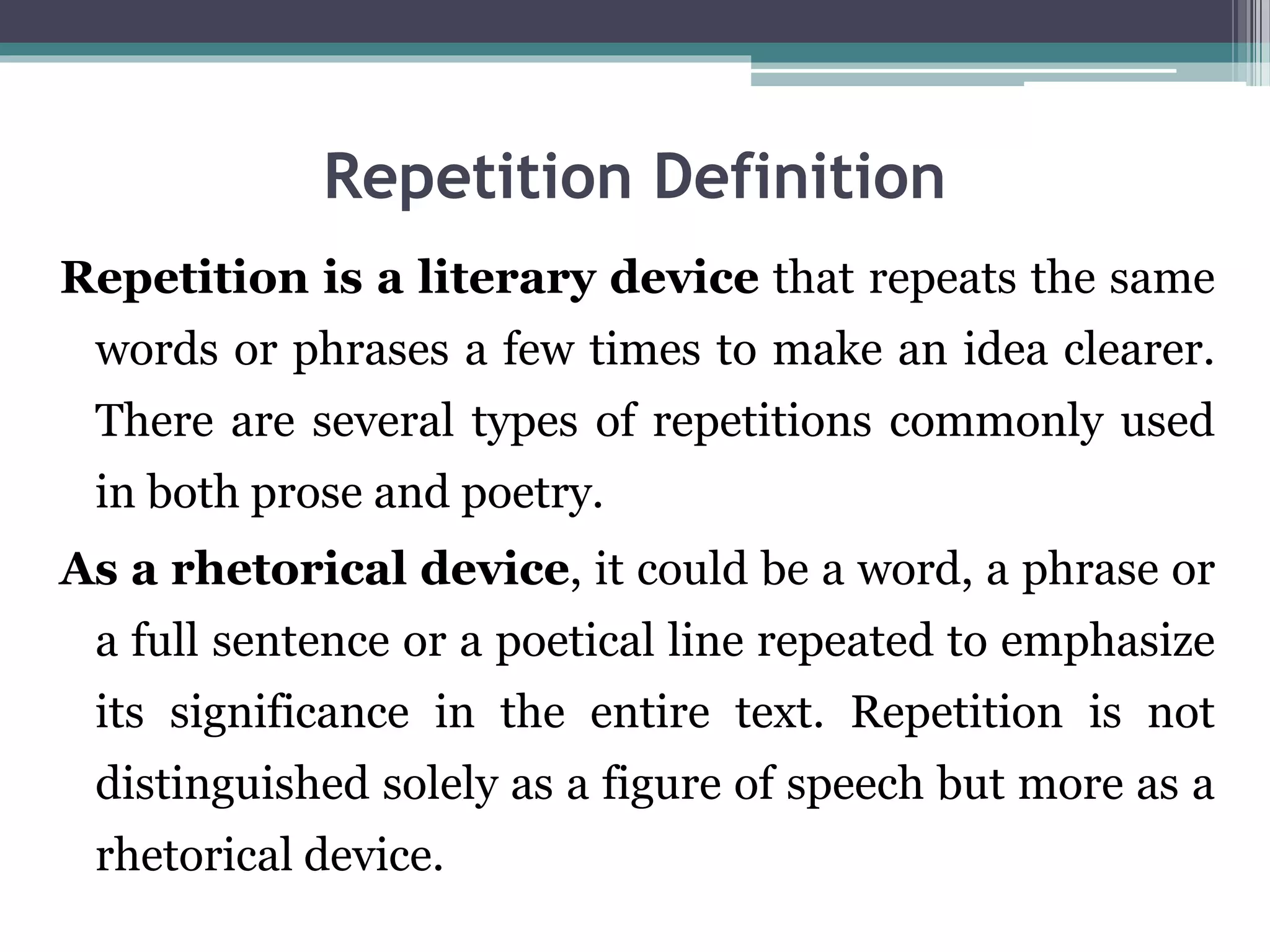
Repetition is a literary device that repeats the same
words or phrases a few times to make an idea clearer.
There are several types of repetitions commonly used
in both prose and poetry.
As a rhetorical device, it could be a word, a phrase or
a full sentence or a poetical line repeated to emphasize
its significance in the entire text. Repetition is not
distinguished solely as a figure of speech but more as a
rhetorical device.
Types of Repetition
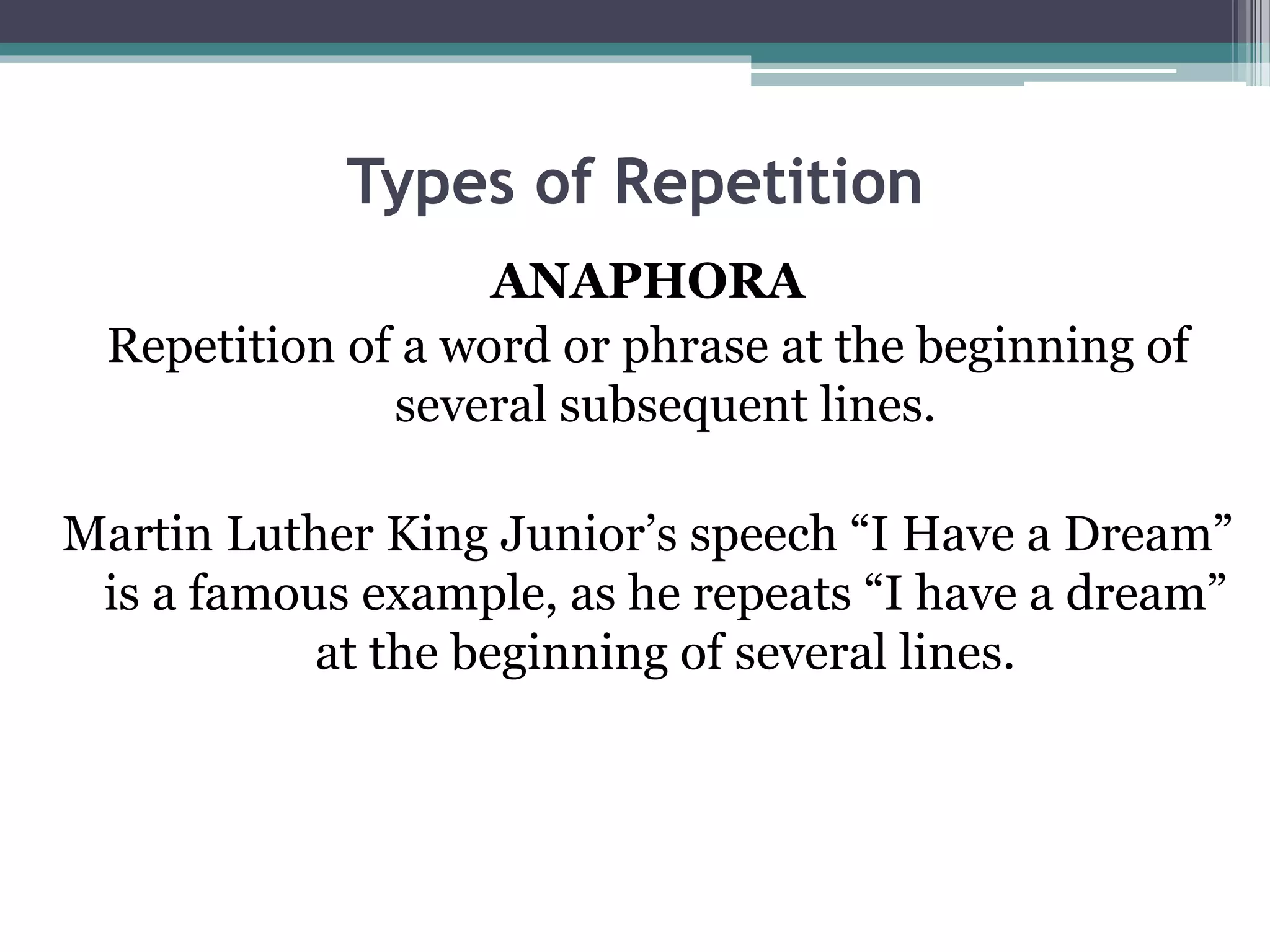
ANAPHORA
Repetition of a word or phrase at the beginning of
several subsequent lines.
Martin Luther King Junior’s speech “I Have a Dream”
is a famous example, as he repeats “I have a dream”
at the beginning of several lines.
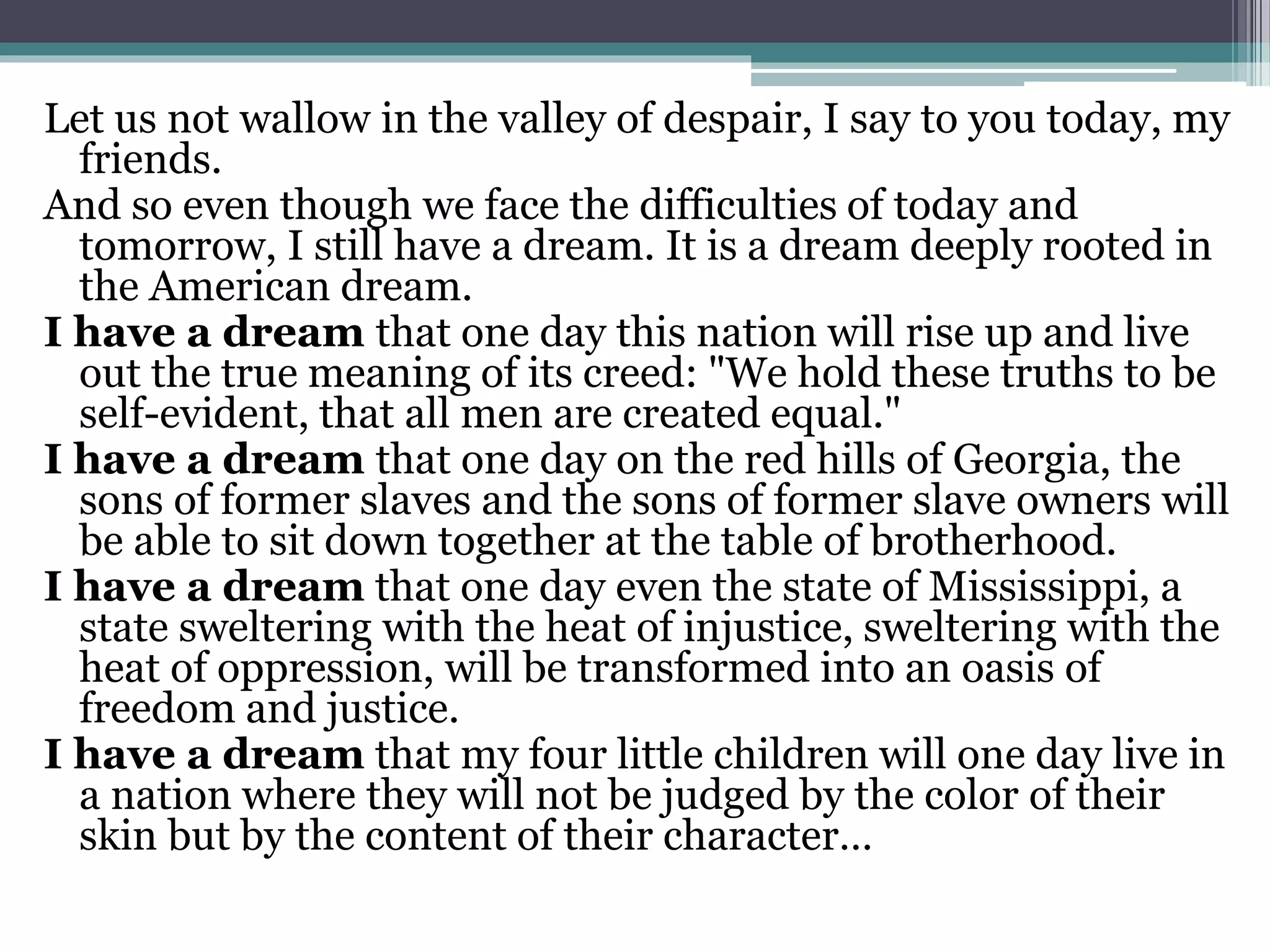
Let us not wallow in the valley of despair, I say to you today, my
friends.
And so even though we face the difficulties of today and
tomorrow, I still have a dream. It is a dream deeply rooted in
the American dream.
I have a dream that one day this nation will rise up and live
out the true meaning of its creed: "We hold these truths to be
self-evident, that all men are created equal."
I have a dream that one day on the red hills of Georgia, the
sons of former slaves and the sons of former slave owners will
be able to sit down together at the table of brotherhood.
I have a dream that one day even the state of Mississippi, a
state sweltering with the heat of injustice, sweltering with the
heat of oppression, will be transformed into an oasis of
freedom and justice.
I have a dream that my four little children will one day live in
a nation where they will not be judged by the color of their
skin but by the content of their character…
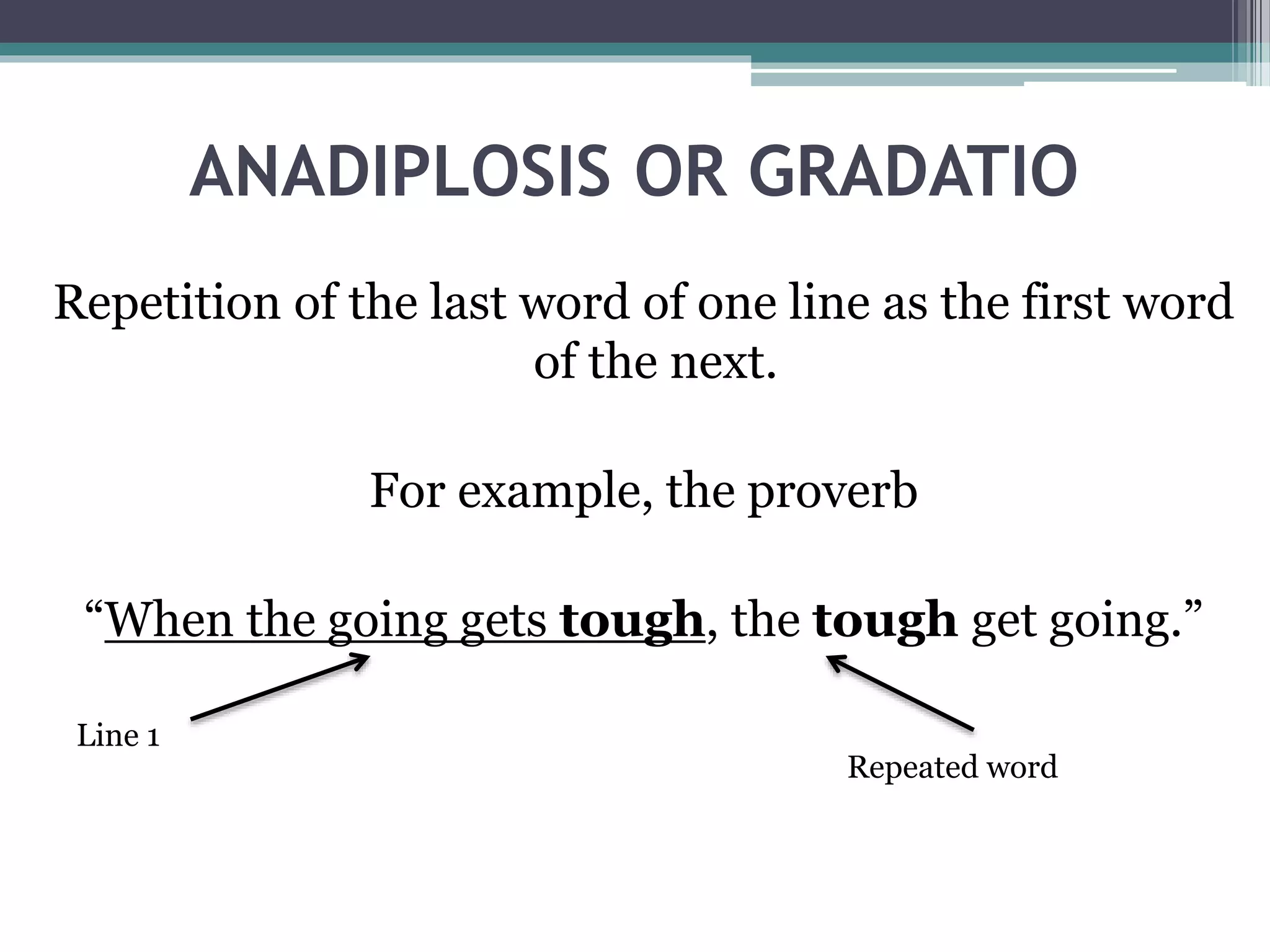
ANADIPLOSIS OR GRADATIO
Repetition of the last word of one line as the first word
of the next.
For example, the proverb
“When the going gets tough, the tough get going.”
Line 1
Repeated word
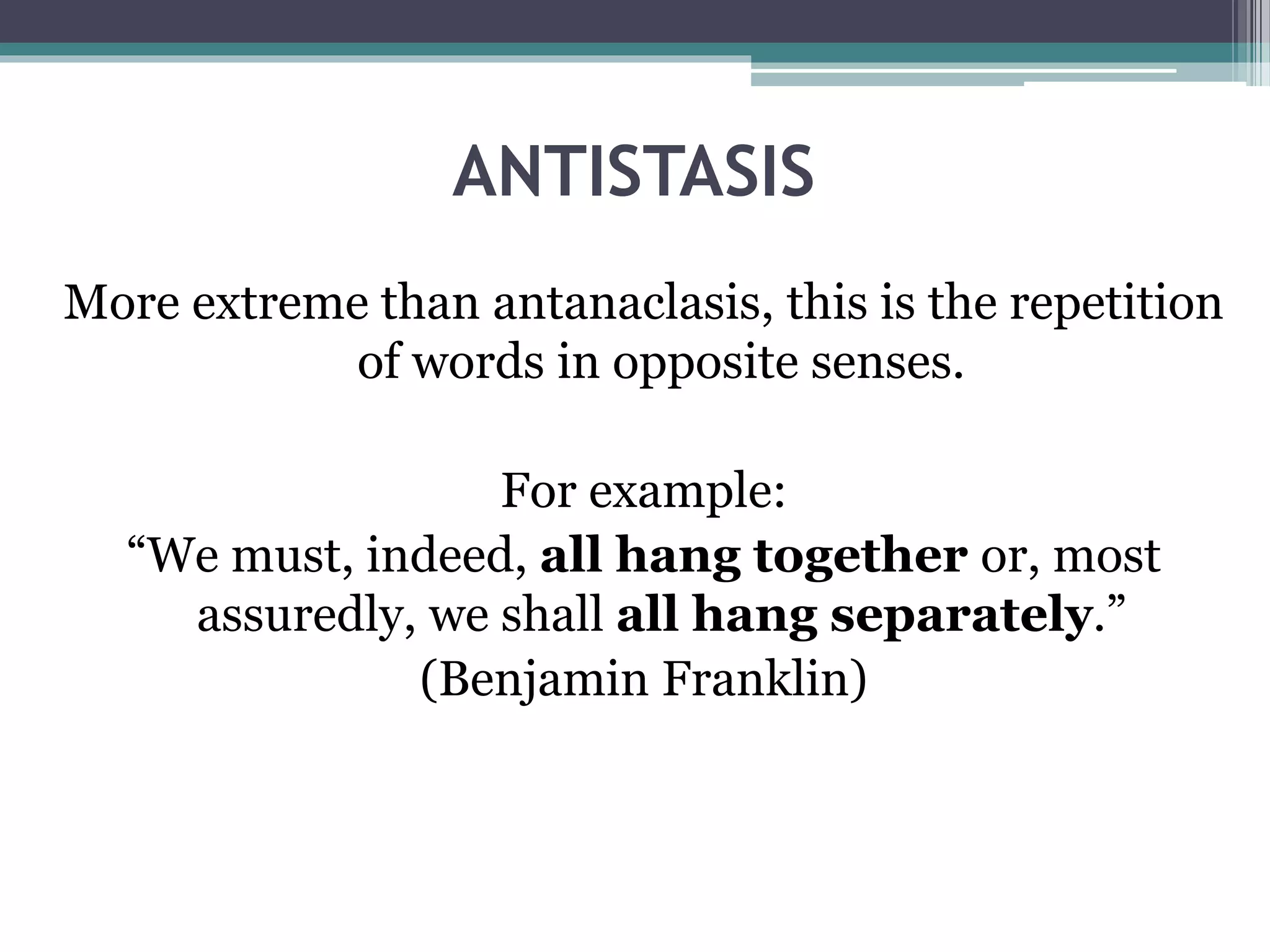
ANTISTASIS
More extreme than antanaclasis, this is the repetition
of words in opposite senses.
For example:
“We must, indeed, all hang together or, most
assuredly, we shall all hang separately.”
(Benjamin Franklin)
DIACOPE
Similar to epizeuxis, this is the repetition of a word or
phrase with only one or two words between the
repeated words.
“Diacope” comes from the Greek for “to cut in two.”
The famous line from Shakespeare’s rendition of the
St. Crispin’s Day speech in Henry V is an example:
“We few, we happy few, we band of brothers.”
We the repeated
words
the repeated
words followed
w/ 2 or 3 words
As well as to the
third phrase
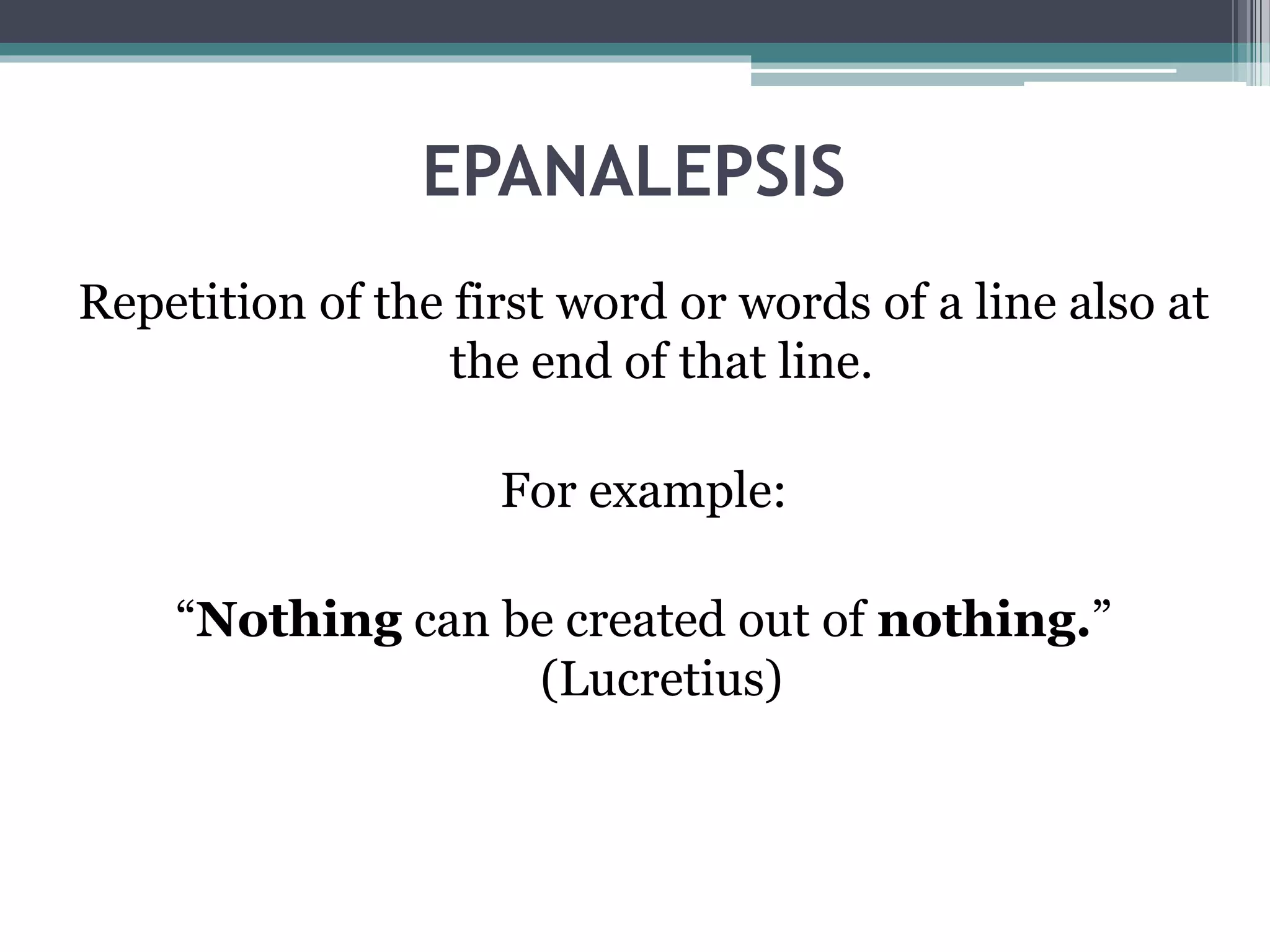
EPANALEPSIS
Repetition of the first word or words of a line also at
the end of that line.
For example:
“Nothing can be created out of nothing.”
(Lucretius)
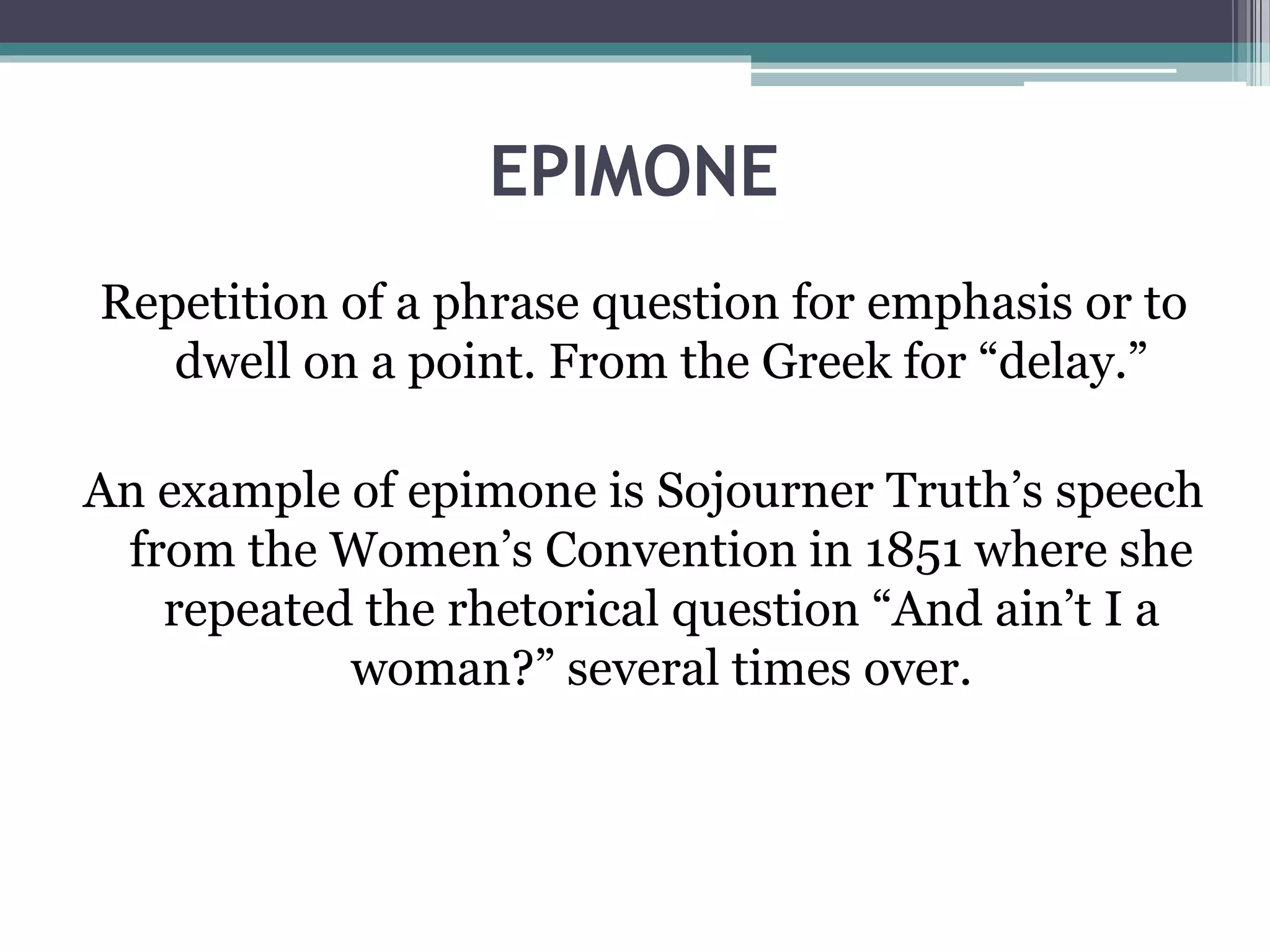
EPIMONE
Repetition of a phrase question for emphasis or to
dwell on a point. From the Greek for “delay.”
An example of epimone is Sojourner Truth’s speech
from the Women’s Convention in 1851 where she
repeated the rhetorical question “And ain’t I a
woman?” several times over.
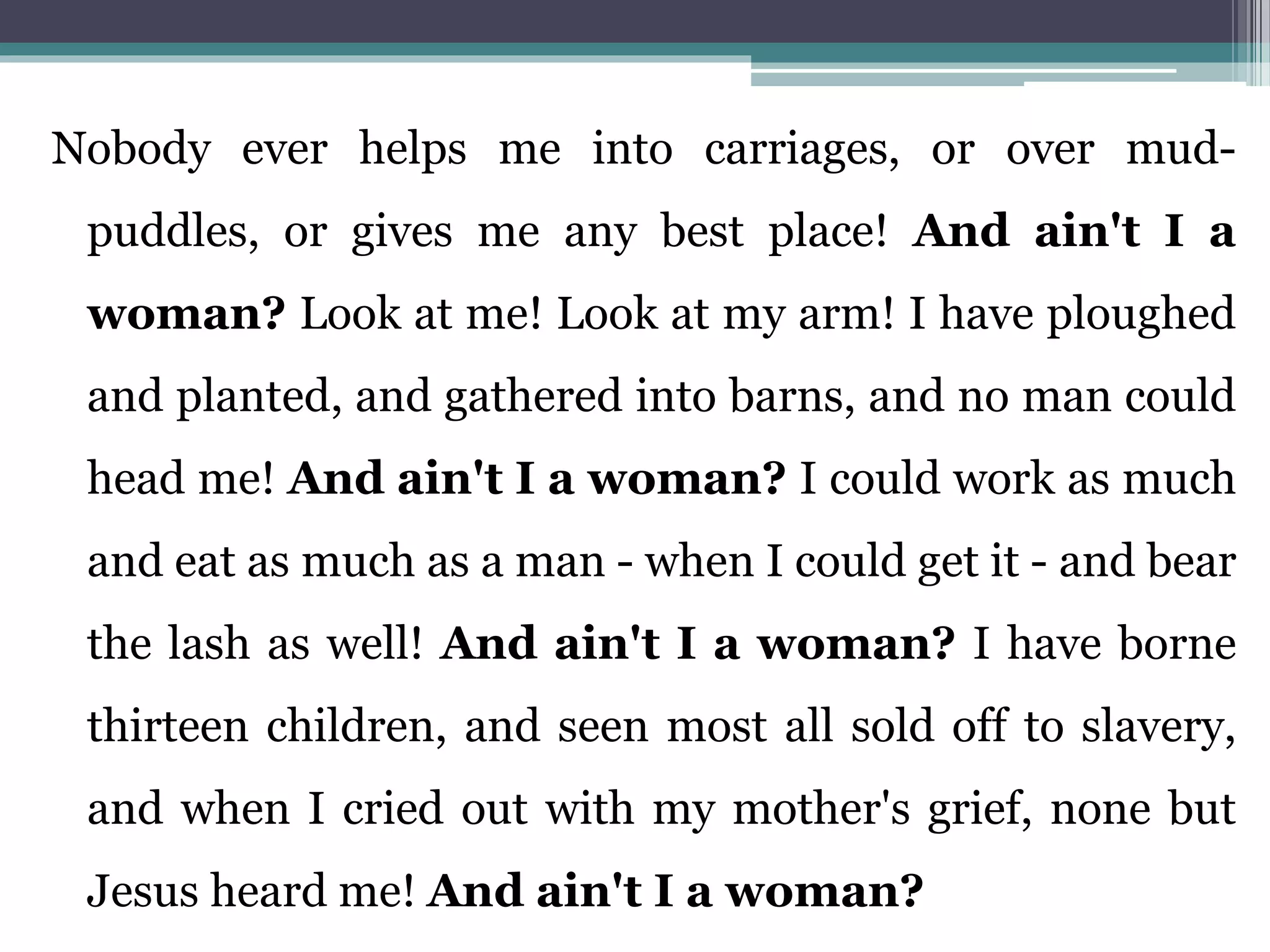
Nobody ever helps me into carriages, or over mud-
puddles, or gives me any best place! And ain't I a
woman? Look at me! Look at my arm! I have ploughed
and planted, and gathered into barns, and no man could
head me! And ain't I a woman? I could work as much
and eat as much as a man - when I could get it - and bear
the lash as well! And ain't I a woman? I have borne
thirteen children, and seen most all sold off to slavery,
and when I cried out with my mother's grief, none but
Jesus heard me! And ain't I a woman?
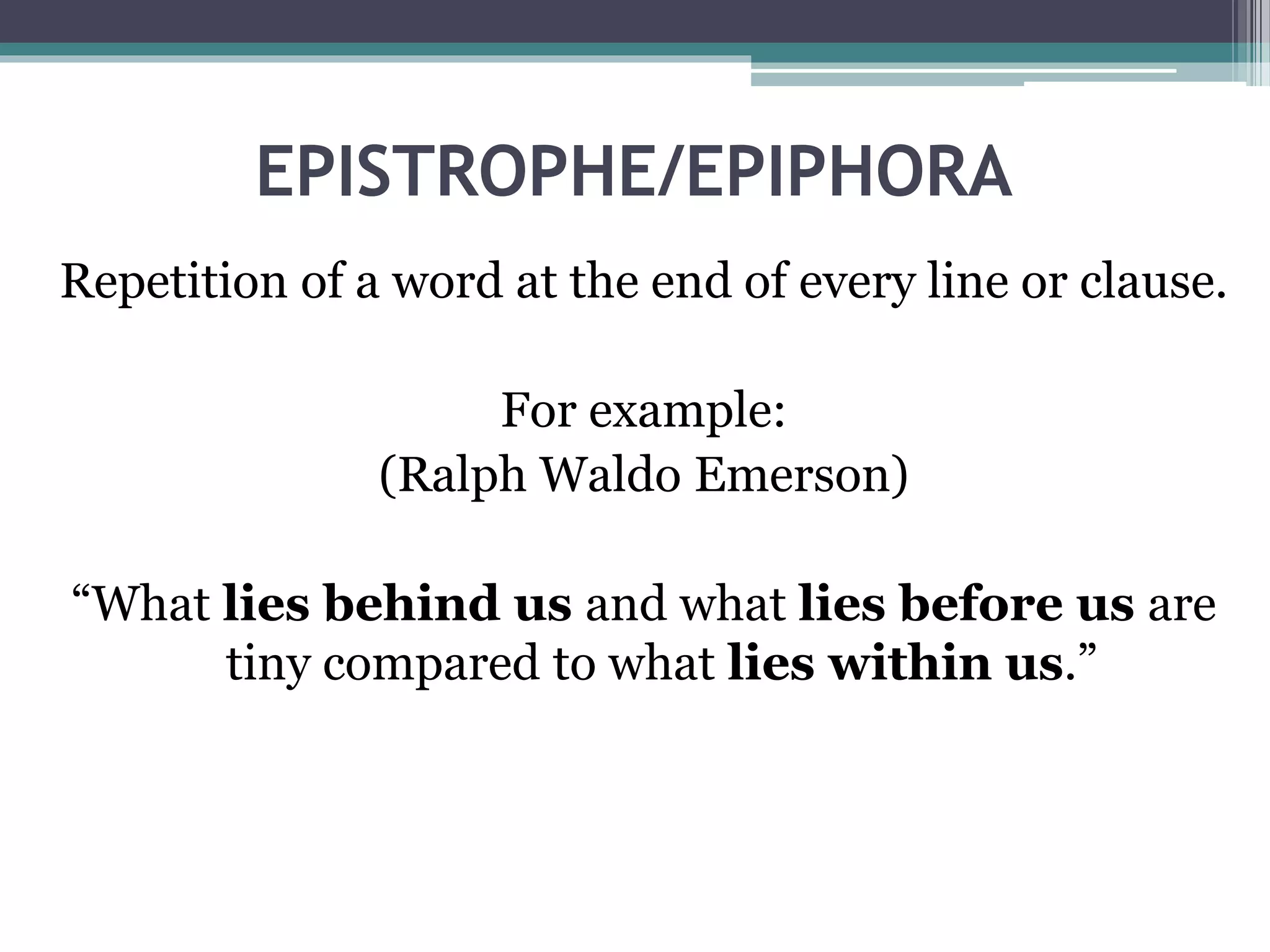
EPISTROPHE/EPIPHORA
Repetition of a word at the end of every line or clause.
For example:
(Ralph Waldo Emerson)
“What lies behind us and what lies before us are
tiny compared to what lies within us.”
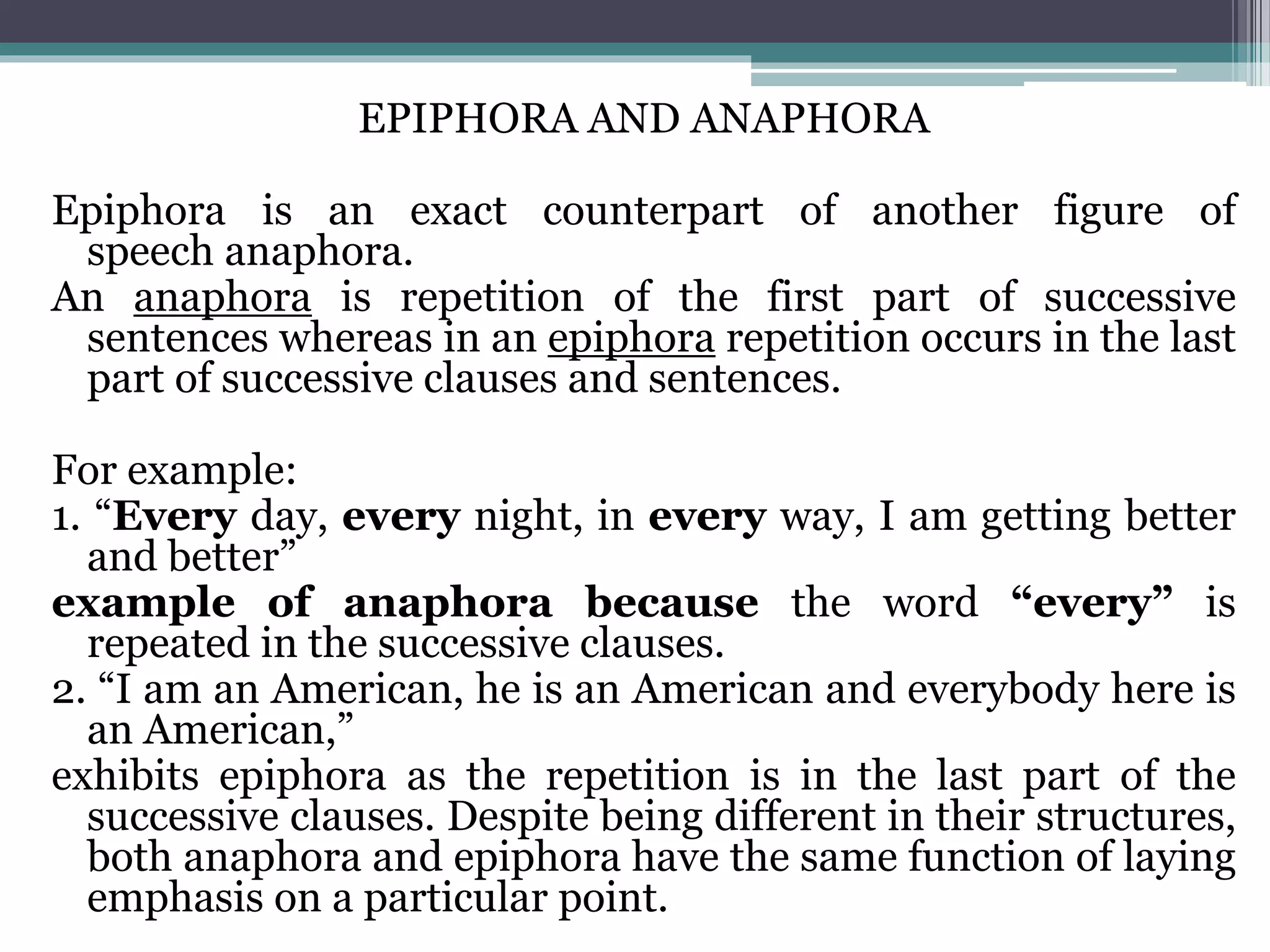
EPIPHORA AND ANAPHORA
Epiphora is an exact counterpart of another figure of
speech anaphora.
An anaphora is repetition of the first part of successive
sentences whereas in an epiphora repetition occurs in the last
part of successive clauses and sentences.
For example:
1. “Every day, every night, in every way, I am getting better
and better”
example of anaphora because the word “every” is
repeated in the successive clauses.
2. “I am an American, he is an American and everybody here is
an American,”
exhibits epiphora as the repetition is in the last part of the
successive clauses. Despite being different in their structures,
both anaphora and epiphora have the same function of laying
emphasis on a particular point.
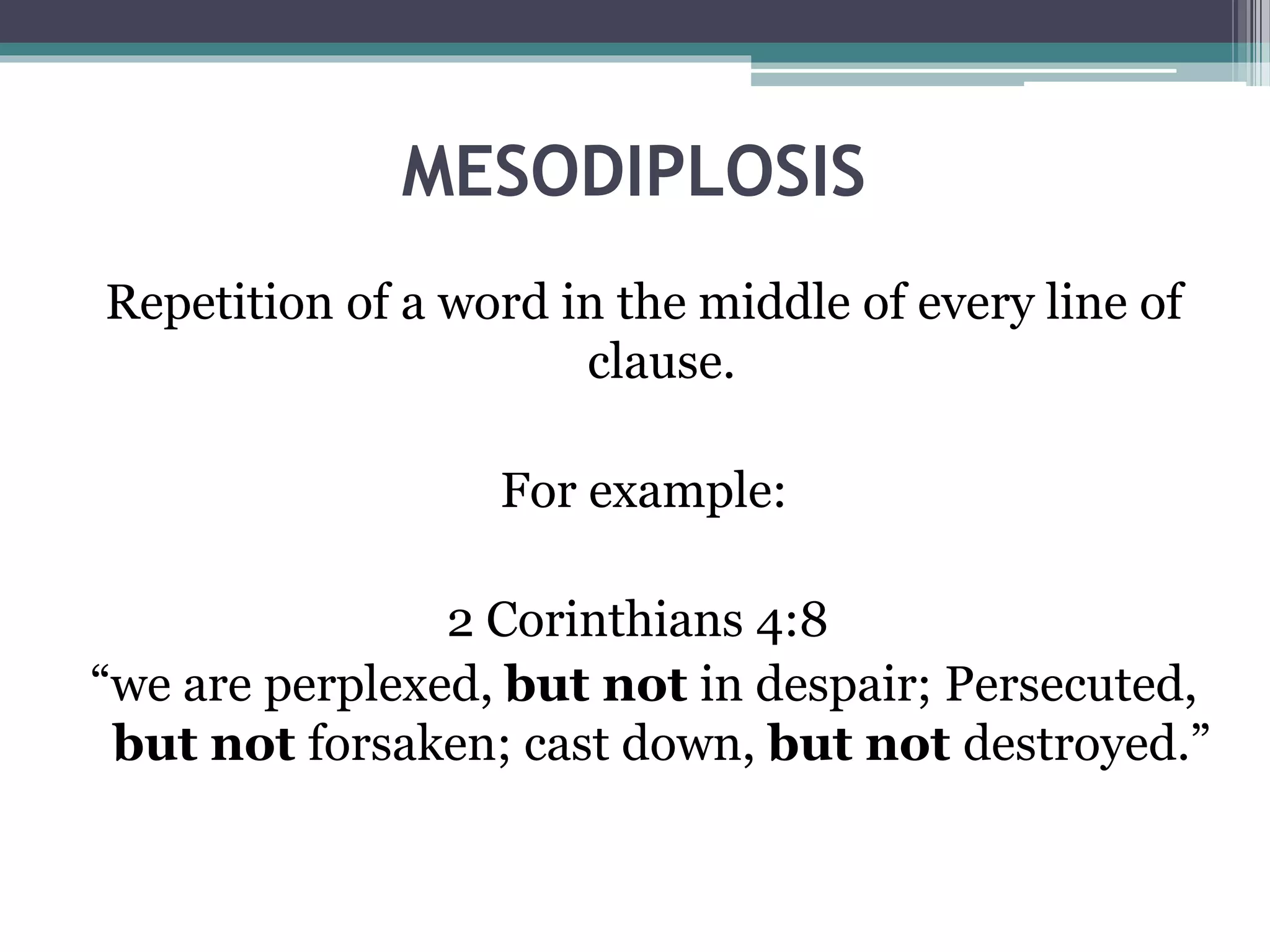
MESODIPLOSIS
Repetition of a word in the middle of every line of
clause.
For example:
2 Corinthians 4:8
“we are perplexed, but not in despair; Persecuted,
but not forsaken; cast down, but not destroyed.”
EPIZEUXIS OR PALILOGIA
Repetition of the same word or phrase without any
words in between.
For example:
“Row, row, row your boat.”
Function of Repetition
The beauty of using figurative language is that the
pattern it arranges the words into is nothing like our
ordinary speech. It is not only stylistically appealing but
it also helps convey the message in much more engaging
and notable way. The aura that is created by the usage of
repetition cannot be achieved through any other device.
It has the ability of making a simple sentence sound like
a dramatic one. It enhances the beauty of a sentence and
stresses on the point of main significance. Repetition
often uses word associations to express the ideas and
emotions in an indirect manner. The beauty of reading a
piece with repetition in it is the balance where we, as
readers, have to decipher such associations and
understand the underlying meanings…
…Repetition as a literary term can be used both
constructively and destructively. The constructive
usage encompasses functions such as, putting
emphasis on a point, confirming a fact or an idea,
cohesion, mimesis, transition, showing
impartiality and or describing a notion. The same
literary device when used destructively can
disintegrate the entire piece of writing. Erasure,
redundancy, continuous present, fragmentation,
copying and habitual misuse of the literary device
are among the destructive effects.
References:
http://literarydevices.net/repetition/
http://www.literarydevices.com/repetition
/

Repetition (tool in stylistic)

  • 1.
  • 2.
    Repetition Definition Repetition isa literary device that repeats the same words or phrases a few times to make an idea clearer. There are several types of repetitions commonly used in both prose and poetry. As a rhetorical device, it could be a word, a phrase or a full sentence or a poetical line repeated to emphasize its significance in the entire text. Repetition is not distinguished solely as a figure of speech but more as a rhetorical device.
  • 3.
    Types of Repetition ANAPHORA Repetitionof a word or phrase at the beginning of several subsequent lines. Martin Luther King Junior’s speech “I Have a Dream” is a famous example, as he repeats “I have a dream” at the beginning of several lines.
  • 4.
    Let us notwallow in the valley of despair, I say to you today, my friends. And so even though we face the difficulties of today and tomorrow, I still have a dream. It is a dream deeply rooted in the American dream. I have a dream that one day this nation will rise up and live out the true meaning of its creed: "We hold these truths to be self-evident, that all men are created equal." I have a dream that one day on the red hills of Georgia, the sons of former slaves and the sons of former slave owners will be able to sit down together at the table of brotherhood. I have a dream that one day even the state of Mississippi, a state sweltering with the heat of injustice, sweltering with the heat of oppression, will be transformed into an oasis of freedom and justice. I have a dream that my four little children will one day live in a nation where they will not be judged by the color of their skin but by the content of their character…
  • 5.
    ANADIPLOSIS OR GRADATIO Repetitionof the last word of one line as the first word of the next. For example, the proverb “When the going gets tough, the tough get going.” Line 1 Repeated word
  • 6.
    ANTISTASIS More extreme thanantanaclasis, this is the repetition of words in opposite senses. For example: “We must, indeed, all hang together or, most assuredly, we shall all hang separately.” (Benjamin Franklin)
  • 7.
    DIACOPE Similar to epizeuxis,this is the repetition of a word or phrase with only one or two words between the repeated words. “Diacope” comes from the Greek for “to cut in two.” The famous line from Shakespeare’s rendition of the St. Crispin’s Day speech in Henry V is an example: “We few, we happy few, we band of brothers.” We the repeated words the repeated words followed w/ 2 or 3 words As well as to the third phrase
  • 8.
    EPANALEPSIS Repetition of thefirst word or words of a line also at the end of that line. For example: “Nothing can be created out of nothing.” (Lucretius)
  • 9.
    EPIMONE Repetition of aphrase question for emphasis or to dwell on a point. From the Greek for “delay.” An example of epimone is Sojourner Truth’s speech from the Women’s Convention in 1851 where she repeated the rhetorical question “And ain’t I a woman?” several times over.
  • 10.
    Nobody ever helpsme into carriages, or over mud- puddles, or gives me any best place! And ain't I a woman? Look at me! Look at my arm! I have ploughed and planted, and gathered into barns, and no man could head me! And ain't I a woman? I could work as much and eat as much as a man - when I could get it - and bear the lash as well! And ain't I a woman? I have borne thirteen children, and seen most all sold off to slavery, and when I cried out with my mother's grief, none but Jesus heard me! And ain't I a woman?
  • 11.
    EPISTROPHE/EPIPHORA Repetition of aword at the end of every line or clause. For example: (Ralph Waldo Emerson) “What lies behind us and what lies before us are tiny compared to what lies within us.”
  • 12.
    EPIPHORA AND ANAPHORA Epiphorais an exact counterpart of another figure of speech anaphora. An anaphora is repetition of the first part of successive sentences whereas in an epiphora repetition occurs in the last part of successive clauses and sentences. For example: 1. “Every day, every night, in every way, I am getting better and better” example of anaphora because the word “every” is repeated in the successive clauses. 2. “I am an American, he is an American and everybody here is an American,” exhibits epiphora as the repetition is in the last part of the successive clauses. Despite being different in their structures, both anaphora and epiphora have the same function of laying emphasis on a particular point.
  • 13.
    MESODIPLOSIS Repetition of aword in the middle of every line of clause. For example: 2 Corinthians 4:8 “we are perplexed, but not in despair; Persecuted, but not forsaken; cast down, but not destroyed.”
  • 14.
    EPIZEUXIS OR PALILOGIA Repetitionof the same word or phrase without any words in between. For example: “Row, row, row your boat.”
  • 15.
    Function of Repetition Thebeauty of using figurative language is that the pattern it arranges the words into is nothing like our ordinary speech. It is not only stylistically appealing but it also helps convey the message in much more engaging and notable way. The aura that is created by the usage of repetition cannot be achieved through any other device. It has the ability of making a simple sentence sound like a dramatic one. It enhances the beauty of a sentence and stresses on the point of main significance. Repetition often uses word associations to express the ideas and emotions in an indirect manner. The beauty of reading a piece with repetition in it is the balance where we, as readers, have to decipher such associations and understand the underlying meanings…
  • 16.
    …Repetition as aliterary term can be used both constructively and destructively. The constructive usage encompasses functions such as, putting emphasis on a point, confirming a fact or an idea, cohesion, mimesis, transition, showing impartiality and or describing a notion. The same literary device when used destructively can disintegrate the entire piece of writing. Erasure, redundancy, continuous present, fragmentation, copying and habitual misuse of the literary device are among the destructive effects.
  • 17.