Functional English
DEPARTMENT OF ENGLISH
THE SENTENCE
 1. When we speak or write we use words. We generally use these words in groups;
as,
Little Jack Homer sat in a corner.
A group of words like this, which makes complete sense, is called a Sentence.
 Kinds of Sentences
2. Sentences are of four kinds:
(1) Those which make statements or assertions; as,
Humpty Dumpty sat on a wall.
(2) Those which ask questions; as Where do you live?
(3) Those which express commands, requests, or entreaties; as,
Be quiet. Have mercy upon us.
(4) Those which express strong feelings; as,
How cold the night is!
What a shame!
 A sentence that makes a statement or
assertion is called a Declarative or
Assertive sentence.
 A sentence that asks a question is called an
Interrogative sentence.
 A sentence that expresses a command or an
entreaty is called an Imperative sentence.
 A sentence that expresses strong feeling is
called an Exclamatory sentence.
SUBJECT AND PREDICATE
 3. When we make a sentence…
(1) We name some person or thing; and
(2) Say something about that person or thing.
 In other words, we must have a subject to speak about and we
must say or predicate something about that subject.
 Hence every sentence has two parts:
(1) The part which names the person or thing we are speaking
about. This is called the Subject of the sentence.
(2) The part which tells something about the Subject. This is
called the Predicate of the sentence.
4. The Subject of a sentence usually comes first,
but occasionally it is put after the Predicate; as,
Here comes the bus.
Sweet are the uses of adversity.
5. In Imperative sentences the Subject is left
out; as,
Sit down. [Here the Subject You is understood].
Thank him. [Here too the Subject You is
understood.]
THE PHRASE AND THE CLAUSE
 6. Examine the group of words “in a corner”. It makes
sense, but not complete sense. Such a group of words,
which makes sense, but not complete sense, is called a
Phrase.
 In the following sentences, the groups of words in italics
are Phrases:
The sun rises in the east.
Humpty Dumpty sat on a wall.
There came a giant to my door.
It was a sunset of great beauty.
The tops of the mountains were covered with
snow.
Show me how to do it.
 7. Examine the groups of words in italics in the
following sentences:
He has a chain of gold.
He has a chain which is made of gold.
 We recognize the first group of words as a Phrase.
 The second group of words, unlike the Phrase of
gold, contains a Subject (which) and a Predicate
(is made of gold).
 Such a group of words which forms part of a
sentence, and contains a Subject and a
Predicate, is called a Clause.
 In the following sentences, the groups of
words in italics are Clauses:
People who pay their debts are trusted.
We cannot start while it is raining.
I think that, you have made a mistake.
PARTS OF SPEECH
 8. Words are divided into different kinds or classes, called Parts
of Speech, according to their use; that is, according to the
work they do in a sentence. The parts of speech are eight in
number:
1. Noun.
2. Adjective.
3. Pronoun.
4. Verb.
5. Adverb.
6. Preposition.
7. Conjunction.
8. Interjection.
Noun
 9. Noun
A Noun is a word used as the name of a person, place, or
thing; as,
Akbar was a great King.
Kolkata is on the Hooghly.
The rose smells sweet.
The sun shines bright.
His courage won him honour.
 Note: The word thing includes (i) all objects that we can
see, hear, taste, touch, or smell; and (ii) something that
we can think of, but cannot perceive by the senses.
Adjective
 10. An Adjective is a word used to add something
to the meaning of a noun; as,
He is a brave boy.
There are twenty boys in this class.
 11. A Pronoun is a word used instead of a noun;
as,
 John is absent, because he is ill.
 The books are where you left them
 12. A Verb is a word used lo express an action or state; as
The girl wrote a letter to her cousin.
Kolkata is a big city.
Iron and copper are useful metals.
 13. An Adverb is a word used to add something to the meaning of a verb, an
adjective, or another adverb; as,
He worked the sum quickly.
This flower is very beautiful.
She pronounced the word quite correctly.
 14. A Preposition is a word used with a noun or a pronoun to show how the
person or thing denoted by the noun or pronoun stands in relation to
something else; as,
There is a cow in the garden.
The girl is fond of music.
A fair little girl sat under a tree.
 15. A Conjunction is a word used to join words or
sentences; as,
Rama and Hari are cousins.
Two and two make four.
I ran fast, but missed the train.
 16. An Interjection is a word which expresses some
sudden feeling; as,
Hurrah! We have won the game.
Alas! She is dead.
 17. Some modern grammars include determiners among the parts of speech.
Determiners are words like a, an, the, this, that, these, those, every, each,
some, any, my, his, one, two, etc., which determine or limit the meaning of
the nouns that follow. all determiners except a, an and the are classed among
adjectives.
 18. As words are divided into different classes according to the work they do
in sentences, it is clear that we cannot say to which part of speech a word
belongs unless we see it used in a sentence.
They arrived soon after. (Adverb)
They arrived after us. (Preposition)
They arrived after we had left. (Conjunction)
 From the above examples we see that the same word can be used as different
parts of speech
THE NOUN: KINDS OF NOUNS
 19. A Noun is a word used as the name of a person, place or thing.
Note: The word thing is used to mean anything that we can think of.
Look at the following sentence:
Akbar was a wise king.
The noun Akbar refers to a particular king, but the noun king might be applied
to any other king as well as to Akbar. We call Akbar a Proper Noun, and king a
Common Noun. Similarly:
Sara is a Proper Noun, while girl is a Common Noun.
Ali is a Proper Noun, while boy is a Common Noun.
Karachi is a Proper Noun, while city is a Common Noun.
Pakistan is a Proper Noun, while country is a Common Noun.
 The word girl is a Common Noun, because it is a name common to all girls,
while Sara is a Proper Noun because it is the name of a particular girl.
 Common noun:
A Common Noun is a name given in common to every person or thing of the
same class or kind. [Common here means shared by all.]
 Proper Noun:
A Proper Noun is the name of some particular person or place, [Proper means
one's own. Hence a Proper Name is a person's own name.]
 Note 1 - Proper Nouns are always written with a capital letter at the
beginning.
 Note 2 - Proper Nouns are sometimes used as Common Nouns; as,
1. He was the Lukman (= the wisest man) of his age.
2. Kalidas is often called the Shakespeare (= the greatest dramatist) of India.
 Common Nouns include what are called Collective Nouns and abstract nouns.
 21. A Collective Noun is the name of a number (or
collection) of persons or things taken together and spoken
of as one whole; as,
Crowd, mob, team, flock, herd, army, fleet, jury, family,
nation, parliament, committee.
The French army was defeated at Waterloo.
The police dispersed the crowd.
The jury found the prisoner guilty.
A herd of cattle is passing.
 22. An Abstract Noun is usually the name of a quality,
action, or state considered apart from the object to which
it belongs; as.
 Quality - Goodness, kindness, whiteness, darkness,
hardness, brightness, honesty, wisdom, bravery.
 Action - Laughter, theft, movement, judgment, hatred.
 State - Childhood, boyhood, youth, slavery, sleep,
sickness, death, poverty.
 The names of the Arts and Science (e.g., grammar, music,
chemistry, etc.) are also Abstract Nouns.
 23. Abstract Nouns are formed:
 (1) From Adjectives; as, Kindness from kind; honesty from honest.
[Most abstract nouns are formed thus.]
 (2) From Verbs: as, Obedience from obey; growth from grow.
 (3) From Common Nouns; as, Childhood from child; slavery from slave.
 24. Another classification of nouns is whether they are “countable” or
“uncountable”. Countable nouns (or countables) are the names of objects,
people, etc. that we can count, e.g., book, pen, apple, boy, sister, doctor,
horse.
 Uncountable nouns (or uncountables) are the names of things which we
cannot count, e.g., milk, oil, sugar, gold, honesty. They mainly denote
substances and abstract things.
 Countable nouns have plural forms while uncountable nouns do not. For
example, we say “books” but we cannot say “milks”.
THE NOUN: GENDER
 25. You know that living beings are of either the male or the female
sex. Now compare the words in the following pairs:
Boy (Lion, Hero, Cock-sparrow)
Girl (Lioness, Heroine, Hen-sparrow)
 What do you notice?
 The first word of each pair is the name of a male animal.
 The second word of each pair is the name of a female animal.
 A noun that denotes a male animal is said to be of the Masculine
Gender. [Gender comes from Latin genus, kind or sort.]
 A noun that denotes a female animal is said to be of the Feminine
Gender.
 26. A noun that denotes either a male or a female is said
to be of the Common Gender; as
Parent, child, friend, pupil, servant, thief, relation,
enemy, cousin, person, orphan, student, baby, monarch,
neighbour, infant.
 27. A noun that denotes a thing that is neither male nor
female (i.e., thing without life) is said to be of the Neuter
Gender; as,
Book, pen, room, tree. [Neuter means neither, that is,
neither male nor female]
 It will be thus seen that in Modern English the Gender of a
noun is entirely a matter of sex or the absence of sex. It
has nothing to do with the form of a noun, which
determines its gender in many other languages, e.g., in
Urdu where bagiche is masculine and lakri is feminine.
 28. Objects without life are often personified, that is,
spoken of as if they were living beings. We then regard
them as males or females.
 The Masculine Gender is often applied to objects
remarkable for strength and violence; as, The Sun,
Summer, Winter, Time, Death, The sun sheds his beams on
rich and poor alike.
 The Feminine Gender is sometimes applied to objects
remarkable for beauty, gentleness, and gracefulness; as,
The Moon, the Earth, Spring, Autumn, Nature, Liberty,
Justice, Mercy, Peace, Hope, Charity.
 The moon has hidden her face behind a cloud. Spring has
spread her mantle of green over the earth.
 Peace hath her victories no less renowned than war.
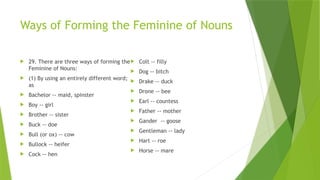
Ways of Forming the Feminine of Nouns
 29. There are three ways of forming the
Feminine of Nouns:
 (1) By using an entirely different word;
as
 Bachelor -- maid, spinster
 Boy -- girl
 Brother -- sister
 Buck -- doe
 Bull (or ox) -- cow
 Bullock -- heifer
 Cock -- hen
 Colt -- filly
 Dog -- bitch
 Drake -- duck
 Drone -- bee
 Earl -- countess
 Father -- mother
 Gander -- goose
 Gentleman -- lady
 Hart -- roe
 Horse -- mare
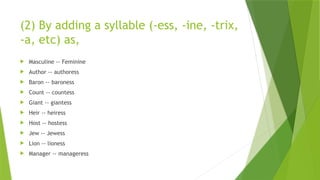
(2) By adding a syllable (-ess, -ine, -trix,
-a, etc) as,
 Masculine -- Feminine
 Author -- authoress
 Baron -- baroness
 Count -- countess
 Giant -- giantess
 Heir -- heiress
 Host -- hostess
 Jew -- Jewess
 Lion -- lioness
 Manager -- manageress
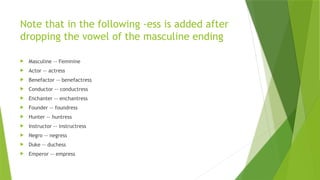
Note that in the following -ess is added after
dropping the vowel of the masculine ending
 Masculine -- Feminine
 Actor -- actress
 Benefactor -- benefactress
 Conductor -- conductress
 Enchanter -- enchantress
 Founder -- foundress
 Hunter -- huntress
 Instructor -- instructress
 Negro -- negress
 Duke -- duchess
 Emperor -- empress
(3) By placing a word before or after;
as,
 Masculine -- Feminine
 Grandfather -- grandmother
 Greatuncle -- greataunt
 Manservant -- maidservant
 Landlord -- landlady
 milkman -- milkwoman
 peacock -- peahen
 salesman -- saleswoman
 washerman -- washerwoman
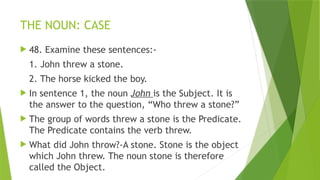
THE NOUN: CASE
 48. Examine these sentences:-
1. John threw a stone.
2. The horse kicked the boy.
 In sentence 1, the noun John is the Subject. It is
the answer to the question, “Who threw a stone?”
 The group of words threw a stone is the Predicate.
The Predicate contains the verb threw.
 What did John throw?-A stone. Stone is the object
which John threw. The noun stone is therefore
called the Object.
 2. The horse kicked the boy.
 In sentence 2, the noun horse is the Subject. It is the
answer to the question, 'Who kicked the boy?” The noun
boy is the Object. It is the answer to the question, 'Whom
did the horse kick?”
49. When a noun (or pronoun) is
used as the Subject of a verb, it is
said to be in the Nominative Case.
 Note-To find the Nominative, put Who? or What?
before the verb.
 When a noun (or pronoun) is used as the Object of a verb, it is said to be in
the Objective (or Accusative) Case.
 To find the Accusative put, Whom? or What? before the verb and its subject.
 50. A noun which comes after a preposition is also said to be in the Accusative
Case; as, The book is in the desk.
The noun desk is in the Accusative Case, governed by the preposition in.
 51. Read the following sentences:-
Hari broke the window. (Object)
The window was broken. (Subject)
 It will be seen that Nouns in English have the same form for the Nominative
and the Accusative.
 The Nominative generally comes before the verb, and the Accusative after
the verb. Hence they are distinguished by the order of words, or by the sense.
 52. Compare:-
1. Rama gave a ball.
2. Rama gave Hari a ball.
 In each of these sentences the noun ball is the
Object of gave. In the second sentence we are
told that Hari was the person to whom Rama gave
a ball. The noun Hari is called the Indirect Object
of the verb gave.
 The noun ball, the ordinary Object, is called the
Direct Object. It will be noticed that the position
of the Indirect Object is immediately after the
verb and before the Direct Object.
 Note:
Rama gave Hari a ball = Rama gave a ball to Hari.
Will you do me a favour? = Will you do a favour to
me?
I bought Rama a ball = I bought a ball for Rama.
Fetch the boy a book = Fetch a book for the boy.
She made Ruth a new dress = She made a new
dress for Ruth.
Get me a taxi = Get a taxi for me.
 We see that the Indirect Object of a verb denotes
the person to whom something is given, or for
whom something is done
 53. Examine the sentence:-
 This is Ram's umbrella. Ram's umbrella =
the umbrella belonging to Rama.
 The form of the noun Rama is changed to
Rama's to show ownership of possession.
The Noun Rama’s is therefore said to be in
the possessive (or Genitive) Case
 The Possessive answers the question,
‘Whose?’ Whose umbrella? - Rama's.
 54. The Possessive Case does not always denote
possession. It is used to denote authorship, origin, kind,
etc. as,
 Shakespeare's plays = the plays written by Shakespeare.
 A mother's love = the love felt by a mother.
 The President's speech = the speech delivered by the
President.
 Mr. Aggarwal's house = the house where Mr. Aggarwal lives.
 Ashok's school = the school where Ashok goes.
 A children's playground = a playground for children.
 A week's holiday = a holiday which lasts a week.
Formation of the Possessive Case
 55. (1) When the noun is Singular, the Possessive Case is formed by adding ‘s
to the noun; as,
The boy's book; the king's crown.
 Note:- The letter s is omitted in a few words where too many hissing sounds
would come together; as, For conscience' sake; for goodness' sake; For justice'
sake; for Jesus' sake; Moses' laws.
 (2) When the noun is Plural, and ends in s, the Possessive Case is formed by
adding only an apostrophe; as,
Boys' school; girls' school; horses' tails.
 (3) When the noun is Plural but does not end in s, the Possessive sign is
formed by adding 's as,
Men's club; children's books.
 56. When a noun or a title consists of several words, the Possessive sign is
attached only to the last word; as,
The King of Bhutan's visit. The Prime Minister of Pakistan's speech.
 57. When two nouns are in apposition, the possessive sign is put to the latter
only; as, That is Tagore the poet's house.
 58. Also when two nouns are closely connected, the possessive is put to the
latter; as, Karim and Salim's bakery. William and Mary's reign.
 59. Each of two or more connected nouns implying separate possession must
take the possessive sign; as, Raja Rao's and R.K. Narayan's novels. Goldsmith's
and Cowper's poems.
Use of the Possessive Case
 60. The Possessive Case is now used chiefly with the names of living thing; as,
The Governor’s bodyguard; the lion’s mane.
 So we must say:
 The leg of the table [not, the table's leg]. The cover of the book [not, the
book's cover]. The roof of the house [not, the house's roof).
 61. But the Possessive is used with the names of personified objects; as,
India's heroes; Nature's laws; Fortune's favourite; at duty's call; at death's
door.
 62. The Possessive is also used with nouns denoting time, space or
weight; as,
A day's march;
a week's holiday;
in a year's time;
 63. The following phrases are also in common use:- At his fingers'
ends; for mercy's sake; to his heart's content; at his wit's end; a boat's
crew.
 64. The possessive of a proper name or of a noun denoting a trade,
profession, or relationship may be used to denote a building or place
of business (church, house, school, college, shop, hospital, the atre;
etc.) as,
 She has gone to the baker's ( = baker's shop). Tonight I am dining at
my uncle's ( = uncle's house). Can you tell me the way to St .Paul's
( ='St. Paul's church)? I attend the Town High School but my cousin
attends St. Xavier's. He was educated at St. Joseph's.
 65. When you are in doubt whether to use a noun in the possessive case or
with the preposition of, remember that, as a general rule, the possessive case
is used to denote possession or ownership. Thus it is better to say 'the defeat
of the enemy' than 'the enemy's defeat', even though no doubt as to the
meaning would arise.
Nouns in Apposition
 Read the following sentence:-
Rama, our captain, made fifty
runs.
 We see that Rama and our captain are one and the same
person. The noun captain follows the noun Rama simply to
explain which Rama is referred to.
 When one noun follows another to describe it, the
noun which follows is said to be in apposition to
the noun which comes before it. [Apposition
means placing near.] A noun in apposition is in the
same case as the noun which it explains. In the
above sentence the noun captain is in apposition
to the noun Rama, and is in the Nominative Case
(because Rama is in the Nominative Case.)
 Further examples:-
1. Kabir, the great reformer, was a weaver.
2. Yesterday I met your uncle, the doctor.
3. Have you seen Ganguli, the artist's drawings?
In sentence 1, the noun in apposition is in the Nominative Case.
In sentence 2, the noun in apposition is in the Accusative Case.
[Why?]
In sentence 3, the noun in apposition is in the Genitive Case.
[Why?]
THE ADJECTIVE
 Read the following sentences :-
1. Sita is a clever girl. (Girl of what kind1?)
2. I don't like that boy, (Which boy ?)
3. He gave me five mangoes. (How many mangoes?)
4. There is little time for preparation. (How much time ?)
In sentence 1, ‘clever’ shows what kind of girl Sita is; or, in other words,
‘clever’ describes the girl Sita.
In sentence 2, ‘that’ points out which boy is meant.
In sentence 3, ‘five’ shows how many mangoes he gave me.
In sentence 4, ‘little’ shows how much time there is for preparation.
 A word used with a noun to describe or point out, the person, animal, place
or thing which the noun names, or to tell the number or quantity, is called an
Adjective.
 So we may define an Adjective as a word used with a noun to add something
for its meaning. [Adjective means added to.].
 Look at the following sentences:-
1. The lazy boy was punished.
2. The boy is lazy.
In sentence 1, the Adjective lazy is used along with the noun boy as an
epithet or attribute. It is, therefore, said to be used Attributively.
In sentence 2, the Adjective lazy is used along with the verb is, and forms
part of the Predicate. It is, therefore, said to be used Predicatively.
Some Adjectives can be used only Predicatively; as, She is afraid of ghosts. I
am quite well.
Kinds of Adjectives
 Adjectives may be divided into the following classes:-
 69. Adjectives of Quality (or Descriptive Adjective) show the kind or quality of
a person or thing; as,
Kolkata is a large city.
He is an honest man.
The foolish old crow tried to sing.
 (Adjectives formed from Proper Nouns (e.g., French wines, Turkish tobacco,
Indian tea, etc.) are sometimes called Proper Adjectives. They are generally
classed with Adjectives of Quality) language.
 Adjectives of Quality answer the question : Of what kind ?
 70. Adjectives of Quantity show how much of a thing is meant as,
I ate some rice.
He showed much patience.
He has little intelligence.
He has lost all his wealth.
You have no sense.
 Adjectives of Quantity answer the question: How much?
 71. Adjectives of Number (or Numeral Adjectives) show how many persons or
things are meant, or in what order a person or thing stands; as,
 The hand has five fingers.
 Few cats like cold water.
 There are no pictures in this book.
 I have taught you many things.
 All men must die.
 Most boys like cricket.
 72. Adjectives of Number (or Numeral Adjectives) are of three kinds:- (i)
Definite Numeral Adjectives, which denote an exact number; as, One, two,
three, etc. -- These are called Cardinals. First, second, third, etc. -- These
are called Ordinals.
 A Cardinal denotes how many, and an Ordinal the order of things in a series. It
will be seen that Ordinals really do the work of Demonstrative Adjectives.
 (ii) Indefinite Numeral Adjectives, which do not denote an exact number; as,
All, no; many, few; some, any; certain, several, sundry.
 (iii) Distributive Numeral Adjectives, which refer to each one of a number;
as., Each boy must take his turn. India expects every man to do his duty.
Every word of it is false. Either pen will do. On either side is a narrow lane.
Neither accusation is true.
 73. The same Adjective may be classed as of Quantity or Number, according
to its use.
ARTICLES
 103. The words a or an and the are called Articles. They come before nouns.
 104. There are two Articles - a (or an) and the.
 105. A or an is called the Indefinite Article, because it usually leaves indefinite
the person or thing spoken of; as, A doctor; that is, any doctor.
 106. The is called the Definite Article, because it normally points out some
particular person or thing; as,
 He saw the doctor; meaning some particular doctor.
 The indefinite article is used before singular countable nouns, e.g. A book, an
orange, a girl
 The definite article is used before singular countable nouns, plural countable
nouns and uncountable nouns, e.g., The book, the books, the milk
A or An
 107. The choice between a and an is determined by sound. Before a word beginning
with a vowel sound an is used; as, an enemy, an ink-pad, an orange, an umbrella, an
hour, an honest man.
 It will be noticed that the words hour, honest, heir begin with a vowel sound, as the
initial consonant h is not pronounced,
 108. Before a word beginning with a consonant sound a is used; as, A boy, a reindeer,
a woman, a yard, a horse, a hole, also a university,, a union, a European, a ewe, a
unicorn, a useful article.
 because these words (university, union, etc.) begin with a consonant sound, that of U.
Similarly we say,
 A one-rupee note, such a one, a one-eyed man.
 because one begins with the consonant sound of w.
 109. Some native speakers use an before words beginning with h if the first syllable is
not stressed An hotel (More common: a hotel) an historical novel (More common: a
historical novel)
Use of the Definite Article
 110. The Definite Article the is used-
(1) When we talk about a particular person or thing, or one already referred to (that
is, when it is clear from the context which one already referred to (that is, when it is
clear from the constant which one we mean); as,
 The book you want is out of print. (Which book? The one you want.) Let's go to the
park. (= the park in this town) The girl cried, (the girl = the girl already talked about)
 (2) When a singular noun is meant to represent a whole class; as,
The cow is a useful animal. [Or we may say, "Cows are useful animals."]
The horse is a noble animal.
The cat loves comfort.
The rose is the sweetest of all flowers.
 The two nouns man and woman can be used in a general sense without either article.
Man is the only animal that uses fire.
Woman is man's mate.
 But in present-day English a man and a woman (or men and women) are more usual. A
woman is more sensitive than a man.
 (3) Before some proper names. these kinds of place-names:
(a) oceans and seas, e.g. the Pacific, the black Sea
(b) rivers, e.g. the Ganga, the Nile
(c) canals, e.g. the Suez Canal
(d) deserts, e.g. the Sahara
(e) groups of islands, e.g. the West Indies
(f) mountain-ranges, e.g. the Himalayas, the Alps
(g) a very few names of countries, which include words like republic and kingdom (e.g.
the Irish Republic, the United Kingdom) also: the Ukraine, the Netherlands (and its seat of
government the Hague)
 (4) Before the names of certain books; as, The Vedas, the Puranas, the Iliad, the
Ramayana.
PERSONAL PRONOUNS
 117. We may say- Hari is absent, because Hari is ill. But it is better to avoid
the repetition of the Noun Hari, and say- Hari is absent, because he is ill.
 A word that is thus used instead of a noun is called a Pronoun {Pronoun means
for-a noun.] Def.- A Pronoun is a word used instead of a Noun.
 118. Read the following sentences :-
I am young.
We are young.
You are young.
They are young.
He (she, it) is young.
 I, we, you, he, (she, it), they are called Personal Pronouns because
they stand for the three persons.
(i) the person speaking.
(ii) the person spoken to, and
(iii) the person spoken of.
The Pronouns I and we, which denote the person or persons speaking, are said
to be Personal Pronouns of the First Person
The Pronoun you, which denotes the person or persons spoken to, is said to be
a Personal Pronoun of the Second Person. You is used both in the singular and
plural
 The pronouns he (she) and they, which denote the person or persons spoken
of, are said to be Personal Pronouns of the Third Person. It, although it
denotes the thing spoken of, is also called a Personal Pronoun of the Third
Person. [The Personal Pronouns of the Third Person are, strictly speaking,
Demonstrative Pronouns.]
Forms of the Personal Pronouns
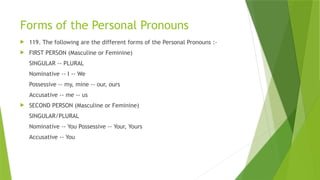
 119. The following are the different forms of the Personal Pronouns :-
 FIRST PERSON (Masculine or Feminine)
SINGULAR -- PLURAL
Nominative -- I -- We
Possessive -- my, mine -- our, ours
Accusative -- me -- us
 SECOND PERSON (Masculine or Feminine)
SINGULAR/PLURAL
Nominative -- You Possessive -- Your, Yours
Accusative -- You
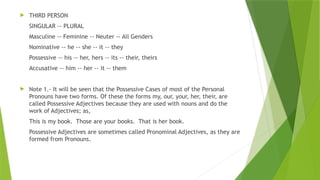
 THIRD PERSON
SINGULAR -- PLURAL
Masculine -- Feminine -- Neuter -- All Genders
Nominative -- he -- she -- it -- they
Possessive -- his -- her, hers -- its -- their, theirs
Accusative -- him -- her -- it -- them
 Note 1.- It will be seen that the Possessive Cases of most of the Personal
Pronouns have two forms. Of these the forms my, our, your, her, their, are
called Possessive Adjectives because they are used with nouns and do the
work of Adjectives; as,
This is my book. Those are your books. That is her book.
Possessive Adjectives are sometimes called Pronominal Adjectives, as they are
formed from Pronouns.
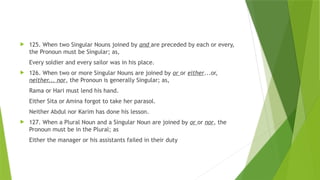
 125. When two Singular Nouns joined by and are preceded by each or every,
the Pronoun must be Singular; as,
Every soldier and every sailor was in his place.
 126. When two or more Singular Nouns are joined by or or either...or,
neither... nor, the Pronoun is generally Singular; as,
Rama or Hari must lend his hand.
Either Sita or Amina forgot to take her parasol.
Neither Abdul nor Karim has done his lesson.
 127. When a Plural Noun and a Singular Noun are joined by or or nor, the
Pronoun must be in the Plural; as
Either the manager or his assistants failed in their duty
REFLEXIVE AND EMPHATIC PRONOUNS
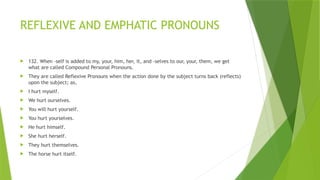
 132. When -self is added to my, your, him, her, it, and -selves to our, your, them, we get
what are called Compound Personal Pronouns.
 They are called Reflexive Pronouns when the action done by the subject turns back (reflects)
upon the subject; as,
 I hurt myself.
 We hurt ourselves.
 You will hurt yourself.
 You hurt yourselves.
 He hurt himself.
 She hurt herself.
 They hurt themselves.
 The horse hurt itself.
 It will be noticed that each of these Reflexive Pronouns is used as the Object
of a verb, and refers to the same person or thing as that denoted by the
Subject of the verb.
 133. Sometimes, in older English, especially in poetry, a simple pronoun was
used reflexively; as;
Now I lay me down to sleep.
 134. The word self is sometimes used as a Noun; as,
To think own self be true.
He cares for nothing but self.
He thinks much for self.
Emphatic Pronouns
 135. Now look at the following sentences:-
I will do it myself.
I myself saw him do it.
We will see to it ourselves.
You yourself can best explain.
He himself said so.
She herself says so.
It was told so by the teacher himself.
We saw the Prime Minister himself.
The town itself is not very large.
They themselves admitted their guilt.
 It will be seen that here Compound Personal Pronouns are used for the sake of
emphasis, and are therefore called Emphatic Pronouns.
DEMONSTRATIVE, INDEFINITE AND
DISTRIBUTIVE PRONOUNS
 136. Consider the following sentences:-
This is a present from my uncle.
These are merely excuses,
Both cars are good; but this is better than that
Mumbai mangoes are better than those of Bangalore.
Make haste, that's a good boy. [Here that - one who makes haste.]
There is no period in ancient-Indian history so glorious as that of the Guptas.
[Do not write, “as the Guptas”]
My views are quite in accordance with those of the University Commission.
I may have offended, but such was not my intention.
He was the representative of the King, and as such (= the representative of
the King) they honoured him.
The stranger is welcomed as such.
That is the Red Fort.
 It will be noticed that the Pronouns in italics are used to point out the objects
to which they refer, and are, therefore, called Demonstrative Pronouns. (Latin
demonstrate, to show clearly).
 137. This, that, etc. are (Demonstrative) Adjectives when they are used with
nouns; as,
This book is mine. That pen is yours.
These books are mine. Those pens are yours.
What was that noise? This horse is better than that horse.,
All such people ought to be avoided.
 138. This refers to what is close at hand, and nearest to the
thought or person of the speaker; that refers to what is 'over
there', farther] away, and more remote. This is better than
that.
 139. That, with its plural those, is used to avoid the
repetition of a preceding Noun; as,
The climate of Belgaum is like that of Pune.
The streets of this city are worse than those of Ahmedabad.
Our soldiers were better drilled than those of enemies.
The rivers of America are larger than those of Europe.
Indefinite Pronouns
 141. Consider the following sentences:
 One hardly knows what to do.
One does not like to say so, but it is only too true.
One cannot be too careful of one's (not, his) good name.
One must not boast of one's own success.
One must use one's best efforts if one wishes to succeed.
One must not praise one's self.
None of his poems are well known.
All were drowned. Some are born great.
Some say he is a sharper.
Somebody has stolen my watch.
Nobody was there to rescue the child.
Few escaped unhurt.
We did not see any of them again.
 All these Pronouns refer to persons or
things in a general way, but do not refer to
any person or thing in particular. They are,
therefore, called Indefinite Pronouns.
Distributive Pronouns
 144. Consider the following sentences:-
Each of the boys gets a prize.
Each took it in turn.
Either of these roads leads to the railway station.
Either of you can go.
Neither of the accusations is true.
 Each, either, neither are called Distributive Pronouns because they refer to
persons or things one at a time. For this reason they are always singular and
as such followed by the verb in the singular.
RELATIVE PRONOUNS
 148. Read the following pairs of sentences:
1. I met Hari. Hari had just returned.
2. I have found the pen. I lost the pen.
3. Here is the book. You lent me the book.
 Let us now combine each of the above pairs into one sentence. Thus :-
1. I met Hari who had just returned.
2. I have found the pen which I lost.
3. Here is the book that you lent me.
 Now let us examine the work done by each of the words, who, which and that.
The word who is used instead of the noun Hari. It, therefore, does the work of
a Pronoun.
The word who joins or connects two statements. It, therefore, does the work of
a Conjunction.
The word who, therefore, does double work-the work of a Pronoun and also the
work of a Conjunction.
 We might, therefore, call it a Conjunctive Pronoun.
 It is, however, called a Relative Pronoun because it refers or relates (Le.,
carries us back) to some noun going before (here, the noun Hari), which is
called its Antecedent.
INTERROGATIVE PRONOUNS
 169. Consider the following sentences :-
Who is there?
Who are you?
About whom you are thinking? Who are you thinking about?
Whom do you want? / Who do you want?
Whose is this book? Which is the house?
Which do you prefer, tea or coffee? What is the matter?
What do you want? What will all (he neighbours say?
 It will be noticed that the Pronouns are similar in form to Relative Pronouns. But the
work which they do is different. They are here used for asking questions, and are,
therefore, called Interrogative Pronouns.

1 Functional English grammar Bs level pptx

  • 1.
  • 2.
    THE SENTENCE  1.When we speak or write we use words. We generally use these words in groups; as, Little Jack Homer sat in a corner. A group of words like this, which makes complete sense, is called a Sentence.  Kinds of Sentences 2. Sentences are of four kinds: (1) Those which make statements or assertions; as, Humpty Dumpty sat on a wall. (2) Those which ask questions; as Where do you live? (3) Those which express commands, requests, or entreaties; as, Be quiet. Have mercy upon us. (4) Those which express strong feelings; as, How cold the night is! What a shame!
  • 3.
     A sentencethat makes a statement or assertion is called a Declarative or Assertive sentence.  A sentence that asks a question is called an Interrogative sentence.  A sentence that expresses a command or an entreaty is called an Imperative sentence.  A sentence that expresses strong feeling is called an Exclamatory sentence.
  • 4.
    SUBJECT AND PREDICATE 3. When we make a sentence… (1) We name some person or thing; and (2) Say something about that person or thing.  In other words, we must have a subject to speak about and we must say or predicate something about that subject.  Hence every sentence has two parts: (1) The part which names the person or thing we are speaking about. This is called the Subject of the sentence. (2) The part which tells something about the Subject. This is called the Predicate of the sentence.
  • 5.
    4. The Subjectof a sentence usually comes first, but occasionally it is put after the Predicate; as, Here comes the bus. Sweet are the uses of adversity. 5. In Imperative sentences the Subject is left out; as, Sit down. [Here the Subject You is understood]. Thank him. [Here too the Subject You is understood.]
  • 6.
    THE PHRASE ANDTHE CLAUSE  6. Examine the group of words “in a corner”. It makes sense, but not complete sense. Such a group of words, which makes sense, but not complete sense, is called a Phrase.  In the following sentences, the groups of words in italics are Phrases: The sun rises in the east. Humpty Dumpty sat on a wall. There came a giant to my door.
  • 7.
    It was asunset of great beauty. The tops of the mountains were covered with snow. Show me how to do it.  7. Examine the groups of words in italics in the following sentences: He has a chain of gold. He has a chain which is made of gold.  We recognize the first group of words as a Phrase.  The second group of words, unlike the Phrase of gold, contains a Subject (which) and a Predicate (is made of gold).
  • 8.
     Such agroup of words which forms part of a sentence, and contains a Subject and a Predicate, is called a Clause.  In the following sentences, the groups of words in italics are Clauses: People who pay their debts are trusted. We cannot start while it is raining. I think that, you have made a mistake.
  • 9.
    PARTS OF SPEECH 8. Words are divided into different kinds or classes, called Parts of Speech, according to their use; that is, according to the work they do in a sentence. The parts of speech are eight in number: 1. Noun. 2. Adjective. 3. Pronoun. 4. Verb. 5. Adverb. 6. Preposition. 7. Conjunction. 8. Interjection.
  • 10.
    Noun  9. Noun ANoun is a word used as the name of a person, place, or thing; as, Akbar was a great King. Kolkata is on the Hooghly. The rose smells sweet. The sun shines bright. His courage won him honour.  Note: The word thing includes (i) all objects that we can see, hear, taste, touch, or smell; and (ii) something that we can think of, but cannot perceive by the senses.
  • 11.
    Adjective  10. AnAdjective is a word used to add something to the meaning of a noun; as, He is a brave boy. There are twenty boys in this class.  11. A Pronoun is a word used instead of a noun; as,  John is absent, because he is ill.  The books are where you left them
  • 12.
     12. AVerb is a word used lo express an action or state; as The girl wrote a letter to her cousin. Kolkata is a big city. Iron and copper are useful metals.  13. An Adverb is a word used to add something to the meaning of a verb, an adjective, or another adverb; as, He worked the sum quickly. This flower is very beautiful. She pronounced the word quite correctly.  14. A Preposition is a word used with a noun or a pronoun to show how the person or thing denoted by the noun or pronoun stands in relation to something else; as, There is a cow in the garden. The girl is fond of music. A fair little girl sat under a tree.
  • 13.
     15. AConjunction is a word used to join words or sentences; as, Rama and Hari are cousins. Two and two make four. I ran fast, but missed the train.  16. An Interjection is a word which expresses some sudden feeling; as, Hurrah! We have won the game. Alas! She is dead.
  • 14.
     17. Somemodern grammars include determiners among the parts of speech. Determiners are words like a, an, the, this, that, these, those, every, each, some, any, my, his, one, two, etc., which determine or limit the meaning of the nouns that follow. all determiners except a, an and the are classed among adjectives.  18. As words are divided into different classes according to the work they do in sentences, it is clear that we cannot say to which part of speech a word belongs unless we see it used in a sentence. They arrived soon after. (Adverb) They arrived after us. (Preposition) They arrived after we had left. (Conjunction)  From the above examples we see that the same word can be used as different parts of speech
  • 15.
    THE NOUN: KINDSOF NOUNS  19. A Noun is a word used as the name of a person, place or thing. Note: The word thing is used to mean anything that we can think of. Look at the following sentence: Akbar was a wise king. The noun Akbar refers to a particular king, but the noun king might be applied to any other king as well as to Akbar. We call Akbar a Proper Noun, and king a Common Noun. Similarly: Sara is a Proper Noun, while girl is a Common Noun. Ali is a Proper Noun, while boy is a Common Noun. Karachi is a Proper Noun, while city is a Common Noun. Pakistan is a Proper Noun, while country is a Common Noun.
  • 16.
     The wordgirl is a Common Noun, because it is a name common to all girls, while Sara is a Proper Noun because it is the name of a particular girl.  Common noun: A Common Noun is a name given in common to every person or thing of the same class or kind. [Common here means shared by all.]  Proper Noun: A Proper Noun is the name of some particular person or place, [Proper means one's own. Hence a Proper Name is a person's own name.]  Note 1 - Proper Nouns are always written with a capital letter at the beginning.  Note 2 - Proper Nouns are sometimes used as Common Nouns; as, 1. He was the Lukman (= the wisest man) of his age. 2. Kalidas is often called the Shakespeare (= the greatest dramatist) of India.  Common Nouns include what are called Collective Nouns and abstract nouns.
  • 17.
     21. ACollective Noun is the name of a number (or collection) of persons or things taken together and spoken of as one whole; as, Crowd, mob, team, flock, herd, army, fleet, jury, family, nation, parliament, committee. The French army was defeated at Waterloo. The police dispersed the crowd. The jury found the prisoner guilty. A herd of cattle is passing.
  • 18.
     22. AnAbstract Noun is usually the name of a quality, action, or state considered apart from the object to which it belongs; as.  Quality - Goodness, kindness, whiteness, darkness, hardness, brightness, honesty, wisdom, bravery.  Action - Laughter, theft, movement, judgment, hatred.  State - Childhood, boyhood, youth, slavery, sleep, sickness, death, poverty.  The names of the Arts and Science (e.g., grammar, music, chemistry, etc.) are also Abstract Nouns.
  • 19.
     23. AbstractNouns are formed:  (1) From Adjectives; as, Kindness from kind; honesty from honest. [Most abstract nouns are formed thus.]  (2) From Verbs: as, Obedience from obey; growth from grow.  (3) From Common Nouns; as, Childhood from child; slavery from slave.  24. Another classification of nouns is whether they are “countable” or “uncountable”. Countable nouns (or countables) are the names of objects, people, etc. that we can count, e.g., book, pen, apple, boy, sister, doctor, horse.  Uncountable nouns (or uncountables) are the names of things which we cannot count, e.g., milk, oil, sugar, gold, honesty. They mainly denote substances and abstract things.  Countable nouns have plural forms while uncountable nouns do not. For example, we say “books” but we cannot say “milks”.
  • 20.
    THE NOUN: GENDER 25. You know that living beings are of either the male or the female sex. Now compare the words in the following pairs: Boy (Lion, Hero, Cock-sparrow) Girl (Lioness, Heroine, Hen-sparrow)  What do you notice?  The first word of each pair is the name of a male animal.  The second word of each pair is the name of a female animal.  A noun that denotes a male animal is said to be of the Masculine Gender. [Gender comes from Latin genus, kind or sort.]  A noun that denotes a female animal is said to be of the Feminine Gender.
  • 21.
     26. Anoun that denotes either a male or a female is said to be of the Common Gender; as Parent, child, friend, pupil, servant, thief, relation, enemy, cousin, person, orphan, student, baby, monarch, neighbour, infant.  27. A noun that denotes a thing that is neither male nor female (i.e., thing without life) is said to be of the Neuter Gender; as, Book, pen, room, tree. [Neuter means neither, that is, neither male nor female]  It will be thus seen that in Modern English the Gender of a noun is entirely a matter of sex or the absence of sex. It has nothing to do with the form of a noun, which determines its gender in many other languages, e.g., in Urdu where bagiche is masculine and lakri is feminine.
  • 22.
     28. Objectswithout life are often personified, that is, spoken of as if they were living beings. We then regard them as males or females.  The Masculine Gender is often applied to objects remarkable for strength and violence; as, The Sun, Summer, Winter, Time, Death, The sun sheds his beams on rich and poor alike.  The Feminine Gender is sometimes applied to objects remarkable for beauty, gentleness, and gracefulness; as, The Moon, the Earth, Spring, Autumn, Nature, Liberty, Justice, Mercy, Peace, Hope, Charity.  The moon has hidden her face behind a cloud. Spring has spread her mantle of green over the earth.  Peace hath her victories no less renowned than war.
  • 23.
    Ways of Formingthe Feminine of Nouns  29. There are three ways of forming the Feminine of Nouns:  (1) By using an entirely different word; as  Bachelor -- maid, spinster  Boy -- girl  Brother -- sister  Buck -- doe  Bull (or ox) -- cow  Bullock -- heifer  Cock -- hen  Colt -- filly  Dog -- bitch  Drake -- duck  Drone -- bee  Earl -- countess  Father -- mother  Gander -- goose  Gentleman -- lady  Hart -- roe  Horse -- mare
  • 24.
    (2) By addinga syllable (-ess, -ine, -trix, -a, etc) as,  Masculine -- Feminine  Author -- authoress  Baron -- baroness  Count -- countess  Giant -- giantess  Heir -- heiress  Host -- hostess  Jew -- Jewess  Lion -- lioness  Manager -- manageress
  • 25.
    Note that inthe following -ess is added after dropping the vowel of the masculine ending  Masculine -- Feminine  Actor -- actress  Benefactor -- benefactress  Conductor -- conductress  Enchanter -- enchantress  Founder -- foundress  Hunter -- huntress  Instructor -- instructress  Negro -- negress  Duke -- duchess  Emperor -- empress
  • 26.
    (3) By placinga word before or after; as,  Masculine -- Feminine  Grandfather -- grandmother  Greatuncle -- greataunt  Manservant -- maidservant  Landlord -- landlady  milkman -- milkwoman  peacock -- peahen  salesman -- saleswoman  washerman -- washerwoman
  • 27.
    THE NOUN: CASE 48. Examine these sentences:- 1. John threw a stone. 2. The horse kicked the boy.  In sentence 1, the noun John is the Subject. It is the answer to the question, “Who threw a stone?”  The group of words threw a stone is the Predicate. The Predicate contains the verb threw.  What did John throw?-A stone. Stone is the object which John threw. The noun stone is therefore called the Object.
  • 28.
     2. Thehorse kicked the boy.  In sentence 2, the noun horse is the Subject. It is the answer to the question, 'Who kicked the boy?” The noun boy is the Object. It is the answer to the question, 'Whom did the horse kick?” 49. When a noun (or pronoun) is used as the Subject of a verb, it is said to be in the Nominative Case.  Note-To find the Nominative, put Who? or What? before the verb.
  • 29.
     When anoun (or pronoun) is used as the Object of a verb, it is said to be in the Objective (or Accusative) Case.  To find the Accusative put, Whom? or What? before the verb and its subject.  50. A noun which comes after a preposition is also said to be in the Accusative Case; as, The book is in the desk. The noun desk is in the Accusative Case, governed by the preposition in.  51. Read the following sentences:- Hari broke the window. (Object) The window was broken. (Subject)  It will be seen that Nouns in English have the same form for the Nominative and the Accusative.  The Nominative generally comes before the verb, and the Accusative after the verb. Hence they are distinguished by the order of words, or by the sense.
  • 30.
     52. Compare:- 1.Rama gave a ball. 2. Rama gave Hari a ball.  In each of these sentences the noun ball is the Object of gave. In the second sentence we are told that Hari was the person to whom Rama gave a ball. The noun Hari is called the Indirect Object of the verb gave.  The noun ball, the ordinary Object, is called the Direct Object. It will be noticed that the position of the Indirect Object is immediately after the verb and before the Direct Object.
  • 31.
     Note: Rama gaveHari a ball = Rama gave a ball to Hari. Will you do me a favour? = Will you do a favour to me? I bought Rama a ball = I bought a ball for Rama. Fetch the boy a book = Fetch a book for the boy. She made Ruth a new dress = She made a new dress for Ruth. Get me a taxi = Get a taxi for me.  We see that the Indirect Object of a verb denotes the person to whom something is given, or for whom something is done
  • 32.
     53. Examinethe sentence:-  This is Ram's umbrella. Ram's umbrella = the umbrella belonging to Rama.  The form of the noun Rama is changed to Rama's to show ownership of possession. The Noun Rama’s is therefore said to be in the possessive (or Genitive) Case  The Possessive answers the question, ‘Whose?’ Whose umbrella? - Rama's.
  • 33.
     54. ThePossessive Case does not always denote possession. It is used to denote authorship, origin, kind, etc. as,  Shakespeare's plays = the plays written by Shakespeare.  A mother's love = the love felt by a mother.  The President's speech = the speech delivered by the President.  Mr. Aggarwal's house = the house where Mr. Aggarwal lives.  Ashok's school = the school where Ashok goes.  A children's playground = a playground for children.  A week's holiday = a holiday which lasts a week.
  • 34.
    Formation of thePossessive Case  55. (1) When the noun is Singular, the Possessive Case is formed by adding ‘s to the noun; as, The boy's book; the king's crown.  Note:- The letter s is omitted in a few words where too many hissing sounds would come together; as, For conscience' sake; for goodness' sake; For justice' sake; for Jesus' sake; Moses' laws.  (2) When the noun is Plural, and ends in s, the Possessive Case is formed by adding only an apostrophe; as, Boys' school; girls' school; horses' tails.  (3) When the noun is Plural but does not end in s, the Possessive sign is formed by adding 's as, Men's club; children's books.
  • 35.
     56. Whena noun or a title consists of several words, the Possessive sign is attached only to the last word; as, The King of Bhutan's visit. The Prime Minister of Pakistan's speech.  57. When two nouns are in apposition, the possessive sign is put to the latter only; as, That is Tagore the poet's house.  58. Also when two nouns are closely connected, the possessive is put to the latter; as, Karim and Salim's bakery. William and Mary's reign.  59. Each of two or more connected nouns implying separate possession must take the possessive sign; as, Raja Rao's and R.K. Narayan's novels. Goldsmith's and Cowper's poems.
  • 36.
    Use of thePossessive Case  60. The Possessive Case is now used chiefly with the names of living thing; as, The Governor’s bodyguard; the lion’s mane.  So we must say:  The leg of the table [not, the table's leg]. The cover of the book [not, the book's cover]. The roof of the house [not, the house's roof).  61. But the Possessive is used with the names of personified objects; as, India's heroes; Nature's laws; Fortune's favourite; at duty's call; at death's door.
  • 37.
     62. ThePossessive is also used with nouns denoting time, space or weight; as, A day's march; a week's holiday; in a year's time;  63. The following phrases are also in common use:- At his fingers' ends; for mercy's sake; to his heart's content; at his wit's end; a boat's crew.  64. The possessive of a proper name or of a noun denoting a trade, profession, or relationship may be used to denote a building or place of business (church, house, school, college, shop, hospital, the atre; etc.) as,  She has gone to the baker's ( = baker's shop). Tonight I am dining at my uncle's ( = uncle's house). Can you tell me the way to St .Paul's ( ='St. Paul's church)? I attend the Town High School but my cousin attends St. Xavier's. He was educated at St. Joseph's.
  • 38.
     65. Whenyou are in doubt whether to use a noun in the possessive case or with the preposition of, remember that, as a general rule, the possessive case is used to denote possession or ownership. Thus it is better to say 'the defeat of the enemy' than 'the enemy's defeat', even though no doubt as to the meaning would arise.
  • 39.
    Nouns in Apposition Read the following sentence:- Rama, our captain, made fifty runs.  We see that Rama and our captain are one and the same person. The noun captain follows the noun Rama simply to explain which Rama is referred to.
  • 40.
     When onenoun follows another to describe it, the noun which follows is said to be in apposition to the noun which comes before it. [Apposition means placing near.] A noun in apposition is in the same case as the noun which it explains. In the above sentence the noun captain is in apposition to the noun Rama, and is in the Nominative Case (because Rama is in the Nominative Case.)
  • 41.
     Further examples:- 1.Kabir, the great reformer, was a weaver. 2. Yesterday I met your uncle, the doctor. 3. Have you seen Ganguli, the artist's drawings? In sentence 1, the noun in apposition is in the Nominative Case. In sentence 2, the noun in apposition is in the Accusative Case. [Why?] In sentence 3, the noun in apposition is in the Genitive Case. [Why?]
  • 42.
    THE ADJECTIVE  Readthe following sentences :- 1. Sita is a clever girl. (Girl of what kind1?) 2. I don't like that boy, (Which boy ?) 3. He gave me five mangoes. (How many mangoes?) 4. There is little time for preparation. (How much time ?) In sentence 1, ‘clever’ shows what kind of girl Sita is; or, in other words, ‘clever’ describes the girl Sita. In sentence 2, ‘that’ points out which boy is meant. In sentence 3, ‘five’ shows how many mangoes he gave me. In sentence 4, ‘little’ shows how much time there is for preparation.
  • 43.
     A wordused with a noun to describe or point out, the person, animal, place or thing which the noun names, or to tell the number or quantity, is called an Adjective.  So we may define an Adjective as a word used with a noun to add something for its meaning. [Adjective means added to.].
  • 44.
     Look atthe following sentences:- 1. The lazy boy was punished. 2. The boy is lazy. In sentence 1, the Adjective lazy is used along with the noun boy as an epithet or attribute. It is, therefore, said to be used Attributively. In sentence 2, the Adjective lazy is used along with the verb is, and forms part of the Predicate. It is, therefore, said to be used Predicatively. Some Adjectives can be used only Predicatively; as, She is afraid of ghosts. I am quite well.
  • 45.
    Kinds of Adjectives Adjectives may be divided into the following classes:-  69. Adjectives of Quality (or Descriptive Adjective) show the kind or quality of a person or thing; as, Kolkata is a large city. He is an honest man. The foolish old crow tried to sing.  (Adjectives formed from Proper Nouns (e.g., French wines, Turkish tobacco, Indian tea, etc.) are sometimes called Proper Adjectives. They are generally classed with Adjectives of Quality) language.  Adjectives of Quality answer the question : Of what kind ?
  • 46.
     70. Adjectivesof Quantity show how much of a thing is meant as, I ate some rice. He showed much patience. He has little intelligence. He has lost all his wealth. You have no sense.  Adjectives of Quantity answer the question: How much?  71. Adjectives of Number (or Numeral Adjectives) show how many persons or things are meant, or in what order a person or thing stands; as,  The hand has five fingers.  Few cats like cold water.  There are no pictures in this book.  I have taught you many things.  All men must die.  Most boys like cricket.
  • 47.
     72. Adjectivesof Number (or Numeral Adjectives) are of three kinds:- (i) Definite Numeral Adjectives, which denote an exact number; as, One, two, three, etc. -- These are called Cardinals. First, second, third, etc. -- These are called Ordinals.  A Cardinal denotes how many, and an Ordinal the order of things in a series. It will be seen that Ordinals really do the work of Demonstrative Adjectives.  (ii) Indefinite Numeral Adjectives, which do not denote an exact number; as, All, no; many, few; some, any; certain, several, sundry.  (iii) Distributive Numeral Adjectives, which refer to each one of a number; as., Each boy must take his turn. India expects every man to do his duty. Every word of it is false. Either pen will do. On either side is a narrow lane. Neither accusation is true.  73. The same Adjective may be classed as of Quantity or Number, according to its use.
  • 48.
    ARTICLES  103. Thewords a or an and the are called Articles. They come before nouns.  104. There are two Articles - a (or an) and the.  105. A or an is called the Indefinite Article, because it usually leaves indefinite the person or thing spoken of; as, A doctor; that is, any doctor.  106. The is called the Definite Article, because it normally points out some particular person or thing; as,  He saw the doctor; meaning some particular doctor.  The indefinite article is used before singular countable nouns, e.g. A book, an orange, a girl  The definite article is used before singular countable nouns, plural countable nouns and uncountable nouns, e.g., The book, the books, the milk
  • 49.
    A or An 107. The choice between a and an is determined by sound. Before a word beginning with a vowel sound an is used; as, an enemy, an ink-pad, an orange, an umbrella, an hour, an honest man.  It will be noticed that the words hour, honest, heir begin with a vowel sound, as the initial consonant h is not pronounced,  108. Before a word beginning with a consonant sound a is used; as, A boy, a reindeer, a woman, a yard, a horse, a hole, also a university,, a union, a European, a ewe, a unicorn, a useful article.  because these words (university, union, etc.) begin with a consonant sound, that of U. Similarly we say,  A one-rupee note, such a one, a one-eyed man.  because one begins with the consonant sound of w.  109. Some native speakers use an before words beginning with h if the first syllable is not stressed An hotel (More common: a hotel) an historical novel (More common: a historical novel)
  • 50.
    Use of theDefinite Article  110. The Definite Article the is used- (1) When we talk about a particular person or thing, or one already referred to (that is, when it is clear from the context which one already referred to (that is, when it is clear from the constant which one we mean); as,  The book you want is out of print. (Which book? The one you want.) Let's go to the park. (= the park in this town) The girl cried, (the girl = the girl already talked about)  (2) When a singular noun is meant to represent a whole class; as, The cow is a useful animal. [Or we may say, "Cows are useful animals."] The horse is a noble animal. The cat loves comfort. The rose is the sweetest of all flowers.
  • 51.
     The twonouns man and woman can be used in a general sense without either article. Man is the only animal that uses fire. Woman is man's mate.  But in present-day English a man and a woman (or men and women) are more usual. A woman is more sensitive than a man.  (3) Before some proper names. these kinds of place-names: (a) oceans and seas, e.g. the Pacific, the black Sea (b) rivers, e.g. the Ganga, the Nile (c) canals, e.g. the Suez Canal (d) deserts, e.g. the Sahara (e) groups of islands, e.g. the West Indies (f) mountain-ranges, e.g. the Himalayas, the Alps (g) a very few names of countries, which include words like republic and kingdom (e.g. the Irish Republic, the United Kingdom) also: the Ukraine, the Netherlands (and its seat of government the Hague)  (4) Before the names of certain books; as, The Vedas, the Puranas, the Iliad, the Ramayana.
  • 52.
    PERSONAL PRONOUNS  117.We may say- Hari is absent, because Hari is ill. But it is better to avoid the repetition of the Noun Hari, and say- Hari is absent, because he is ill.  A word that is thus used instead of a noun is called a Pronoun {Pronoun means for-a noun.] Def.- A Pronoun is a word used instead of a Noun.  118. Read the following sentences :- I am young. We are young. You are young. They are young. He (she, it) is young.
  • 53.
     I, we,you, he, (she, it), they are called Personal Pronouns because they stand for the three persons. (i) the person speaking. (ii) the person spoken to, and (iii) the person spoken of. The Pronouns I and we, which denote the person or persons speaking, are said to be Personal Pronouns of the First Person The Pronoun you, which denotes the person or persons spoken to, is said to be a Personal Pronoun of the Second Person. You is used both in the singular and plural
  • 54.
     The pronounshe (she) and they, which denote the person or persons spoken of, are said to be Personal Pronouns of the Third Person. It, although it denotes the thing spoken of, is also called a Personal Pronoun of the Third Person. [The Personal Pronouns of the Third Person are, strictly speaking, Demonstrative Pronouns.]
  • 55.
    Forms of thePersonal Pronouns  119. The following are the different forms of the Personal Pronouns :-  FIRST PERSON (Masculine or Feminine) SINGULAR -- PLURAL Nominative -- I -- We Possessive -- my, mine -- our, ours Accusative -- me -- us  SECOND PERSON (Masculine or Feminine) SINGULAR/PLURAL Nominative -- You Possessive -- Your, Yours Accusative -- You
  • 56.
     THIRD PERSON SINGULAR-- PLURAL Masculine -- Feminine -- Neuter -- All Genders Nominative -- he -- she -- it -- they Possessive -- his -- her, hers -- its -- their, theirs Accusative -- him -- her -- it -- them  Note 1.- It will be seen that the Possessive Cases of most of the Personal Pronouns have two forms. Of these the forms my, our, your, her, their, are called Possessive Adjectives because they are used with nouns and do the work of Adjectives; as, This is my book. Those are your books. That is her book. Possessive Adjectives are sometimes called Pronominal Adjectives, as they are formed from Pronouns.
  • 57.
     125. Whentwo Singular Nouns joined by and are preceded by each or every, the Pronoun must be Singular; as, Every soldier and every sailor was in his place.  126. When two or more Singular Nouns are joined by or or either...or, neither... nor, the Pronoun is generally Singular; as, Rama or Hari must lend his hand. Either Sita or Amina forgot to take her parasol. Neither Abdul nor Karim has done his lesson.  127. When a Plural Noun and a Singular Noun are joined by or or nor, the Pronoun must be in the Plural; as Either the manager or his assistants failed in their duty
  • 58.
    REFLEXIVE AND EMPHATICPRONOUNS  132. When -self is added to my, your, him, her, it, and -selves to our, your, them, we get what are called Compound Personal Pronouns.  They are called Reflexive Pronouns when the action done by the subject turns back (reflects) upon the subject; as,  I hurt myself.  We hurt ourselves.  You will hurt yourself.  You hurt yourselves.  He hurt himself.  She hurt herself.  They hurt themselves.  The horse hurt itself.
  • 59.
     It willbe noticed that each of these Reflexive Pronouns is used as the Object of a verb, and refers to the same person or thing as that denoted by the Subject of the verb.  133. Sometimes, in older English, especially in poetry, a simple pronoun was used reflexively; as; Now I lay me down to sleep.  134. The word self is sometimes used as a Noun; as, To think own self be true. He cares for nothing but self. He thinks much for self.
  • 60.
    Emphatic Pronouns  135.Now look at the following sentences:- I will do it myself. I myself saw him do it. We will see to it ourselves. You yourself can best explain. He himself said so. She herself says so. It was told so by the teacher himself. We saw the Prime Minister himself. The town itself is not very large. They themselves admitted their guilt.  It will be seen that here Compound Personal Pronouns are used for the sake of emphasis, and are therefore called Emphatic Pronouns.
  • 61.
    DEMONSTRATIVE, INDEFINITE AND DISTRIBUTIVEPRONOUNS  136. Consider the following sentences:- This is a present from my uncle. These are merely excuses, Both cars are good; but this is better than that Mumbai mangoes are better than those of Bangalore. Make haste, that's a good boy. [Here that - one who makes haste.] There is no period in ancient-Indian history so glorious as that of the Guptas. [Do not write, “as the Guptas”]
  • 62.
    My views arequite in accordance with those of the University Commission. I may have offended, but such was not my intention. He was the representative of the King, and as such (= the representative of the King) they honoured him. The stranger is welcomed as such. That is the Red Fort.  It will be noticed that the Pronouns in italics are used to point out the objects to which they refer, and are, therefore, called Demonstrative Pronouns. (Latin demonstrate, to show clearly).  137. This, that, etc. are (Demonstrative) Adjectives when they are used with nouns; as, This book is mine. That pen is yours. These books are mine. Those pens are yours. What was that noise? This horse is better than that horse., All such people ought to be avoided.
  • 63.
     138. Thisrefers to what is close at hand, and nearest to the thought or person of the speaker; that refers to what is 'over there', farther] away, and more remote. This is better than that.  139. That, with its plural those, is used to avoid the repetition of a preceding Noun; as, The climate of Belgaum is like that of Pune. The streets of this city are worse than those of Ahmedabad. Our soldiers were better drilled than those of enemies. The rivers of America are larger than those of Europe.
  • 64.
    Indefinite Pronouns  141.Consider the following sentences:  One hardly knows what to do. One does not like to say so, but it is only too true. One cannot be too careful of one's (not, his) good name. One must not boast of one's own success. One must use one's best efforts if one wishes to succeed. One must not praise one's self. None of his poems are well known. All were drowned. Some are born great. Some say he is a sharper. Somebody has stolen my watch. Nobody was there to rescue the child. Few escaped unhurt. We did not see any of them again.
  • 65.
     All thesePronouns refer to persons or things in a general way, but do not refer to any person or thing in particular. They are, therefore, called Indefinite Pronouns.
  • 66.
    Distributive Pronouns  144.Consider the following sentences:- Each of the boys gets a prize. Each took it in turn. Either of these roads leads to the railway station. Either of you can go. Neither of the accusations is true.  Each, either, neither are called Distributive Pronouns because they refer to persons or things one at a time. For this reason they are always singular and as such followed by the verb in the singular.
  • 67.
    RELATIVE PRONOUNS  148.Read the following pairs of sentences: 1. I met Hari. Hari had just returned. 2. I have found the pen. I lost the pen. 3. Here is the book. You lent me the book.  Let us now combine each of the above pairs into one sentence. Thus :- 1. I met Hari who had just returned. 2. I have found the pen which I lost. 3. Here is the book that you lent me.
  • 68.
     Now letus examine the work done by each of the words, who, which and that. The word who is used instead of the noun Hari. It, therefore, does the work of a Pronoun. The word who joins or connects two statements. It, therefore, does the work of a Conjunction. The word who, therefore, does double work-the work of a Pronoun and also the work of a Conjunction.  We might, therefore, call it a Conjunctive Pronoun.  It is, however, called a Relative Pronoun because it refers or relates (Le., carries us back) to some noun going before (here, the noun Hari), which is called its Antecedent.
  • 69.
    INTERROGATIVE PRONOUNS  169.Consider the following sentences :- Who is there? Who are you? About whom you are thinking? Who are you thinking about? Whom do you want? / Who do you want? Whose is this book? Which is the house? Which do you prefer, tea or coffee? What is the matter? What do you want? What will all (he neighbours say?  It will be noticed that the Pronouns are similar in form to Relative Pronouns. But the work which they do is different. They are here used for asking questions, and are, therefore, called Interrogative Pronouns.