MODULE 6
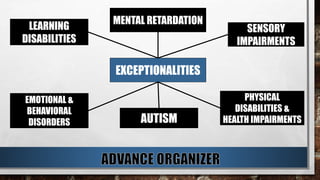
EXCEPTIONALITIES
MENTAL RETARDATION
SENSORY
IMPAIRMENTS
AUTISM
LEARNING
DISABILITIES
PHYSICAL
DISABILITIES &
HEALTH IMPAIRMENTS
EMOTIONAL &
BEHAVIORAL
DISORDERS
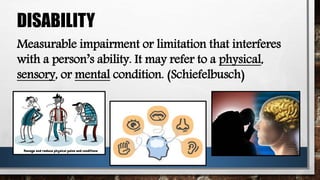
DISABILITY
Measurable impairment or limitation that interferes
with a person’s ability. It may refer to a physical,
sensory, or mental condition. (Schiefelbusch)
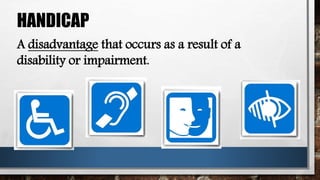
HANDICAP
A disadvantage that occurs as a result of a
disability or impairment.
Categories of
Exceptionalities
SPECIFIC COGNITIVE OR ACADEMIC
DIFFICULTIES
Learning disabilities
involves difficulties in specific cognitive processes. Like dyslexia
(reading), dyscalculia (number operations), and dysgraphia
(writing).
Attention-deficit hyperactivity disorder (ADHD)
1. Difficulty in focusing and maintaining attention.
2. Recurrent hyperactive and impulsive behavior..
Speech and communication disorder
difficulties in spoken language like voice disorders, inability to
produce the sounds correctly, stuttering.
.
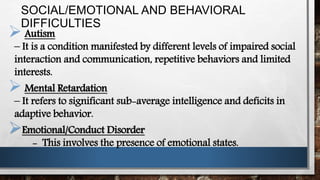
SOCIAL/EMOTIONAL AND BEHAVIORAL
DIFFICULTIES
Autism
– It is a condition manifested by different levels of impaired social
interaction and communication, repetitive behaviors and limited
interests.
Mental Retardation
– It refers to significant sub-average intelligence and deficits in
adaptive behavior.
Emotional/Conduct Disorder
- This involves the presence of emotional states..
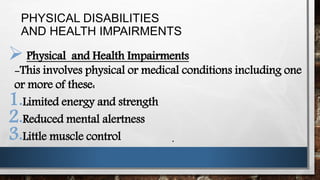
PHYSICAL DISABILITIES
AND HEALTH IMPAIRMENTS
Physical and Health Impairments
-This involves physical or medical conditions including one
or more of these:
1.Limited energy and strength
2.Reduced mental alertness
3.Little muscle control .
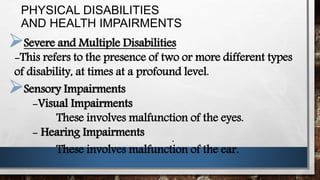
PHYSICAL DISABILITIES
AND HEALTH IMPAIRMENTS
Severe and Multiple Disabilities
-This refers to the presence of two or more different types
of disability, at times at a profound level.
Sensory Impairments
-Visual Impairments
These involves malfunction of the eyes.
- Hearing Impairments
These involves malfunction of the ear.
.
PHYSICAL DISABILITIES
AND HEALTH IMPAIRMENTS
.
Giftedness
-This involves a significantly high level of cognitive
development.
PEOPLE-FIRST LANGUAGE
.
Putting the person first, not the disability.
Ex:
Person with disability not disabled person.
“Person with AIDS”, rather than “AIDS
Victim”
PEOPLE-FIRST LANGUAGE
.
Avoiding generic labels
people with mental retardation is preferable to mentally retarded.
Emphasizing abilities, not limitations
uses a wheelchair is preferable to confined to a wheelchair.
Avoiding euphemism
physically-challenged
Avoiding implying illness or suffering
Had folio is preferable to is a polio victim and Multiple sclerosis is
preferable to suffers from multiple sclerosis.

Module 6 Learners with exceptionalities

  • 1.
  • 2.
  • 3.
    DISABILITY Measurable impairment orlimitation that interferes with a person’s ability. It may refer to a physical, sensory, or mental condition. (Schiefelbusch)
  • 4.
    HANDICAP A disadvantage thatoccurs as a result of a disability or impairment.
  • 5.
  • 6.
    SPECIFIC COGNITIVE ORACADEMIC DIFFICULTIES Learning disabilities involves difficulties in specific cognitive processes. Like dyslexia (reading), dyscalculia (number operations), and dysgraphia (writing). Attention-deficit hyperactivity disorder (ADHD) 1. Difficulty in focusing and maintaining attention. 2. Recurrent hyperactive and impulsive behavior.. Speech and communication disorder difficulties in spoken language like voice disorders, inability to produce the sounds correctly, stuttering. .
  • 7.
    SOCIAL/EMOTIONAL AND BEHAVIORAL DIFFICULTIES Autism –It is a condition manifested by different levels of impaired social interaction and communication, repetitive behaviors and limited interests. Mental Retardation – It refers to significant sub-average intelligence and deficits in adaptive behavior. Emotional/Conduct Disorder - This involves the presence of emotional states..
  • 8.
    PHYSICAL DISABILITIES AND HEALTHIMPAIRMENTS Physical and Health Impairments -This involves physical or medical conditions including one or more of these: 1.Limited energy and strength 2.Reduced mental alertness 3.Little muscle control .
  • 9.
    PHYSICAL DISABILITIES AND HEALTHIMPAIRMENTS Severe and Multiple Disabilities -This refers to the presence of two or more different types of disability, at times at a profound level. Sensory Impairments -Visual Impairments These involves malfunction of the eyes. - Hearing Impairments These involves malfunction of the ear. .
  • 10.
    PHYSICAL DISABILITIES AND HEALTHIMPAIRMENTS . Giftedness -This involves a significantly high level of cognitive development.
  • 11.
    PEOPLE-FIRST LANGUAGE . Putting theperson first, not the disability. Ex: Person with disability not disabled person. “Person with AIDS”, rather than “AIDS Victim”
  • 12.
    PEOPLE-FIRST LANGUAGE . Avoiding genericlabels people with mental retardation is preferable to mentally retarded. Emphasizing abilities, not limitations uses a wheelchair is preferable to confined to a wheelchair. Avoiding euphemism physically-challenged Avoiding implying illness or suffering Had folio is preferable to is a polio victim and Multiple sclerosis is preferable to suffers from multiple sclerosis.