
MODULE 6
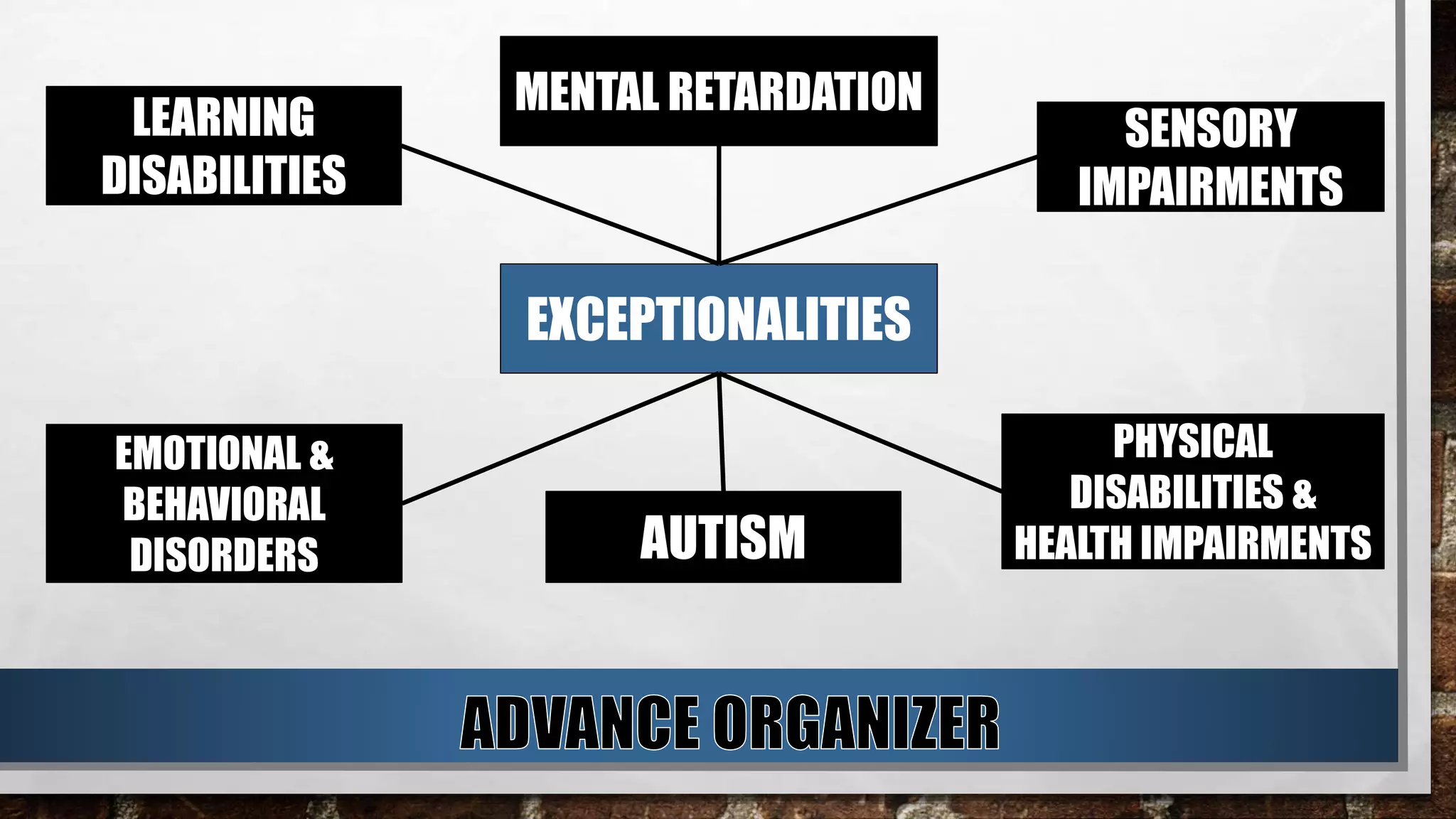
EXCEPTIONALITIES
MENTAL RETARDATION
SENSORY
IMPAIRMENTS
AUTISM
LEARNING
DISABILITIES
PHYSICAL
DISABILITIES &
HEALTH IMPAIRMENTS
EMOTIONAL &
BEHAVIORAL
DISORDERS
The term 'exceptionality' is used by
the Department of Education and Early
Childhood Development to identify
patterns of strengths and needs
common to groups of students.
DISABILITY
Measurable impairment or limitation that interferes
with a person’s ability. It may refer to a physical,
sensory, or mental condition. (Schiefelbusch)
HANDICAP
A disadvantage that occurs as a result of a
disability or impairment.
Categories of
Exceptionalities
SPECIFIC COGNITIVE OR ACADEMIC
DIFFICULTIES
Learning disabilities
involves difficulties in specific cognitive
processes. Like dyslexia (reading), dyscalculia
(number operations), and dysgraphia (writing).
.
SPECIFIC COGNITIVE OR ACADEMIC
DIFFICULTIES
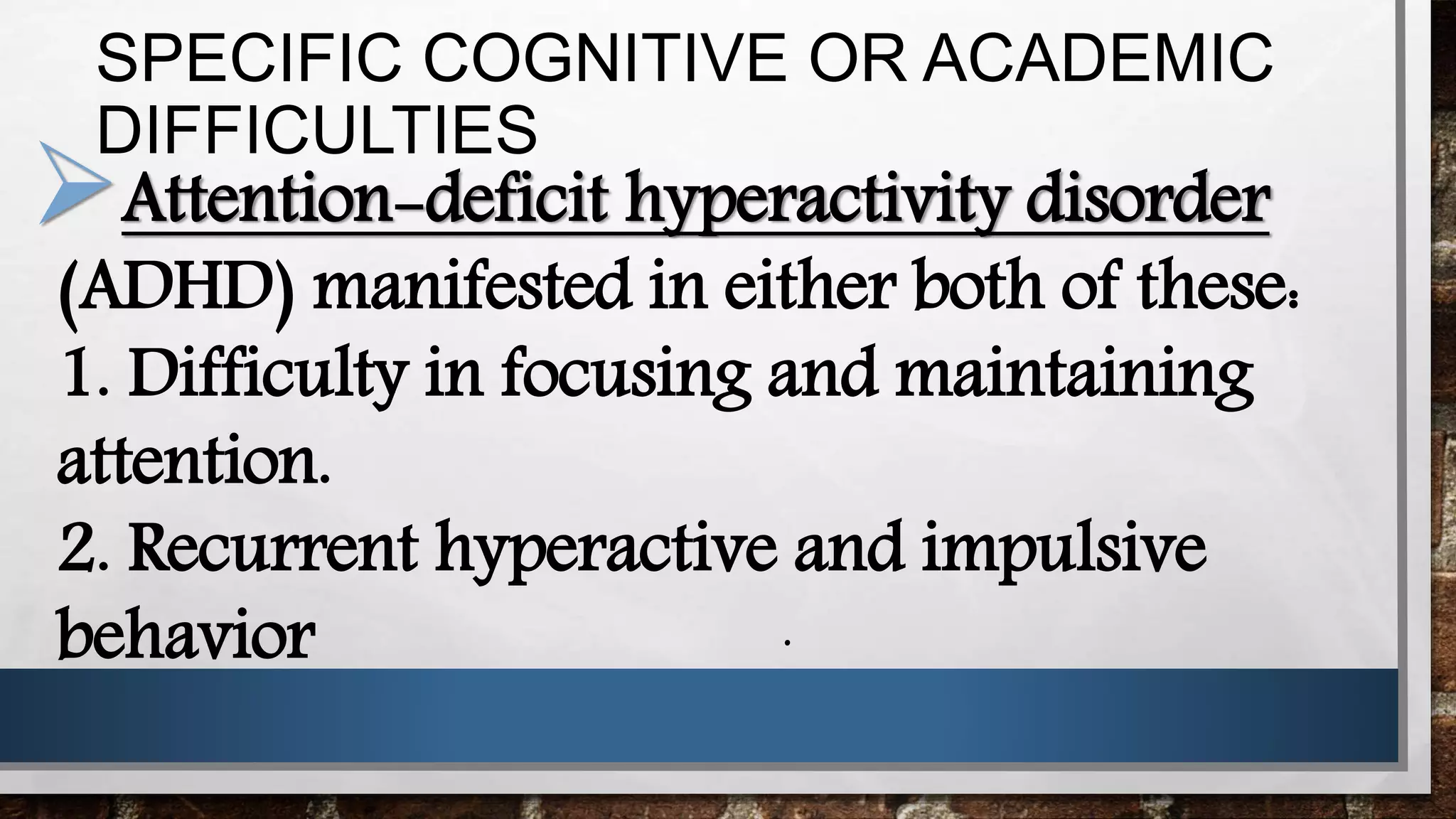
Attention-deficit hyperactivity disorder
(ADHD) manifested in either both of these:
1. Difficulty in focusing and maintaining
attention.
2. Recurrent hyperactive and impulsive
behavior .
SOCIAL/EMOTIONAL AND BEHAVIORAL
DIFFICULTIESAutism - is a condition
manifested by different levels of
levels of impaired social
interaction and communication,
communication, repetitive
behaviors and limited interest..
SOCIAL/EMOTIONAL AND BEHAVIORAL
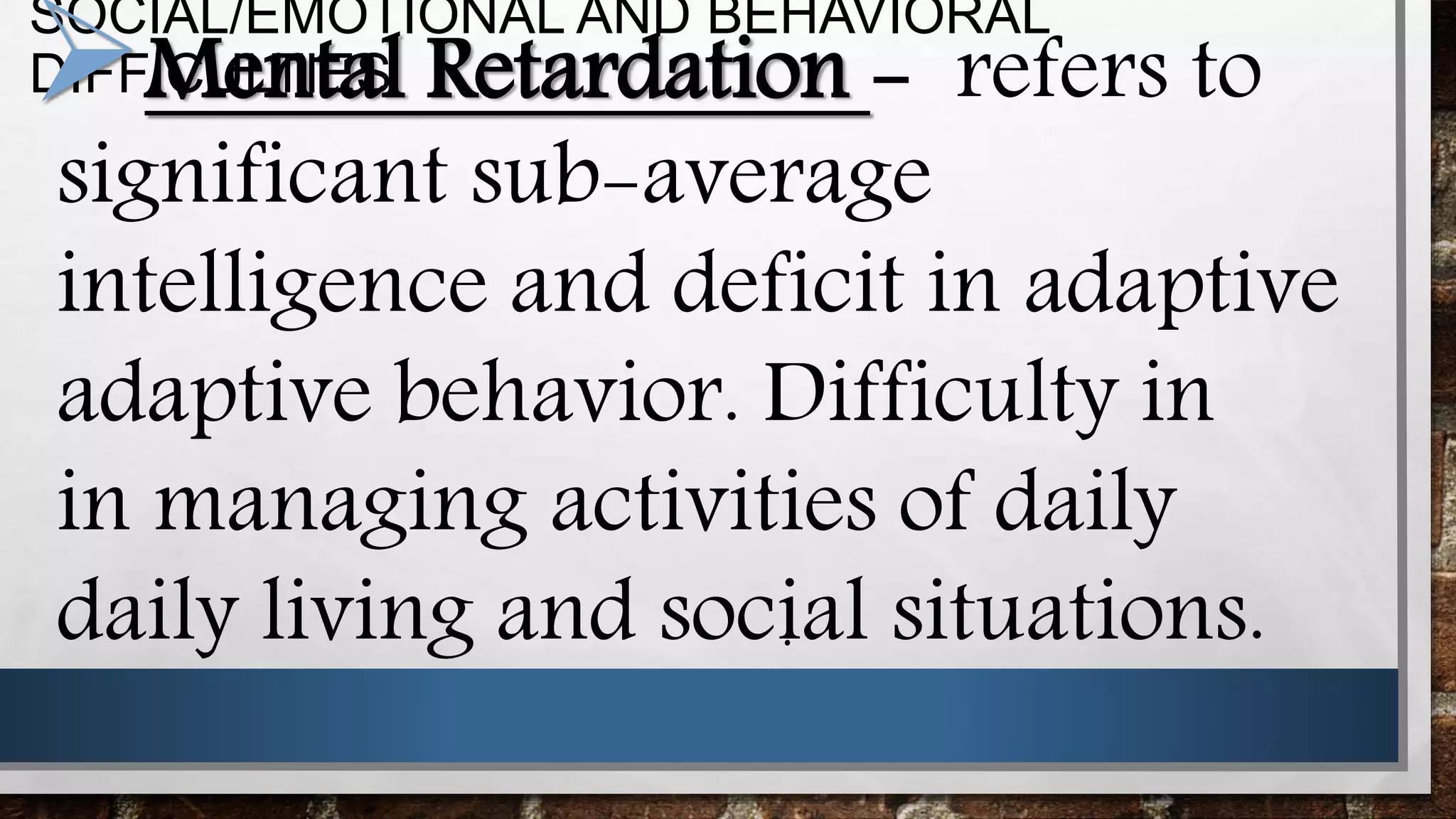
DIFFICULTIESMental Retardation - refers to
significant sub-average
intelligence and deficit in adaptive
adaptive behavior. Difficulty in
in managing activities of daily
daily living and social situations..
POSSIBLE CAUSES:
1) DOWN SYNDROME
2) HYDROCEPHALUS
3)CEREBRAL PALSY
4) LEAD POISONING
5)FANCONI ANEMIA
SOCIAL/EMOTIONAL AND BEHAVIORAL
DIFFICULTIES
Emotional/Conduct Disorder
- This involves the presence of
emotional states like depression
depression and aggression over a
over a considerable amount of
amount of time that disturb
disturb learning and performance
performance in school.
.
PHYSICAL DISABILITIES
AND HEALTH IMPAIRMENTS
 Physical and Health Impairments
-This involves physical or medical conditions
including one or more of these:
1.Limited energy and strength
2.Reduced mental alertness
3.Little muscle control
PHYSICAL DISABILITIES
AND HEALTH IMPAIRMENTS
Severe and Multiple Disabilities
-This refers to the presence of two or more
different types of disability, at times at a
profound level.
.
SENSORY IMPAIRMENTS
Visual Impairments
These involves malfunction
of the eyes.
Hearing Impairments
These involves malfunction
of the ear. .
Giftedness
-This involves a
significantly high
level of cognitive
cognitive
development.
PEOPLE-FIRST LANGUAGE
.
 Putting the person first, not
the disability.
Ex:
Person with AIDS AIDS Victim
Person with disability Disabled person
PEOPLE-FIRST LANGUAGE
.
Avoiding generic labels
people with mental retardation is preferable
to the mentally retarded.
Emphasizing abilities, not limitations
uses a wheelchair is preferable to confined
PEOPLE-FIRST LANGUAGE
.
Avoiding euphemism
(such as physically-challenged)
challenged) which are regarded as
regarded as condescending and
and avoid the real issues that result
that result from a disability.
PEOPLE-FIRST LANGUAGE
Avoiding implying illness or
suffering
Had polio is preferable to is a polio
a polio victim and Multiple sclerosis is
sclerosis is preferable to suffers from
suffers from multiple sclerosis.
Learners with Exceptionalities

Learners with Exceptionalities