NOUNS
2
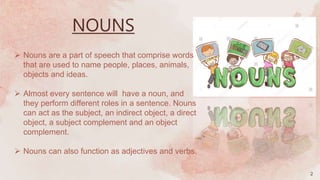
 Nouns are a part of speech that comprise words
that are used to name people, places, animals,
objects and ideas.
 Almost every sentence will have a noun, and
they perform different roles in a sentence. Nouns
can act as the subject, an indirect object, a direct
object, a subject complement and an object
complement.
 Nouns can also function as adjectives and verbs.
EXAMPLES
OF NOUNS
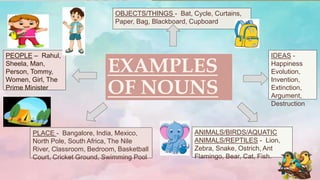
PEOPLE – Rahul,
Sheela, Man,
Person, Tommy,
Women, Girl, The
Prime Minister
PLACE - Bangalore, India, Mexico,
North Pole, South Africa, The Nile
River, Classroom, Bedroom, Basketball
Court, Cricket Ground, Swimming Pool
ANIMALS/BIRDS/AQUATIC
ANIMALS/REPTILES - Lion,
Zebra, Snake, Ostrich, Ant
Flamingo, Bear, Cat, Fish.
OBJECTS/THINGS - Bat, Cycle, Curtains,
Paper, Bag, Blackboard, Cupboard
IDEAS -
Happiness
Evolution,
Invention,
Extinction,
Argument,
Destruction
TYPES OF NOUNS
4
PROPER NOUN
PLURAL NOUN
SINGULAR NOUN
ABSTRACT NOUN
COMMON NOUN
COMMON NOUN
UNCOUNTABLE NOUN
COLLECTIVE NOUN
COUNTABLE NOUN
CONCRETE NOUN
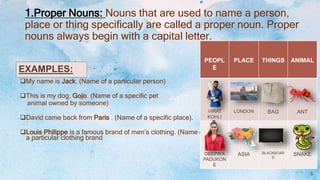
1.Proper Nouns: Nouns that are used to name a person,
place or thing specifically are called a proper noun. Proper
nouns always begin with a capital letter.
My name is Jack. (Name of a particular person)
This is my dog, Gojo. (Name of a specific pet
animal owned by someone)
David came back from Paris . (Name of a specific place).
Louis Philippe is a famous brand of men’s clothing. (Name of
a particular clothing brand
5
PEOPL
E
PLACE THINGS ANIMAL
VIRAT
KOHLI
LONDON BAG ANT
DEEPIKA
PADUKON
E
ASIA BLACKBOAR
D
SNAKE
EXAMPLES:
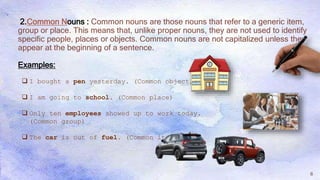
2.Common Nouns : Common nouns are those nouns that refer to a generic item,
group or place. This means that, unlike proper nouns, they are not used to identify
specific people, places or objects. Common nouns are not capitalized unless they
appear at the beginning of a sentence.
Examples:
6
 I bought a pen yesterday. (Common object)
 I am going to school. (Common place)
 Only ten employees showed up to work today.
(Common group)
 The car is out of fuel. (Common items)
3. Singular Nouns: These are words that are used to name a single person,
place, animal, bird or object.
Examples:
There is a little boy in front of our house. (Single person)
That is my daughter. (Single person)
I found a wounded sparrow in the bush. (Single bird)
7
4. Plural Nouns: Plural nouns refer to a number of people, places,
animals or things. Nouns are made plural by adding an ‘s’ or ‘es’ or
‘ies’ or ‘ves’ to the existing root word. Nouns that end with an ‘s’
remain the same. Some nouns remain the same in both their singular and
plural forms, and some others have totally different spelling
EXAMPLES:
 I need some apples.
 Did you find the boxes you were looking for?
 I bought mangoes from the market.
5. Countable Nouns: Countable nouns are those nouns that can
be counted or measured.
Examples:
 Tom brought ten packets of lays for the trip. (Specific number – ten)
 Mom asked me to buy a dozen eggs. (Specific – dozen means twelve)
 I saw an airplane around seven in the morning. (Specific – an means one)
6. Uncountable Nouns :are those nouns that cannot be counted.
This category of nouns includes both concrete and abstract
nouns.
Examples:
 I have a lot of homework to do. (Not specific)
 I have a cup of tea. (Cannot count)
 We are facing terrible weather today. (Cannot count)
7. Collective Nouns: A collective noun is a naming word
that is used to denote a group of objects, animals or
people.
Examples:
Collective nouns for groups of animals
A pride of lions
A flock of sheep
A swarm of bees
A herd of elephants
Collective nouns for groups of people
A band of musicians
A board of directors
A crew of sailors
A company of actors
Collective nouns for a number of things/objects
A pair of shoes
A chain of mountains
A fleet of ships
A bunch of grapes
9
8. Concrete Nouns: A concrete noun refers to objects
that are material and can be perceived by the human
senses.
Examples:
 The book is on the table.
 I had a cup of coffee.
 Sharon opened the windows.
 Hardy goes to school by bus.
 Love is a strong emotion.
 Honesty is the best policy.
 It takes a lot of courage to raise your voice and stand up
against injustice.
 You should not misuse the freedom you are given.
9. Abstract Nouns: Any entity that cannot be perceived by the
five senses of the human body are called an abstract noun.
Examples:
20XX 10
Nouns Used as Different Components
of a Sentence
Nouns used as a subject
When used as a subject, a noun
mostly appears at the
beginning of a sentence. It
can be identified by asking
the question ‘who’.
Examples:
•Bruno went to the playground.
•The teacher asked the students
to submit their assignments.
•The elephant was rescued
safely after ten long hours.
Nouns used as an object
When nouns are used as objects, they
appear in the latter part of a
sentence. It can be identified by
asking the question ‘what’.
Examples:
•I bought a pen.
•Where is your book?
•I cannot find today’s newspaper.
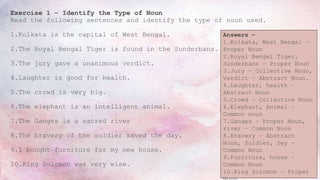
Exercise 1 – Identify the Type of Noun
Read the following sentences and identify the type of noun used.
1.Kolkata is the capital of West Bengal.
2.The Royal Bengal Tiger is found in the Sunderbans.
3.The jury gave a unanimous verdict.
4.Laughter is good for health.
5.The crowd is very big.
6.The elephant is an intelligent animal.
7.The Ganges is a sacred river
8.The bravery of the soldier saved the day.
9.I bought furniture for my new house.
10.King Solomon was very wise.
Answers –
1.Kolkata, West Bengal –
Proper Noun
2.Royal Bengal Tiger,
Sunderbans – Proper Noun
3.Jury – Collective Noun,
Verdict – Abstract Noun.
4.Laughter, health –
Abstract Noun
5.Crowd – Collective Noun
6.Elephant, Animal –
Common noun
7.Ganges – Proper Noun,
river – Common Noun
8.Bravery – Abstract
Noun, Soldier, Day –
Common Noun
9.Furniture, house –
Common Noun
10.King Solomon – Proper
13
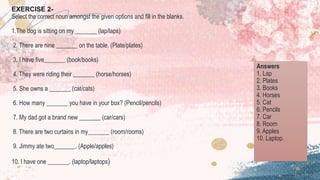
Answers
1. Lap
2. Plates
3. Books
4. Horses
5. Cat
6. Pencils
7. Car
8. Room
9. Apples
10. Laptop.
EXERCISE 2-
Select the correct noun amongst the given options and fill in the blanks.
1.The dog is sitting on my _______ (lap/laps)
2. There are nine _______ on the table. (Plate/plates)
3. I have five_______ (book/books)
4. They were riding their _______ (horse/horses)
5. She owns a _______ (cat/cats)
6. How many _______ you have in your box? (Pencil/pencils)
7. My dad got a brand new _______ (car/cars)
8. There are two curtains in my_______ (room/rooms)
9. Jimmy ate two_______. (Apple/apples)
10. I have one _______. (laptop/laptops)
14
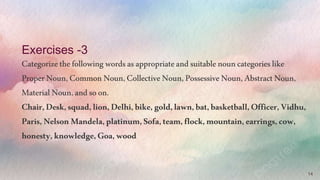
Exercises -3
Categorizethefollowingwordsasappropriateandsuitablenouncategorieslike
ProperNoun,CommonNoun,CollectiveNoun,PossessiveNoun,AbstractNoun,
MaterialNoun,andsoon.
Chair,Desk,squad,lion,Delhi,bike, gold,lawn,bat,basketball, Officer,Vidhu,
Paris,NelsonMandela,platinum,Sofa,team,flock,mountain,earrings,cow,
honesty,knowledge, Goa,wood
•Answers
•ProperNouns:Delhi,Vidhu,Paris,NelsonMandela,Goa
•CommonNouns:Chair,Desk,lion,bike,lawn,Bat,basketball,Officer,
Sofa,Mountain,earrings,cow
•CollectiveNouns:squad,team,Flock
•AbstractNouns:Honesty,knowledge
•MaterialsNouns:Gold,platinum,wood
15
THANK YOU
20XX presentation title 16

Noun and it's types. It's examples.

  • 2.
    NOUNS 2  Nouns area part of speech that comprise words that are used to name people, places, animals, objects and ideas.  Almost every sentence will have a noun, and they perform different roles in a sentence. Nouns can act as the subject, an indirect object, a direct object, a subject complement and an object complement.  Nouns can also function as adjectives and verbs.
  • 3.
    EXAMPLES OF NOUNS PEOPLE –Rahul, Sheela, Man, Person, Tommy, Women, Girl, The Prime Minister PLACE - Bangalore, India, Mexico, North Pole, South Africa, The Nile River, Classroom, Bedroom, Basketball Court, Cricket Ground, Swimming Pool ANIMALS/BIRDS/AQUATIC ANIMALS/REPTILES - Lion, Zebra, Snake, Ostrich, Ant Flamingo, Bear, Cat, Fish. OBJECTS/THINGS - Bat, Cycle, Curtains, Paper, Bag, Blackboard, Cupboard IDEAS - Happiness Evolution, Invention, Extinction, Argument, Destruction
  • 4.
    TYPES OF NOUNS 4 PROPERNOUN PLURAL NOUN SINGULAR NOUN ABSTRACT NOUN COMMON NOUN COMMON NOUN UNCOUNTABLE NOUN COLLECTIVE NOUN COUNTABLE NOUN CONCRETE NOUN
  • 5.
    1.Proper Nouns: Nounsthat are used to name a person, place or thing specifically are called a proper noun. Proper nouns always begin with a capital letter. My name is Jack. (Name of a particular person) This is my dog, Gojo. (Name of a specific pet animal owned by someone) David came back from Paris . (Name of a specific place). Louis Philippe is a famous brand of men’s clothing. (Name of a particular clothing brand 5 PEOPL E PLACE THINGS ANIMAL VIRAT KOHLI LONDON BAG ANT DEEPIKA PADUKON E ASIA BLACKBOAR D SNAKE EXAMPLES:
  • 6.
    2.Common Nouns :Common nouns are those nouns that refer to a generic item, group or place. This means that, unlike proper nouns, they are not used to identify specific people, places or objects. Common nouns are not capitalized unless they appear at the beginning of a sentence. Examples: 6  I bought a pen yesterday. (Common object)  I am going to school. (Common place)  Only ten employees showed up to work today. (Common group)  The car is out of fuel. (Common items)
  • 7.
    3. Singular Nouns:These are words that are used to name a single person, place, animal, bird or object. Examples: There is a little boy in front of our house. (Single person) That is my daughter. (Single person) I found a wounded sparrow in the bush. (Single bird) 7 4. Plural Nouns: Plural nouns refer to a number of people, places, animals or things. Nouns are made plural by adding an ‘s’ or ‘es’ or ‘ies’ or ‘ves’ to the existing root word. Nouns that end with an ‘s’ remain the same. Some nouns remain the same in both their singular and plural forms, and some others have totally different spelling EXAMPLES:  I need some apples.  Did you find the boxes you were looking for?  I bought mangoes from the market.
  • 8.
    5. Countable Nouns:Countable nouns are those nouns that can be counted or measured. Examples:  Tom brought ten packets of lays for the trip. (Specific number – ten)  Mom asked me to buy a dozen eggs. (Specific – dozen means twelve)  I saw an airplane around seven in the morning. (Specific – an means one) 6. Uncountable Nouns :are those nouns that cannot be counted. This category of nouns includes both concrete and abstract nouns. Examples:  I have a lot of homework to do. (Not specific)  I have a cup of tea. (Cannot count)  We are facing terrible weather today. (Cannot count)
  • 9.
    7. Collective Nouns:A collective noun is a naming word that is used to denote a group of objects, animals or people. Examples: Collective nouns for groups of animals A pride of lions A flock of sheep A swarm of bees A herd of elephants Collective nouns for groups of people A band of musicians A board of directors A crew of sailors A company of actors Collective nouns for a number of things/objects A pair of shoes A chain of mountains A fleet of ships A bunch of grapes 9
  • 10.
    8. Concrete Nouns:A concrete noun refers to objects that are material and can be perceived by the human senses. Examples:  The book is on the table.  I had a cup of coffee.  Sharon opened the windows.  Hardy goes to school by bus.  Love is a strong emotion.  Honesty is the best policy.  It takes a lot of courage to raise your voice and stand up against injustice.  You should not misuse the freedom you are given. 9. Abstract Nouns: Any entity that cannot be perceived by the five senses of the human body are called an abstract noun. Examples: 20XX 10
  • 11.
    Nouns Used asDifferent Components of a Sentence Nouns used as a subject When used as a subject, a noun mostly appears at the beginning of a sentence. It can be identified by asking the question ‘who’. Examples: •Bruno went to the playground. •The teacher asked the students to submit their assignments. •The elephant was rescued safely after ten long hours. Nouns used as an object When nouns are used as objects, they appear in the latter part of a sentence. It can be identified by asking the question ‘what’. Examples: •I bought a pen. •Where is your book? •I cannot find today’s newspaper.
  • 12.
    Exercise 1 –Identify the Type of Noun Read the following sentences and identify the type of noun used. 1.Kolkata is the capital of West Bengal. 2.The Royal Bengal Tiger is found in the Sunderbans. 3.The jury gave a unanimous verdict. 4.Laughter is good for health. 5.The crowd is very big. 6.The elephant is an intelligent animal. 7.The Ganges is a sacred river 8.The bravery of the soldier saved the day. 9.I bought furniture for my new house. 10.King Solomon was very wise. Answers – 1.Kolkata, West Bengal – Proper Noun 2.Royal Bengal Tiger, Sunderbans – Proper Noun 3.Jury – Collective Noun, Verdict – Abstract Noun. 4.Laughter, health – Abstract Noun 5.Crowd – Collective Noun 6.Elephant, Animal – Common noun 7.Ganges – Proper Noun, river – Common Noun 8.Bravery – Abstract Noun, Soldier, Day – Common Noun 9.Furniture, house – Common Noun 10.King Solomon – Proper
  • 13.
    13 Answers 1. Lap 2. Plates 3.Books 4. Horses 5. Cat 6. Pencils 7. Car 8. Room 9. Apples 10. Laptop. EXERCISE 2- Select the correct noun amongst the given options and fill in the blanks. 1.The dog is sitting on my _______ (lap/laps) 2. There are nine _______ on the table. (Plate/plates) 3. I have five_______ (book/books) 4. They were riding their _______ (horse/horses) 5. She owns a _______ (cat/cats) 6. How many _______ you have in your box? (Pencil/pencils) 7. My dad got a brand new _______ (car/cars) 8. There are two curtains in my_______ (room/rooms) 9. Jimmy ate two_______. (Apple/apples) 10. I have one _______. (laptop/laptops)
  • 14.
  • 15.
  • 16.