WALT: State what the 
Sociological Theories say 
about Socialization? 
C - Can describe, explain and summarise what sociological theories say 
about socialization 
B - Can assess what Sociological Theories say about Socialization 
A - Can evaluate what Sociological Theories say about Socialization
What is Socialization for? 
Rally table a list of ideas…
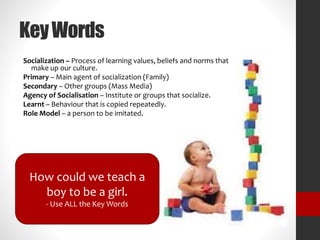
Key Words 
Socialization – Process of learning values, beliefs and norms that 
make up our culture. 
Primary –Main agent of socialization (Family) 
Secondary – Other groups (Mass Media) 
Agency of Socialisation – Institute or groups that socialize. 
Learnt – Behaviour that is copied repeatedly. 
Role Model – a person to be imitated. 
How could we teach a 
boy to be a girl. 
- Use ALL the Key Words
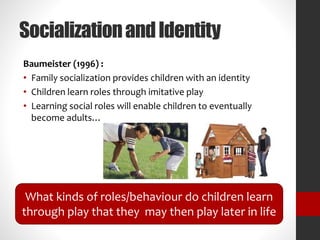
Socialization and Identity 
Baumeister (1996) : 
• Family socialization provides children with an identity 
• Children learn roles through imitative play 
• Learning social roles will enable children to eventually 
become adults… 
What kinds of roles/behaviour do children learn 
through play that they may then play later in life
Socialization and Social Control 
Morgan (1996) 
• Parents use sanctions to reinforce and reward socially 
approved behaviour 
• Sanctions lead to the development of a conscience in a child 
– which leads to independent action 
• Toilet training – instils control over bodily functions so child 
is ‘civilised’ and avoid ‘uncivilised’ behaviours 
• Gender Socialization – children internalise cultural 
expectations about femininity/masculinity
Evaluation of 
Baumeister/Morgan 
• 3 criticisms and strengths
Experts – 4 agencies of socialization 
1. Number off 1-4 
2. Allocate topic: 
- Education 
- Religion 
- Mass Media 
- Peer Group 
3. Create a summary for topic 
E/D – Describe and define what is meant by your agent of socialization. 
C – Explain how they socialize… 
A – Evaluate from a sociologist view point (Marxist / Functionalist).
Experts – 4 agencies of socialization 
4. Join other experts to reinforce learning 
5. With experts, create 4 knowledge questions – you will take 
these back to your group to do. 
6. Return to home table. Take it into turns to deliver expert 
topic 
7. When everyone has finished…then test them using 4 
knowledge questions
Q-Q-T 
• Create Quiz Quiz Trade cards with questions about each of 
the four different agencies of socialization.
Link to Sociology (Try 
Socialization)
Sociological views of Socialization. 
Education… 
Schools deliver knowledge and skills that prepare you for the 
world with a formal curriculum (what students learn). 
There is also another side to the socialization process known 
as the hidden curriculum. (Schools have rules, expected to 
conform). 
Functionalist – Plays a vital role in teaching the values and 
norms of society to each new generation. 
Marxist – Education socializes individuals into accepting the 
vales of the Ruling Class.
Sociological views of Socialization. 
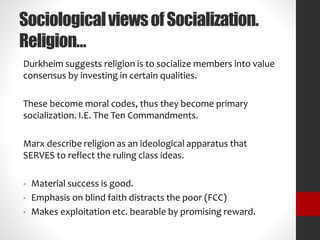
Religion… 
Durkheim suggests religion is to socialize members into value 
consensus by investing in certain qualities. 
These become moral codes, thus they become primary 
socialization. I.E. The Ten Commandments. 
Marx describe religion as an ideological apparatus that 
SERVES to reflect the ruling class ideas. 
- Material success is good. 
- Emphasis on blind faith distracts the poor (FCC) 
- Makes exploitation etc. bearable by promising reward.
Sociological views of Socialization. 
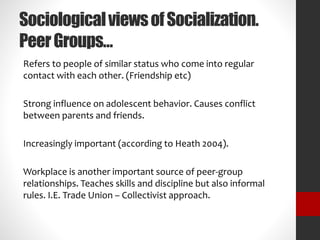
Peer Groups… 
Refers to people of similar status who come into regular 
contact with each other. (Friendship etc) 
Strong influence on adolescent behavior. Causes conflict 
between parents and friends. 
Increasingly important (according to Heath 2004). 
Workplace is another important source of peer-group 
relationships. Teaches skills and discipline but also informal 
rules. I.E. Trade Union – Collectivist approach.
Sociological views of Socialization. 
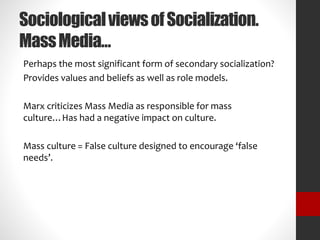
Mass Media… 
Perhaps the most significant form of secondary socialization? 
Provides values and beliefs as well as role models. 
Marx criticizes Mass Media as responsible for mass 
culture…Has had a negative impact on culture. 
Mass culture = False culture designed to encourage ‘false 
needs’.
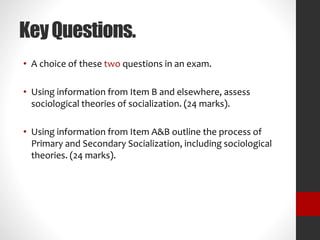
Key Questions. 
• A choice of these two questions in an exam. 
• Using information from Item B and elsewhere, assess 
sociological theories of socialization. (24 marks). 
• Using information from Item A&B outline the process of 
Primary and Secondary Socialization, including sociological 
theories. (24 marks).
Criticisms of Socialization 
How could the process have negative consequences for some 
children? 
Is socialization straightforward? 
Is socialization a one way process?
Evaluation 
Postman (1982) 
• Childhood is much shorter compared to 50 years ago. 
• Children have lost innocence. 
Palmer (2007) 
• Negative influence of TV/Computer games impact on 
process. 
Phillip (1997) 
• Children have too many rights and use these to resist 
parental power.
Choice of Challenge … 
• With a Partner you now have to choose a Challenge Card to 
complete about the criticisms of Socialization as a process. 
• You nee to read page 42 and complete your challenge. Take 
notes in your book if necessary.
Key Words of Culture & Socialization. 
Socialization – Process of teaching and learning culture. 
Society – Community bound together by social institutions and culture. 
Culture – A way of life of a society – Shared values, beliefs and norms. 
Identity – How the individual sees themselves. 
Globalization – The influence on British culture of cultural products produced outside of the UK. 
High Culture – Cultural products defined as superior to mass or popular. 
Mass Culture – Cultural products consumed by a lot of people. 
Sub Cultures – Groups that exist within or alongside main culture. 
Folk Culture – Traditional cultural products. 
Values – Important beliefs. 
Norms –Ways of behaving 
Customs – Traditional way of doing things. 
Value Consensus – Shared agreement on important beliefs (FUNCTIONALIST) 
Conflict Theory - The belief that societies are unequal and unfair and in conflict (MARX) 
False Class Consciousness – State of not being aware of our true identity as exploited workers. 
(MARX) 
Conformity – Obeying the rules without questioning them. 
Consensus – Agreement of 50%+ 
Sanctions – Punishments and rewards. 
Imitative play – Copying adults and learning… 
Hidden curriculum – Invisible way schools encourage conformity.

1209 Socialization Theories

  • 1.
    WALT: State whatthe Sociological Theories say about Socialization? C - Can describe, explain and summarise what sociological theories say about socialization B - Can assess what Sociological Theories say about Socialization A - Can evaluate what Sociological Theories say about Socialization
  • 2.
    What is Socializationfor? Rally table a list of ideas…
  • 3.
    Key Words Socialization– Process of learning values, beliefs and norms that make up our culture. Primary –Main agent of socialization (Family) Secondary – Other groups (Mass Media) Agency of Socialisation – Institute or groups that socialize. Learnt – Behaviour that is copied repeatedly. Role Model – a person to be imitated. How could we teach a boy to be a girl. - Use ALL the Key Words
  • 4.
    Socialization and Identity Baumeister (1996) : • Family socialization provides children with an identity • Children learn roles through imitative play • Learning social roles will enable children to eventually become adults… What kinds of roles/behaviour do children learn through play that they may then play later in life
  • 5.
    Socialization and SocialControl Morgan (1996) • Parents use sanctions to reinforce and reward socially approved behaviour • Sanctions lead to the development of a conscience in a child – which leads to independent action • Toilet training – instils control over bodily functions so child is ‘civilised’ and avoid ‘uncivilised’ behaviours • Gender Socialization – children internalise cultural expectations about femininity/masculinity
  • 6.
    Evaluation of Baumeister/Morgan • 3 criticisms and strengths
  • 7.
    Experts – 4agencies of socialization 1. Number off 1-4 2. Allocate topic: - Education - Religion - Mass Media - Peer Group 3. Create a summary for topic E/D – Describe and define what is meant by your agent of socialization. C – Explain how they socialize… A – Evaluate from a sociologist view point (Marxist / Functionalist).
  • 8.
    Experts – 4agencies of socialization 4. Join other experts to reinforce learning 5. With experts, create 4 knowledge questions – you will take these back to your group to do. 6. Return to home table. Take it into turns to deliver expert topic 7. When everyone has finished…then test them using 4 knowledge questions
  • 9.
    Q-Q-T • CreateQuiz Quiz Trade cards with questions about each of the four different agencies of socialization.
  • 10.
    Link to Sociology(Try Socialization)
  • 11.
    Sociological views ofSocialization. Education… Schools deliver knowledge and skills that prepare you for the world with a formal curriculum (what students learn). There is also another side to the socialization process known as the hidden curriculum. (Schools have rules, expected to conform). Functionalist – Plays a vital role in teaching the values and norms of society to each new generation. Marxist – Education socializes individuals into accepting the vales of the Ruling Class.
  • 12.
    Sociological views ofSocialization. Religion… Durkheim suggests religion is to socialize members into value consensus by investing in certain qualities. These become moral codes, thus they become primary socialization. I.E. The Ten Commandments. Marx describe religion as an ideological apparatus that SERVES to reflect the ruling class ideas. - Material success is good. - Emphasis on blind faith distracts the poor (FCC) - Makes exploitation etc. bearable by promising reward.
  • 13.
    Sociological views ofSocialization. Peer Groups… Refers to people of similar status who come into regular contact with each other. (Friendship etc) Strong influence on adolescent behavior. Causes conflict between parents and friends. Increasingly important (according to Heath 2004). Workplace is another important source of peer-group relationships. Teaches skills and discipline but also informal rules. I.E. Trade Union – Collectivist approach.
  • 14.
    Sociological views ofSocialization. Mass Media… Perhaps the most significant form of secondary socialization? Provides values and beliefs as well as role models. Marx criticizes Mass Media as responsible for mass culture…Has had a negative impact on culture. Mass culture = False culture designed to encourage ‘false needs’.
  • 15.
    Key Questions. •A choice of these two questions in an exam. • Using information from Item B and elsewhere, assess sociological theories of socialization. (24 marks). • Using information from Item A&B outline the process of Primary and Secondary Socialization, including sociological theories. (24 marks).
  • 16.
    Criticisms of Socialization How could the process have negative consequences for some children? Is socialization straightforward? Is socialization a one way process?
  • 17.
    Evaluation Postman (1982) • Childhood is much shorter compared to 50 years ago. • Children have lost innocence. Palmer (2007) • Negative influence of TV/Computer games impact on process. Phillip (1997) • Children have too many rights and use these to resist parental power.
  • 18.
    Choice of Challenge… • With a Partner you now have to choose a Challenge Card to complete about the criticisms of Socialization as a process. • You nee to read page 42 and complete your challenge. Take notes in your book if necessary.
  • 19.
    Key Words ofCulture & Socialization. Socialization – Process of teaching and learning culture. Society – Community bound together by social institutions and culture. Culture – A way of life of a society – Shared values, beliefs and norms. Identity – How the individual sees themselves. Globalization – The influence on British culture of cultural products produced outside of the UK. High Culture – Cultural products defined as superior to mass or popular. Mass Culture – Cultural products consumed by a lot of people. Sub Cultures – Groups that exist within or alongside main culture. Folk Culture – Traditional cultural products. Values – Important beliefs. Norms –Ways of behaving Customs – Traditional way of doing things. Value Consensus – Shared agreement on important beliefs (FUNCTIONALIST) Conflict Theory - The belief that societies are unequal and unfair and in conflict (MARX) False Class Consciousness – State of not being aware of our true identity as exploited workers. (MARX) Conformity – Obeying the rules without questioning them. Consensus – Agreement of 50%+ Sanctions – Punishments and rewards. Imitative play – Copying adults and learning… Hidden curriculum – Invisible way schools encourage conformity.