

SOCIAL STRUCTURE,
SOCIAL CONTROL,SOCIAL
GROUP
PRESENTED BY:-PRASHANT
RAJ
B.A.ENG (H)
Definition
 It can be defined as the control of the society over the
individuals.
 To control the behaviour of individuals different sanctions of
rewards and punishment are applied.
 Social control is the way in which entire social order coheres
and maintains itself.
Nature of Social Control
 Social control is the control of society over individuals.
 Social control denotes some kind of influence. This
influence may be exercised in various ways by means of
public opinion, coercion, religion, leadership etc.
 The influence of social control is universal. Where there is
society, there is social control.
 Social control is exercised through both formal and informal
agencies
Need of Social Control
 Herbert Spencer has put forwarded the view that society is a
collection of group of individuals. Man lives in society
because it has a utility. Through society he is able to preserve
his identity and views.
 In order to preserve his identity and characteristics, he has to
exercise some control for which certain rules and institutions
are created. These agencies of social control are helpful for
preserving the identity of the individuals and society.
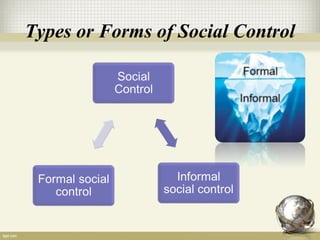
Types or Forms of Social Control
Formal social control
 The formal means of social control come from institutions.
 Man is forced to accept these forms of social control
 Generally these forms are exercised by secondary groups.
 The state, law, education and those which have legitimate
power. They apply coercive measures in the case of deviance.
Informal social control
 These agencies of Social Control have grown according to
the needs of the society.
 Folk ways, mores, customs, social norms etc. fall under this
category of social control.
 Generally primary institutions exercise this type of social
control.
Agencies of Social Control
 There are following agencies of social control
Law
State
Education
Folkways
Mores
Administration
Religions
Family
Neighborhood
Public Opinion
Law
 Administration is very powerful and the most effective
instrument of social control. It forces the individual to obey
social control. The administrations punish the violators with the
help of the police, the army etc
Family
 Family is a very important instrument agency of social
control. Family prescribes rules and regulations that the
members have to follow. These rules and regulations form a
part of social control.
 The family socializes the child into the norms, values,
traditions and customs of the group. Thus, family has
predominant role in the shaping of the personality of the
child. Family teaches the child to conform to the norms of
the society. It exercises control over its members to bring
about the desired action.
Social Groups and
characteristics and types of
social groups
© MTCJennBau
SOCIAL GROUPS
It is groups of people in which they social
interactions and relationships.
Or, it may be defined as two or more
people who interact with one anoher ,share
similar characteristics and collectively have
a sense of unity.
Characteristics of Social GroupCharacteristics of Social Group
• Group members interact on a fairly regular
basis through communication.
• Members should develop a structure where
each member assumes a specific status and
adopts a particular role.
• Certain orderly procedures and values are
agreed upon.
• The members of the group feel a sense of
identity.
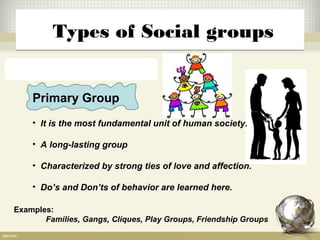
Types of Social groupsTypes of Social groups
Primary Group
• It is the most fundamental unit of human society.
• A long-lasting group
• Characterized by strong ties of love and affection.
• Do’s and Don’ts of behavior are learned here.
Examples:
Families, Gangs, Cliques, Play Groups, Friendship Groups
Secondary Groups
• Groups with which the individual comes in contact later
in life.
• Characterized by impersonal, business-like, contractual,
formal and casual relationship.
• Usually Large in size, not very enduring and limited
relationships.
• People needed other people for the satisfaction of their
complex needs.
Examples:
Industrial Workers; business associates, Faculty Staff,
Company Employees
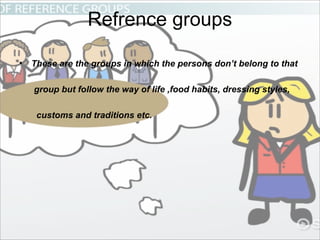
Refrence groups
• These are the groups in which the persons don’t belong to that
group but follow the way of life ,food habits, dressing styles,
customs and traditions etc.
SOCIAL STRUCTURE.
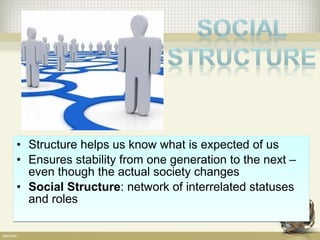
• Structure helps us know what is expected of us
• Ensures stability from one generation to the next –
even though the actual society changes
• Social Structure: network of interrelated statuses
and roles
• Structure helps us know what is expected of us
• Ensures stability from one generation to the next –
even though the actual society changes
• Social Structure: network of interrelated statuses
and roles
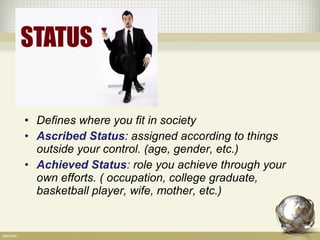
• Defines where you fit in society
• Ascribed Status: assigned according to things
outside your control. (age, gender, etc.)
• Achieved Status: role you achieve through your
own efforts. ( occupation, college graduate,
basketball player, wife, mother, etc.)
• Statuses are social categories –
but roles bring statuses to life
• You occupy a status – you play a
role
• Social Structure:
network of interrelated
statuses and roles
• Status: Defines where
you fit in society
• Ascribed Status:
assigned
• Achieved Status: role
you achieve through your
own efforts
• Master Status: One rank
that determines your
social identity.
• Social Structure:
network of interrelated
statuses and roles
• Status: Defines where
you fit in society
• Ascribed Status:
assigned
• Achieved Status: role
you achieve through your
own efforts
• Master Status: One rank
that determines your
social identity.
• Role: you play - bring
statuses to life
• Reciprocal Roles: define
interaction with others
• Role Expectations:
Socially determined
expected behaviors
• Role Conflict: conflict
between statuses.
• Role Strain: difficulty
meeting the role of a
single status.
• Role: you play - bring
statuses to life
• Reciprocal Roles: define
interaction with others
• Role Expectations:
Socially determined
expected behaviors
• Role Conflict: conflict
between statuses.
• Role Strain: difficulty
meeting the role of a
single status.
THANK YOU

social structure ,social control, social group.

  • 1.
  • 3.
    Definition  It canbe defined as the control of the society over the individuals.  To control the behaviour of individuals different sanctions of rewards and punishment are applied.  Social control is the way in which entire social order coheres and maintains itself.
  • 4.
    Nature of SocialControl  Social control is the control of society over individuals.  Social control denotes some kind of influence. This influence may be exercised in various ways by means of public opinion, coercion, religion, leadership etc.  The influence of social control is universal. Where there is society, there is social control.  Social control is exercised through both formal and informal agencies
  • 5.
    Need of SocialControl  Herbert Spencer has put forwarded the view that society is a collection of group of individuals. Man lives in society because it has a utility. Through society he is able to preserve his identity and views.  In order to preserve his identity and characteristics, he has to exercise some control for which certain rules and institutions are created. These agencies of social control are helpful for preserving the identity of the individuals and society.
  • 6.
    Types or Formsof Social Control
  • 7.
    Formal social control The formal means of social control come from institutions.  Man is forced to accept these forms of social control  Generally these forms are exercised by secondary groups.  The state, law, education and those which have legitimate power. They apply coercive measures in the case of deviance.
  • 8.
    Informal social control These agencies of Social Control have grown according to the needs of the society.  Folk ways, mores, customs, social norms etc. fall under this category of social control.  Generally primary institutions exercise this type of social control.
  • 9.
    Agencies of SocialControl  There are following agencies of social control Law State Education Folkways Mores Administration Religions Family Neighborhood Public Opinion
  • 10.
    Law  Administration isvery powerful and the most effective instrument of social control. It forces the individual to obey social control. The administrations punish the violators with the help of the police, the army etc
  • 11.
    Family  Family isa very important instrument agency of social control. Family prescribes rules and regulations that the members have to follow. These rules and regulations form a part of social control.  The family socializes the child into the norms, values, traditions and customs of the group. Thus, family has predominant role in the shaping of the personality of the child. Family teaches the child to conform to the norms of the society. It exercises control over its members to bring about the desired action.
  • 12.
    Social Groups and characteristicsand types of social groups © MTCJennBau
  • 13.
    SOCIAL GROUPS It isgroups of people in which they social interactions and relationships. Or, it may be defined as two or more people who interact with one anoher ,share similar characteristics and collectively have a sense of unity.
  • 14.
    Characteristics of SocialGroupCharacteristics of Social Group • Group members interact on a fairly regular basis through communication. • Members should develop a structure where each member assumes a specific status and adopts a particular role. • Certain orderly procedures and values are agreed upon. • The members of the group feel a sense of identity.
  • 15.
    Types of SocialgroupsTypes of Social groups Primary Group • It is the most fundamental unit of human society. • A long-lasting group • Characterized by strong ties of love and affection. • Do’s and Don’ts of behavior are learned here. Examples: Families, Gangs, Cliques, Play Groups, Friendship Groups
  • 16.
    Secondary Groups • Groupswith which the individual comes in contact later in life. • Characterized by impersonal, business-like, contractual, formal and casual relationship. • Usually Large in size, not very enduring and limited relationships. • People needed other people for the satisfaction of their complex needs. Examples: Industrial Workers; business associates, Faculty Staff, Company Employees
  • 17.
    Refrence groups • Theseare the groups in which the persons don’t belong to that group but follow the way of life ,food habits, dressing styles, customs and traditions etc.
  • 18.
  • 19.
    • Structure helpsus know what is expected of us • Ensures stability from one generation to the next – even though the actual society changes • Social Structure: network of interrelated statuses and roles • Structure helps us know what is expected of us • Ensures stability from one generation to the next – even though the actual society changes • Social Structure: network of interrelated statuses and roles
  • 20.
    • Defines whereyou fit in society • Ascribed Status: assigned according to things outside your control. (age, gender, etc.) • Achieved Status: role you achieve through your own efforts. ( occupation, college graduate, basketball player, wife, mother, etc.)
  • 21.
    • Statuses aresocial categories – but roles bring statuses to life • You occupy a status – you play a role
  • 22.
    • Social Structure: networkof interrelated statuses and roles • Status: Defines where you fit in society • Ascribed Status: assigned • Achieved Status: role you achieve through your own efforts • Master Status: One rank that determines your social identity. • Social Structure: network of interrelated statuses and roles • Status: Defines where you fit in society • Ascribed Status: assigned • Achieved Status: role you achieve through your own efforts • Master Status: One rank that determines your social identity. • Role: you play - bring statuses to life • Reciprocal Roles: define interaction with others • Role Expectations: Socially determined expected behaviors • Role Conflict: conflict between statuses. • Role Strain: difficulty meeting the role of a single status. • Role: you play - bring statuses to life • Reciprocal Roles: define interaction with others • Role Expectations: Socially determined expected behaviors • Role Conflict: conflict between statuses. • Role Strain: difficulty meeting the role of a single status.
  • 23.