Section 25: Joints – Structure
and Function
25-1
Joints
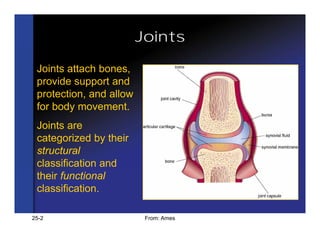
Joints attach bones,
provide support and
protection, and allow
for body movement
for body movement.
Joints are
categorized by their
structural
classification and
their functional
classification.
25-2 From: Ames
Chapter 5 – The Skeletal System
Joints
Joints
• Provide necessary range of motion
Provide necessary range of motion
• Classification based on structure: fibrous,
cartilagenous synovial
cartilagenous, synovial
• Classification based on function:
th (i bl ) hi th
synarthroses (immovable), amphiarthroses
(slightly movable), diarthoses (freely
bl )
movable)
25-3 From: Arora
JOINTS
JOINTS
• Joints are where two or more bones articulate
( )
(move).
• Joints are classified according to how much
movement they allow
movement they allow.
1. Fibrous – these are fixed or immovable joints
such as the cranium sacrum and the coccyx
such as the cranium, sacrum and the coccyx.
2. Cartilaginous – these are slightly movable
joints such as the vertebrae
joints such as the vertebrae.
3. Synovial – these are freely movable joints such
as the shoulder and hip
25-4 From: Essex
as the shoulder and hip.
Cartilaginous joints
• Articulating bones are united by cartilage
Articulating bones are united by cartilage
• Lack a joint cavity
T t h d d
• Two types – synchondroses and
symphyses
25-5 From: Mathis
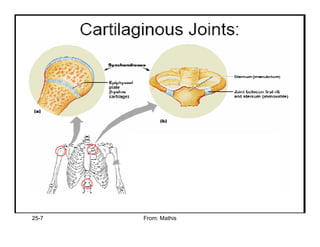
Cartilaginous joints: synchondroses
• A bar or plate of hyaline cartilage unites
A bar or plate of hyaline cartilage unites
the bones
• All synchondroses are synarthrotic
• Examples include:
– Epiphyseal plates of children
– Joint between the costal cartilage of the first
rib and the sternum
25-6 From: Mathis
25-7 From: Mathis
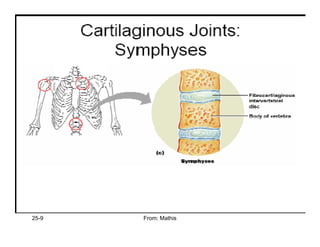
Cartilaginous joints: symphyses
• Hyaline cartilage covers the articulating
Hyaline cartilage covers the articulating
surface of the bone and is fused to an
intervening pad of fibrocartilage
• Amphiarthrotic joints designed for strength
and flexibility
and flexibility
• Examples include intervertebral joints and
th bi h i f th l i
the pubic symphysis of the pelvis
25-8 From: Mathis
25-9 From: Mathis
Synovial Joints
Synovial Joints
• Bone ends separated by a joint cavity
Bone ends separated by a joint cavity
containing synovial fluid
• Most joints of the limbs
• Full range of motion available in most
j i t
joints
25-10 From: Arora
Synovial joints
Synovial joints
• Those joints in which the articulating
Those joints in which the articulating
bones are separated by a fluid-containing
joint cavity
joint cavity
• All are freely movable diarthroses
E l ll li b j i t d t j i t
• Examples – all limb joints, and most joints
of the body
25-11 From: Mathis
Components of synovial joints
• A joint capsule consists of two layers
j p y
– Fibrous capsule holds the ends of the bones
together and allows movement of the joint
Synovial membrane which consists of connective
– Synovial membrane which consists of connective
tissue
• Synovial fluid: combination of materials filtered
y
from blood and secreted by cells of the synovial
membrane
C t i h l i id hi h k th fl id
– Contains hyaluronic acid, which makes the fluid very
slippery
– Lubricant to reduce friction within the joint
25-12 From: Hoxha
• Articular (hyaline) cartilage covers ends
Articular (hyaline) cartilage covers ends
of the bones. Smooth and resilient.
• Joint cavity is a small space bounded by
the synovial membrane and the articular
cartilages It is filled with synovial fluid
cartilages. It is filled with synovial fluid
25-13 From: Hoxha
Structure of synovial joints
• Articular cartilage – hyaline
Articular cartilage hyaline
• Fibrous capsule
J i t it t i i l fl id
• Joint cavity, contains synovial fluid
• Reinforcing ligaments
25-14 From: Arora
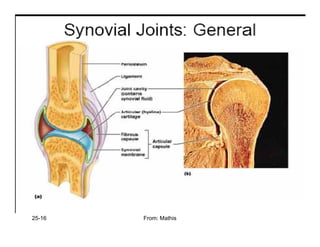
Synovial joints: general structure
• Synovial joints all have the following
Synovial joints all have the following
– Articular cartilage
Joint (synovial) cavity
– Joint (synovial) cavity
– Articular capsule
Synovial fluid
– Synovial fluid
– Reinforcing ligaments
25-15 From: Mathis
25-16 From: Mathis
Synovial joints: friction-reducing
d
and extra structures
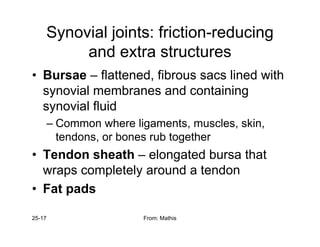
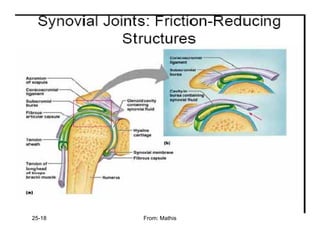
• Bursae – flattened fibrous sacs lined with
Bursae flattened, fibrous sacs lined with
synovial membranes and containing
synovial fluid
synovial fluid
– Common where ligaments, muscles, skin,
tendons or bones rub together
tendons, or bones rub together
• Tendon sheath – elongated bursa that
wraps completely around a tendon
• Fat pads
25-17 From: Mathis
25-18 From: Mathis

Structure and Function of Joints - MyPharmaGuide

  • 1.
    Section 25: Joints– Structure and Function 25-1
  • 2.
    Joints Joints attach bones, providesupport and protection, and allow for body movement for body movement. Joints are categorized by their categorized by their structural classification and their functional classification. 25-2 From: Ames Chapter 5 – The Skeletal System
  • 3.
    Joints Joints • Provide necessaryrange of motion Provide necessary range of motion • Classification based on structure: fibrous, cartilagenous synovial cartilagenous, synovial • Classification based on function: th (i bl ) hi th synarthroses (immovable), amphiarthroses (slightly movable), diarthoses (freely bl ) movable) 25-3 From: Arora
  • 4.
    JOINTS JOINTS • Joints arewhere two or more bones articulate ( ) (move). • Joints are classified according to how much movement they allow movement they allow. 1. Fibrous – these are fixed or immovable joints such as the cranium sacrum and the coccyx such as the cranium, sacrum and the coccyx. 2. Cartilaginous – these are slightly movable joints such as the vertebrae joints such as the vertebrae. 3. Synovial – these are freely movable joints such as the shoulder and hip 25-4 From: Essex as the shoulder and hip.
  • 5.
    Cartilaginous joints Cartilaginous joints •Articulating bones are united by cartilage Articulating bones are united by cartilage • Lack a joint cavity T t h d d • Two types – synchondroses and symphyses 25-5 From: Mathis
  • 6.
    Cartilaginous joints: synchondroses Cartilaginousjoints: synchondroses • A bar or plate of hyaline cartilage unites A bar or plate of hyaline cartilage unites the bones • All synchondroses are synarthrotic • All synchondroses are synarthrotic • Examples include: – Epiphyseal plates of children – Joint between the costal cartilage of the first rib and the sternum 25-6 From: Mathis
  • 7.
  • 8.
    Cartilaginous joints: symphyses Cartilaginousjoints: symphyses • Hyaline cartilage covers the articulating Hyaline cartilage covers the articulating surface of the bone and is fused to an intervening pad of fibrocartilage intervening pad of fibrocartilage • Amphiarthrotic joints designed for strength and flexibility and flexibility • Examples include intervertebral joints and th bi h i f th l i the pubic symphysis of the pelvis 25-8 From: Mathis
  • 9.
  • 10.
    Synovial Joints Synovial Joints •Bone ends separated by a joint cavity Bone ends separated by a joint cavity containing synovial fluid • Most joints of the limbs • Most joints of the limbs • Full range of motion available in most j i t joints 25-10 From: Arora
  • 11.
    Synovial joints Synovial joints •Those joints in which the articulating Those joints in which the articulating bones are separated by a fluid-containing joint cavity joint cavity • All are freely movable diarthroses E l ll li b j i t d t j i t • Examples – all limb joints, and most joints of the body 25-11 From: Mathis
  • 12.
    Components of synovialjoints Components of synovial joints • A joint capsule consists of two layers j p y – Fibrous capsule holds the ends of the bones together and allows movement of the joint Synovial membrane which consists of connective – Synovial membrane which consists of connective tissue • Synovial fluid: combination of materials filtered y from blood and secreted by cells of the synovial membrane C t i h l i id hi h k th fl id – Contains hyaluronic acid, which makes the fluid very slippery – Lubricant to reduce friction within the joint 25-12 From: Hoxha
  • 13.
    • Articular (hyaline)cartilage covers ends Articular (hyaline) cartilage covers ends of the bones. Smooth and resilient. • Joint cavity is a small space bounded by • Joint cavity is a small space bounded by the synovial membrane and the articular cartilages It is filled with synovial fluid cartilages. It is filled with synovial fluid 25-13 From: Hoxha
  • 14.
    Structure of synovialjoints Structure of synovial joints • Articular cartilage – hyaline Articular cartilage hyaline • Fibrous capsule J i t it t i i l fl id • Joint cavity, contains synovial fluid • Reinforcing ligaments 25-14 From: Arora
  • 15.
    Synovial joints: generalstructure Synovial joints: general structure • Synovial joints all have the following Synovial joints all have the following – Articular cartilage Joint (synovial) cavity – Joint (synovial) cavity – Articular capsule Synovial fluid – Synovial fluid – Reinforcing ligaments 25-15 From: Mathis
  • 16.
  • 17.
    Synovial joints: friction-reducing d andextra structures • Bursae – flattened fibrous sacs lined with Bursae flattened, fibrous sacs lined with synovial membranes and containing synovial fluid synovial fluid – Common where ligaments, muscles, skin, tendons or bones rub together tendons, or bones rub together • Tendon sheath – elongated bursa that wraps completely around a tendon wraps completely around a tendon • Fat pads 25-17 From: Mathis
  • 18.