Essentials of Anatomy & Physiology, 4th Edition
Martini/Bartholomew
PowerPoint® Lecture Outlines
prepared by Alan Magid, Duke University
The Cardiovascular
System: The Heart
12
Copyright © 2007 Pearson Education, Inc., publishing as Benjamin Cummings
Slides 1 to 65
Heart’s Place in the Circulation
Heart Pumps Blood into Two Circuits
in Sequence
• Pulmonary circuit
• To and from the lungs
• Systemic circuit
• To and from the rest of the body
Copyright © 2007 Pearson Education, Inc., publishing as Benjamin Cummings
Heart’s Place in the Circulation
Three Kinds of Blood Vessels
• Arteries
• Carry blood away from heart and carry it to
the capillaries
• Capillaries
• Microscopic vessels where exchange
between cells and blood takes place
• Veins
• Receive blood from capillaries and carry it
back to the heart
Copyright © 2007 Pearson Education, Inc., publishing as Benjamin Cummings
Heart’s Place in the Circulation
Two Sets of Pumping Chambers in Heart
• Right atrium
• Receives systemic blood
• Right ventricle
• Pumps blood to lungs (pulmonary)
• Left atrium
• Receives blood from lungs
• Left ventricle
• Pumps blood to organ systems (systemic)
Copyright © 2007 Pearson Education, Inc., publishing as Benjamin Cummings
Heart’s Place in the Circulation
Overview of the
Cardiovascular
System
Figure 12-1
The Anatomy of the Heart
Pericardial Cavity
• Surrounds the heart
• Lined by pericardium
• Two layers
• Visceral pericardium (epicardium)
• Covers heart surface
• Parietal pericardium
• Lines pericardial sac that
surrounds heart
Copyright © 2007 Pearson Education, Inc., publishing as Benjamin Cummings
The Anatomy of the Heart
Figure 12-2
The Location of the Heart in the Thoracic Cavity
The Anatomy of the Heart
Surface Features of the Heart
• Auricle—Outer portion of atrium
• Coronary sulcus—Deep groove that marks
boundary of atria and ventricles
• Anterior interventricular sulcus
• Posterior interventricular sulcus
• Mark boundary between left and right
ventricles
• Sulci contain major cardiac blood vessels
• Filled with protective fat
Copyright © 2007 Pearson Education, Inc., publishing as Benjamin Cummings
The Anatomy of the Heart
The Surface
Anatomy
of the Heart
Figure 12-3(a)
1 of 2
The Anatomy of the Heart
The Surface
Anatomy
of the Heart
Figure 12-3(a)
2 of 2
The Anatomy of the Heart
Figure 12-3(b)
The Surface
Anatomy
of the Heart
The Anatomy of the Heart
The Heart Wall
• Epicardium (visceral pericardium)
• Outermost layer
• Serous membrane
• Myocardium
• Middle layer
• Thick muscle layer
• Endocardium
• Inner lining of pumping chambers
• Continuous with endothelium
Copyright © 2007 Pearson Education, Inc., publishing as Benjamin Cummings
The Anatomy of the Heart
The Heart Wall
and Cardiac
Muscle Tissue
Figure 12-4
The Anatomy of the Heart
The Heart Wall and Cardiac Muscle Tissue
Figure 12-4(a)
The Anatomy of the Heart
Figure 12-4(b)
The Heart Wall
and Cardiac
Muscle Tissue
The Anatomy of the Heart
The Heart Wall and Cardiac Muscle Tissue
Figure 12-4(c)
The Anatomy of the Heart
Figure 12-4(d)
The Heart Wall
and Cardiac
Muscle Tissue
The Anatomy of the Heart
Cardiac Muscle Cells
• Shorter than skeletal muscle fibers
• Have single nucleus
• Have striations (sarcomere organization)
• Depend on aerobic metabolism
• Connected by intercalated discs
• Desmosomes transmit tension
• Gap junctions transmit action potential
Copyright © 2007 Pearson Education, Inc., publishing as Benjamin Cummings
The Anatomy of the Heart
Internal Anatomy and Organization
• Interatrial septum
• Separates atria
• Interventricular septum
• Separates ventricles
• Atrioventricular valves
• Located between atrium and ventricle
• Ensure one-way flow from atrium to
ventricle
Copyright © 2007 Pearson Education, Inc., publishing as Benjamin Cummings
The Anatomy of the Heart
Blood Flow in the Heart
• Superior and inferior venae cavae
• Large veins carry systemic blood to right
atrium
• Right atrium sends blood to right ventricle
• Flows through right AV valve
• Bounded by three cusps (tricuspid valve)
• Cusps anchored by chordae tendinae
• Chordae attached to papillary muscles
Copyright © 2007 Pearson Education, Inc., publishing as Benjamin Cummings
The Anatomy of the Heart
Blood Flow in the Heart (cont’d)
• Right ventricle pumps blood through
pulmonary semilunar valve
• Enters pulmonary trunk
• Flows to lungs through right, left pulmonary
arteries where it picks up oxygen
• Pulmonary veins carry blood to left atrium
• Left atrium sends blood to left ventricle
• Enters through left AV valve (bicuspid or
mitral)
• Left ventricle pumps blood to aorta
• Through aortic semilunar valve to systems
Copyright © 2007 Pearson Education, Inc., publishing as Benjamin Cummings
The Anatomy of the Heart
The Sectional Anatomy of the Heart
Figure 12-5
The Anatomy of the Heart
Functional Anatomy of the Heart
• Left ventricular myocardium much
thicker than right
• Reflects functional difference in load
• Valves ensure one-way flow of blood
• Prevent backward flow (regurgitation)
• Fibrous skeleton supports valves and
muscle cells
Copyright © 2007 Pearson Education, Inc., publishing as Benjamin Cummings
The Anatomy of the Heart
The Valves of the Heart
Figure 12-6(a)
The Anatomy of the Heart
The Valves of the Heart
Figure 12-6(b)
The Heart: Anatomy
PLAY
The Anatomy of the Heart
Key Note
The heart has four chambers, the right
atrium and ventricle with the pulmonary
circuit and left atrium and ventricle with the
systemic circuit. The left ventricle’s greater
workload makes it more massive than the
right, but the two pump equal amounts of
blood. AV valves prevent backflow from
the ventricles into the atria, and semilunar
valves prevent backflow from the outflow
vessels into the ventricles.
Copyright © 2007 Pearson Education, Inc., publishing as Benjamin Cummings
The Anatomy of the Heart
The Blood Supply to the Heart
• Coronary circulation meets heavy demands
of myocardium for oxygen, nutrients
• Coronary arteries (right, left) branch from
aorta base
• Anastomoses (arterial interconnections)
ensure constant blood supply
• Drainage is to right atrium
• Great, middle cardiac veins drain capillaries
• Empty into coronary sinus
Copyright © 2007 Pearson Education, Inc., publishing as Benjamin Cummings
The Anatomy of the Heart
The Coronary Circulation
Figure 12-7(a)
The Anatomy of the Heart
The Coronary Circulation
Figure 12-7(b)
The Heartbeat
Heartbeat Needs two Types of Cardiac
Cells
• Contractile cells
• Provide the pumping action
• Cells of the conducting system
• Generate and spread the action
potential
Copyright © 2007 Pearson Education, Inc., publishing as Benjamin Cummings
The Heartbeat
Differences between Cardiac and
Skeletal Muscle Cells
• Cardiac action potential has long
plateau phase
• Cardiac muscle has long, slow twitch
• Cardiac muscle has long refractory
period
• Can’t be tetanized
Copyright © 2007 Pearson Education, Inc., publishing as Benjamin Cummings
Figure 12-8(a)
1 of 5
Rapid
Depolarization
Cause: Na+ entry
Duration: 3-5 msec
Ends with: Closure of
voltage-regulated
sodium channels
The Plateau
Cause: Ca2+ entry
Duration: ~175 msec
Ends with: Closure of
calcium channels
Repolarization
Cause: K+ loss
Duration: 75 msec
Ends with: Closure of
potassium channels
+30
0
mV
Stimulus
–90
0 100 200 300
Time (msec)
Refractory period
1
1
2
2
3
3
Copyright © 2007 Pearson Education, Inc., publishing as Benjamin Cummings
Figure 12-8(a)
2 of 5
Rapid
Depolarization
Cause: Na+ entry
Duration: 3-5 msec
Ends with: Closure of
voltage-regulated
sodium channels
+30
0
mV
Stimulus
–90
0 100 200 300
Time (msec)
1
1
Copyright © 2007 Pearson Education, Inc., publishing as Benjamin Cummings
Figure 12-8(a)
3 of 5
Rapid
Depolarization
Cause: Na+ entry
Duration: 3-5 msec
Ends with: Closure of
voltage-regulated
sodium channels
The Plateau
Cause: Ca2+ entry
Duration: ~175 msec
Ends with: Closure of
calcium channels
+30
0
mV
Stimulus
–90
0 100 200 300
Time (msec)
1
1
2
2
Copyright © 2007 Pearson Education, Inc., publishing as Benjamin Cummings
Figure 12-8(a)
4 of 5
Rapid
Depolarization
Cause: Na+ entry
Duration: 3-5 msec
Ends with: Closure of
voltage-regulated
sodium channels
The Plateau
Cause: Ca2+ entry
Duration: ~175 msec
Ends with: Closure of
calcium channels
Repolarization
Cause: K+ loss
Duration: 75 msec
Ends with: Closure of
potassium channels
+30
0
mV
Stimulus
–90
0 100 200 300
Time (msec)
1
1
2
2
3
3
Copyright © 2007 Pearson Education, Inc., publishing as Benjamin Cummings
Figure 12-8(a)
5 of 5
Rapid
Depolarization
Cause: Na+ entry
Duration: 3-5 msec
Ends with: Closure of
voltage-regulated
sodium channels
The Plateau
Cause: Ca2+ entry
Duration: ~175 msec
Ends with: Closure of
calcium channels
Repolarization
Cause: K+ loss
Duration: 75 msec
Ends with: Closure of
potassium channels
+30
0
mV
Stimulus
–90
0 100 200 300
Time (msec)
Refractory period
1
1
2
2
3
3
Copyright © 2007 Pearson Education, Inc., publishing as Benjamin Cummings
The Heartbeat
Action Potentials and
Muscle Cell
Contraction in Skeletal
and Cardiac Muscle
Figure 12-8(b)
The Heartbeat
The Conducting System
• Initiates and spreads electrical impulses
in heart
• Two types of cells
• Nodal cells
• Pacemaker cells
Reach threshold first
Set heart rate
• Conducting cells
• Distributes stimuli to myocardium
Copyright © 2007 Pearson Education, Inc., publishing as Benjamin Cummings
The Heartbeat
The Conducting System (cont’d)
• Heart is self-exciting
• Pacemaker cells establish heart rate
• Normal pacemaker is sinoatrial (SA)
node
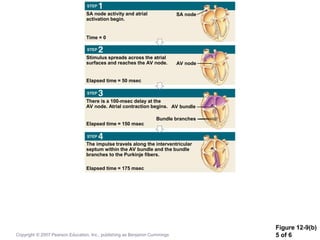
• Impulse spreads from SA node:
• Across atria
• To atrioventricular (AV) node
• To AV bundle and bundle branches
• Via Purkinje fibers to ventricles
Copyright © 2007 Pearson Education, Inc., publishing as Benjamin Cummings
The Heartbeat
Figure 12-9(a)
The Conducting
System of the
Heart
The Heart:
Conduction System
PLAY
Figure 12-9(b)
1 of 6
SA node activity and atrial
activation begin.
Stimulus spreads across the atrial
surfaces and reaches the AV node.
There is a 100-msec delay at the
AV node. Atrial contraction begins.
The impulse travels along the interventricular
septum within the AV bundle and the bundle
branches to the Purkinje fibers.
The impulse is distributed by Purkinje fibers
and relayed throughout the ventricular
myocardium. Atrial contraction is completed,
and ventricular contraction begins.
Time = 0
SA node
AV node
Elapsed time = 50 msec
Elapsed time = 150 msec
AV bundle
Bundle branches
Elapsed time = 175 msec
Elapsed time = 225 msec Purkinje fibers
Copyright © 2007 Pearson Education, Inc., publishing as Benjamin Cummings
Figure 12-9(b)
2 of 6
SA node activity and atrial
activation begin.
Time = 0
SA node
Copyright © 2007 Pearson Education, Inc., publishing as Benjamin Cummings
Figure 12-9(b)
3 of 6
SA node activity and atrial
activation begin.
Stimulus spreads across the atrial
surfaces and reaches the AV node.
Time = 0
SA node
AV node
Elapsed time = 50 msec
Copyright © 2007 Pearson Education, Inc., publishing as Benjamin Cummings
Figure 12-9(b)
4 of 6
SA node activity and atrial
activation begin.
Stimulus spreads across the atrial
surfaces and reaches the AV node.
There is a 100-msec delay at the
AV node. Atrial contraction begins.
Time = 0
SA node
AV node
Elapsed time = 50 msec
Elapsed time = 150 msec
AV bundle
Bundle branches
Copyright © 2007 Pearson Education, Inc., publishing as Benjamin Cummings
Figure 12-9(b)
5 of 6
SA node activity and atrial
activation begin.
Stimulus spreads across the atrial
surfaces and reaches the AV node.
There is a 100-msec delay at the
AV node. Atrial contraction begins.
The impulse travels along the interventricular
septum within the AV bundle and the bundle
branches to the Purkinje fibers.
Time = 0
SA node
AV node
Elapsed time = 50 msec
Elapsed time = 150 msec
AV bundle
Bundle branches
Elapsed time = 175 msec
Copyright © 2007 Pearson Education, Inc., publishing as Benjamin Cummings
Figure 12-9(b)
6 of 6
SA node activity and atrial
activation begin.
Stimulus spreads across the atrial
surfaces and reaches the AV node.
There is a 100-msec delay at the
AV node. Atrial contraction begins.
The impulse travels along the interventricular
septum within the AV bundle and the bundle
branches to the Purkinje fibers.
The impulse is distributed by Purkinje fibers
and relayed throughout the ventricular
myocardium. Atrial contraction is completed,
and ventricular contraction begins.
Time = 0
SA node
AV node
Elapsed time = 50 msec
Elapsed time = 150 msec
AV bundle
Bundle branches
Elapsed time = 175 msec
Elapsed time = 225 msec Purkinje fibers
Copyright © 2007 Pearson Education, Inc., publishing as Benjamin Cummings
The Heartbeat
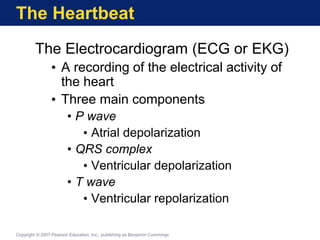
The Electrocardiogram (ECG or EKG)
• A recording of the electrical activity of
the heart
• Three main components
• P wave
• Atrial depolarization
• QRS complex
• Ventricular depolarization
• T wave
• Ventricular repolarization
Copyright © 2007 Pearson Education, Inc., publishing as Benjamin Cummings
The Heartbeat
Figure 12-10
An Electrocardiogram
The Heartbeat
Key Note
The heart rate is established by the SA
node, as modified by autonomic activity,
hormones, ions, etc. From there, the
stimulus is conducted through the atrium
to the AV node, the AV bundle, the
bundle branches, and Purkinje fibers to
the ventricular myocardium. The ECG
shows the electrical events associated
with the heartbeat.
Copyright © 2007 Pearson Education, Inc., publishing as Benjamin Cummings
The Heartbeat
The Cardiac Cycle
• Two phases in cardiac cycle
• Systole
• Contraction phase
• Both ventricles simultaneously
• Diastole
• Relaxation phase
Copyright © 2007 Pearson Education, Inc., publishing as Benjamin Cummings
Figure 12-11
1 of 6
START
(f) Ventricular diastole—late:
All chambers are relaxed.
Ventricles fill passively.
(e) Ventricular diastole—early:
As ventricles relax, pressure
in ventricles drops; blood
flows back against cusps of
semilunar valves and forces
them closed. Blood flows
into the relaxed atria.
(a) Atriole systole begins:
Atrial contraction forces
a small amount of additional
blood into relaxed ventricles.
(b) Atriole systole ends
atrial diastole begins
(c) Ventricular systole—
first phase: Ventricular
contraction pushes AV
valves closed but does
not create enough pressure
to open semilunar valves.
(d) Ventricular systole—
second phase: As ventricular
pressure rises and exceeds
pressure in the arteries, the
semilunar valves open and
blood is ejected.
370
msec
100
msec
0
msec
800
msec
Cardiac
cycle
Copyright © 2007 Pearson Education, Inc., publishing as Benjamin Cummings
Figure 12-11
2 of 6
START
(a) Atriole systole begins:
Atrial contraction forces
a small amount of additional
blood into relaxed ventricles.
100
msec
0
msec
Cardiac
cycle
Copyright © 2007 Pearson Education, Inc., publishing as Benjamin Cummings
Figure 12-11
3 of 6
START
(a) Atriole systole begins:
Atrial contraction forces
a small amount of additional
blood into relaxed ventricles.
(b) Atriole systole ends
atrial diastole begins
(c) Ventricular systole—
first phase: Ventricular
contraction pushes AV
valves closed but does
not create enough pressure
to open semilunar valves.
100
msec
0
msec
Cardiac
cycle
Copyright © 2007 Pearson Education, Inc., publishing as Benjamin Cummings
Figure 12-11
4 of 6
START
(a) Atriole systole begins:
Atrial contraction forces
a small amount of additional
blood into relaxed ventricles.
(b) Atriole systole ends
atrial diastole begins
(c) Ventricular systole—
first phase: Ventricular
contraction pushes AV
valves closed but does
not create enough pressure
to open semilunar valves.
(d) Ventricular systole—
second phase: As ventricular
pressure rises and exceeds
pressure in the arteries, the
semilunar valves open and
blood is ejected.
370
msec
100
msec
0
msec
Cardiac
cycle
Copyright © 2007 Pearson Education, Inc., publishing as Benjamin Cummings
Figure 12-11
5 of 6
START
(e) Ventricular diastole—early:
As ventricles relax, pressure
in ventricles drops; blood
flows back against cusps of
semilunar valves and forces
them closed. Blood flows
into the relaxed atria.
(a) Atriole systole begins:
Atrial contraction forces
a small amount of additional
blood into relaxed ventricles.
(b) Atriole systole ends
atrial diastole begins
(c) Ventricular systole—
first phase: Ventricular
contraction pushes AV
valves closed but does
not create enough pressure
to open semilunar valves.
(d) Ventricular systole—
second phase: As ventricular
pressure rises and exceeds
pressure in the arteries, the
semilunar valves open and
blood is ejected.
370
msec
100
msec
0
msec
Cardiac
cycle
Copyright © 2007 Pearson Education, Inc., publishing as Benjamin Cummings
Figure 12-11
6 of 6
START
(f) Ventricular diastole—late:
All chambers are relaxed.
Ventricles fill passively.
(e) Ventricular diastole—early:
As ventricles relax, pressure
in ventricles drops; blood
flows back against cusps of
semilunar valves and forces
them closed. Blood flows
into the relaxed atria.
(a) Atriole systole begins:
Atrial contraction forces
a small amount of additional
blood into relaxed ventricles.
(b) Atriole systole ends
atrial diastole begins
(c) Ventricular systole—
first phase: Ventricular
contraction pushes AV
valves closed but does
not create enough pressure
to open semilunar valves.
(d) Ventricular systole—
second phase: As ventricular
pressure rises and exceeds
pressure in the arteries, the
semilunar valves open and
blood is ejected.
370
msec
100
msec
0
msec
800
msec
Cardiac
cycle
Copyright © 2007 Pearson Education, Inc., publishing as Benjamin Cummings
The Heartbeat
Heart Sounds
• Generated by closing of valves
• Two main heart sounds
• First sound (lubb)
• Closing of AV valve
• Second sound (dupp)
• Closing of aortic valve
• Indicate start/stop of systole
• Heard with stethoscope
Copyright © 2007 Pearson Education, Inc., publishing as Benjamin Cummings
Heart Dynamics
Some Essential Definitions
• Heart dynamics—Movements and
forces generated during cardiac
contraction
• Stroke volume—Amount of blood
pumped in a single beat
• Cardiac output—Amount of blood
pumped each minute
Copyright © 2007 Pearson Education, Inc., publishing as Benjamin Cummings
Heart Dynamics
Factors Controlling Cardiac Output
• Blood volume reflexes
• Autonomic innervation
• Heart rate effects
• Stroke volume effects
• Hormones
Copyright © 2007 Pearson Education, Inc., publishing as Benjamin Cummings
Heart Dynamics
Blood Volume Reflexes
• Stimulated by changes in venous return
• VR is amount of blood entering heart
• Atrial reflex
• Speeds up heart rate
• Triggered by stretching wall of right atrium
• Frank-Starling principle
• Increases ventricular output
• Triggered by stretching wall of ventricles
Copyright © 2007 Pearson Education, Inc., publishing as Benjamin Cummings
Heart Dynamics
Autonomic Control of the Heart
• Parasympathetic innervation
• Releases acetylcholine (ACh)
• Lowers heart rate and stroke volume
• Sympathetic innervation
• Releases norepinephrine (NE)
• Raises heart rate and stroke volume
Copyright © 2007 Pearson Education, Inc., publishing as Benjamin Cummings
Heart Dynamics
Autonomic
Innervation of the
Heart
Figure 12-12
Heart Dynamics
Hormone Effects on Cardiac Output
• Adrenal medulla hormones
• Epinephrine, norepinephrine released
• Heart rate and stroke volume increased
• Other hormones that increase output
• Thyroid hormones
• Glucagon
Copyright © 2007 Pearson Education, Inc., publishing as Benjamin Cummings
Heart Dynamics
CNS Control of the Heart
• Basic control in medulla oblongata
• Cardioacceleratory center
• Activation of sympathetic neurons
• Cardioinhibitory center
• Governing of parasympathetic neurons
• Other inputs
• Higher centers
• Blood pressure sensors
• Oxygen, carbon dioxide sensors
Copyright © 2007 Pearson Education, Inc., publishing as Benjamin Cummings
Heart Dynamics
Key Note
Cardiac output is the amount of blood
pumped by the left ventricle each minute.
It is adjusted moment-to-moment by the
ANS, and by circulating hormones,
changes in blood volume and in venous
return. A healthy person can increase
cardiac output by three-fold to five-fold.
Copyright © 2007 Pearson Education, Inc., publishing as Benjamin Cummings

Cardiovascular System - MyPharmaGuide

  • 1.
    Essentials of Anatomy& Physiology, 4th Edition Martini/Bartholomew PowerPoint® Lecture Outlines prepared by Alan Magid, Duke University The Cardiovascular System: The Heart 12 Copyright © 2007 Pearson Education, Inc., publishing as Benjamin Cummings Slides 1 to 65
  • 2.
    Heart’s Place inthe Circulation Heart Pumps Blood into Two Circuits in Sequence • Pulmonary circuit • To and from the lungs • Systemic circuit • To and from the rest of the body Copyright © 2007 Pearson Education, Inc., publishing as Benjamin Cummings
  • 3.
    Heart’s Place inthe Circulation Three Kinds of Blood Vessels • Arteries • Carry blood away from heart and carry it to the capillaries • Capillaries • Microscopic vessels where exchange between cells and blood takes place • Veins • Receive blood from capillaries and carry it back to the heart Copyright © 2007 Pearson Education, Inc., publishing as Benjamin Cummings
  • 4.
    Heart’s Place inthe Circulation Two Sets of Pumping Chambers in Heart • Right atrium • Receives systemic blood • Right ventricle • Pumps blood to lungs (pulmonary) • Left atrium • Receives blood from lungs • Left ventricle • Pumps blood to organ systems (systemic) Copyright © 2007 Pearson Education, Inc., publishing as Benjamin Cummings
  • 5.
    Heart’s Place inthe Circulation Overview of the Cardiovascular System Figure 12-1
  • 6.
    The Anatomy ofthe Heart Pericardial Cavity • Surrounds the heart • Lined by pericardium • Two layers • Visceral pericardium (epicardium) • Covers heart surface • Parietal pericardium • Lines pericardial sac that surrounds heart Copyright © 2007 Pearson Education, Inc., publishing as Benjamin Cummings
  • 7.
    The Anatomy ofthe Heart Figure 12-2 The Location of the Heart in the Thoracic Cavity
  • 8.
    The Anatomy ofthe Heart Surface Features of the Heart • Auricle—Outer portion of atrium • Coronary sulcus—Deep groove that marks boundary of atria and ventricles • Anterior interventricular sulcus • Posterior interventricular sulcus • Mark boundary between left and right ventricles • Sulci contain major cardiac blood vessels • Filled with protective fat Copyright © 2007 Pearson Education, Inc., publishing as Benjamin Cummings
  • 9.
    The Anatomy ofthe Heart The Surface Anatomy of the Heart Figure 12-3(a) 1 of 2
  • 10.
    The Anatomy ofthe Heart The Surface Anatomy of the Heart Figure 12-3(a) 2 of 2
  • 11.
    The Anatomy ofthe Heart Figure 12-3(b) The Surface Anatomy of the Heart
  • 12.
    The Anatomy ofthe Heart The Heart Wall • Epicardium (visceral pericardium) • Outermost layer • Serous membrane • Myocardium • Middle layer • Thick muscle layer • Endocardium • Inner lining of pumping chambers • Continuous with endothelium Copyright © 2007 Pearson Education, Inc., publishing as Benjamin Cummings
  • 13.
    The Anatomy ofthe Heart The Heart Wall and Cardiac Muscle Tissue Figure 12-4
  • 14.
    The Anatomy ofthe Heart The Heart Wall and Cardiac Muscle Tissue Figure 12-4(a)
  • 15.
    The Anatomy ofthe Heart Figure 12-4(b) The Heart Wall and Cardiac Muscle Tissue
  • 16.
    The Anatomy ofthe Heart The Heart Wall and Cardiac Muscle Tissue Figure 12-4(c)
  • 17.
    The Anatomy ofthe Heart Figure 12-4(d) The Heart Wall and Cardiac Muscle Tissue
  • 18.
    The Anatomy ofthe Heart Cardiac Muscle Cells • Shorter than skeletal muscle fibers • Have single nucleus • Have striations (sarcomere organization) • Depend on aerobic metabolism • Connected by intercalated discs • Desmosomes transmit tension • Gap junctions transmit action potential Copyright © 2007 Pearson Education, Inc., publishing as Benjamin Cummings
  • 19.
    The Anatomy ofthe Heart Internal Anatomy and Organization • Interatrial septum • Separates atria • Interventricular septum • Separates ventricles • Atrioventricular valves • Located between atrium and ventricle • Ensure one-way flow from atrium to ventricle Copyright © 2007 Pearson Education, Inc., publishing as Benjamin Cummings
  • 20.
    The Anatomy ofthe Heart Blood Flow in the Heart • Superior and inferior venae cavae • Large veins carry systemic blood to right atrium • Right atrium sends blood to right ventricle • Flows through right AV valve • Bounded by three cusps (tricuspid valve) • Cusps anchored by chordae tendinae • Chordae attached to papillary muscles Copyright © 2007 Pearson Education, Inc., publishing as Benjamin Cummings
  • 21.
    The Anatomy ofthe Heart Blood Flow in the Heart (cont’d) • Right ventricle pumps blood through pulmonary semilunar valve • Enters pulmonary trunk • Flows to lungs through right, left pulmonary arteries where it picks up oxygen • Pulmonary veins carry blood to left atrium • Left atrium sends blood to left ventricle • Enters through left AV valve (bicuspid or mitral) • Left ventricle pumps blood to aorta • Through aortic semilunar valve to systems Copyright © 2007 Pearson Education, Inc., publishing as Benjamin Cummings
  • 22.
    The Anatomy ofthe Heart The Sectional Anatomy of the Heart Figure 12-5
  • 23.
    The Anatomy ofthe Heart Functional Anatomy of the Heart • Left ventricular myocardium much thicker than right • Reflects functional difference in load • Valves ensure one-way flow of blood • Prevent backward flow (regurgitation) • Fibrous skeleton supports valves and muscle cells Copyright © 2007 Pearson Education, Inc., publishing as Benjamin Cummings
  • 24.
    The Anatomy ofthe Heart The Valves of the Heart Figure 12-6(a)
  • 25.
    The Anatomy ofthe Heart The Valves of the Heart Figure 12-6(b) The Heart: Anatomy PLAY
  • 26.
    The Anatomy ofthe Heart Key Note The heart has four chambers, the right atrium and ventricle with the pulmonary circuit and left atrium and ventricle with the systemic circuit. The left ventricle’s greater workload makes it more massive than the right, but the two pump equal amounts of blood. AV valves prevent backflow from the ventricles into the atria, and semilunar valves prevent backflow from the outflow vessels into the ventricles. Copyright © 2007 Pearson Education, Inc., publishing as Benjamin Cummings
  • 27.
    The Anatomy ofthe Heart The Blood Supply to the Heart • Coronary circulation meets heavy demands of myocardium for oxygen, nutrients • Coronary arteries (right, left) branch from aorta base • Anastomoses (arterial interconnections) ensure constant blood supply • Drainage is to right atrium • Great, middle cardiac veins drain capillaries • Empty into coronary sinus Copyright © 2007 Pearson Education, Inc., publishing as Benjamin Cummings
  • 28.
    The Anatomy ofthe Heart The Coronary Circulation Figure 12-7(a)
  • 29.
    The Anatomy ofthe Heart The Coronary Circulation Figure 12-7(b)
  • 30.
    The Heartbeat Heartbeat Needstwo Types of Cardiac Cells • Contractile cells • Provide the pumping action • Cells of the conducting system • Generate and spread the action potential Copyright © 2007 Pearson Education, Inc., publishing as Benjamin Cummings
  • 31.
    The Heartbeat Differences betweenCardiac and Skeletal Muscle Cells • Cardiac action potential has long plateau phase • Cardiac muscle has long, slow twitch • Cardiac muscle has long refractory period • Can’t be tetanized Copyright © 2007 Pearson Education, Inc., publishing as Benjamin Cummings
  • 32.
    Figure 12-8(a) 1 of5 Rapid Depolarization Cause: Na+ entry Duration: 3-5 msec Ends with: Closure of voltage-regulated sodium channels The Plateau Cause: Ca2+ entry Duration: ~175 msec Ends with: Closure of calcium channels Repolarization Cause: K+ loss Duration: 75 msec Ends with: Closure of potassium channels +30 0 mV Stimulus –90 0 100 200 300 Time (msec) Refractory period 1 1 2 2 3 3 Copyright © 2007 Pearson Education, Inc., publishing as Benjamin Cummings
  • 33.
    Figure 12-8(a) 2 of5 Rapid Depolarization Cause: Na+ entry Duration: 3-5 msec Ends with: Closure of voltage-regulated sodium channels +30 0 mV Stimulus –90 0 100 200 300 Time (msec) 1 1 Copyright © 2007 Pearson Education, Inc., publishing as Benjamin Cummings
  • 34.
    Figure 12-8(a) 3 of5 Rapid Depolarization Cause: Na+ entry Duration: 3-5 msec Ends with: Closure of voltage-regulated sodium channels The Plateau Cause: Ca2+ entry Duration: ~175 msec Ends with: Closure of calcium channels +30 0 mV Stimulus –90 0 100 200 300 Time (msec) 1 1 2 2 Copyright © 2007 Pearson Education, Inc., publishing as Benjamin Cummings
  • 35.
    Figure 12-8(a) 4 of5 Rapid Depolarization Cause: Na+ entry Duration: 3-5 msec Ends with: Closure of voltage-regulated sodium channels The Plateau Cause: Ca2+ entry Duration: ~175 msec Ends with: Closure of calcium channels Repolarization Cause: K+ loss Duration: 75 msec Ends with: Closure of potassium channels +30 0 mV Stimulus –90 0 100 200 300 Time (msec) 1 1 2 2 3 3 Copyright © 2007 Pearson Education, Inc., publishing as Benjamin Cummings
  • 36.
    Figure 12-8(a) 5 of5 Rapid Depolarization Cause: Na+ entry Duration: 3-5 msec Ends with: Closure of voltage-regulated sodium channels The Plateau Cause: Ca2+ entry Duration: ~175 msec Ends with: Closure of calcium channels Repolarization Cause: K+ loss Duration: 75 msec Ends with: Closure of potassium channels +30 0 mV Stimulus –90 0 100 200 300 Time (msec) Refractory period 1 1 2 2 3 3 Copyright © 2007 Pearson Education, Inc., publishing as Benjamin Cummings
  • 37.
    The Heartbeat Action Potentialsand Muscle Cell Contraction in Skeletal and Cardiac Muscle Figure 12-8(b)
  • 38.
    The Heartbeat The ConductingSystem • Initiates and spreads electrical impulses in heart • Two types of cells • Nodal cells • Pacemaker cells Reach threshold first Set heart rate • Conducting cells • Distributes stimuli to myocardium Copyright © 2007 Pearson Education, Inc., publishing as Benjamin Cummings
  • 39.
    The Heartbeat The ConductingSystem (cont’d) • Heart is self-exciting • Pacemaker cells establish heart rate • Normal pacemaker is sinoatrial (SA) node • Impulse spreads from SA node: • Across atria • To atrioventricular (AV) node • To AV bundle and bundle branches • Via Purkinje fibers to ventricles Copyright © 2007 Pearson Education, Inc., publishing as Benjamin Cummings
  • 40.
    The Heartbeat Figure 12-9(a) TheConducting System of the Heart The Heart: Conduction System PLAY
  • 41.
    Figure 12-9(b) 1 of6 SA node activity and atrial activation begin. Stimulus spreads across the atrial surfaces and reaches the AV node. There is a 100-msec delay at the AV node. Atrial contraction begins. The impulse travels along the interventricular septum within the AV bundle and the bundle branches to the Purkinje fibers. The impulse is distributed by Purkinje fibers and relayed throughout the ventricular myocardium. Atrial contraction is completed, and ventricular contraction begins. Time = 0 SA node AV node Elapsed time = 50 msec Elapsed time = 150 msec AV bundle Bundle branches Elapsed time = 175 msec Elapsed time = 225 msec Purkinje fibers Copyright © 2007 Pearson Education, Inc., publishing as Benjamin Cummings
  • 42.
    Figure 12-9(b) 2 of6 SA node activity and atrial activation begin. Time = 0 SA node Copyright © 2007 Pearson Education, Inc., publishing as Benjamin Cummings
  • 43.
    Figure 12-9(b) 3 of6 SA node activity and atrial activation begin. Stimulus spreads across the atrial surfaces and reaches the AV node. Time = 0 SA node AV node Elapsed time = 50 msec Copyright © 2007 Pearson Education, Inc., publishing as Benjamin Cummings
  • 44.
    Figure 12-9(b) 4 of6 SA node activity and atrial activation begin. Stimulus spreads across the atrial surfaces and reaches the AV node. There is a 100-msec delay at the AV node. Atrial contraction begins. Time = 0 SA node AV node Elapsed time = 50 msec Elapsed time = 150 msec AV bundle Bundle branches Copyright © 2007 Pearson Education, Inc., publishing as Benjamin Cummings
  • 45.
    Figure 12-9(b) 5 of6 SA node activity and atrial activation begin. Stimulus spreads across the atrial surfaces and reaches the AV node. There is a 100-msec delay at the AV node. Atrial contraction begins. The impulse travels along the interventricular septum within the AV bundle and the bundle branches to the Purkinje fibers. Time = 0 SA node AV node Elapsed time = 50 msec Elapsed time = 150 msec AV bundle Bundle branches Elapsed time = 175 msec Copyright © 2007 Pearson Education, Inc., publishing as Benjamin Cummings
  • 46.
    Figure 12-9(b) 6 of6 SA node activity and atrial activation begin. Stimulus spreads across the atrial surfaces and reaches the AV node. There is a 100-msec delay at the AV node. Atrial contraction begins. The impulse travels along the interventricular septum within the AV bundle and the bundle branches to the Purkinje fibers. The impulse is distributed by Purkinje fibers and relayed throughout the ventricular myocardium. Atrial contraction is completed, and ventricular contraction begins. Time = 0 SA node AV node Elapsed time = 50 msec Elapsed time = 150 msec AV bundle Bundle branches Elapsed time = 175 msec Elapsed time = 225 msec Purkinje fibers Copyright © 2007 Pearson Education, Inc., publishing as Benjamin Cummings
  • 47.
    The Heartbeat The Electrocardiogram(ECG or EKG) • A recording of the electrical activity of the heart • Three main components • P wave • Atrial depolarization • QRS complex • Ventricular depolarization • T wave • Ventricular repolarization Copyright © 2007 Pearson Education, Inc., publishing as Benjamin Cummings
  • 48.
  • 49.
    The Heartbeat Key Note Theheart rate is established by the SA node, as modified by autonomic activity, hormones, ions, etc. From there, the stimulus is conducted through the atrium to the AV node, the AV bundle, the bundle branches, and Purkinje fibers to the ventricular myocardium. The ECG shows the electrical events associated with the heartbeat. Copyright © 2007 Pearson Education, Inc., publishing as Benjamin Cummings
  • 50.
    The Heartbeat The CardiacCycle • Two phases in cardiac cycle • Systole • Contraction phase • Both ventricles simultaneously • Diastole • Relaxation phase Copyright © 2007 Pearson Education, Inc., publishing as Benjamin Cummings
  • 51.
    Figure 12-11 1 of6 START (f) Ventricular diastole—late: All chambers are relaxed. Ventricles fill passively. (e) Ventricular diastole—early: As ventricles relax, pressure in ventricles drops; blood flows back against cusps of semilunar valves and forces them closed. Blood flows into the relaxed atria. (a) Atriole systole begins: Atrial contraction forces a small amount of additional blood into relaxed ventricles. (b) Atriole systole ends atrial diastole begins (c) Ventricular systole— first phase: Ventricular contraction pushes AV valves closed but does not create enough pressure to open semilunar valves. (d) Ventricular systole— second phase: As ventricular pressure rises and exceeds pressure in the arteries, the semilunar valves open and blood is ejected. 370 msec 100 msec 0 msec 800 msec Cardiac cycle Copyright © 2007 Pearson Education, Inc., publishing as Benjamin Cummings
  • 52.
    Figure 12-11 2 of6 START (a) Atriole systole begins: Atrial contraction forces a small amount of additional blood into relaxed ventricles. 100 msec 0 msec Cardiac cycle Copyright © 2007 Pearson Education, Inc., publishing as Benjamin Cummings
  • 53.
    Figure 12-11 3 of6 START (a) Atriole systole begins: Atrial contraction forces a small amount of additional blood into relaxed ventricles. (b) Atriole systole ends atrial diastole begins (c) Ventricular systole— first phase: Ventricular contraction pushes AV valves closed but does not create enough pressure to open semilunar valves. 100 msec 0 msec Cardiac cycle Copyright © 2007 Pearson Education, Inc., publishing as Benjamin Cummings
  • 54.
    Figure 12-11 4 of6 START (a) Atriole systole begins: Atrial contraction forces a small amount of additional blood into relaxed ventricles. (b) Atriole systole ends atrial diastole begins (c) Ventricular systole— first phase: Ventricular contraction pushes AV valves closed but does not create enough pressure to open semilunar valves. (d) Ventricular systole— second phase: As ventricular pressure rises and exceeds pressure in the arteries, the semilunar valves open and blood is ejected. 370 msec 100 msec 0 msec Cardiac cycle Copyright © 2007 Pearson Education, Inc., publishing as Benjamin Cummings
  • 55.
    Figure 12-11 5 of6 START (e) Ventricular diastole—early: As ventricles relax, pressure in ventricles drops; blood flows back against cusps of semilunar valves and forces them closed. Blood flows into the relaxed atria. (a) Atriole systole begins: Atrial contraction forces a small amount of additional blood into relaxed ventricles. (b) Atriole systole ends atrial diastole begins (c) Ventricular systole— first phase: Ventricular contraction pushes AV valves closed but does not create enough pressure to open semilunar valves. (d) Ventricular systole— second phase: As ventricular pressure rises and exceeds pressure in the arteries, the semilunar valves open and blood is ejected. 370 msec 100 msec 0 msec Cardiac cycle Copyright © 2007 Pearson Education, Inc., publishing as Benjamin Cummings
  • 56.
    Figure 12-11 6 of6 START (f) Ventricular diastole—late: All chambers are relaxed. Ventricles fill passively. (e) Ventricular diastole—early: As ventricles relax, pressure in ventricles drops; blood flows back against cusps of semilunar valves and forces them closed. Blood flows into the relaxed atria. (a) Atriole systole begins: Atrial contraction forces a small amount of additional blood into relaxed ventricles. (b) Atriole systole ends atrial diastole begins (c) Ventricular systole— first phase: Ventricular contraction pushes AV valves closed but does not create enough pressure to open semilunar valves. (d) Ventricular systole— second phase: As ventricular pressure rises and exceeds pressure in the arteries, the semilunar valves open and blood is ejected. 370 msec 100 msec 0 msec 800 msec Cardiac cycle Copyright © 2007 Pearson Education, Inc., publishing as Benjamin Cummings
  • 57.
    The Heartbeat Heart Sounds •Generated by closing of valves • Two main heart sounds • First sound (lubb) • Closing of AV valve • Second sound (dupp) • Closing of aortic valve • Indicate start/stop of systole • Heard with stethoscope Copyright © 2007 Pearson Education, Inc., publishing as Benjamin Cummings
  • 58.
    Heart Dynamics Some EssentialDefinitions • Heart dynamics—Movements and forces generated during cardiac contraction • Stroke volume—Amount of blood pumped in a single beat • Cardiac output—Amount of blood pumped each minute Copyright © 2007 Pearson Education, Inc., publishing as Benjamin Cummings
  • 59.
    Heart Dynamics Factors ControllingCardiac Output • Blood volume reflexes • Autonomic innervation • Heart rate effects • Stroke volume effects • Hormones Copyright © 2007 Pearson Education, Inc., publishing as Benjamin Cummings
  • 60.
    Heart Dynamics Blood VolumeReflexes • Stimulated by changes in venous return • VR is amount of blood entering heart • Atrial reflex • Speeds up heart rate • Triggered by stretching wall of right atrium • Frank-Starling principle • Increases ventricular output • Triggered by stretching wall of ventricles Copyright © 2007 Pearson Education, Inc., publishing as Benjamin Cummings
  • 61.
    Heart Dynamics Autonomic Controlof the Heart • Parasympathetic innervation • Releases acetylcholine (ACh) • Lowers heart rate and stroke volume • Sympathetic innervation • Releases norepinephrine (NE) • Raises heart rate and stroke volume Copyright © 2007 Pearson Education, Inc., publishing as Benjamin Cummings
  • 62.
  • 63.
    Heart Dynamics Hormone Effectson Cardiac Output • Adrenal medulla hormones • Epinephrine, norepinephrine released • Heart rate and stroke volume increased • Other hormones that increase output • Thyroid hormones • Glucagon Copyright © 2007 Pearson Education, Inc., publishing as Benjamin Cummings
  • 64.
    Heart Dynamics CNS Controlof the Heart • Basic control in medulla oblongata • Cardioacceleratory center • Activation of sympathetic neurons • Cardioinhibitory center • Governing of parasympathetic neurons • Other inputs • Higher centers • Blood pressure sensors • Oxygen, carbon dioxide sensors Copyright © 2007 Pearson Education, Inc., publishing as Benjamin Cummings
  • 65.
    Heart Dynamics Key Note Cardiacoutput is the amount of blood pumped by the left ventricle each minute. It is adjusted moment-to-moment by the ANS, and by circulating hormones, changes in blood volume and in venous return. A healthy person can increase cardiac output by three-fold to five-fold. Copyright © 2007 Pearson Education, Inc., publishing as Benjamin Cummings