SKLETAL SYSTEM
N A M E – O M PAT E L
R E G N O . – 1 1 9 0 1 3 7 0
R O L L N O . – 1 1
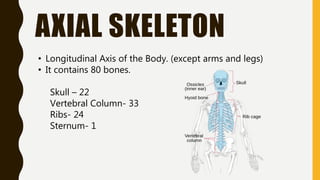
AXIAL SKELETON
• Longitudinal Axis of the Body. (except arms and legs)
• It contains 80 bones.
Skull – 22
Vertebral Column- 33
Ribs- 24
Sternum- 1
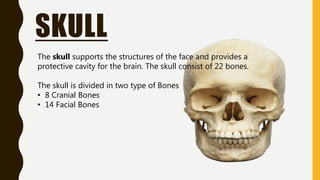
SKULL
The skull supports the structures of the face and provides a
protective cavity for the brain. The skull consist of 22 bones.
The skull is divided in two type of Bones
• 8 Cranial Bones
• 14 Facial Bones
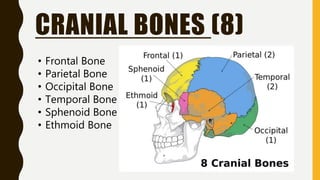
CRANIAL BONES (8)
• Frontal Bone
• Parietal Bone
• Occipital Bone
• Temporal Bone
• Sphenoid Bone
• Ethmoid Bone
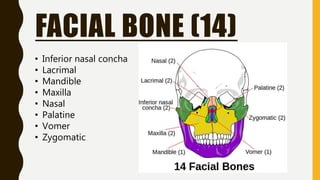
FACIAL BONE (14)
• Inferior nasal concha
• Lacrimal
• Mandible
• Maxilla
• Nasal
• Palatine
• Vomer
• Zygomatic
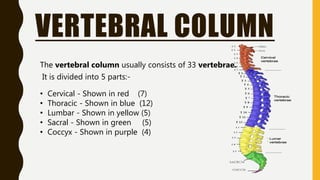
VERTEBRAL COLUMN
The vertebral column usually consists of 33 vertebrae.
It is divided into 5 parts:-
• Cervical - Shown in red (7)
• Thoracic - Shown in blue (12)
• Lumbar - Shown in yellow (5)
• Sacral - Shown in green (5)
• Coccyx - Shown in purple (4)
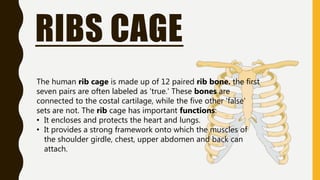
RIBS CAGE
The human rib cage is made up of 12 paired rib bone. the first
seven pairs are often labeled as 'true.' These bones are
connected to the costal cartilage, while the five other 'false'
sets are not. The rib cage has important functions:
• It encloses and protects the heart and lungs.
• It provides a strong framework onto which the muscles of
the shoulder girdle, chest, upper abdomen and back can
attach.
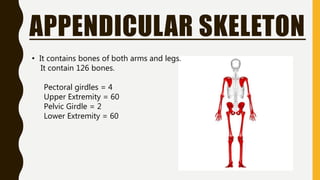
APPENDICULAR SKELETON
• It contains bones of both arms and legs.
It contain 126 bones.
Pectoral girdles = 4
Upper Extremity = 60
Pelvic Girdle = 2
Lower Extremity = 60
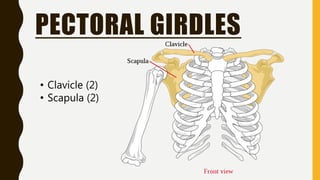
PECTORAL GIRDLES
• Clavicle (2)
• Scapula (2)
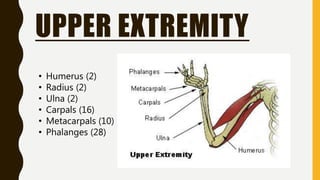
UPPER EXTREMITY
• Humerus (2)
• Radius (2)
• Ulna (2)
• Carpals (16)
• Metacarpals (10)
• Phalanges (28)
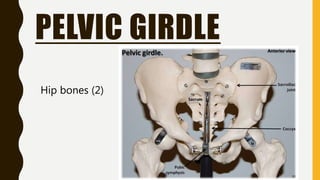
PELVIC GIRDLE
Hip bones (2)
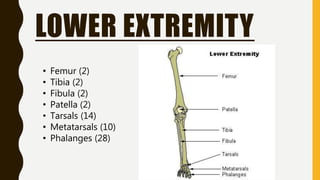
LOWER EXTREMITY
• Femur (2)
• Tibia (2)
• Fibula (2)
• Patella (2)
• Tarsals (14)
• Metatarsals (10)
• Phalanges (28)
JOINTS
DEFINITION
It is a site at which any two or more bones articulated is called
Joint.
Types of joint :-
• Fibrous or fixed joint
• Cartilaginous or slightly movable joint
• Synovial or freely movable joint
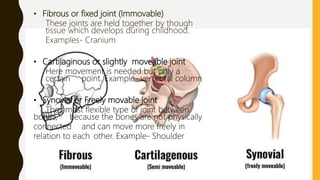
• Fibrous or fixed joint (Immovable)
These joints are held together by though
tissue which develops during childhood.
Examples- Cranium
• Cartilaginous or slightly moveable joint
Here movement is needed but only a
certain point. Example- vertebral column
• Synovial or Freely movable joint
They most flexible type of joint between
bones, because the bones are not physically
connected and can move more freely in
relation to each other. Example- Shoulder
TYPES OF SYNOVIAL JOINTS
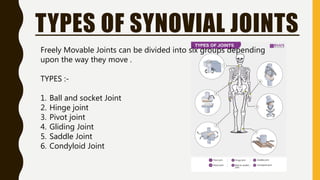
Freely Movable Joints can be divided into six groups depending
upon the way they move .
TYPES :-
1. Ball and socket Joint
2. Hinge joint
3. Pivot joint
4. Gliding Joint
5. Saddle Joint
6. Condyloid Joint
BALL AND SOCKET JOINT
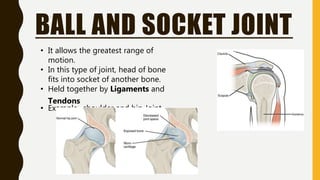
• It allows the greatest range of
motion.
• In this type of joint, head of bone
fits into socket of another bone.
• Held together by Ligaments and
Tendons
• Example- shoulder and hip Joint
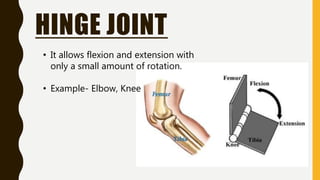
HINGE JOINT
• It allows flexion and extension with
only a small amount of rotation.
• Example- Elbow, Knee
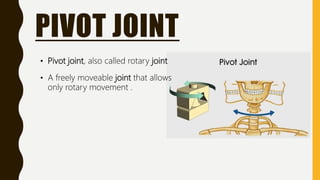
PIVOT JOINT
• Pivot joint, also called rotary joint
• A freely moveable joint that allows
only rotary movement .
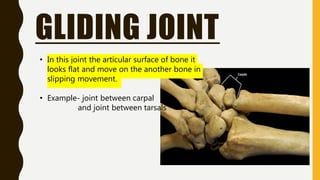
GLIDING JOINT
• In this joint the articular surface of bone it
looks flat and move on the another bone in
slipping movement.
• Example- joint between carpal
and joint between tarsals
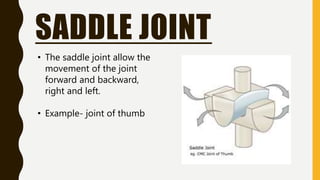
SADDLE JOINT
• The saddle joint allow the
movement of the joint
forward and backward,
right and left.
• Example- joint of thumb
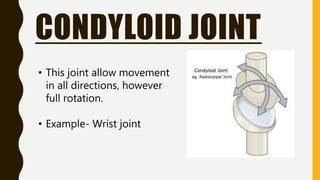
CONDYLOID JOINT
• This joint allow movement
in all directions, however
full rotation.
• Example- Wrist joint

Skletal system

  • 1.
    SKLETAL SYSTEM N AM E – O M PAT E L R E G N O . – 1 1 9 0 1 3 7 0 R O L L N O . – 1 1
  • 2.
    AXIAL SKELETON • LongitudinalAxis of the Body. (except arms and legs) • It contains 80 bones. Skull – 22 Vertebral Column- 33 Ribs- 24 Sternum- 1
  • 3.
    SKULL The skull supportsthe structures of the face and provides a protective cavity for the brain. The skull consist of 22 bones. The skull is divided in two type of Bones • 8 Cranial Bones • 14 Facial Bones
  • 4.
    CRANIAL BONES (8) •Frontal Bone • Parietal Bone • Occipital Bone • Temporal Bone • Sphenoid Bone • Ethmoid Bone
  • 5.
    FACIAL BONE (14) •Inferior nasal concha • Lacrimal • Mandible • Maxilla • Nasal • Palatine • Vomer • Zygomatic
  • 6.
    VERTEBRAL COLUMN The vertebralcolumn usually consists of 33 vertebrae. It is divided into 5 parts:- • Cervical - Shown in red (7) • Thoracic - Shown in blue (12) • Lumbar - Shown in yellow (5) • Sacral - Shown in green (5) • Coccyx - Shown in purple (4)
  • 7.
    RIBS CAGE The humanrib cage is made up of 12 paired rib bone. the first seven pairs are often labeled as 'true.' These bones are connected to the costal cartilage, while the five other 'false' sets are not. The rib cage has important functions: • It encloses and protects the heart and lungs. • It provides a strong framework onto which the muscles of the shoulder girdle, chest, upper abdomen and back can attach.
  • 8.
    APPENDICULAR SKELETON • Itcontains bones of both arms and legs. It contain 126 bones. Pectoral girdles = 4 Upper Extremity = 60 Pelvic Girdle = 2 Lower Extremity = 60
  • 9.
    PECTORAL GIRDLES • Clavicle(2) • Scapula (2)
  • 10.
    UPPER EXTREMITY • Humerus(2) • Radius (2) • Ulna (2) • Carpals (16) • Metacarpals (10) • Phalanges (28)
  • 11.
  • 12.
    LOWER EXTREMITY • Femur(2) • Tibia (2) • Fibula (2) • Patella (2) • Tarsals (14) • Metatarsals (10) • Phalanges (28)
  • 13.
  • 14.
    DEFINITION It is asite at which any two or more bones articulated is called Joint. Types of joint :- • Fibrous or fixed joint • Cartilaginous or slightly movable joint • Synovial or freely movable joint
  • 15.
    • Fibrous orfixed joint (Immovable) These joints are held together by though tissue which develops during childhood. Examples- Cranium • Cartilaginous or slightly moveable joint Here movement is needed but only a certain point. Example- vertebral column • Synovial or Freely movable joint They most flexible type of joint between bones, because the bones are not physically connected and can move more freely in relation to each other. Example- Shoulder
  • 16.
    TYPES OF SYNOVIALJOINTS Freely Movable Joints can be divided into six groups depending upon the way they move . TYPES :- 1. Ball and socket Joint 2. Hinge joint 3. Pivot joint 4. Gliding Joint 5. Saddle Joint 6. Condyloid Joint
  • 17.
    BALL AND SOCKETJOINT • It allows the greatest range of motion. • In this type of joint, head of bone fits into socket of another bone. • Held together by Ligaments and Tendons • Example- shoulder and hip Joint
  • 18.
    HINGE JOINT • Itallows flexion and extension with only a small amount of rotation. • Example- Elbow, Knee
  • 19.
    PIVOT JOINT • Pivotjoint, also called rotary joint • A freely moveable joint that allows only rotary movement .
  • 20.
    GLIDING JOINT • Inthis joint the articular surface of bone it looks flat and move on the another bone in slipping movement. • Example- joint between carpal and joint between tarsals
  • 21.
    SADDLE JOINT • Thesaddle joint allow the movement of the joint forward and backward, right and left. • Example- joint of thumb
  • 22.
    CONDYLOID JOINT • Thisjoint allow movement in all directions, however full rotation. • Example- Wrist joint