Structure & Functions of Skin
Dr N. K. Kansal
Associate Professor
Dermatology
• Dermatology – defined as ‘the branch of medicine
concerned with the diagnosis & treatment of skin
disorders’
• However, dermatologists do not confine themselves
purely to a study of intrinsic disorders of the skin
• Must also study internal medicine & the many
environmental & occupational factors that so
frequently cause skin problems
Dermatology
• Probably at least 2000 different skin conditions might
present to the dermatologist; vary enormously in
severity
• Range from cosmetic problems, e.g., dry skin or
wrinkles, through a huge variety of acute or chronic
diseases - disfiguring, itchy or painful, less commonly
fatal to life-threatening conditions
• Certain diseases, if untreated, may prove fatal within
days (e.g., toxic epidermal necrolysis), weeks (e.g.,
pemphigus), months (e.g., malignant melanoma) or
years (e.g., mycosis fungoides)
Dermatology
• The patterns of dermatological diseases / disorders
vary from one country to another
• Even in the same city the work of dermatologists
differ, depending on their particular interests &
expertise & on the social mix of their patients
Dermatology
• Largest organ of the body
• In a 70 - kg person: skin wt- >5 kg; SA = 2 m2
• Consists of a stratified, cellular epidermis & an
underlying dermis of connective tissue
• Epidermis is mainly composed of keratinocytes & is
typically 0.05 – 0.1 mm in thickness, up to 1.5 mm in
palms & soles
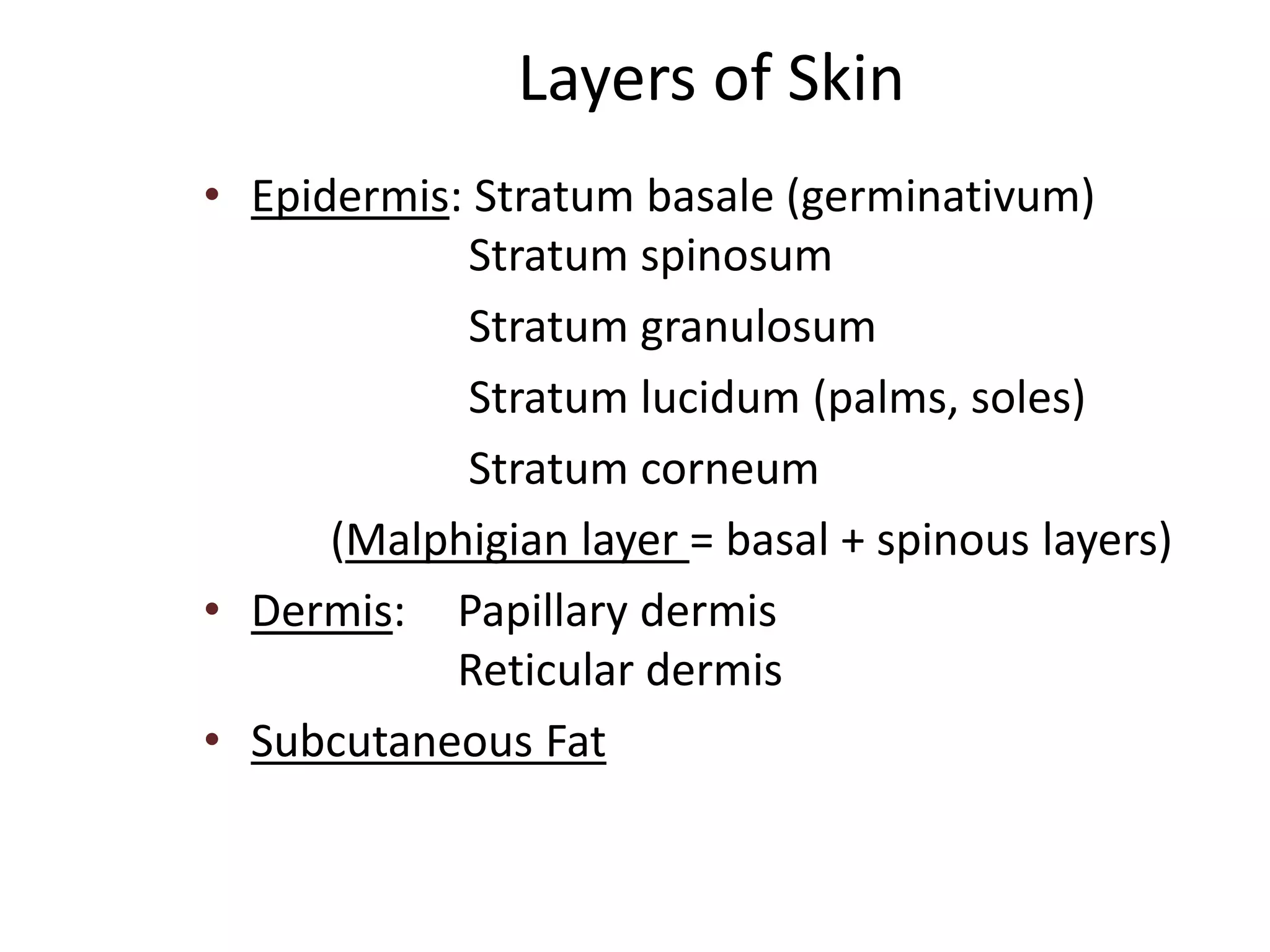
Layers of Skin
• Epidermis: Stratum basale (germinativum)
Stratum spinosum
Stratum granulosum
Stratum lucidum (palms, soles)
Stratum corneum
(Malphigian layer = basal + spinous layers)
• Dermis: Papillary dermis
Reticular dermis
• Subcutaneous Fat
m
HPE Skin - forearm – very thin epidermis
HPE – Palm – stratum lucidum
Different Types of Cells in Epidermis
• Keratinocyte
• Melanocyte
• Langerhans’ cell
• Merkel cell
Strata (layers) of Epidermis
• Stratum basale: Columnar / cuboidal cells; large
oval nuclei, dense basophilic cytoplasm
• Stratum spinosum (spinous / prickle cell layer):
Polygonal cells with delicate processes,
desmosomes connect adjacent keratinocytes
• Stratum granulosum: Flattened diamond-
shaped cells filled with coarse basophilic
‘keratohyaline’ granules
Strata of Epidermis
• Stratum lucidum : Clear layer found in palms
and soles, cells are nucleated, sometimes k/a
transitional cells
• Stratum corneum : Flat, non-nucleated,
eosinophilic layer; cells k/a corneocytes
Dead layer shed during epidermal turnover
Epidermal turnover/ transit time:
• Time taken for a cell to pass from basal layer to
surface of skin
• Apprx. 40 – 56 days (normal skin)
Melanocyte
• Neural crest derived cells
• Dendritic arborizing cells that synthesize and
secrete melanin containing organelles called
melanosomes
• Located in basal layer; 1:10 ratio
• Epidermal-Melanin Unit: A single melanocyte
supplies melanosomes to 36 keratinocytes (1:36)
• Melanosomes vary in number and size according
to skin type  differing skin color
Melanocytes in culture
Melanocyte
• Function of melanin
- Impart colour to skin and hair
- Protect the skin from UV radiation
- Biochemical neutralizer of toxic, free radical
oxygen derivatives
• Melanin: Eumelanin (brown / black) &
phaeomelanin (yellow / red)
Langerhans’ cell & Merkel cell
• Langerhans’ cell
- Type of macrophage, APCs
- Originate from bone marrow (mesodermal in
origin)
- Role in various immune processes like allergic
contact dermatitis, immune tolerance,
surveillance against neoplasia
• Merkel cell also k/a Merkel-Ranvier cell:
- Oval receptor cells
- Probably derived from keratinocytes
- Associated with sensation of light touch
discrimination of shapes & textures
Dermis
• Papillary dermis – A thin zone which lies beneath
the epidermis
• Reticular dermis - thick zone which extends from
base of papillary dermis to the surface of
subcutaneous fat
Structure of dermis
• Mainly non-cellular connective tissue
• Constituted of collagen, elastic fibers & ground
substance (mucopolysaccharides, chondroitin
sulphate & glycoproteins)
• Embedded nerves, blood vessels / capillaries,
lymphatics, muscles & pilosebaceous, apocrine
& eccrine units
• Cellular contents include fibroblasts, mast cells,
histiocytes, Langerhans’ cells, lymphocytes &
eosinophils
Variation in thickness of skin
• Difference of thickness of the skin is dependent
largely on dermal thickness, with the palms and
soles being thickest (about 1.5 mm) & thinnest
in the eyelids & post-auricular region (about
0.05 mm)
• Children & elderly have thinner skin than adults
• Males have thicker skin than females
Hair
• Hair - a keratinized product of the hair follicle, a
tube-like structure continuous with the epidermis at
its upper end
• Present all over the skin except on vermillion of lips,
palms, soles & skin of nail folds
Types of hair
Types of hair:
1) Lanugo (fine, soft, unpigmented; seen in utero- shed
in 8th-9th month of gestation)
2) Vellus (soft)
3) Terminal (longer, coarse, pigmented)
Also intermediate
After puberty : secondary sexual terminal hair
Hair Cycle
 Hair follicles undergo a repetitive sequence of growth
& rest called the hair cycle
 Period of active hair growth is Anagen. Duration of
this phase decides the length of hair; In humans, it is
maximum on scalp
 Catagen is the regressive phase in which the follicular
activity declines & ceases
 The hair stays in the Telogen (resting) phase till the
beginning of next anagen phase
Sebaceous Glands
• Lipid producing holocrine glands
• Arise from the hair follicle at the junction of the
infundibulum & the isthmus
• Distributed all over the body except the palms & soles;
most numerous, large and productive over the face &
scalp
• Mature at puberty are stimulated by various hormones
• Major components of sebum: Triglycerides, wax
esters, squalene, cholesterol esters & cholesterol
Nail
Nail Growth
Functions of nails
 Help to grasp & manipulate objects
 Help in ‘pincer grip’
 Protect terminal phalanx & fingertip
 Serve an aesthetic & cosmetic purpose
Functions of Skin
• Barrier function
• Permeability
• Maintenance of fluid & electrolyte balance
• Thermoregulation- sweating
• Pigmentation
• Immune function
• Sensory receptor
• Endocrine function: Vitamin D synthesis
Thank you!

Structure and function of Skin (Integumentary system) - mypharmaguide

  • 1.
    Structure & Functionsof Skin Dr N. K. Kansal Associate Professor
  • 2.
    Dermatology • Dermatology –defined as ‘the branch of medicine concerned with the diagnosis & treatment of skin disorders’ • However, dermatologists do not confine themselves purely to a study of intrinsic disorders of the skin • Must also study internal medicine & the many environmental & occupational factors that so frequently cause skin problems
  • 3.
    Dermatology • Probably atleast 2000 different skin conditions might present to the dermatologist; vary enormously in severity • Range from cosmetic problems, e.g., dry skin or wrinkles, through a huge variety of acute or chronic diseases - disfiguring, itchy or painful, less commonly fatal to life-threatening conditions • Certain diseases, if untreated, may prove fatal within days (e.g., toxic epidermal necrolysis), weeks (e.g., pemphigus), months (e.g., malignant melanoma) or years (e.g., mycosis fungoides)
  • 4.
    Dermatology • The patternsof dermatological diseases / disorders vary from one country to another • Even in the same city the work of dermatologists differ, depending on their particular interests & expertise & on the social mix of their patients
  • 5.
    Dermatology • Largest organof the body • In a 70 - kg person: skin wt- >5 kg; SA = 2 m2 • Consists of a stratified, cellular epidermis & an underlying dermis of connective tissue • Epidermis is mainly composed of keratinocytes & is typically 0.05 – 0.1 mm in thickness, up to 1.5 mm in palms & soles
  • 6.
    Layers of Skin •Epidermis: Stratum basale (germinativum) Stratum spinosum Stratum granulosum Stratum lucidum (palms, soles) Stratum corneum (Malphigian layer = basal + spinous layers) • Dermis: Papillary dermis Reticular dermis • Subcutaneous Fat
  • 8.
  • 9.
    HPE Skin -forearm – very thin epidermis
  • 10.
    HPE – Palm– stratum lucidum
  • 11.
    Different Types ofCells in Epidermis • Keratinocyte • Melanocyte • Langerhans’ cell • Merkel cell
  • 12.
    Strata (layers) ofEpidermis • Stratum basale: Columnar / cuboidal cells; large oval nuclei, dense basophilic cytoplasm • Stratum spinosum (spinous / prickle cell layer): Polygonal cells with delicate processes, desmosomes connect adjacent keratinocytes • Stratum granulosum: Flattened diamond- shaped cells filled with coarse basophilic ‘keratohyaline’ granules
  • 13.
    Strata of Epidermis •Stratum lucidum : Clear layer found in palms and soles, cells are nucleated, sometimes k/a transitional cells • Stratum corneum : Flat, non-nucleated, eosinophilic layer; cells k/a corneocytes Dead layer shed during epidermal turnover
  • 14.
    Epidermal turnover/ transittime: • Time taken for a cell to pass from basal layer to surface of skin • Apprx. 40 – 56 days (normal skin)
  • 15.
    Melanocyte • Neural crestderived cells • Dendritic arborizing cells that synthesize and secrete melanin containing organelles called melanosomes • Located in basal layer; 1:10 ratio • Epidermal-Melanin Unit: A single melanocyte supplies melanosomes to 36 keratinocytes (1:36) • Melanosomes vary in number and size according to skin type  differing skin color
  • 16.
  • 17.
    Melanocyte • Function ofmelanin - Impart colour to skin and hair - Protect the skin from UV radiation - Biochemical neutralizer of toxic, free radical oxygen derivatives • Melanin: Eumelanin (brown / black) & phaeomelanin (yellow / red)
  • 18.
    Langerhans’ cell &Merkel cell • Langerhans’ cell - Type of macrophage, APCs - Originate from bone marrow (mesodermal in origin) - Role in various immune processes like allergic contact dermatitis, immune tolerance, surveillance against neoplasia
  • 20.
    • Merkel cellalso k/a Merkel-Ranvier cell: - Oval receptor cells - Probably derived from keratinocytes - Associated with sensation of light touch discrimination of shapes & textures
  • 21.
    Dermis • Papillary dermis– A thin zone which lies beneath the epidermis • Reticular dermis - thick zone which extends from base of papillary dermis to the surface of subcutaneous fat
  • 22.
    Structure of dermis •Mainly non-cellular connective tissue • Constituted of collagen, elastic fibers & ground substance (mucopolysaccharides, chondroitin sulphate & glycoproteins) • Embedded nerves, blood vessels / capillaries, lymphatics, muscles & pilosebaceous, apocrine & eccrine units • Cellular contents include fibroblasts, mast cells, histiocytes, Langerhans’ cells, lymphocytes & eosinophils
  • 23.
    Variation in thicknessof skin • Difference of thickness of the skin is dependent largely on dermal thickness, with the palms and soles being thickest (about 1.5 mm) & thinnest in the eyelids & post-auricular region (about 0.05 mm) • Children & elderly have thinner skin than adults • Males have thicker skin than females
  • 24.
    Hair • Hair -a keratinized product of the hair follicle, a tube-like structure continuous with the epidermis at its upper end • Present all over the skin except on vermillion of lips, palms, soles & skin of nail folds
  • 25.
    Types of hair Typesof hair: 1) Lanugo (fine, soft, unpigmented; seen in utero- shed in 8th-9th month of gestation) 2) Vellus (soft) 3) Terminal (longer, coarse, pigmented) Also intermediate After puberty : secondary sexual terminal hair
  • 27.
    Hair Cycle  Hairfollicles undergo a repetitive sequence of growth & rest called the hair cycle  Period of active hair growth is Anagen. Duration of this phase decides the length of hair; In humans, it is maximum on scalp  Catagen is the regressive phase in which the follicular activity declines & ceases  The hair stays in the Telogen (resting) phase till the beginning of next anagen phase
  • 28.
    Sebaceous Glands • Lipidproducing holocrine glands • Arise from the hair follicle at the junction of the infundibulum & the isthmus • Distributed all over the body except the palms & soles; most numerous, large and productive over the face & scalp • Mature at puberty are stimulated by various hormones • Major components of sebum: Triglycerides, wax esters, squalene, cholesterol esters & cholesterol
  • 29.
  • 30.
  • 31.
    Functions of nails Help to grasp & manipulate objects  Help in ‘pincer grip’  Protect terminal phalanx & fingertip  Serve an aesthetic & cosmetic purpose
  • 32.
    Functions of Skin •Barrier function • Permeability • Maintenance of fluid & electrolyte balance • Thermoregulation- sweating • Pigmentation • Immune function • Sensory receptor • Endocrine function: Vitamin D synthesis
  • 33.