Structural OD Intervention
Prepared By
Kindly restrict the use of slides for personal purpose.
Please seek permission to reproduce the same in public forms and presentations.
Manu Melwin Joy
Assistant Professor
Ilahia School of Management Studies
Kerala, India.
Phone – 9744551114
Mail – manu_melwinjoy@yahoo.com
Structural Intervention
• These interventions deal with an
organization’s technology (for
examples its task methods and
job design) and structure (for
example, division of labor and
hierarchy).
• These interventions are rooted in
the disciplines of engineering,
sociology, and psychology and in
the applied fields of socio-
technical systems and
organization design. Practitioners
place emphasis both on
productivity and human
fulfillment.
Structural Design
• This change process
concerns the organization’s
division of labour – how to
specialize task
performances.
• Diagnostic guidelines exist
to determine which
structure is appropriate for
particular organizational
environments, technologies,
and conditions.
Self-managed teams.
• A self-managed team is a group
of employees that's responsible
and accountable for all or most
aspects of producing a product
or delivering a service.
• A self-managed team carries out
supporting tasks, such as
planning and scheduling the
workflow and managing annual
leave and absence, in addition to
technical tasks. Management
and technical responsibilities are
typically rotated among the
team members.
Quality circles
• A quality circle is a participatory
management technique that
enlists the help of employees in
solving problems related to
their own jobs.
• Circles are formed of employees
working together in an
operation who meet at intervals
to discuss problems of quality
and to devise solutions for
improvements.
Downsizing
• This intervention
reduces costs and
bureaucracy by
decreasing the size of
the organization
through personnel
layoffs, organization
redesign,
and outsourcing.
• Clarify the organization’s
strategy
• Assess downsizing options
and make relevant choices
• Implement the changes
• Address the needs of survivors
and those who leave
• Follow through with growth
plans
Downsizing Process
Cummings & Worley, 7e (c) 2001 South-
Western College Publishing
14-9
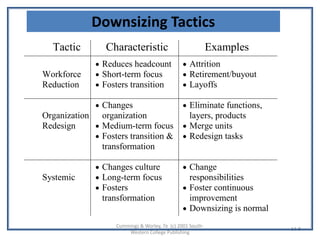
Downsizing Tactics
Tactic Characteristic Examples
Workforce
Reduction
 Reduces headcount
 Short-term focus
 Fosters transition
 Attrition
 Retirement/buyout
 Layoffs
Organization
Redesign
 Changes
organization
 Medium-term focus
 Fosters transition &
transformation
 Eliminate functions,
layers, products
 Merge units
 Redesign tasks
Systemic
 Changes culture
 Long-term focus
 Fosters
transformation
 Change
responsibilities
 Foster continuous
improvement
 Downsizing is normal
High-involvement Organizations
• This intervention
reduces costs and
bureaucracy by
decreasing the size of
the organization
through personnel
layoffs, organization
redesign,
and outsourcing.
Work redesign
• This refers to OD
interventions aimed at
creating jobs, and
work groups that
generate high levels of
employee fulfilment and
productivity.
Quality of Work Life (QWL)
• Organizational
improvement efforts.
– Attempt to restructure
multiple dimensions of the
organization.
– To institute a mechanism
which introduces and
sustains changes over time.
• An increase in participation
by employees and increase
in problem solving between
the union and
management.
Parallel Structures
• Some companies stand to gain
improved employee effectiveness
though peer communication and
sharing experiences encountered
throughout the working day.
• This behavior happens naturally, to an
extent, wherever the staff gathers for
breaks and shares conversation.
• Formalizing the process ensures that
all employees in a similar department,
regardless of their position in the
traditional hierarchy, have the chance
to contribute ideas to the broader
organization.
Management by objectives (MBO).
• Management by objectives (MBO), also
known as management by results (MBR), is
a process of defining objectives within an
organization so that management and
employees agree to the objectives and
understand what they need to do in the
organization in order to achieve them.
• The essence of MBO is participative goal
setting, choosing course of actions and
decision making. An important part of the
MBO is the measurement and the
comparison of the employee’s actual
performance with the standards set. Ideally,
when employees themselves have been
involved with the goal setting and choosing
the course of action to be followed by them,
they are more likely to fulfill their
responsibilities.
Structural od intervention -  Organizational Change and Development - Manu Melwin Joy

Structural od intervention - Organizational Change and Development - Manu Melwin Joy

  • 1.
  • 2.
    Prepared By Kindly restrictthe use of slides for personal purpose. Please seek permission to reproduce the same in public forms and presentations. Manu Melwin Joy Assistant Professor Ilahia School of Management Studies Kerala, India. Phone – 9744551114 Mail – manu_melwinjoy@yahoo.com
  • 3.
    Structural Intervention • Theseinterventions deal with an organization’s technology (for examples its task methods and job design) and structure (for example, division of labor and hierarchy). • These interventions are rooted in the disciplines of engineering, sociology, and psychology and in the applied fields of socio- technical systems and organization design. Practitioners place emphasis both on productivity and human fulfillment.
  • 4.
    Structural Design • Thischange process concerns the organization’s division of labour – how to specialize task performances. • Diagnostic guidelines exist to determine which structure is appropriate for particular organizational environments, technologies, and conditions.
  • 5.
    Self-managed teams. • Aself-managed team is a group of employees that's responsible and accountable for all or most aspects of producing a product or delivering a service. • A self-managed team carries out supporting tasks, such as planning and scheduling the workflow and managing annual leave and absence, in addition to technical tasks. Management and technical responsibilities are typically rotated among the team members.
  • 6.
    Quality circles • Aquality circle is a participatory management technique that enlists the help of employees in solving problems related to their own jobs. • Circles are formed of employees working together in an operation who meet at intervals to discuss problems of quality and to devise solutions for improvements.
  • 7.
    Downsizing • This intervention reducescosts and bureaucracy by decreasing the size of the organization through personnel layoffs, organization redesign, and outsourcing.
  • 8.
    • Clarify theorganization’s strategy • Assess downsizing options and make relevant choices • Implement the changes • Address the needs of survivors and those who leave • Follow through with growth plans Downsizing Process
  • 9.
    Cummings & Worley,7e (c) 2001 South- Western College Publishing 14-9 Downsizing Tactics Tactic Characteristic Examples Workforce Reduction  Reduces headcount  Short-term focus  Fosters transition  Attrition  Retirement/buyout  Layoffs Organization Redesign  Changes organization  Medium-term focus  Fosters transition & transformation  Eliminate functions, layers, products  Merge units  Redesign tasks Systemic  Changes culture  Long-term focus  Fosters transformation  Change responsibilities  Foster continuous improvement  Downsizing is normal
  • 10.
    High-involvement Organizations • Thisintervention reduces costs and bureaucracy by decreasing the size of the organization through personnel layoffs, organization redesign, and outsourcing.
  • 11.
    Work redesign • Thisrefers to OD interventions aimed at creating jobs, and work groups that generate high levels of employee fulfilment and productivity.
  • 12.
    Quality of WorkLife (QWL) • Organizational improvement efforts. – Attempt to restructure multiple dimensions of the organization. – To institute a mechanism which introduces and sustains changes over time. • An increase in participation by employees and increase in problem solving between the union and management.
  • 13.
    Parallel Structures • Somecompanies stand to gain improved employee effectiveness though peer communication and sharing experiences encountered throughout the working day. • This behavior happens naturally, to an extent, wherever the staff gathers for breaks and shares conversation. • Formalizing the process ensures that all employees in a similar department, regardless of their position in the traditional hierarchy, have the chance to contribute ideas to the broader organization.
  • 14.
    Management by objectives(MBO). • Management by objectives (MBO), also known as management by results (MBR), is a process of defining objectives within an organization so that management and employees agree to the objectives and understand what they need to do in the organization in order to achieve them. • The essence of MBO is participative goal setting, choosing course of actions and decision making. An important part of the MBO is the measurement and the comparison of the employee’s actual performance with the standards set. Ideally, when employees themselves have been involved with the goal setting and choosing the course of action to be followed by them, they are more likely to fulfill their responsibilities.