MANAGEMENT SERVICES
Organisational Effectiveness 2A (OEF22A2)
Work Measurement Techniques and Applications
Mr. V . Lukonga
University of Johannesburg
South Africa
Auckland Park Campus Bunting Road
Concowan Building
2
RULES
• YOUR ATTENDANCE IS CRUCIAL (VERY IMPORTANT)
• TESTS RESULTS ARE ONLY SUBMITTED IN THE CLASS NOT
IN THE OFFICE
• NO CHANGES WILL MADE ON THE MARKS FOR THE TEST
YOU WROTE DURING THE ISSUING OF RESULTS IN THE
CLASS IF YOU WERE NOT IN THE CLASS
• YOUR PROBLEM IS NOT MY PROBLEM
• NO EXCUSE WILL BE TAKEN
• RESPECT FOR OTHERS, STAFF AND FACILITIES
• TEAMWORK NOT GROUP WORK
• TEST DATES ARE NOT POSPONED
• I DO NOT BELIEVE IN A SCOPE (BECAUSE THIS IS
MAGAZINE THAT IS FICTITIOUS)
3
Overview
• Introduction
• Role of Management services
• Productivity
4
Introduction
• In Organisational Effectiveness 1A the term
“Management Services,” was defined as a selection of
people with the knowledge and skills that, generally,
advise the Management of any organisation on better
and more efficient ways of working. The module
focused on a part of management services, namely,
work study, which is broadly divided into method
study and work measurement.
• Most of the aspects discussed in Organisational
Effectiveness 1A were based on method study as one
of the techniques of work study.
5
Introduction (Cont.)
• Whereas in Organisational Effectiveness 1B focused
on work measurement as the second technique of
work study which is regarded as the application of
techniques designed to establish the time for a
qualified worker to carry out a task at a defined rate of
working. (See Kanawaty, p. 249).
• Now Organisational Effectiveness 2 will continue with
Work measurement including direct and indirect work
measurement techniques.
6
Introduction (Cont.)
• The O&W profession in SA existed under the auspices
(support) of the SA Institute of Organization and
Methods (SAIOM) since its establishment on 3 May
1960.
• SAIOM provided the infrastructure to facilitate training
and it gave recognition to its members. It also
provided a forum for the development of organization
and work study techniques and the dissemination of
information to its members.
7
Introduction (Cont.)
•By October 1993, the Institute transformed itself into
The Southern Africa Institute of Management Services
(SAIMAS).
•This was in reaction to the general development in
knowledge and technology and in various fields of
business.
•Many of these fields were regarded as part of
Management Services.
•It was realized that O&W was too a restricted
description of what the people concerned were actually
doing and the name Management Services was chosen
as a replacement.
8
Introduction (Cont.)
• This development made the professional field wider
and more accessible to other related functions within
the management services field, thus rendering a more
comprehensive service to its members.
9
1. Role of Management
Services (MS)
• Definition
• Areas of the business where MS is applied
• Benefits in management services
• Techniques used by MS practitioners
• MS as a tool in strategic management
• Skills acquired by MS
10
Definition
• MS is widely used, but with different meanings
• MS(s) are generally used by those groups of activities, which assist
management in the improvement, and control of effective and
efficient work practices
• Work practices take place in the following areas:
- System
- Structure
- Methods
- Procedures
- Environment
11
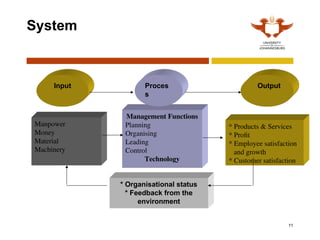
System
Manpower
Money
Material
Machinery
Management Functions
Planning
Organising
Leading
Control
Technology
* Products & Services
* Profit
* Employee satisfaction
and growth
* Customer satisfaction
Input Proces
s
Output
* Organisational status
* Feedback from the
environment
12
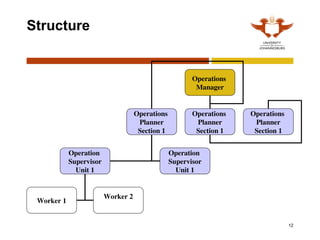
Structure
Operations
Manager
Operations
Planner
Section 1
Operations
Planner
Section 1
Operations
Planner
Section 1
Operation
Supervisor
Unit 1
Operation
Supervisor
Unit 1
Worker 1
Worker 2
13
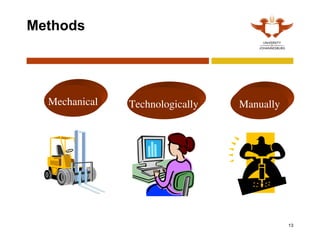
Methods
Mechanical Technologically Manually
14
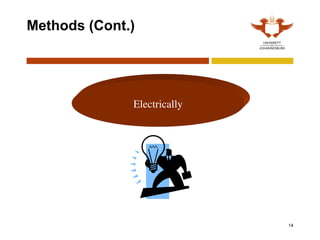
Methods (Cont.)
Electrically
15
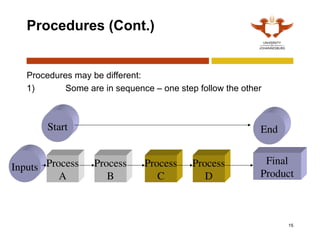
Procedures (Cont.)
Procedures may be different:
1) Some are in sequence – one step follow the other
Process
A
Final
Product
Start End
Process
D
Process
C
Process
B
Inputs
16
Procedures (Cont.)
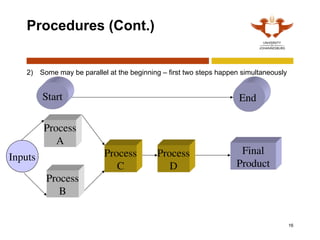
2) Some may be parallel at the beginning – first two steps happen simultaneously
Process
A
Process
B
Process
C
Process
D
Final
Product
Start End
Inputs
17
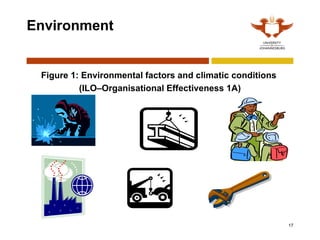
Environment
Figure 1: Environmental factors and climatic conditions
(ILO–Organisational Effectiveness 1A)
18
Areas of the business where
MS is applied
• Business Development and Design;
• Financial Management;
• Information Management;
• Organisational Transformation;
• Human Resource Management;
• Operations Management
• Quality Management, etc.
19
Benefits in MS
Benefits
• Identify the problem
• Analyse the problem
• Propose solution
20
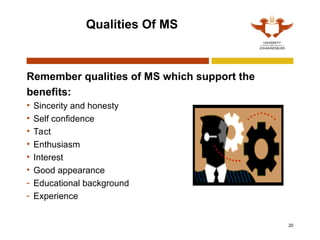
Qualities Of MS
Remember qualities of MS which support the
benefits:
• Sincerity and honesty
• Self confidence
• Tact
• Enthusiasm
• Interest
• Good appearance
- Educational background
- Experience
21
Techniques used by MS
practitioners
• Work Study
• Organisation and Methods
• Operation Research
• Data Processing
• Ergonomics
• Economic Forecasting
• Business process reengineering
• Job Evaluation, etc.
22
Skills acquired by MS
• Consultation;
• Facilitation;
• Communication;
• Information Analysis;
• Decision Making;
• Creativity and Innovation
• Negotiation;
• Project Management.
23
2. Methods, standards, and
work design : Productivity Ch1
• Productivity and basic human needs
• Definition of productivity
• Productivity improvement
• Productivity measurement
• Misunderstanding concerning Productivity
• Factors leading to Efficient Production
• Guides in Productivity Improvement
• Five Step Method Improvement Plan
24
Productivity (Cont.)
• Define Specific Resource Productivity and Total
Resource Productivity
• Calculate Specific Resource Productivity and Total
Resource Productivity
• Interpret results and make appropriate
recommendations
Productivity Importance
(Worldwide) Freivalds (2009)
• Certain changes continually take place in the industrial and
business environment must be considered both economically
and practically.
• These include globalisation of both the market and producer,
the growth of the service sector, the computerisation of all facets
of an enterprise, and the ever expanding applications of the
Internet and Web.
• The only way the business or enterprise can grow and increase
its profitability is by increasing productivity.
• The fundamental tools that result in increased productivity are:
methods, time study standards (work measurement
techniques) and work design.
25
Productivity Importance
(Worldwide) Freivalds (2009)
26
• Over the last 100 years (from 1909), productivity in the United
State (US) has increased approximately 4% per year.
• In the last ten years the U.S. rate or productivity has been
exceeded by that of Japan, Korea, and Germany, and it may be
soon challenged by China.
• Of the total cost of typical metal products manufacturing
enterprise, 12 % is direct labour, 45% is direct material, and
43% is overhead (e.g. rent, lighting, insurance, and wages).
• Sales, finance, production, engineering, cost, maintenance
and management provide fertile areas for the application of
methods, standards, and work design.
Productivity Importance
(Worldwide) Freivalds (2009)
• Today U.S. businesses and industries are, by necessity,
restructuring themselves by downsizing, to operate more
effectively in an increasingly competitive worlds.
• U.S. now is addressing cost reduction and quality
improvement through productivity improvement.
• U.S. is also critically examining all non value business
components (those that do not contribute to their profitability).
They are: maintenance, transportation, sales and
management.
27
Traditional Areas Contributing to
Productivity Improvement - Freivalds
(2009)
Traditional Areas (Disciplines):
• Engineering
• Industrial management
• Management Services
• Business administration
• Industrial psychology
• Labour management relations
28
Traditional Areas Contributing to
Productivity Improvement - Freivalds
(2009)
• These areas of opportunity are not only contributing to
manufacturing industries but also equally important in service
industries.
• These service industries include department stores, hotels,
educational institutions, hospitals, banks, airlines, insurance
offices, military service centers, government agencies, and
retirement complexes.
• In U.S. 10% of the total labour force is employed in
manufacturing.
• The remaining 90% is engaged in service industries.
• Similarly, methods, standards, and work design activity are also
the key part of productivity improvement in service industries.
29
Techniques used by MS (and
other disciplines) - Freivalds (2009)
• Work measurement
• Work methods and design
• Production engineering
• Manufacturing analysis and control
• Facilities planning
• Wage administration
• Ergonomics and safety
• Production and inventory control
• Quality control
30
31
Productivity and basic human
needs
• Recall from the 1st unit (introduction and history of
work-study) how needs motivated the Egyptians,
Romans and Chinese to build structures to satisfy
those needs. (Read that part again).
• Today still, needs are the driving forces or
motivation for people to do things to satisfy those
needs. Only in the less civilised and most poor
countries today, people will work to only sustain
themselves from day to day.
32
Productivity and basic human
needs (Cont.)
• In our modern, competitive and civilised world,
people cannot work on their own to satisfy only
personal needs. There simply is no suitable land in
say, Johannesburg, to cultivate maize or potatoes
or whatever a person needs to survive.
• The only (acceptable) way people can satisfy needs, is
to join a group and work with others in an organised
manner. This means joining a business or starting your
own. Working together for the same goal creates
wealth for many people and also the country as a
whole.
33
Productivity and basic human
needs (Cont.)
• Wealth creation basically is the process by which people
and the State earn money that is used to create more
means such as hospitals, schools, roads, etc. It means that
more people earn money with which basic human needs
such as food and clothing can be bought. Because people
work together, businesses can survive, make a profit and
eventually, the state can collect taxes that are used to run
the country.
• The question is: How does all this concern the work-
study official? The reason is that one must understand
why people work and what businesses must do to
remain in business.
34
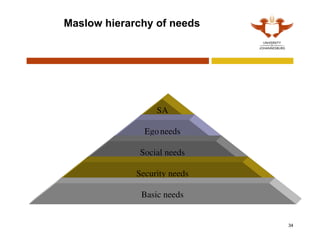
Maslow hierarchy of needs
SA
Egoneeds
Social needs
Security needs
Basic needs
35
Definition of productivity
• Is the ratio of output to input
• Is a yardstick of efficiency whereby the output/input performance
of an economy, a sector, a business, or a function of a business
is measured against the performance in a previous period or
against the performance of other businesses or against set
standards.
36
Concepts involved in
productivity
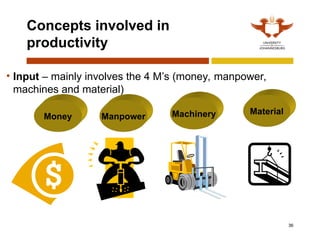
• Input – mainly involves the 4 M’s (money, manpower,
machines and material)
Manpower
Money Machinery Material
37
Concepts involved in
productivity Cont.)
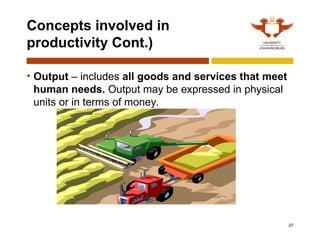
• Output – includes all goods and services that meet
human needs. Output may be expressed in physical
units or in terms of money.
38
Concepts involved in
productivity Cont.)
• Economic motive – is man’s striving to satisfy a
tremendous (great) and indeed almost unlimited
needs.
• Economic principle – is to obtain the greatest
possible satisfaction of needs with limited resources.
• Effectiveness – implies the attainment of a desired
goal (in other words the right job has been done,
irrespective of the method or techniques used in so
doing – doing the right thing).
39
Concepts involved in
productivity Cont.)
• Efficiency – implies the right technique or method has
been used for doing the job or achieving a goal (doing
things right)
• Profitability – is the relationship expressed as a
percentage between profits made during a specific
period and the capital used to make the profits.
• Turnover – if the turnover of a business has
increased, it means that a business has produced
more of a specific product or service in a certain
period, than in the previous corresponding period.
40
Productivity Improvement
•Is the optimum combination and maximum utilization of all
the
productive resources engaged in the business, so that only
the economically unavoidable costs are retained in the
business in order to maximize the profitability of the business
in the long-term.
• Refers to the increase in output per work-hour or time expended,
(Freivalds, 2009:1)
•Let suppose the company produces 2000 tables for 8 man hours
for this year and decides to increase production by 100 tables the
following year, but still using the same hours (8 man hours) still
productivity increases.
41
Productivity Improvement
This year Following year
Manpower SRP: Units of
Output/ Man hours
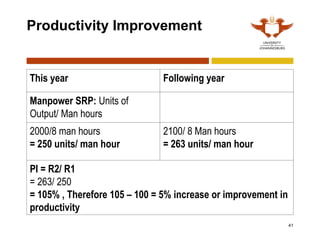
2000/8 man hours
= 250 units/ man hour
2100/ 8 Man hours
= 263 units/ man hour
PI = R2/ R1
= 263/ 250
= 105% , Therefore 105 – 100 = 5% increase or improvement in
productivity
42
Productivity Measurement
• Means if you measure what you are talking about and are
able to express it in numbers, you know what you are talking
about, but if you cannot measure it or express it in numbers,
your knowledge is incomplete and unsatisfactory.
• e.g. if there is no time table that the lecturer cannot use to attend
his venues on expected time
• he/ she cannot be able to control the situation in terms of his or
her job as a lecturer.
43
Objectives of Productivity
Measurement
• To control the extent to which various functions,
departments, groups operations and individual workers
are efficient.
• To cast light on the remuneration that should be
allocated to the various factors of production.
• To make proper planning and business forecasting
possible.
• To determine which factors in the organisation,
particularly influence productivity.
44
Objectives of Productivity
Measurement(Cont.)
• To detect changes in output in respect of alternative
inputs, in order to correct undesirable action and to
exploit desirable methods/ techniques.
• To serve as a psychological stimulus towards better
performance by management, supervisors and
workers.
45
Misunderstanding concerning
Productivity
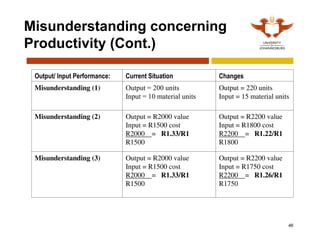
(1)Higher production does not necessarily mean higher
productivity.
(2)Higher profits does not necessarily mean higher
productivity.
(3)Cost reduction does not necessarily mean higher
productivity.
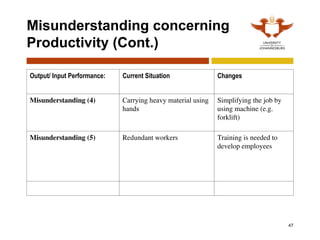
(4)Productivity improvement does not necessarily mean
harder work.
(5)Productivity improvement does not necessarily mean
unemployment.
46
Misunderstanding concerning
Productivity (Cont.)
Output/ Input Performance: Current Situation Changes
Misunderstanding (1) Output = 200 units
Input = 10 material units
Output = 220 units
Input = 15 material units
Misunderstanding (2) Output = R2000 value
Input = R1500 cost
R2000 = R1.33/R1
R1500
Output = R2200 value
Input = R1800 cost
R2200 = R1.22/R1
R1800
Misunderstanding (3) Output = R2000 value
Input = R1500 cost
R2000 = R1.33/R1
R1500
Output = R2200 value
Input = R1750 cost
R2200 = R1.26/R1
R1750
47
Misunderstanding concerning
Productivity (Cont.)
Output/ Input Performance: Current Situation Changes
Misunderstanding (4) Carrying heavy material using
hands
Simplifying the job by
using machine (e.g.
forklift)
Misunderstanding (5) Redundant workers Training is needed to
develop employees
48
Factors leading to Efficient
Production
• Individual – the organization must ensure there is
clear work specifications and aptitude testing for
the employee. Training and practice is also
essential to build the employee’s skill.
• Supervisor – the supervisor must make ensure that
communication is enhanced and feedback is given
to employees on regular basis.
• The physical environment – processes and
conditions must be optimized.
49
Factors leading to Efficient
Production (Cont.)
• Individual + Supervisor + physical environment = skill,
the will to do the, job which must lead to efficient
work
50
Guides in Productivity
Improvement
1) Eliminate non productive work
- Proper training
- Improve layout
- Correct equipment
2) Eliminate Spoils material
- Correct handling method
- Material-economic design
3) Eliminate non productive time
- Appropriate planning for workflow
- Regular measurement of employee performance
51
Guides in Productivity
Improvement (Cont.)
4) Eliminate delays in material supply
Just in time delivery
5) Eliminate losses
• Improve quality material
• Correct machines/ equipment essential
• Install preventive maintenance plans
• Security improvement
• Safety practice monitoring
52
Guides in Productivity
Improvement (Cont.)
6) Labour quality improvement
• Select and test against job specifications
• Train employees
7) Improve communication
• Clear instructions
• Ensure feedback
• Distribute comprehensive job guides with standards
53
Guides in Productivity
Improvement (Cont.)
8) Minimise de-motivators
• Proper administrative practices
• Correct adverse working conditions
• Train supervisors in labour relations
• Improved relationships
• Improve incorrect wages
9) Maximise motivators
• Recognition
• Achievement
• Advancement
54
Five Step Method
Improvement Plan
1) Challenge the necessity of the operation
• Critical questioning Matrix(4W’s & H)
• Eliminate or combine activities
2) Analyse the work done
• Inspect work
• Identify chart – use the relevant chart for each step
• Inspect step after chart has been used
55
Five Step Method Improvement
Plan (Cont.)
3) Question every step
• Use analysis Sheet for elimination of unnecessary
steps
• Eliminate delays
• Check if training is acquired by the employees
• Review area
• Revise method
56
Five Step Method Improvement
Plan (Cont.)
4) Develop a new method
• Check the objective of the operation
• Eliminate unnecessary work
• Make changes
• Check against the guides to productivity improvement
• Test the new method and adjust if necessary
57
Five Step Method Improvement
Plan (Cont.)
5) Apply the new method
• Submit proposal
• Obtain approval
• Train workers in the new method
• Increase supervision
• Get participation
Methods and standards scope:
Productivity - Freivalds (2009)
Opportunities for saving through the applications of
methods engineering (Method Study) and time
study:
• Work content added by defects in design or specification of
product.
• Work content added by inefficient work design and methods of
manufacture or operation.
• Time added due to shortcoming of management.
• Time added due to shortcoming of worker.
58
(A)Work content added by defects in design
or specification of product
59
• Bad design
•Lack of standardisation
•Incorrect quality standards
•Design demands
(B)Work content added by inefficient work
design and methods of manufacture or
operation
60
• Wrong machine used
• Process not operated correctly
• Wrong tools used
• Bad layout
• Operators’ bad working methods
(C) Time added due to shortcoming of
management
61
• Excessive product variety
• Lack of standardisation
• Design changes
• Bad planning of work
• Lack of raw material
• Plant breakdowns
• Plant/ factory in bad conditions
• Accidents, ineffective time
• Weak supervision
(D)Time added due to shortcoming of
worker
62
• Working less than normal pace
• Taking excessive allowances
• Careless workmanship
• Accidents and ineffective time
Methods and standards scope:
Productivity - Freivalds (2009)
• Methods engineering
• Standards
• Work design
63
Methods engineering - Freivalds
(2009)
• Select the project (job to be studied)
• Get and present the data (recording data)
• Analyse the data (Examine the data critically)
• Develop the ideal method (new method)
• Present and Install (implement) the new method
• Develop a job analysis (new method)
• Establish time standards
• Follow up (maintain) the method
64
Standards - Freivalds (2009)
• Standards are the end results of time study or work measurement.
• This technique establishes a time standard allowed to perform a
given task based on the following: measurement of work content
considering also fatigue, personal allowance, and unavoidable
delays.
• Management services analysts (and other analysts in other areas
for opportunity) use several techniques to a establish a standard.
• The following MS techniques are used: 1) stopwatch time study,
2) computerised data collection, 3) standard data,
• 4) predetermined time systems, 5) work sampling, and 6)
estimates based on historical data.
•
65
Standards (Continues) - Freivalds
(2009)
• Wage payment activities also is performed in concert with those
responsible for conducting job analyses and job evaluations, so
that these closely related activities function smoothly.
66
Work design (Human factor/
Ergonomics) - Freivalds (2009)
Chapter 4 to Chapter 7 of Freivalds (2009):
• Manual Work
• Equipment
• Machine Work
• Work Environmental Design
• Cognitive Work
67
Objectives of Methods, Standards
and Work design Freivalds (2009)
• To minimise the time required to perform tasks
• To continually improve the quality and reliability of products and
services
• To conserve resources and minimise cost by specifying the most
appropriate direct and indirect materials for the production of
goods and services
• To consider the cost and availability of power
• To maximise the safety, health, and well being of all employees
• To produce with an increasing concern for protecting the
environment
• To follow a human program of management that results in job
interest and satisfaction for each employee.
68


OEF22A2 CLASS NOTES Part 1992541762_1.ppt

  • 1.
    MANAGEMENT SERVICES Organisational Effectiveness2A (OEF22A2) Work Measurement Techniques and Applications Mr. V . Lukonga University of Johannesburg South Africa Auckland Park Campus Bunting Road Concowan Building
  • 2.
    2 RULES • YOUR ATTENDANCEIS CRUCIAL (VERY IMPORTANT) • TESTS RESULTS ARE ONLY SUBMITTED IN THE CLASS NOT IN THE OFFICE • NO CHANGES WILL MADE ON THE MARKS FOR THE TEST YOU WROTE DURING THE ISSUING OF RESULTS IN THE CLASS IF YOU WERE NOT IN THE CLASS • YOUR PROBLEM IS NOT MY PROBLEM • NO EXCUSE WILL BE TAKEN • RESPECT FOR OTHERS, STAFF AND FACILITIES • TEAMWORK NOT GROUP WORK • TEST DATES ARE NOT POSPONED • I DO NOT BELIEVE IN A SCOPE (BECAUSE THIS IS MAGAZINE THAT IS FICTITIOUS)
  • 3.
    3 Overview • Introduction • Roleof Management services • Productivity
  • 4.
    4 Introduction • In OrganisationalEffectiveness 1A the term “Management Services,” was defined as a selection of people with the knowledge and skills that, generally, advise the Management of any organisation on better and more efficient ways of working. The module focused on a part of management services, namely, work study, which is broadly divided into method study and work measurement. • Most of the aspects discussed in Organisational Effectiveness 1A were based on method study as one of the techniques of work study.
  • 5.
    5 Introduction (Cont.) • Whereasin Organisational Effectiveness 1B focused on work measurement as the second technique of work study which is regarded as the application of techniques designed to establish the time for a qualified worker to carry out a task at a defined rate of working. (See Kanawaty, p. 249). • Now Organisational Effectiveness 2 will continue with Work measurement including direct and indirect work measurement techniques.
  • 6.
    6 Introduction (Cont.) • TheO&W profession in SA existed under the auspices (support) of the SA Institute of Organization and Methods (SAIOM) since its establishment on 3 May 1960. • SAIOM provided the infrastructure to facilitate training and it gave recognition to its members. It also provided a forum for the development of organization and work study techniques and the dissemination of information to its members.
  • 7.
    7 Introduction (Cont.) •By October1993, the Institute transformed itself into The Southern Africa Institute of Management Services (SAIMAS). •This was in reaction to the general development in knowledge and technology and in various fields of business. •Many of these fields were regarded as part of Management Services. •It was realized that O&W was too a restricted description of what the people concerned were actually doing and the name Management Services was chosen as a replacement.
  • 8.
    8 Introduction (Cont.) • Thisdevelopment made the professional field wider and more accessible to other related functions within the management services field, thus rendering a more comprehensive service to its members.
  • 9.
    9 1. Role ofManagement Services (MS) • Definition • Areas of the business where MS is applied • Benefits in management services • Techniques used by MS practitioners • MS as a tool in strategic management • Skills acquired by MS
  • 10.
    10 Definition • MS iswidely used, but with different meanings • MS(s) are generally used by those groups of activities, which assist management in the improvement, and control of effective and efficient work practices • Work practices take place in the following areas: - System - Structure - Methods - Procedures - Environment
  • 11.
    11 System Manpower Money Material Machinery Management Functions Planning Organising Leading Control Technology * Products& Services * Profit * Employee satisfaction and growth * Customer satisfaction Input Proces s Output * Organisational status * Feedback from the environment
  • 12.
  • 13.
  • 14.
  • 15.
    15 Procedures (Cont.) Procedures maybe different: 1) Some are in sequence – one step follow the other Process A Final Product Start End Process D Process C Process B Inputs
  • 16.
    16 Procedures (Cont.) 2) Somemay be parallel at the beginning – first two steps happen simultaneously Process A Process B Process C Process D Final Product Start End Inputs
  • 17.
    17 Environment Figure 1: Environmentalfactors and climatic conditions (ILO–Organisational Effectiveness 1A)
  • 18.
    18 Areas of thebusiness where MS is applied • Business Development and Design; • Financial Management; • Information Management; • Organisational Transformation; • Human Resource Management; • Operations Management • Quality Management, etc.
  • 19.
    19 Benefits in MS Benefits •Identify the problem • Analyse the problem • Propose solution
  • 20.
    20 Qualities Of MS Rememberqualities of MS which support the benefits: • Sincerity and honesty • Self confidence • Tact • Enthusiasm • Interest • Good appearance - Educational background - Experience
  • 21.
    21 Techniques used byMS practitioners • Work Study • Organisation and Methods • Operation Research • Data Processing • Ergonomics • Economic Forecasting • Business process reengineering • Job Evaluation, etc.
  • 22.
    22 Skills acquired byMS • Consultation; • Facilitation; • Communication; • Information Analysis; • Decision Making; • Creativity and Innovation • Negotiation; • Project Management.
  • 23.
    23 2. Methods, standards,and work design : Productivity Ch1 • Productivity and basic human needs • Definition of productivity • Productivity improvement • Productivity measurement • Misunderstanding concerning Productivity • Factors leading to Efficient Production • Guides in Productivity Improvement • Five Step Method Improvement Plan
  • 24.
    24 Productivity (Cont.) • DefineSpecific Resource Productivity and Total Resource Productivity • Calculate Specific Resource Productivity and Total Resource Productivity • Interpret results and make appropriate recommendations
  • 25.
    Productivity Importance (Worldwide) Freivalds(2009) • Certain changes continually take place in the industrial and business environment must be considered both economically and practically. • These include globalisation of both the market and producer, the growth of the service sector, the computerisation of all facets of an enterprise, and the ever expanding applications of the Internet and Web. • The only way the business or enterprise can grow and increase its profitability is by increasing productivity. • The fundamental tools that result in increased productivity are: methods, time study standards (work measurement techniques) and work design. 25
  • 26.
    Productivity Importance (Worldwide) Freivalds(2009) 26 • Over the last 100 years (from 1909), productivity in the United State (US) has increased approximately 4% per year. • In the last ten years the U.S. rate or productivity has been exceeded by that of Japan, Korea, and Germany, and it may be soon challenged by China. • Of the total cost of typical metal products manufacturing enterprise, 12 % is direct labour, 45% is direct material, and 43% is overhead (e.g. rent, lighting, insurance, and wages). • Sales, finance, production, engineering, cost, maintenance and management provide fertile areas for the application of methods, standards, and work design.
  • 27.
    Productivity Importance (Worldwide) Freivalds(2009) • Today U.S. businesses and industries are, by necessity, restructuring themselves by downsizing, to operate more effectively in an increasingly competitive worlds. • U.S. now is addressing cost reduction and quality improvement through productivity improvement. • U.S. is also critically examining all non value business components (those that do not contribute to their profitability). They are: maintenance, transportation, sales and management. 27
  • 28.
    Traditional Areas Contributingto Productivity Improvement - Freivalds (2009) Traditional Areas (Disciplines): • Engineering • Industrial management • Management Services • Business administration • Industrial psychology • Labour management relations 28
  • 29.
    Traditional Areas Contributingto Productivity Improvement - Freivalds (2009) • These areas of opportunity are not only contributing to manufacturing industries but also equally important in service industries. • These service industries include department stores, hotels, educational institutions, hospitals, banks, airlines, insurance offices, military service centers, government agencies, and retirement complexes. • In U.S. 10% of the total labour force is employed in manufacturing. • The remaining 90% is engaged in service industries. • Similarly, methods, standards, and work design activity are also the key part of productivity improvement in service industries. 29
  • 30.
    Techniques used byMS (and other disciplines) - Freivalds (2009) • Work measurement • Work methods and design • Production engineering • Manufacturing analysis and control • Facilities planning • Wage administration • Ergonomics and safety • Production and inventory control • Quality control 30
  • 31.
    31 Productivity and basichuman needs • Recall from the 1st unit (introduction and history of work-study) how needs motivated the Egyptians, Romans and Chinese to build structures to satisfy those needs. (Read that part again). • Today still, needs are the driving forces or motivation for people to do things to satisfy those needs. Only in the less civilised and most poor countries today, people will work to only sustain themselves from day to day.
  • 32.
    32 Productivity and basichuman needs (Cont.) • In our modern, competitive and civilised world, people cannot work on their own to satisfy only personal needs. There simply is no suitable land in say, Johannesburg, to cultivate maize or potatoes or whatever a person needs to survive. • The only (acceptable) way people can satisfy needs, is to join a group and work with others in an organised manner. This means joining a business or starting your own. Working together for the same goal creates wealth for many people and also the country as a whole.
  • 33.
    33 Productivity and basichuman needs (Cont.) • Wealth creation basically is the process by which people and the State earn money that is used to create more means such as hospitals, schools, roads, etc. It means that more people earn money with which basic human needs such as food and clothing can be bought. Because people work together, businesses can survive, make a profit and eventually, the state can collect taxes that are used to run the country. • The question is: How does all this concern the work- study official? The reason is that one must understand why people work and what businesses must do to remain in business.
  • 34.
    34 Maslow hierarchy ofneeds SA Egoneeds Social needs Security needs Basic needs
  • 35.
    35 Definition of productivity •Is the ratio of output to input • Is a yardstick of efficiency whereby the output/input performance of an economy, a sector, a business, or a function of a business is measured against the performance in a previous period or against the performance of other businesses or against set standards.
  • 36.
    36 Concepts involved in productivity •Input – mainly involves the 4 M’s (money, manpower, machines and material) Manpower Money Machinery Material
  • 37.
    37 Concepts involved in productivityCont.) • Output – includes all goods and services that meet human needs. Output may be expressed in physical units or in terms of money.
  • 38.
    38 Concepts involved in productivityCont.) • Economic motive – is man’s striving to satisfy a tremendous (great) and indeed almost unlimited needs. • Economic principle – is to obtain the greatest possible satisfaction of needs with limited resources. • Effectiveness – implies the attainment of a desired goal (in other words the right job has been done, irrespective of the method or techniques used in so doing – doing the right thing).
  • 39.
    39 Concepts involved in productivityCont.) • Efficiency – implies the right technique or method has been used for doing the job or achieving a goal (doing things right) • Profitability – is the relationship expressed as a percentage between profits made during a specific period and the capital used to make the profits. • Turnover – if the turnover of a business has increased, it means that a business has produced more of a specific product or service in a certain period, than in the previous corresponding period.
  • 40.
    40 Productivity Improvement •Is theoptimum combination and maximum utilization of all the productive resources engaged in the business, so that only the economically unavoidable costs are retained in the business in order to maximize the profitability of the business in the long-term. • Refers to the increase in output per work-hour or time expended, (Freivalds, 2009:1) •Let suppose the company produces 2000 tables for 8 man hours for this year and decides to increase production by 100 tables the following year, but still using the same hours (8 man hours) still productivity increases.
  • 41.
    41 Productivity Improvement This yearFollowing year Manpower SRP: Units of Output/ Man hours 2000/8 man hours = 250 units/ man hour 2100/ 8 Man hours = 263 units/ man hour PI = R2/ R1 = 263/ 250 = 105% , Therefore 105 – 100 = 5% increase or improvement in productivity
  • 42.
    42 Productivity Measurement • Meansif you measure what you are talking about and are able to express it in numbers, you know what you are talking about, but if you cannot measure it or express it in numbers, your knowledge is incomplete and unsatisfactory. • e.g. if there is no time table that the lecturer cannot use to attend his venues on expected time • he/ she cannot be able to control the situation in terms of his or her job as a lecturer.
  • 43.
    43 Objectives of Productivity Measurement •To control the extent to which various functions, departments, groups operations and individual workers are efficient. • To cast light on the remuneration that should be allocated to the various factors of production. • To make proper planning and business forecasting possible. • To determine which factors in the organisation, particularly influence productivity.
  • 44.
    44 Objectives of Productivity Measurement(Cont.) •To detect changes in output in respect of alternative inputs, in order to correct undesirable action and to exploit desirable methods/ techniques. • To serve as a psychological stimulus towards better performance by management, supervisors and workers.
  • 45.
    45 Misunderstanding concerning Productivity (1)Higher productiondoes not necessarily mean higher productivity. (2)Higher profits does not necessarily mean higher productivity. (3)Cost reduction does not necessarily mean higher productivity. (4)Productivity improvement does not necessarily mean harder work. (5)Productivity improvement does not necessarily mean unemployment.
  • 46.
    46 Misunderstanding concerning Productivity (Cont.) Output/Input Performance: Current Situation Changes Misunderstanding (1) Output = 200 units Input = 10 material units Output = 220 units Input = 15 material units Misunderstanding (2) Output = R2000 value Input = R1500 cost R2000 = R1.33/R1 R1500 Output = R2200 value Input = R1800 cost R2200 = R1.22/R1 R1800 Misunderstanding (3) Output = R2000 value Input = R1500 cost R2000 = R1.33/R1 R1500 Output = R2200 value Input = R1750 cost R2200 = R1.26/R1 R1750
  • 47.
    47 Misunderstanding concerning Productivity (Cont.) Output/Input Performance: Current Situation Changes Misunderstanding (4) Carrying heavy material using hands Simplifying the job by using machine (e.g. forklift) Misunderstanding (5) Redundant workers Training is needed to develop employees
  • 48.
    48 Factors leading toEfficient Production • Individual – the organization must ensure there is clear work specifications and aptitude testing for the employee. Training and practice is also essential to build the employee’s skill. • Supervisor – the supervisor must make ensure that communication is enhanced and feedback is given to employees on regular basis. • The physical environment – processes and conditions must be optimized.
  • 49.
    49 Factors leading toEfficient Production (Cont.) • Individual + Supervisor + physical environment = skill, the will to do the, job which must lead to efficient work
  • 50.
    50 Guides in Productivity Improvement 1)Eliminate non productive work - Proper training - Improve layout - Correct equipment 2) Eliminate Spoils material - Correct handling method - Material-economic design 3) Eliminate non productive time - Appropriate planning for workflow - Regular measurement of employee performance
  • 51.
    51 Guides in Productivity Improvement(Cont.) 4) Eliminate delays in material supply Just in time delivery 5) Eliminate losses • Improve quality material • Correct machines/ equipment essential • Install preventive maintenance plans • Security improvement • Safety practice monitoring
  • 52.
    52 Guides in Productivity Improvement(Cont.) 6) Labour quality improvement • Select and test against job specifications • Train employees 7) Improve communication • Clear instructions • Ensure feedback • Distribute comprehensive job guides with standards
  • 53.
    53 Guides in Productivity Improvement(Cont.) 8) Minimise de-motivators • Proper administrative practices • Correct adverse working conditions • Train supervisors in labour relations • Improved relationships • Improve incorrect wages 9) Maximise motivators • Recognition • Achievement • Advancement
  • 54.
    54 Five Step Method ImprovementPlan 1) Challenge the necessity of the operation • Critical questioning Matrix(4W’s & H) • Eliminate or combine activities 2) Analyse the work done • Inspect work • Identify chart – use the relevant chart for each step • Inspect step after chart has been used
  • 55.
    55 Five Step MethodImprovement Plan (Cont.) 3) Question every step • Use analysis Sheet for elimination of unnecessary steps • Eliminate delays • Check if training is acquired by the employees • Review area • Revise method
  • 56.
    56 Five Step MethodImprovement Plan (Cont.) 4) Develop a new method • Check the objective of the operation • Eliminate unnecessary work • Make changes • Check against the guides to productivity improvement • Test the new method and adjust if necessary
  • 57.
    57 Five Step MethodImprovement Plan (Cont.) 5) Apply the new method • Submit proposal • Obtain approval • Train workers in the new method • Increase supervision • Get participation
  • 58.
    Methods and standardsscope: Productivity - Freivalds (2009) Opportunities for saving through the applications of methods engineering (Method Study) and time study: • Work content added by defects in design or specification of product. • Work content added by inefficient work design and methods of manufacture or operation. • Time added due to shortcoming of management. • Time added due to shortcoming of worker. 58
  • 59.
    (A)Work content addedby defects in design or specification of product 59 • Bad design •Lack of standardisation •Incorrect quality standards •Design demands
  • 60.
    (B)Work content addedby inefficient work design and methods of manufacture or operation 60 • Wrong machine used • Process not operated correctly • Wrong tools used • Bad layout • Operators’ bad working methods
  • 61.
    (C) Time addeddue to shortcoming of management 61 • Excessive product variety • Lack of standardisation • Design changes • Bad planning of work • Lack of raw material • Plant breakdowns • Plant/ factory in bad conditions • Accidents, ineffective time • Weak supervision
  • 62.
    (D)Time added dueto shortcoming of worker 62 • Working less than normal pace • Taking excessive allowances • Careless workmanship • Accidents and ineffective time
  • 63.
    Methods and standardsscope: Productivity - Freivalds (2009) • Methods engineering • Standards • Work design 63
  • 64.
    Methods engineering -Freivalds (2009) • Select the project (job to be studied) • Get and present the data (recording data) • Analyse the data (Examine the data critically) • Develop the ideal method (new method) • Present and Install (implement) the new method • Develop a job analysis (new method) • Establish time standards • Follow up (maintain) the method 64
  • 65.
    Standards - Freivalds(2009) • Standards are the end results of time study or work measurement. • This technique establishes a time standard allowed to perform a given task based on the following: measurement of work content considering also fatigue, personal allowance, and unavoidable delays. • Management services analysts (and other analysts in other areas for opportunity) use several techniques to a establish a standard. • The following MS techniques are used: 1) stopwatch time study, 2) computerised data collection, 3) standard data, • 4) predetermined time systems, 5) work sampling, and 6) estimates based on historical data. • 65
  • 66.
    Standards (Continues) -Freivalds (2009) • Wage payment activities also is performed in concert with those responsible for conducting job analyses and job evaluations, so that these closely related activities function smoothly. 66
  • 67.
    Work design (Humanfactor/ Ergonomics) - Freivalds (2009) Chapter 4 to Chapter 7 of Freivalds (2009): • Manual Work • Equipment • Machine Work • Work Environmental Design • Cognitive Work 67
  • 68.
    Objectives of Methods,Standards and Work design Freivalds (2009) • To minimise the time required to perform tasks • To continually improve the quality and reliability of products and services • To conserve resources and minimise cost by specifying the most appropriate direct and indirect materials for the production of goods and services • To consider the cost and availability of power • To maximise the safety, health, and well being of all employees • To produce with an increasing concern for protecting the environment • To follow a human program of management that results in job interest and satisfaction for each employee. 68
Editor's Notes