CONSENSUS AND
CONFLICT THEORY
•Define Consensus and Conflict
Theories.
•Differentiate Consensus and
Conflict Theories.
•Discuss Consensus and Conflict
Theories in the Educational
System.
Learning Objectives:
CONSENSUS & CONFLICT THEORY
•Consensus
•is a general or widespread agreement
among all members of a particular
society.
•Conflict
•is a clash between ideas, principles
and people.
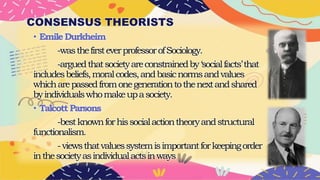
CONSENSUS THEORISTS
• EmileDurkheim
-wasthefirsteverprofessorofSociology.
-arguedthatsocietyareconstrainedby‘socialfacts’that
includesbeliefs,moralcodes,andbasicnormsandvalues
whicharepassedfromonegenerationtothenextandshared
byindividualswhomakeupasociety.
• TalcottParsons
-bestknownforhissocialactiontheoryandstructural
functionalism.
-viewsthatvaluessystemisimportantforkeepingorder
inthesocietyasindividualactsinways
CONFLICT THEORIST
•Karl Marx
- thefatherofcommunism.
- initiated Conflict Theory, an
approach of viewing thesocietythrough the
inequalitiesin societythatgives rise to class
conflicts.
-viewsocietyas fragmentedintogroups
thatcompete for socialand economic
resources.
•Consensus theorists is concerned with the
maintenance or continuationof social order in society,
in relationto accepted norms, values, rules and
regulations as widely accepted or collectivelyby the
society or within a particular society itself.
•Conflict theorists are interested in how society’s
institutions– the family, government, religion,
education, and the media – may help to maintainthe
privileges of some groups and keep others in a
subservient position.
CONSENSUS CONFLICT
 Examine values integration
in society.
 Examine conflicts of interest
and coercion that holds
society together.
 Absence of conflict is seen
as the equilibrium sets on
a general or widespread
agreement among all
members of a particular
society.
 Focus on the heterogeneous
nature of society and the
differential distribution of
political and social power—
Horton and Hunt ( 1984).
ConsensusTheories Conflict Theories
 Shared norms and
values as fundamental
to society
 Emphasize the
dominance of some
social groups
 Focus on social order
based on tacit
agreements
 See social order as
manipulation and control
by dominant groups.
 Social change occurs in
slow and orderly
fashion
 Social change occurs
rapidly and in a
disorderly fashion
Consensus Theory in the Educational
System.
 Schools teach generally accepted norms and
values.
 Education System follows consensual norms
and values.
 Students learn to agree on how to behave in
some social situations. e.g. greetings & school/
classroom rules
 School community & Stakeholders are involve
in School- Based Management.
 Education is essential to maintain the
modern workforce.
Conflict Theory in the Educational
System.
 Educational system reinforces and perpetuates
social inequalities that arise from differences in
class, gender, race and ethnicity.
 Educational System preserves the status quo and
push people of lower status into obedience.
 Education works as a means by which those on
power stay in power.
 The fulfillment of one’s Education closely link to
social class.
 Schools contribute to the unequal distribution of
people into jobs in society.

CONSENSUS AND CONFLICT THEORY.pptx

  • 1.
  • 2.
    •Define Consensus andConflict Theories. •Differentiate Consensus and Conflict Theories. •Discuss Consensus and Conflict Theories in the Educational System. Learning Objectives:
  • 3.
    CONSENSUS & CONFLICTTHEORY •Consensus •is a general or widespread agreement among all members of a particular society. •Conflict •is a clash between ideas, principles and people.
  • 4.
  • 5.
    CONFLICT THEORIST •Karl Marx -thefatherofcommunism. - initiated Conflict Theory, an approach of viewing thesocietythrough the inequalitiesin societythatgives rise to class conflicts. -viewsocietyas fragmentedintogroups thatcompete for socialand economic resources.
  • 6.
    •Consensus theorists isconcerned with the maintenance or continuationof social order in society, in relationto accepted norms, values, rules and regulations as widely accepted or collectivelyby the society or within a particular society itself. •Conflict theorists are interested in how society’s institutions– the family, government, religion, education, and the media – may help to maintainthe privileges of some groups and keep others in a subservient position.
  • 7.
    CONSENSUS CONFLICT  Examinevalues integration in society.  Examine conflicts of interest and coercion that holds society together.  Absence of conflict is seen as the equilibrium sets on a general or widespread agreement among all members of a particular society.  Focus on the heterogeneous nature of society and the differential distribution of political and social power— Horton and Hunt ( 1984).
  • 8.
    ConsensusTheories Conflict Theories Shared norms and values as fundamental to society  Emphasize the dominance of some social groups  Focus on social order based on tacit agreements  See social order as manipulation and control by dominant groups.  Social change occurs in slow and orderly fashion  Social change occurs rapidly and in a disorderly fashion
  • 9.
    Consensus Theory inthe Educational System.  Schools teach generally accepted norms and values.  Education System follows consensual norms and values.  Students learn to agree on how to behave in some social situations. e.g. greetings & school/ classroom rules  School community & Stakeholders are involve in School- Based Management.  Education is essential to maintain the modern workforce.
  • 10.
    Conflict Theory inthe Educational System.  Educational system reinforces and perpetuates social inequalities that arise from differences in class, gender, race and ethnicity.  Educational System preserves the status quo and push people of lower status into obedience.  Education works as a means by which those on power stay in power.  The fulfillment of one’s Education closely link to social class.  Schools contribute to the unequal distribution of people into jobs in society.