Basics of Marxism  Leading to an  Understanding of Communism   Basnillo, Ruth Ann Angiwot, Jennifer Franco, Kim Nebres, Annaliza Rafael, Henry
Understanding Marx’s Theories
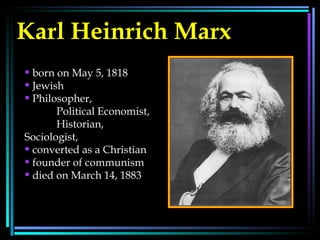
Karl Heinrich Marx   born on May 5, 1818 Jewish Philosopher,  Political Economist,  Historian,  Sociologist, converted as a Christian founder of communism died on March 14, 1883
Communist Manifesto published by Marx and Engels on behalf of a group idealistic workers originally drafted as a program for an international “communist league” become one of the most important political documents of all time left an incredible mark on human progress
Key Demands   Abolition of property in land and application of all rents on land to public purposes. A heavy progressive or graduated income tax.  Abolition of all right of inheritance.  Confiscation of the property of all emigrants and rebels.
Key Demands Centralization of credit in the hands of the state, by means of a national bank with state capital and an exclusive monopoly.  Centralization of communication and transport in the hands of the state.  Equal liability of all to labor. Establishment of industrial armies, especially for agriculture.
Key Demands Extension of factories and instruments of production owned by the state, the bringing in cultivation of waste lands, and the improvement of the soil generally in accordance with a common plan.
Key Demands Combination of agriculture with manufacturing industries; gradual abolition of the distinction between town and country, by a more equable distribution of population over the country.  Free education for all children in public schools. Abolition of children's factory labor in its resent form.
Three Parts of Marxism   Philosophical basis Derives much from Hegel Neatly inverts the key central idea of Hegelian perspective Theories of political economy  Follow from the philosophical position Theory of Surplus Value  Labor theory of Value Theory of revolution
A Materialist World   our ideas do not make the world, the world makes are ideas  the dialect made Marx and Engels theories scientific  free of mysticism and  metaphysics but describing something like a scientific “law” (inevitably)
Modernist Optimism   a view that underneath the haphazard and contingent ordinariness of everyday life were certain dynamic power that while remaining hidden, controlled the way things changed and determine the future  materialistic and positivistic  believing in progress through an accumulated of knowledge
Class Struggles
Class Struggle active expression of class conflict looked at from any kind of socialist perspective  Main class struggle Bourgeoisie Proletariat
Class   refers to the hierarchical distinctions between individuals or groups in societies or cultures social classes in capitalist societies  Bourgeoisie  Petite Bourgeoisie Proletariat  lumpenproletariat  landlords  peasantry and farmers
2 Main Class Struggles
Bourgeoisie   those who own means of production control the process of production buy labor power from proletariat Their wealth depend on the work of the proletariat exploit proletariat
Proletariat   individuals who sell their labor power  add value to the products  do not own means of production  labor power generates surplus value greater than the worker's wages
Stages of Development
Stages of Development   Primitive Communism Slave Society Feudalism Capitalism Socialism Communism
Primitive Communism   as seen in cooperative tribal societies  everyone would share in what was produced by hunting and gathering  no private property  primitive society produced no surplus  few things that existed for any length of time were held communally  there would have been no state
Slave Society   when the tribe becomes a city-state. Aristocracy is born  Systematic exploitation of labour  Compelled to work for another  held against their will from the time of their capture, purchase, or birth  deprived of the right to leave, to refuse to work, or to receive compensation in return for their labour
Feudalism   aristocracy is the ruling class Merchants develop into capitalists derived from the Latin word  feodum   composed of a set of reciprocal legal and military obligations among the warrior nobility  revolving around the three key concepts  lord Vassals fiefs
Capitalism   ruling class, who create and employ the true working class  Economic system in which the private ownership of property is protected by law  mode of production characterized by predominant private ownership of the means of production distribution and  exchange in a mainly market economy
has been dominant in the Western world since the end of feudalism  provided the main, but not exclusive, means of industrialization throughout much of the world  Capitalism
Socialism   Dictatorship of the Proletariat  workers gain class consciousness  share the belief that capitalism unfairly concentrates power  achieved via class struggle and a proletarian revolution which represents the  transitional  stage between capitalism and communism
Communism   classless and stateless society  socioeconomic structure and political ideology based on common ownership of the means of production and property in general
The Prophecy Revolution would be preceded by a series of intensifying crisis  Goods would be produced which the impoverished proletariat could not afford to buy  More workers would be forced out of work because their labor was not needed
The Prophecy This would drive wages down further  Lessen the ability of people to buy the products of capitalism Enterprises would collapse and be swallowed by larger organization in the centralization of capital
Class Status and World View
Class  Identity of a social class is derived from its relationship to the means of production. Social Classes in Capitalist Societies Proletariat Bourgeoisie  very wealthy Bourgeoisie Petit Bourgeoisie  Lumpenproletariat  Landlords  Peasantry and farmers
Class Antagonism Hostility Between two antagonistic classes. Exploiters  Exploited
Revolution
Capitalism’s Role Capitalism: constitutes necessary and progressive step toward ultimate human liberation  > Cause: * Capitalists are alienated from their true human nature
Capitalism’s Role Capitalism cannot resolve the internal contradiction between its forces of production and its relation of production  > Forces of production: actual  material methods of production  previously in a given society >Relations of Production: human  side of the production process
Forces of production promises social wealth but relation of production remains unchanged. In short, capitalism produces the means of human liberation but prevents its realization
Rise of Revolutionary Consciousness in the boom and bust cycle of capitalism: 1. Poor becomes progressively poorer  and their lives more intolerable. 2. Simple contrast with the bourgeoisie  becomes too flagrant to be ignored  because proletarian ranks have swelled.
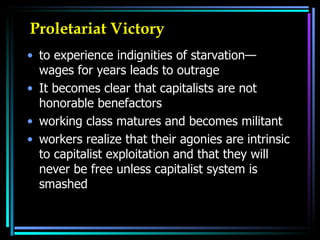
Proletariat Victory to experience indignities of starvation— wages for years leads to outrage It becomes clear that capitalists are not honorable benefactors working class matures and becomes militant  workers realize that their agonies are intrinsic to capitalist exploitation and that they will never be free unless capitalist system is smashed
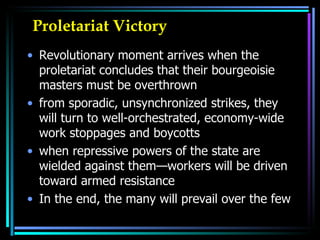
Proletariat Victory Revolutionary moment arrives when the proletariat concludes that their bourgeoisie masters must be overthrown  from sporadic, unsynchronized strikes, they will turn to well-orchestrated, economy-wide work stoppages and boycotts  when repressive powers of the state are wielded against them—workers will be driven toward armed resistance  In the end, the many will prevail over the few
Proletariat  individuals who sell their labor power  add value to the products  do not own means of production labor power generates surplus value greater than the worker's wages
Proletariat as Universal Embodiment of everything that is wrong with capitalism very being refutes the bourgeoisies’ claim to have created a just and human society  they do not wish to merely alleviate their own suffering  their aim is to abolish themselves as a class because their degradation is limitless, and their dehumanization total, their aims are universal as well
Dictatorship of the Proletariat turns the table on what had been the dictatorship of the bourgeoisie for Marx, this would be more human and less dictatorial than its predecessor Role of the great majority over the few minority Coercive only in order to serve broad interests of humanity explicitly a transitional stage
DAWN OF COMMUNISM arrives when the workers: >take control of the means of production >humanize the relation of production >unleash the forces of production allowing them to work without impediment for the general good release of the forces of production for the destructions of capitalism will make for a quantum leap in human material abundance
WITHERING OF THE STATE results when a super-abundant, classless society would be a society without dissension or coercion > State would lose its functions > State would lack anyone to  repress >in place would only be the  administration of things for the  general  good proletariat will have abolished itself and created a universal society
FUTURE COMMUNIST SOCIETY Marx ideal communist society is democratic in a radical sense work, though it would still be necessary, would no longer be drudgery possessiveness would disappear as its cause, scarcity was overcome  conception of cooperative public ownership will be a communist alternative to private ownership
FUTURE COMMUNIST SOCIETY No longer would individuals be appendages to their social belongings and social statuses  family would be replaced by new forms of human association >equality, free choice, love, and human need are decisive there will be a creation of international working-class unity
Analysis Although Marxism is an alternative for capitalism was a great idea, we still found this not good. Our reason is that if the country which is not that advanced would grasp this concept and apply this; we would also have a hard time. The equality in democracy that we have today could be means of having the will to achieve something. If communism would be applied in the Philippines, then, most of us would just be dependent since we could still have something for our living due to the equal distribution of resources.

Marxism

  • 1.
    Basics of Marxism Leading to an Understanding of Communism Basnillo, Ruth Ann Angiwot, Jennifer Franco, Kim Nebres, Annaliza Rafael, Henry
  • 2.
  • 3.
    Karl Heinrich Marx born on May 5, 1818 Jewish Philosopher, Political Economist, Historian, Sociologist, converted as a Christian founder of communism died on March 14, 1883
  • 4.
    Communist Manifesto publishedby Marx and Engels on behalf of a group idealistic workers originally drafted as a program for an international “communist league” become one of the most important political documents of all time left an incredible mark on human progress
  • 5.
    Key Demands Abolition of property in land and application of all rents on land to public purposes. A heavy progressive or graduated income tax. Abolition of all right of inheritance. Confiscation of the property of all emigrants and rebels.
  • 6.
    Key Demands Centralizationof credit in the hands of the state, by means of a national bank with state capital and an exclusive monopoly. Centralization of communication and transport in the hands of the state. Equal liability of all to labor. Establishment of industrial armies, especially for agriculture.
  • 7.
    Key Demands Extensionof factories and instruments of production owned by the state, the bringing in cultivation of waste lands, and the improvement of the soil generally in accordance with a common plan.
  • 8.
    Key Demands Combinationof agriculture with manufacturing industries; gradual abolition of the distinction between town and country, by a more equable distribution of population over the country. Free education for all children in public schools. Abolition of children's factory labor in its resent form.
  • 9.
    Three Parts ofMarxism Philosophical basis Derives much from Hegel Neatly inverts the key central idea of Hegelian perspective Theories of political economy Follow from the philosophical position Theory of Surplus Value Labor theory of Value Theory of revolution
  • 10.
    A Materialist World our ideas do not make the world, the world makes are ideas the dialect made Marx and Engels theories scientific free of mysticism and metaphysics but describing something like a scientific “law” (inevitably)
  • 11.
    Modernist Optimism a view that underneath the haphazard and contingent ordinariness of everyday life were certain dynamic power that while remaining hidden, controlled the way things changed and determine the future materialistic and positivistic believing in progress through an accumulated of knowledge
  • 12.
  • 13.
    Class Struggle activeexpression of class conflict looked at from any kind of socialist perspective Main class struggle Bourgeoisie Proletariat
  • 14.
    Class refers to the hierarchical distinctions between individuals or groups in societies or cultures social classes in capitalist societies Bourgeoisie Petite Bourgeoisie Proletariat lumpenproletariat landlords peasantry and farmers
  • 15.
    2 Main ClassStruggles
  • 16.
    Bourgeoisie those who own means of production control the process of production buy labor power from proletariat Their wealth depend on the work of the proletariat exploit proletariat
  • 17.
    Proletariat individuals who sell their labor power add value to the products do not own means of production labor power generates surplus value greater than the worker's wages
  • 18.
  • 19.
    Stages of Development Primitive Communism Slave Society Feudalism Capitalism Socialism Communism
  • 20.
    Primitive Communism as seen in cooperative tribal societies everyone would share in what was produced by hunting and gathering no private property primitive society produced no surplus few things that existed for any length of time were held communally there would have been no state
  • 21.
    Slave Society when the tribe becomes a city-state. Aristocracy is born Systematic exploitation of labour Compelled to work for another held against their will from the time of their capture, purchase, or birth deprived of the right to leave, to refuse to work, or to receive compensation in return for their labour
  • 22.
    Feudalism aristocracy is the ruling class Merchants develop into capitalists derived from the Latin word feodum composed of a set of reciprocal legal and military obligations among the warrior nobility revolving around the three key concepts lord Vassals fiefs
  • 23.
    Capitalism ruling class, who create and employ the true working class Economic system in which the private ownership of property is protected by law mode of production characterized by predominant private ownership of the means of production distribution and exchange in a mainly market economy
  • 24.
    has been dominantin the Western world since the end of feudalism provided the main, but not exclusive, means of industrialization throughout much of the world Capitalism
  • 25.
    Socialism Dictatorship of the Proletariat workers gain class consciousness share the belief that capitalism unfairly concentrates power achieved via class struggle and a proletarian revolution which represents the transitional stage between capitalism and communism
  • 26.
    Communism classless and stateless society socioeconomic structure and political ideology based on common ownership of the means of production and property in general
  • 27.
    The Prophecy Revolutionwould be preceded by a series of intensifying crisis Goods would be produced which the impoverished proletariat could not afford to buy More workers would be forced out of work because their labor was not needed
  • 28.
    The Prophecy Thiswould drive wages down further Lessen the ability of people to buy the products of capitalism Enterprises would collapse and be swallowed by larger organization in the centralization of capital
  • 29.
    Class Status andWorld View
  • 30.
    Class Identityof a social class is derived from its relationship to the means of production. Social Classes in Capitalist Societies Proletariat Bourgeoisie very wealthy Bourgeoisie Petit Bourgeoisie Lumpenproletariat Landlords Peasantry and farmers
  • 31.
    Class Antagonism HostilityBetween two antagonistic classes. Exploiters Exploited
  • 32.
  • 33.
    Capitalism’s Role Capitalism:constitutes necessary and progressive step toward ultimate human liberation > Cause: * Capitalists are alienated from their true human nature
  • 34.
    Capitalism’s Role Capitalismcannot resolve the internal contradiction between its forces of production and its relation of production > Forces of production: actual material methods of production previously in a given society >Relations of Production: human side of the production process
  • 35.
    Forces of productionpromises social wealth but relation of production remains unchanged. In short, capitalism produces the means of human liberation but prevents its realization
  • 36.
    Rise of RevolutionaryConsciousness in the boom and bust cycle of capitalism: 1. Poor becomes progressively poorer and their lives more intolerable. 2. Simple contrast with the bourgeoisie becomes too flagrant to be ignored because proletarian ranks have swelled.
  • 37.
    Proletariat Victory toexperience indignities of starvation— wages for years leads to outrage It becomes clear that capitalists are not honorable benefactors working class matures and becomes militant workers realize that their agonies are intrinsic to capitalist exploitation and that they will never be free unless capitalist system is smashed
  • 38.
    Proletariat Victory Revolutionarymoment arrives when the proletariat concludes that their bourgeoisie masters must be overthrown from sporadic, unsynchronized strikes, they will turn to well-orchestrated, economy-wide work stoppages and boycotts when repressive powers of the state are wielded against them—workers will be driven toward armed resistance In the end, the many will prevail over the few
  • 39.
    Proletariat individualswho sell their labor power add value to the products do not own means of production labor power generates surplus value greater than the worker's wages
  • 40.
    Proletariat as UniversalEmbodiment of everything that is wrong with capitalism very being refutes the bourgeoisies’ claim to have created a just and human society they do not wish to merely alleviate their own suffering their aim is to abolish themselves as a class because their degradation is limitless, and their dehumanization total, their aims are universal as well
  • 41.
    Dictatorship of theProletariat turns the table on what had been the dictatorship of the bourgeoisie for Marx, this would be more human and less dictatorial than its predecessor Role of the great majority over the few minority Coercive only in order to serve broad interests of humanity explicitly a transitional stage
  • 42.
    DAWN OF COMMUNISMarrives when the workers: >take control of the means of production >humanize the relation of production >unleash the forces of production allowing them to work without impediment for the general good release of the forces of production for the destructions of capitalism will make for a quantum leap in human material abundance
  • 43.
    WITHERING OF THESTATE results when a super-abundant, classless society would be a society without dissension or coercion > State would lose its functions > State would lack anyone to repress >in place would only be the administration of things for the general good proletariat will have abolished itself and created a universal society
  • 44.
    FUTURE COMMUNIST SOCIETYMarx ideal communist society is democratic in a radical sense work, though it would still be necessary, would no longer be drudgery possessiveness would disappear as its cause, scarcity was overcome conception of cooperative public ownership will be a communist alternative to private ownership
  • 45.
    FUTURE COMMUNIST SOCIETYNo longer would individuals be appendages to their social belongings and social statuses family would be replaced by new forms of human association >equality, free choice, love, and human need are decisive there will be a creation of international working-class unity
  • 46.
    Analysis Although Marxismis an alternative for capitalism was a great idea, we still found this not good. Our reason is that if the country which is not that advanced would grasp this concept and apply this; we would also have a hard time. The equality in democracy that we have today could be means of having the will to achieve something. If communism would be applied in the Philippines, then, most of us would just be dependent since we could still have something for our living due to the equal distribution of resources.