Approaches in Social Sciences
1. Structural-Functionalism
2. Marxism
3. Symbolic Interactionism
4. Psychoanalysis
5. Rational Choice
6. Institutionalism
7. Feminist Theory
8. Hermeneutical Phenomenology
9. Human-Environment Systems
Structural
Functionalism
Objectives
• At the end of the lesson, you are
expected to:
–Understand the concept of
Structural-Functionalism
–Identify the early functionalists
–Determine the manifest and latent
functions and dysfunctions of
sociocultural phenomena
What is Structural
Functionalism?
Structural- Functionalism
Focus: The organization of society and the
relationships between broad social units, such
as Institutions.
The group is the unit of analysis.
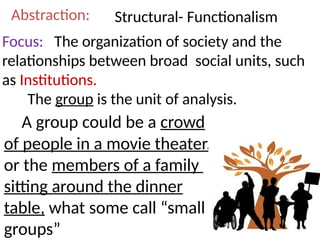
A group could be a crowd
of people in a movie theater,
or the members of a family
sitting around the dinner
table, what some call “small
groups”
Abstraction:
An institution is an established organization, practice,
or custom that plays a significant role in a society. It
can refer to various entities, including:
Organizations: This could be educational institutions,
governmental bodies, religious groups, or financial
entities.
Social Practices: Institutions also include social norms
and systems, such as marriage, the legal system, or
the healthcare system.
Cultural Norms: Institutions can refer to long-
standing traditions or practices that are integral to a
society's way of life, like rites of passage or traditional
ceremonies.
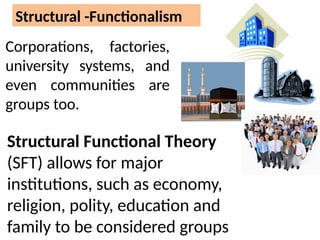
Structural -Functionalism
Corporations, factories,
university systems, and
even communities are
groups too.
Structural Functional Theory
(SFT) allows for major
institutions, such as economy,
religion, polity, education and
family to be considered groups
Structural Functionalism
The Functionalists Perspectives
A perspective is
simply a way of
looking at the
world.
A theory is a set of
interrelated propositions
or principles designed to
answer a question or
explain a particular
phenomenon; it
provides us with a
perspective
Structural
Relating to the way
something is built or
organized.
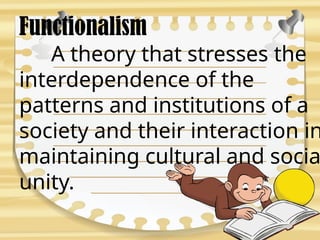
Functionalism
A theory that stresses the
interdependence of the
patterns and institutions of a
society and their interaction in
maintaining cultural and socia
unity.
Structural Functionalism
Functionalism, also called
structural-functional theory, sees
society as a structure with interrelated
parts designed to meet the biological
and social needs of the individuals in
that society.
Structural Functionalism
*It is a sociological theory that
attempts to explain why society
functions the way it does by focusing
on relationships between various
social institutions that make up
society.
Structural-Functionalism
Sociological theories - help us to explain
and predict the social world in which we
live in.
The Functionalists Perspectives
The Functionalists Perspectives is based largely
on the works of Herbert Spencer, Emile Durkheim,
Talcott Parsons, and Robert Merton.
According to Functionalism, society is a
system of interconnected parts that work
together in harmony to maintain a state of
balance and social equilibrium for the whole.
Structural Functionalism
The Functionalists Perspectives
For example:
Each of the social institutions contributes
important functions for society: family provides a
context for reproducing, nurturing, and socializing
children. Education offers a way to transmit a
society’s skills, knowledge, and culture to its youth.
Politics provides a means of governing members of
society. Economics provides for the production,
distribution, and consumption of goods and services.
And religion provides moral guidance and an outlet
for worship of a higher power.
Structural -Functionalism
The Functionalists Perspectives
The Functionalists perspectives emphasizes
the interconnectedness of society by focusing
on how each part influences and is influenced
by other parts.
For example:
The increase in single parent and dual-earner
families has contributed to the number of
children who are failing in school because
parents have become less available to supervise
their children’s homework.
Structural-Functionalism
The Functionalists Perspectives
For example:
As a result of changes in technology, colleges
are offering more technical programs, and many
adults are returning to school to learn new skills that
are required in the workplace.
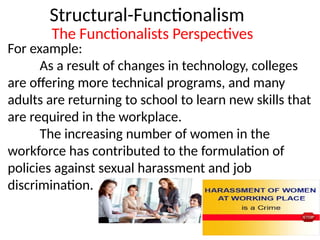
The increasing number of women in the
workforce has contributed to the formulation of
policies against sexual harassment and job
discrimination.
Structural Functionalism
Functionalists use the terms functional
and dysfunctional to describe the effects
of social elements on society.
o Elements of society are functional if they
contribute to social stability.
o They are dysfunctional if they disrupt
social stability.
Structural Functionalism
Some aspects of society can be both functional
and dysfunctional.
For example, crime is dysfunctional in that
it is associated with physical violence, loss of
property, and fear.
But according to Durkheim and other
functionalists, crime is also functional for
society because it leads to heightened
awareness of shared moral bonds and
increased social cohesion.
Structural Functionalism
Sociologists have identified two types of
functions:
A. Manifest functions are consequences
that are intended and commonly
recognized.
B. Latent functions are consequences that
are unintended and often hidden.
Structural Functionalism
For example:
The manifest function of education is to
transmit knowledge and skills to society’s
youth. But public elementary schools also
serve as babysitters for employed parents, and
colleges offer a place for young adults to meet
potential mates. The baby-sitting and mate-
selection functions are not the intended or
commonly recognized functions of education;
hence they are latent functions
Structural-Functionalism
The organization of society and the relationships between
broad social units, such as Institutions.
The group is the unit of analysis.
A group could be a crowd of people in a movie theater, or the
members of a family sitting around the dinner table, what
some call “small groups”
Corporations, factories, university systems, and even
communities are groups too.
Structural-Functional Theory (SFT) allows for major
institutions, such as economy, religion, politics, education,
and family to be considered as groups.
Structural-Functionalism
Background and History
The early functionalists were anthropologists (i.e., Levi- Strauss,
Radcliff-Brown, Malinowski, and others). Claude Levi-Strauss Alfred
Radcliffe-Brown Bronislaw Malinowski
They were seminal ((of a work, event, moment, or figure) strongly
influencing later developments)thinkers of the middle 1800s who made
direct observations of primitive cultures, theorizing about the
organization of these folk in relation to Western society.
Their theories were often quite simple and required only a few
assumptions. The point they were making was this: Individual and
group behavior, more often than not, serves a FUNCTION for the larger
society.
Who are the
proponents of this
theory?
Theorists Responsible
*Auguste Comte
*Herbert Spencer
*Talcott Parsons
*Robert Merton
*Gabriel Almond and Bingham Powell
*Kingsley Davis and Wilbert E. Moore
Key Ideas Behind
the Theory
Key Ideas
1. Systems have a property of order and
interdependent parts.
2. Systems tend towards self-maintaining
order or equilibrium.
3. The system may be static or involved in
an ordered process of change.
Key Ideas
4. The nature of one part of the system has
an impact on the form that other parts
take.
5. Systems maintain boundaries within
their environments.
Key Ideas
6. Allocation and integration are two
fundamental processes necessary for a given
state of equilibrium within a system.
7. Systems tend towards self-maintenance
involving control of boundaries and
relationships of parts to the whole, control of
the environment and control of tendencies to
change the system from within.
Key Assumptions
about the Theory
Key Assumptions
*Societies and social units have order and
interdependent parts like a biological
organism held together by cooperation
and orderliness.
*Societies and social units work toward
the natural or smooth working of the
system, ie towards equilibrium.
Key Assumptions
*Societies and social units, just as
natural(external) environments, are
separate or distinct but adapt to each
other-if one or more parts conflict with
others, others must adapt.
Criticisms about the
Theory
Criticisms
*In the 1960s, functionalism was criticized for
being unable to account for social change, or
for structural contradictions and conflict.
*It ignores inequalities including race, gender,
class, which causes tension and conflict.
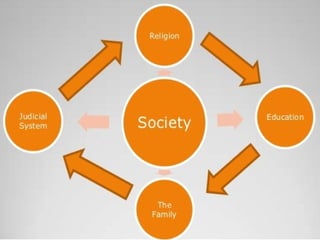
How these institutions create balance in the society.
Concept map

A 3 - major approaches - structural functionalism.pptx

  • 1.
    Approaches in SocialSciences 1. Structural-Functionalism 2. Marxism 3. Symbolic Interactionism 4. Psychoanalysis 5. Rational Choice 6. Institutionalism 7. Feminist Theory 8. Hermeneutical Phenomenology 9. Human-Environment Systems
  • 2.
  • 3.
    Objectives • At theend of the lesson, you are expected to: –Understand the concept of Structural-Functionalism –Identify the early functionalists –Determine the manifest and latent functions and dysfunctions of sociocultural phenomena
  • 4.
  • 5.
    Structural- Functionalism Focus: Theorganization of society and the relationships between broad social units, such as Institutions. The group is the unit of analysis. A group could be a crowd of people in a movie theater, or the members of a family sitting around the dinner table, what some call “small groups” Abstraction:
  • 6.
    An institution isan established organization, practice, or custom that plays a significant role in a society. It can refer to various entities, including: Organizations: This could be educational institutions, governmental bodies, religious groups, or financial entities. Social Practices: Institutions also include social norms and systems, such as marriage, the legal system, or the healthcare system. Cultural Norms: Institutions can refer to long- standing traditions or practices that are integral to a society's way of life, like rites of passage or traditional ceremonies.

  • 7.
    Structural -Functionalism Corporations, factories, universitysystems, and even communities are groups too. Structural Functional Theory (SFT) allows for major institutions, such as economy, religion, polity, education and family to be considered groups
  • 8.
    Structural Functionalism The FunctionalistsPerspectives A perspective is simply a way of looking at the world. A theory is a set of interrelated propositions or principles designed to answer a question or explain a particular phenomenon; it provides us with a perspective
  • 9.
    Structural Relating to theway something is built or organized.
  • 10.
    Functionalism A theory thatstresses the interdependence of the patterns and institutions of a society and their interaction in maintaining cultural and socia unity.
  • 11.
    Structural Functionalism Functionalism, alsocalled structural-functional theory, sees society as a structure with interrelated parts designed to meet the biological and social needs of the individuals in that society.
  • 12.
    Structural Functionalism *It isa sociological theory that attempts to explain why society functions the way it does by focusing on relationships between various social institutions that make up society.
  • 14.
    Structural-Functionalism Sociological theories -help us to explain and predict the social world in which we live in. The Functionalists Perspectives The Functionalists Perspectives is based largely on the works of Herbert Spencer, Emile Durkheim, Talcott Parsons, and Robert Merton. According to Functionalism, society is a system of interconnected parts that work together in harmony to maintain a state of balance and social equilibrium for the whole.
  • 15.
    Structural Functionalism The FunctionalistsPerspectives For example: Each of the social institutions contributes important functions for society: family provides a context for reproducing, nurturing, and socializing children. Education offers a way to transmit a society’s skills, knowledge, and culture to its youth. Politics provides a means of governing members of society. Economics provides for the production, distribution, and consumption of goods and services. And religion provides moral guidance and an outlet for worship of a higher power.
  • 16.
    Structural -Functionalism The FunctionalistsPerspectives The Functionalists perspectives emphasizes the interconnectedness of society by focusing on how each part influences and is influenced by other parts. For example: The increase in single parent and dual-earner families has contributed to the number of children who are failing in school because parents have become less available to supervise their children’s homework.
  • 17.
    Structural-Functionalism The Functionalists Perspectives Forexample: As a result of changes in technology, colleges are offering more technical programs, and many adults are returning to school to learn new skills that are required in the workplace. The increasing number of women in the workforce has contributed to the formulation of policies against sexual harassment and job discrimination.
  • 18.
    Structural Functionalism Functionalists usethe terms functional and dysfunctional to describe the effects of social elements on society. o Elements of society are functional if they contribute to social stability. o They are dysfunctional if they disrupt social stability.
  • 19.
    Structural Functionalism Some aspectsof society can be both functional and dysfunctional. For example, crime is dysfunctional in that it is associated with physical violence, loss of property, and fear. But according to Durkheim and other functionalists, crime is also functional for society because it leads to heightened awareness of shared moral bonds and increased social cohesion.
  • 20.
    Structural Functionalism Sociologists haveidentified two types of functions: A. Manifest functions are consequences that are intended and commonly recognized. B. Latent functions are consequences that are unintended and often hidden.
  • 21.
    Structural Functionalism For example: Themanifest function of education is to transmit knowledge and skills to society’s youth. But public elementary schools also serve as babysitters for employed parents, and colleges offer a place for young adults to meet potential mates. The baby-sitting and mate- selection functions are not the intended or commonly recognized functions of education; hence they are latent functions
  • 22.
    Structural-Functionalism The organization ofsociety and the relationships between broad social units, such as Institutions. The group is the unit of analysis. A group could be a crowd of people in a movie theater, or the members of a family sitting around the dinner table, what some call “small groups” Corporations, factories, university systems, and even communities are groups too. Structural-Functional Theory (SFT) allows for major institutions, such as economy, religion, politics, education, and family to be considered as groups.
  • 23.
    Structural-Functionalism Background and History Theearly functionalists were anthropologists (i.e., Levi- Strauss, Radcliff-Brown, Malinowski, and others). Claude Levi-Strauss Alfred Radcliffe-Brown Bronislaw Malinowski They were seminal ((of a work, event, moment, or figure) strongly influencing later developments)thinkers of the middle 1800s who made direct observations of primitive cultures, theorizing about the organization of these folk in relation to Western society. Their theories were often quite simple and required only a few assumptions. The point they were making was this: Individual and group behavior, more often than not, serves a FUNCTION for the larger society.
  • 24.
    Who are the proponentsof this theory?
  • 25.
    Theorists Responsible *Auguste Comte *HerbertSpencer *Talcott Parsons *Robert Merton *Gabriel Almond and Bingham Powell *Kingsley Davis and Wilbert E. Moore
  • 26.
  • 27.
    Key Ideas 1. Systemshave a property of order and interdependent parts. 2. Systems tend towards self-maintaining order or equilibrium. 3. The system may be static or involved in an ordered process of change.
  • 28.
    Key Ideas 4. Thenature of one part of the system has an impact on the form that other parts take. 5. Systems maintain boundaries within their environments.
  • 29.
    Key Ideas 6. Allocationand integration are two fundamental processes necessary for a given state of equilibrium within a system. 7. Systems tend towards self-maintenance involving control of boundaries and relationships of parts to the whole, control of the environment and control of tendencies to change the system from within.
  • 30.
  • 31.
    Key Assumptions *Societies andsocial units have order and interdependent parts like a biological organism held together by cooperation and orderliness. *Societies and social units work toward the natural or smooth working of the system, ie towards equilibrium.
  • 32.
    Key Assumptions *Societies andsocial units, just as natural(external) environments, are separate or distinct but adapt to each other-if one or more parts conflict with others, others must adapt.
  • 33.
  • 34.
    Criticisms *In the 1960s,functionalism was criticized for being unable to account for social change, or for structural contradictions and conflict. *It ignores inequalities including race, gender, class, which causes tension and conflict.
  • 36.
    How these institutionscreate balance in the society. Concept map