STRUCTURAL-FUNCTIONALISM:
TALCOTT PARSONS & ROBERT
MERTON
INTRODUCTION TO
STRUCTURAL-FUNCTIONALISM
• A sociological perspective that sees society as a complex
system
• Emphasizes the interdependence of social institutions
• Society functions through social structures that work
together
TALCOTT PARSONS' THEORY
• • Developed the AGIL Model for societal stability:
• - A (Adaptation): Economic system adjusts to environment
• - G (Goal Attainment): Political system sets and achieves
goals
• - I (Integration): Social system maintains harmony
• - L (Latency): Cultural system preserves values
• • Society functions like a living organism with interdependent
parts
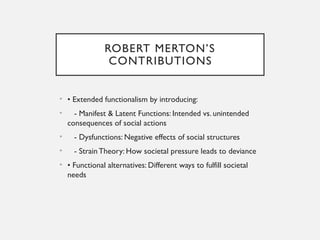
ROBERT MERTON’S
CONTRIBUTIONS
• • Extended functionalism by introducing:
• - Manifest & Latent Functions: Intended vs. unintended
consequences of social actions
• - Dysfunctions: Negative effects of social structures
• - StrainTheory: How societal pressure leads to deviance
• • Functional alternatives: Different ways to fulfill societal
needs
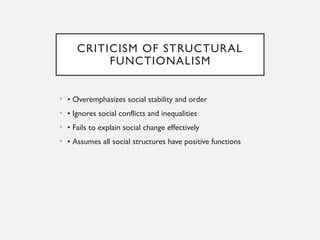
CRITICISM OF STRUCTURAL
FUNCTIONALISM
• • Overemphasizes social stability and order
• • Ignores social conflicts and inequalities
• • Fails to explain social change effectively
• • Assumes all social structures have positive functions
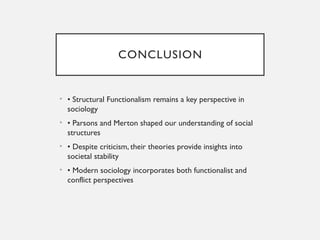
CONCLUSION
• • Structural Functionalism remains a key perspective in
sociology
• • Parsons and Merton shaped our understanding of social
structures
• • Despite criticism, their theories provide insights into
societal stability
• • Modern sociology incorporates both functionalist and
conflict perspectives

Structural functionalism (Person and Merton)

  • 1.
  • 2.
    INTRODUCTION TO STRUCTURAL-FUNCTIONALISM • Asociological perspective that sees society as a complex system • Emphasizes the interdependence of social institutions • Society functions through social structures that work together
  • 3.
    TALCOTT PARSONS' THEORY •• Developed the AGIL Model for societal stability: • - A (Adaptation): Economic system adjusts to environment • - G (Goal Attainment): Political system sets and achieves goals • - I (Integration): Social system maintains harmony • - L (Latency): Cultural system preserves values • • Society functions like a living organism with interdependent parts
  • 4.
    ROBERT MERTON’S CONTRIBUTIONS • •Extended functionalism by introducing: • - Manifest & Latent Functions: Intended vs. unintended consequences of social actions • - Dysfunctions: Negative effects of social structures • - StrainTheory: How societal pressure leads to deviance • • Functional alternatives: Different ways to fulfill societal needs
  • 5.
    CRITICISM OF STRUCTURAL FUNCTIONALISM •• Overemphasizes social stability and order • • Ignores social conflicts and inequalities • • Fails to explain social change effectively • • Assumes all social structures have positive functions
  • 6.
    CONCLUSION • • StructuralFunctionalism remains a key perspective in sociology • • Parsons and Merton shaped our understanding of social structures • • Despite criticism, their theories provide insights into societal stability • • Modern sociology incorporates both functionalist and conflict perspectives