Analyze the
following
pictures
1
NUCLEA
R
FAMILY 2
Extende
d
Family 3
4
Transnational
Family
5
Reconstituted
Family
7
CONSE
NSUS
8
Structural-
functionalis
m
At the end of this session, you should
be able to:
× Explain the theories on Structural
Functionalism.
× Analyze the basic concepts and principles of
the structural functionalism theory.
× Appreciate one’s personal and social
experiences using the theories structural
functionalism
10
LESSON 1: STRUCTURAL
FUNCTIONALISM
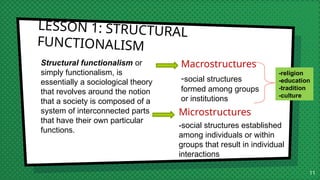
Structural functionalism or
simply functionalism, is
essentially a sociological theory
that revolves around the notion
that a society is composed of a
system of interconnected parts
that have their own particular
functions.
Macrostructures
-social structures
formed among groups
or institutions
11
-religion
-education
-tradition
-culture
Microstructures
-social structures established
among individuals or within
groups that result in individual
interactions
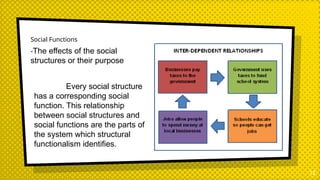
Social Functions
-The effects of the social
structures or their purpose
12
Every social structure
has a corresponding social
function. This relationship
between social structures and
social functions are the parts of
the system which structural
functionalism identifies.
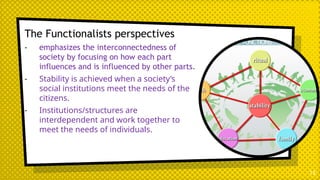
The Functionalists perspectives
- emphasizes the interconnectedness of
society by focusing on how each part
influences and is influenced by other parts.
- Stability is achieved when a society’s
social institutions meet the needs of the
citizens.
- Institutions/structures are
interdependent and work together to
meet the needs of individuals.
13
For example:
Each of the social institutions
contributes important functions for society:
family provides a context for reproducing,
nurturing, and socializing children. Education
offers a way to transmit a society’s skills,
knowledge, and culture to its youth. Politics
provides a means of governing members of
society. Economics provides for the production,
distribution, and consumption of goods and
services. And religion provides moral guidance

and an outlet for worship of a higher power.
14
15
MANIFE
ST AND
LATENT
FUNCTI
ON 16
KEY CONCEPTS IN STRUCTURAL
FUNCTIONALISM
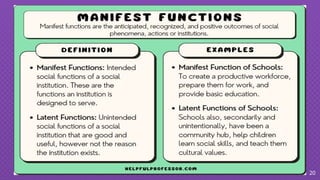
A manifest function is the
predicted, intended, expected, and
knowable effect of a social
structure.
An example of which is when people go to
church, in order to pray and to hear mass.
17
A latent function is the unintended
outcome of social structure. So, if the
manifest function of going to church
is to pray and hear mass, its
latent function is to gather people
together in one place to reinforce the
sense of community.
18
19
20
21
Manifest and latent
dysfunctions bring
about negative effects
or outcomes.
22
DYSFUNCTION
KEY CONCEPTS IN STRUCTURAL
FUNCTIONALISM
A manifest dysfunction is the predicted, expected, and knowable
disruptions of a social structure.
For example, a large gathering of people such as concerts and other
events disrupts traffic flow within the vicinity of the event, even though
it was not intended to do so.
23
A latent dysfunction is the unpredicted
and unexpected disruptions
of social structures. For example, there
are costumers who usually take pictures
of food in social media. But since these
customers are not the only ones doing it,
the average time spent by customers in
their tables will increase.
24
EXAMPLES
25
26
Understanding manifest and latent
dysfunctions help sociologists assess
risks and prepare accordingly. Such
assessments and preparations can be
in different fields and can be useful in
various fields and professions.
27
Give example of
Manifest and Latent
Function
(10 pts.)
28
29
IMPORTANT
THEORISTS
30
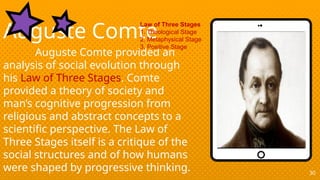
Auguste Comte
Auguste Comte provided an
analysis of social evolution through
his Law of Three Stages. Comte
provided a theory of society and
man’s cognitive progression from
religious and abstract concepts to a
scientific perspective. The Law of
Three Stages itself is a critique of the
social structures and of how humans
were shaped by progressive thinking.
Law of Three Stages
1. Theological Stage
2. Metaphysical Stage
3. Positive Stage
31
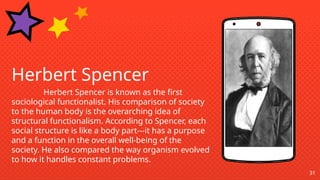
Herbert Spencer
Herbert Spencer is known as the first
sociological functionalist. His comparison of society
to the human body is the overarching idea of
structural functionalism. According to Spencer, each
social structure is like a body part---it has a purpose
and a function in the overall well-being of the
society. He also compared the way organism evolved
to how it handles constant problems.
32
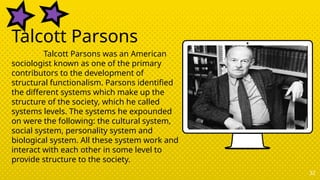
Talcott Parsons
Talcott Parsons was an American
sociologist known as one of the primary
contributors to the development of
structural functionalism. Parsons identified
the different systems which make up the
structure of the society, which he called
systems levels. The systems he expounded
on were the following: the cultural system,
social system, personality system and
biological system. All these system work and
interact with each other in some level to
provide structure to the society.
33
The cultural system is the structure that the
society generated throughout history so that people can
socialize and live together as a community. The social
system is understood as the roles people have in
society. The personality system refers to how
individuals affect society through their personalities,
attitudes, behaviors, beliefs and other characteristics.
Lastly, the behavioral or biological system is the
physical body of the individual and the environment
where he or she lives in.
34
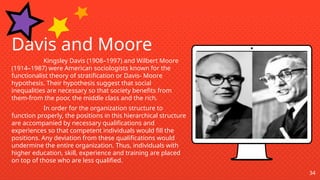
Davis and Moore
Kingsley Davis (1908–1997) and Wilbert Moore
(1914–1987) were American sociologists known for the
functionalist theory of stratification or Davis- Moore
hypothesis. Their hypothesis suggest that social
inequalities are necessary so that society benefits from
them-from the poor, the middle class and the rich.
In order for the organization structure to
function properly, the positions in this hierarchical structure
are accompanied by necessary qualifications and
experiences so that competent individuals would fill the
positions. Any deviation from these qualifications would
undermine the entire organization. Thus, individuals with
higher education, skill, experience and training are placed
on top of those who are less qualified.
35
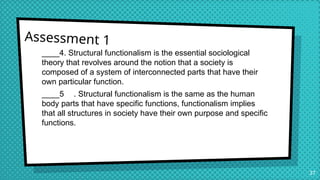
Robert Merton (1910–2003) was
an American sociologist who is also a key
contributor to the functionalist theory of
society. Specifically, he was the one who
developed the concepts of manifest and
latent functions and dysfunctions.
Merton focused on dysfunction as
it opposes the idea of functional unity,
which presupposes that everything
works optimally all the time and that
distortions exist in society. Because
dysfunction is dependent upon who is
asked, it is called valued term.
Assessment 1
Direction: Read each item carefully and write T f the statement
is true, and write F if the statement is false. Write your answers
in your activity notebook.
____1. Microstructures are the social structures formed among
groups or institutions.
____2. Social functions are the effects of social structures or
their purpose.
____3. Macrostructures are social structures that were
established by the individual or within a group that resulted in
individual interactions.
36
Assessment 1
____4. Structural functionalism is the essential sociological
theory that revolves around the notion that a society is
composed of a system of interconnected parts that have their
own particular function.
____5 . Structural functionalism is the same as the human
body parts that have specific functions, functionalism implies
that all structures in society have their own purpose and specific
functions.
37
sharing
× What are your strengths?
× How about your weaknesses?
× List down 5 each
38
STRENGTH
AND
WEAKNESS
ES OF
Structural
Functionali
sm 39
40
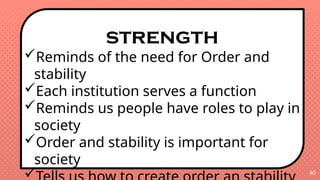
strength
Reminds of the need for Order and
stability
Each institution serves a function
Reminds us people have roles to play in
society
Order and stability is important for
society

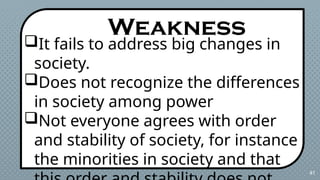
41
It fails to address big changes in
society.
Does not recognize the differences
in society among power
Not everyone agrees with order
and stability of society, for instance
the minorities in society and that
Weakness
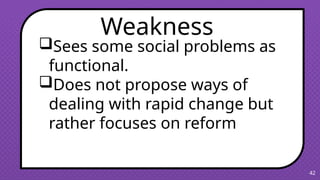
42
Sees some social problems as
functional.
Does not propose ways of
dealing with rapid change but
rather focuses on reform
Weakness
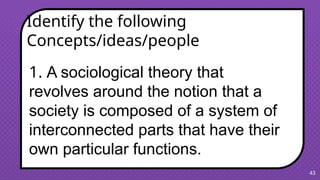
43
1. A sociological theory that
revolves around the notion that a
society is composed of a system of
interconnected parts that have their
own particular functions.
Identify the following
Concepts/ideas/people
44
2. The predicted, intended,
expected, and knowable effect
of a social structure.
Identify the following
Concepts/ideas/people
45
THAN
KS!
Any questions?

THE CONCEPT OF Structural-Functionalism .pptx

  • 1.
  • 2.
  • 3.
  • 4.
  • 5.
  • 7.
  • 8.
  • 9.
  • 10.
    At the endof this session, you should be able to: × Explain the theories on Structural Functionalism. × Analyze the basic concepts and principles of the structural functionalism theory. × Appreciate one’s personal and social experiences using the theories structural functionalism 10
  • 11.
    LESSON 1: STRUCTURAL FUNCTIONALISM Structuralfunctionalism or simply functionalism, is essentially a sociological theory that revolves around the notion that a society is composed of a system of interconnected parts that have their own particular functions. Macrostructures -social structures formed among groups or institutions 11 -religion -education -tradition -culture Microstructures -social structures established among individuals or within groups that result in individual interactions
  • 12.
    Social Functions -The effectsof the social structures or their purpose 12 Every social structure has a corresponding social function. This relationship between social structures and social functions are the parts of the system which structural functionalism identifies.
  • 13.
    The Functionalists perspectives -emphasizes the interconnectedness of society by focusing on how each part influences and is influenced by other parts. - Stability is achieved when a society’s social institutions meet the needs of the citizens. - Institutions/structures are interdependent and work together to meet the needs of individuals. 13
  • 14.
    For example: Each ofthe social institutions contributes important functions for society: family provides a context for reproducing, nurturing, and socializing children. Education offers a way to transmit a society’s skills, knowledge, and culture to its youth. Politics provides a means of governing members of society. Economics provides for the production, distribution, and consumption of goods and services. And religion provides moral guidance and an outlet for worship of a higher power. 14
  • 15.
  • 16.
  • 17.
    KEY CONCEPTS INSTRUCTURAL FUNCTIONALISM A manifest function is the predicted, intended, expected, and knowable effect of a social structure. An example of which is when people go to church, in order to pray and to hear mass. 17
  • 18.
    A latent functionis the unintended outcome of social structure. So, if the manifest function of going to church is to pray and hear mass, its latent function is to gather people together in one place to reinforce the sense of community. 18
  • 19.
  • 20.
  • 21.
  • 22.
    Manifest and latent dysfunctionsbring about negative effects or outcomes. 22 DYSFUNCTION
  • 23.
    KEY CONCEPTS INSTRUCTURAL FUNCTIONALISM A manifest dysfunction is the predicted, expected, and knowable disruptions of a social structure. For example, a large gathering of people such as concerts and other events disrupts traffic flow within the vicinity of the event, even though it was not intended to do so. 23
  • 24.
    A latent dysfunctionis the unpredicted and unexpected disruptions of social structures. For example, there are costumers who usually take pictures of food in social media. But since these customers are not the only ones doing it, the average time spent by customers in their tables will increase. 24
  • 25.
  • 26.
  • 27.
    Understanding manifest andlatent dysfunctions help sociologists assess risks and prepare accordingly. Such assessments and preparations can be in different fields and can be useful in various fields and professions. 27
  • 28.
    Give example of Manifestand Latent Function (10 pts.) 28
  • 29.
  • 30.
    30 Auguste Comte Auguste Comteprovided an analysis of social evolution through his Law of Three Stages. Comte provided a theory of society and man’s cognitive progression from religious and abstract concepts to a scientific perspective. The Law of Three Stages itself is a critique of the social structures and of how humans were shaped by progressive thinking. Law of Three Stages 1. Theological Stage 2. Metaphysical Stage 3. Positive Stage
  • 31.
    31 Herbert Spencer Herbert Spenceris known as the first sociological functionalist. His comparison of society to the human body is the overarching idea of structural functionalism. According to Spencer, each social structure is like a body part---it has a purpose and a function in the overall well-being of the society. He also compared the way organism evolved to how it handles constant problems.
  • 32.
    32 Talcott Parsons Talcott Parsonswas an American sociologist known as one of the primary contributors to the development of structural functionalism. Parsons identified the different systems which make up the structure of the society, which he called systems levels. The systems he expounded on were the following: the cultural system, social system, personality system and biological system. All these system work and interact with each other in some level to provide structure to the society.
  • 33.
    33 The cultural systemis the structure that the society generated throughout history so that people can socialize and live together as a community. The social system is understood as the roles people have in society. The personality system refers to how individuals affect society through their personalities, attitudes, behaviors, beliefs and other characteristics. Lastly, the behavioral or biological system is the physical body of the individual and the environment where he or she lives in.
  • 34.
    34 Davis and Moore KingsleyDavis (1908–1997) and Wilbert Moore (1914–1987) were American sociologists known for the functionalist theory of stratification or Davis- Moore hypothesis. Their hypothesis suggest that social inequalities are necessary so that society benefits from them-from the poor, the middle class and the rich. In order for the organization structure to function properly, the positions in this hierarchical structure are accompanied by necessary qualifications and experiences so that competent individuals would fill the positions. Any deviation from these qualifications would undermine the entire organization. Thus, individuals with higher education, skill, experience and training are placed on top of those who are less qualified.
  • 35.
    35 Robert Merton (1910–2003)was an American sociologist who is also a key contributor to the functionalist theory of society. Specifically, he was the one who developed the concepts of manifest and latent functions and dysfunctions. Merton focused on dysfunction as it opposes the idea of functional unity, which presupposes that everything works optimally all the time and that distortions exist in society. Because dysfunction is dependent upon who is asked, it is called valued term.
  • 36.
    Assessment 1 Direction: Readeach item carefully and write T f the statement is true, and write F if the statement is false. Write your answers in your activity notebook. ____1. Microstructures are the social structures formed among groups or institutions. ____2. Social functions are the effects of social structures or their purpose. ____3. Macrostructures are social structures that were established by the individual or within a group that resulted in individual interactions. 36
  • 37.
    Assessment 1 ____4. Structuralfunctionalism is the essential sociological theory that revolves around the notion that a society is composed of a system of interconnected parts that have their own particular function. ____5 . Structural functionalism is the same as the human body parts that have specific functions, functionalism implies that all structures in society have their own purpose and specific functions. 37
  • 38.
    sharing × What areyour strengths? × How about your weaknesses? × List down 5 each 38
  • 39.
  • 40.
    40 strength Reminds of theneed for Order and stability Each institution serves a function Reminds us people have roles to play in society Order and stability is important for society 
  • 41.
    41 It fails toaddress big changes in society. Does not recognize the differences in society among power Not everyone agrees with order and stability of society, for instance the minorities in society and that Weakness
  • 42.
    42 Sees some socialproblems as functional. Does not propose ways of dealing with rapid change but rather focuses on reform Weakness
  • 43.
    43 1. A sociologicaltheory that revolves around the notion that a society is composed of a system of interconnected parts that have their own particular functions. Identify the following Concepts/ideas/people
  • 44.
    44 2. The predicted,intended, expected, and knowable effect of a social structure. Identify the following Concepts/ideas/people
  • 45.