




Dominant Approaches
in Social Sciences
Structural Functionalism
Marxism
Symbolic Interactionism
Psychoanalysis
Rational Choice Theory
Institutionalism
The Feminist Theory
The Hermeneutical Phenomenology
The Human – Environment System
What is a THEORY?
Dominant Approaches in Social Sciences
Structural Functionalism
Marxism
Symbolic Interactionism
Psychoanalysis
Rational Choice Theory
Institutionalism
The Feminist Theory
The Hermeneutical Phenomenology
The Human – Environment System
a perspective
which describes the
society as a social
system that has a
social structure of
its own, made up of
different parts
which are
interconnected which
works together in
harmony to achieve
balance of social
Dominant Approaches in Social Sciences
Social institutions as pillars of
society:
The most
functional and most
important element of human society.
 Government
 Economy
 Education
 Religion
 Family Family
Structural Functionalism
Dominant Approaches in Social Sciences
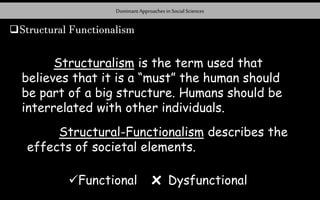
Structuralism is the term used that
believes that it is a “must” the human should
be part of a big structure. Humans should be
interrelated with other individuals.
Structural-Functionalism describes the
effects of societal elements.
Functional x Dysfunctional
Structural Functionalism
Dominant Approaches in Social Sciences
2 Types of Function
Structural Functionalism
Dominant Approaches in Social Sciences
2 Types of Function
MANIFEST LATENT
effects that are
intended and
recognized by norms
consequences that are
unintended or hidden
Structural Functionalism
Dominant Approaches in Social Sciences
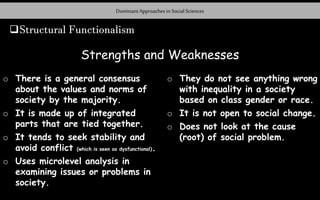
Strengths and Weaknesses
o There is a general consensus
about the values and norms of
society by the majority.
o It is made up of integrated
parts that are tied together.
o It tends to seek stability and
avoid conflict (which is seen as dysfunctional).
o Uses microlevel analysis in
examining issues or problems in
society.
o They do not see anything wrong
with inequality in a society
based on class gender or race.
o It is not open to social change.
o Does not look at the cause
(root) of social problem.
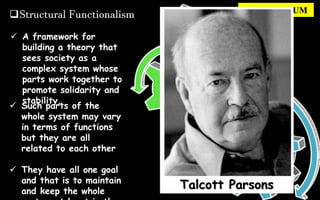
Structural Functionalism EQUILIBRIUM
 A framework for
building a theory that
sees society as a
complex system whose
parts work together to
promote solidarity and
stability.
 Such parts of the
whole system may vary
in terms of functions
but they are all
related to each other
 They have all one goal
and that is to maintain
and keep the whole
Talcott Parsons
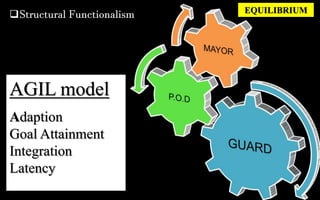
Structural Functionalism EQUILIBRIUM
AGIL model
Adaption
Goal Attainment
Integration
Latency
Structural Functionalism
Marxism
Karl Marx
Industrialism
Structural Functionalism
Marxism

DISS - Approaches - Structural Functionalism

  • 1.
    Dominant Approaches in SocialSciences Structural Functionalism Marxism Symbolic Interactionism Psychoanalysis Rational Choice Theory Institutionalism The Feminist Theory The Hermeneutical Phenomenology The Human – Environment System
  • 2.
    What is aTHEORY?
  • 3.
    Dominant Approaches inSocial Sciences Structural Functionalism Marxism Symbolic Interactionism Psychoanalysis Rational Choice Theory Institutionalism The Feminist Theory The Hermeneutical Phenomenology The Human – Environment System a perspective which describes the society as a social system that has a social structure of its own, made up of different parts which are interconnected which works together in harmony to achieve balance of social
  • 4.
    Dominant Approaches inSocial Sciences Social institutions as pillars of society: The most functional and most important element of human society.  Government  Economy  Education  Religion  Family Family Structural Functionalism
  • 5.
    Structural Functionalism Dominant Approachesin Social Sciences Structuralism is the term used that believes that it is a “must” the human should be part of a big structure. Humans should be interrelated with other individuals. Structural-Functionalism describes the effects of societal elements. Functional x Dysfunctional
  • 6.
    Structural Functionalism Dominant Approachesin Social Sciences 2 Types of Function
  • 7.
    Structural Functionalism Dominant Approachesin Social Sciences 2 Types of Function MANIFEST LATENT effects that are intended and recognized by norms consequences that are unintended or hidden
  • 8.
    Structural Functionalism Dominant Approachesin Social Sciences Strengths and Weaknesses o There is a general consensus about the values and norms of society by the majority. o It is made up of integrated parts that are tied together. o It tends to seek stability and avoid conflict (which is seen as dysfunctional). o Uses microlevel analysis in examining issues or problems in society. o They do not see anything wrong with inequality in a society based on class gender or race. o It is not open to social change. o Does not look at the cause (root) of social problem.
  • 9.
    Structural Functionalism EQUILIBRIUM A framework for building a theory that sees society as a complex system whose parts work together to promote solidarity and stability.  Such parts of the whole system may vary in terms of functions but they are all related to each other  They have all one goal and that is to maintain and keep the whole Talcott Parsons
  • 10.
    Structural Functionalism EQUILIBRIUM AGILmodel Adaption Goal Attainment Integration Latency
  • 11.
  • 12.