


Presented by:-
Vikas Kumar
2nd year Student of B.Sc.(Agriculture)
Gochar Mahavidyalya
Rampur Maniharan, Saharanpur (UP)
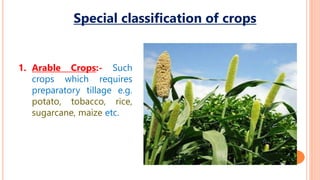
1. Arable Crops:- Such
crops which requires
preparatory tillage e.g.
potato, tobacco, rice,
sugarcane, maize etc.
Special classification of crops
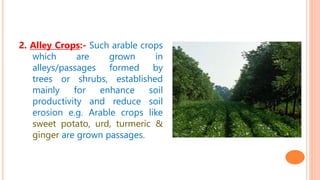
2. Alley Crops:- Such arable crops
which are grown in
alleys/passages formed by
trees or shrubs, established
mainly for enhance soil
productivity and reduce soil
erosion e.g. Arable crops like
sweet potato, urd, turmeric &
ginger are grown passages.
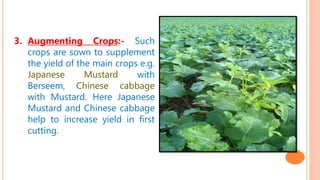
3. Augmenting Crops:- Such
crops are sown to supplement
the yield of the main crops e.g.
Japanese Mustard with
Berseem, Chinese cabbage
with Mustard. Here Japanese
Mustard and Chinese cabbage
help to increase yield in first
cutting.
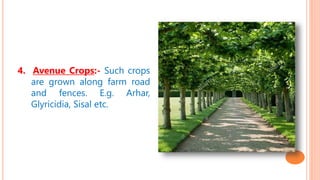
4. Avenue Crops:- Such crops
are grown along farm road
and fences. E.g. Arhar,
Glyricidia, Sisal etc.
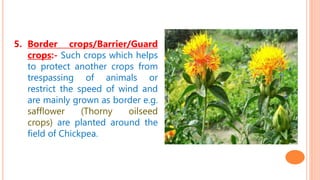
5. Border crops/Barrier/Guard
crops:- Such crops which helps
to protect another crops from
trespassing of animals or
restrict the speed of wind and
are mainly grown as border e.g.
safflower (Thorny oilseed
crops) are planted around the
field of Chickpea.
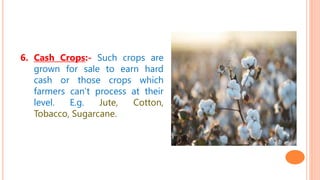
6. Cash Crops:- Such crops are
grown for sale to earn hard
cash or those crops which
farmers can’t process at their
level. E.g. Jute, Cotton,
Tobacco, Sugarcane.
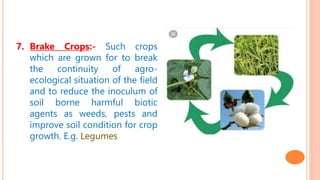
7. Brake Crops:- Such crops
which are grown for to break
the continuity of agro-
ecological situation of the field
and to reduce the inoculum of
soil borne harmful biotic
agents as weeds, pests and
improve soil condition for crop
growth. E.g. Legumes
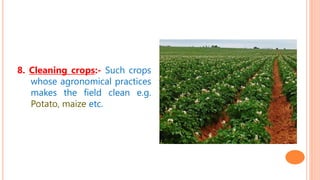
8. Cleaning crops:- Such crops
whose agronomical practices
makes the field clean e.g.
Potato, maize etc.
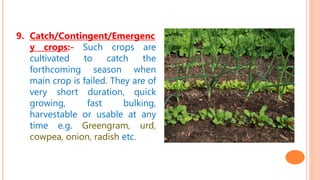
9. Catch/Contingent/Emergenc
y crops:- Such crops are
cultivated to catch the
forthcoming season when
main crop is failed. They are of
very short duration, quick
growing, fast bulking,
harvestable or usable at any
time e.g. Greengram, urd,
cowpea, onion, radish etc.
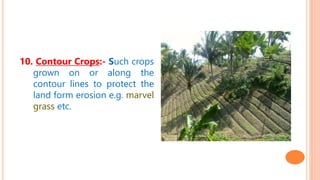
10. Contour Crops:- Such crops
grown on or along the
contour lines to protect the
land form erosion e.g. marvel
grass etc.
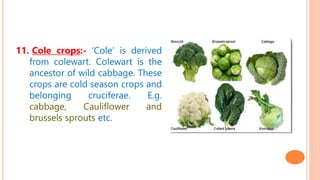
11. Cole crops:- ‘Cole’ is derived
from colewart. Colewart is the
ancestor of wild cabbage. These
crops are cold season crops and
belonging cruciferae. E.g.
cabbage, Cauliflower and
brussels sprouts etc.
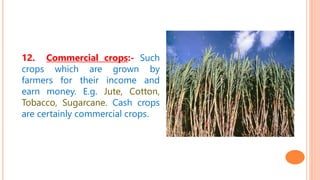
12. Commercial crops:- Such
crops which are grown by
farmers for their income and
earn money. E.g. Jute, Cotton,
Tobacco, Sugarcane. Cash crops
are certainly commercial crops.
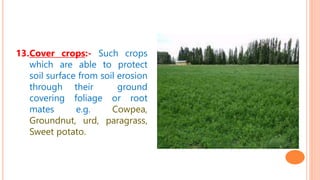
13.Cover crops:- Such crops
which are able to protect
soil surface from soil erosion
through their ground
covering foliage or root
mates e.g. Cowpea,
Groundnut, urd, paragrass,
Sweet potato.
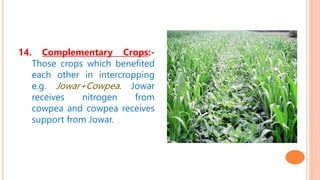
14. Complementary Crops:-
Those crops which benefited
each other in intercropping
e.g. Jowar+Cowpea. Jowar
receives nitrogen from
cowpea and cowpea receives
support from Jowar.
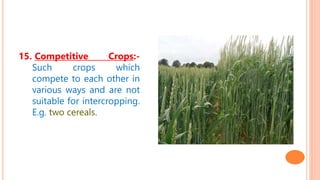
15. Competitive Crops:-
Such crops which
compete to each other in
various ways and are not
suitable for intercropping.
E.g. two cereals.
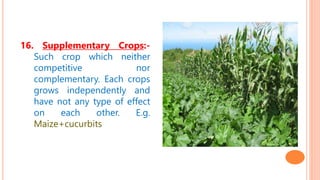
16. Supplementary Crops:-
Such crop which neither
competitive nor
complementary. Each crops
grows independently and
have not any type of effect
on each other. E.g.
Maize+cucurbits
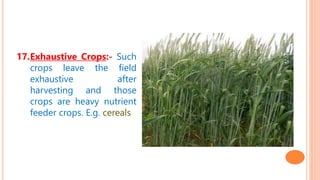
17.Exhaustive Crops:- Such
crops leave the field
exhaustive after
harvesting and those
crops are heavy nutrient
feeder crops. E.g. cereals
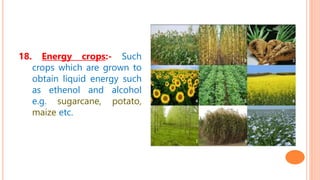
18. Energy crops:- Such
crops which are grown to
obtain liquid energy such
as ethenol and alcohol
e.g. sugarcane, potato,
maize etc.
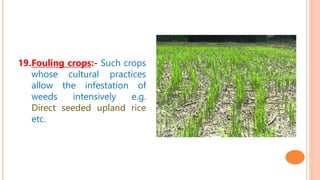
19.Fouling crops:- Such crops
whose cultural practices
allow the infestation of
weeds intensively e.g.
Direct seeded upland rice
etc.
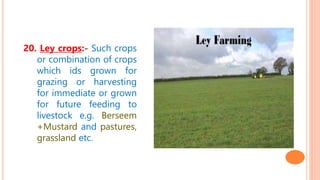
20. Ley crops:- Such crops
or combination of crops
which ids grown for
grazing or harvesting
for immediate or grown
for future feeding to
livestock e.g. Berseem
+Mustard and pastures,
grassland etc.
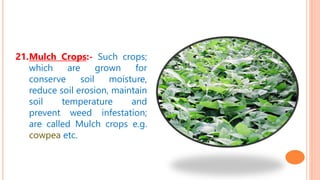
21.Mulch Crops:- Such crops;
which are grown for
conserve soil moisture,
reduce soil erosion, maintain
soil temperature and
prevent weed infestation;
are called Mulch crops e.g.
cowpea etc.
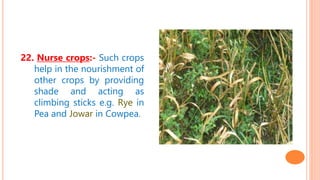
22. Nurse crops:- Such crops
help in the nourishment of
other crops by providing
shade and acting as
climbing sticks e.g. Rye in
Pea and Jowar in Cowpea.
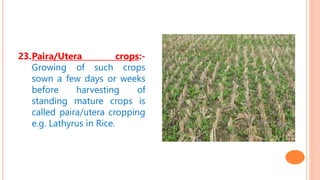
23.Paira/Utera crops:-
Growing of such crops
sown a few days or weeks
before harvesting of
standing mature crops is
called paira/utera cropping
e.g. Lathyrus in Rice.
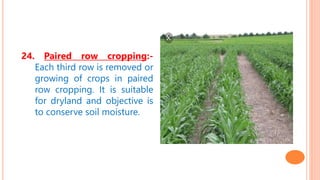
24. Paired row cropping:-
Each third row is removed or
growing of crops in paired
row cropping. It is suitable
for dryland and objective is
to conserve soil moisture.
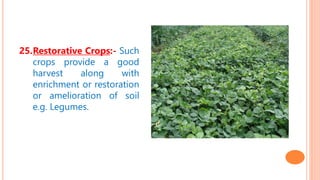
25.Restorative Crops:- Such
crops provide a good
harvest along with
enrichment or restoration
or amelioration of soil
e.g. Legumes.
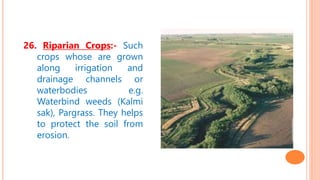
26. Riparian Crops:- Such
crops whose are grown
along irrigation and
drainage channels or
waterbodies e.g.
Waterbind weeds (Kalmi
sak), Pargrass. They helps
to protect the soil from
erosion.
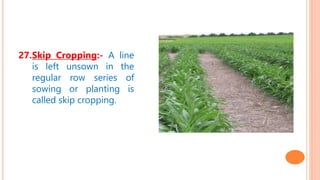
27.Skip Cropping:- A line
is left unsown in the
regular row series of
sowing or planting is
called skip cropping.
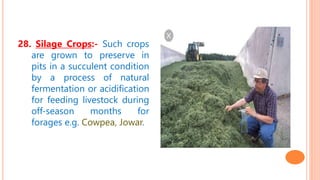
28. Silage Crops:- Such crops
are grown to preserve in
pits in a succulent condition
by a process of natural
fermentation or acidification
for feeding livestock during
off-season months for
forages e.g. Cowpea, Jowar.
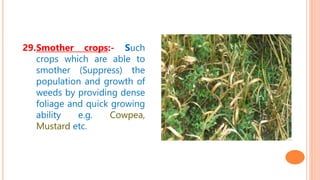
29.Smother crops:- Such
crops which are able to
smother (Suppress) the
population and growth of
weeds by providing dense
foliage and quick growing
ability e.g. Cowpea,
Mustard etc.
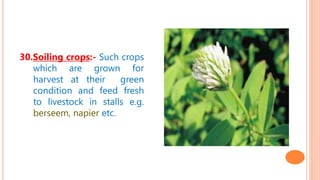
30.Soiling crops:- Such crops
which are grown for
harvest at their green
condition and feed fresh
to livestock in stalls e.g.
berseem, napier etc.
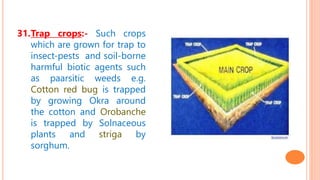
31.Trap crops:- Such crops
which are grown for trap to
insect-pests and soil-borne
harmful biotic agents such
as paarsitic weeds e.g.
Cotton red bug is trapped
by growing Okra around
the cotton and Orobanche
is trapped by Solnaceous
plants and striga by
sorghum.
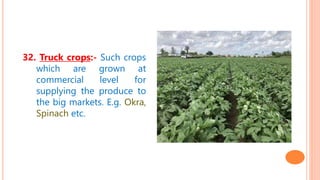
32. Truck crops:- Such crops
which are grown at
commercial level for
supplying the produce to
the big markets. E.g. Okra,
Spinach etc.
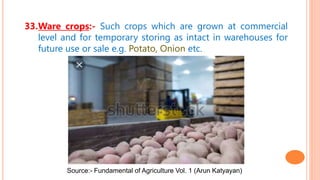
33.Ware crops:- Such crops which are grown at commercial
level and for temporary storing as intact in warehouses for
future use or sale e.g. Potato, Onion etc.
Source:- Fundamental of Agriculture Vol. 1 (Arun Katyayan)
Special Classification of Crops

Special Classification of Crops

  • 1.
    Presented by:- Vikas Kumar 2ndyear Student of B.Sc.(Agriculture) Gochar Mahavidyalya Rampur Maniharan, Saharanpur (UP)
  • 2.
    1. Arable Crops:-Such crops which requires preparatory tillage e.g. potato, tobacco, rice, sugarcane, maize etc. Special classification of crops
  • 3.
    2. Alley Crops:-Such arable crops which are grown in alleys/passages formed by trees or shrubs, established mainly for enhance soil productivity and reduce soil erosion e.g. Arable crops like sweet potato, urd, turmeric & ginger are grown passages.
  • 4.
    3. Augmenting Crops:-Such crops are sown to supplement the yield of the main crops e.g. Japanese Mustard with Berseem, Chinese cabbage with Mustard. Here Japanese Mustard and Chinese cabbage help to increase yield in first cutting.
  • 5.
    4. Avenue Crops:-Such crops are grown along farm road and fences. E.g. Arhar, Glyricidia, Sisal etc.
  • 6.
    5. Border crops/Barrier/Guard crops:-Such crops which helps to protect another crops from trespassing of animals or restrict the speed of wind and are mainly grown as border e.g. safflower (Thorny oilseed crops) are planted around the field of Chickpea.
  • 7.
    6. Cash Crops:-Such crops are grown for sale to earn hard cash or those crops which farmers can’t process at their level. E.g. Jute, Cotton, Tobacco, Sugarcane.
  • 8.
    7. Brake Crops:-Such crops which are grown for to break the continuity of agro- ecological situation of the field and to reduce the inoculum of soil borne harmful biotic agents as weeds, pests and improve soil condition for crop growth. E.g. Legumes
  • 9.
    8. Cleaning crops:-Such crops whose agronomical practices makes the field clean e.g. Potato, maize etc.
  • 10.
    9. Catch/Contingent/Emergenc y crops:-Such crops are cultivated to catch the forthcoming season when main crop is failed. They are of very short duration, quick growing, fast bulking, harvestable or usable at any time e.g. Greengram, urd, cowpea, onion, radish etc.
  • 11.
    10. Contour Crops:-Such crops grown on or along the contour lines to protect the land form erosion e.g. marvel grass etc.
  • 12.
    11. Cole crops:-‘Cole’ is derived from colewart. Colewart is the ancestor of wild cabbage. These crops are cold season crops and belonging cruciferae. E.g. cabbage, Cauliflower and brussels sprouts etc.
  • 13.
    12. Commercial crops:-Such crops which are grown by farmers for their income and earn money. E.g. Jute, Cotton, Tobacco, Sugarcane. Cash crops are certainly commercial crops.
  • 14.
    13.Cover crops:- Suchcrops which are able to protect soil surface from soil erosion through their ground covering foliage or root mates e.g. Cowpea, Groundnut, urd, paragrass, Sweet potato.
  • 15.
    14. Complementary Crops:- Thosecrops which benefited each other in intercropping e.g. Jowar+Cowpea. Jowar receives nitrogen from cowpea and cowpea receives support from Jowar.
  • 16.
    15. Competitive Crops:- Suchcrops which compete to each other in various ways and are not suitable for intercropping. E.g. two cereals.
  • 17.
    16. Supplementary Crops:- Suchcrop which neither competitive nor complementary. Each crops grows independently and have not any type of effect on each other. E.g. Maize+cucurbits
  • 18.
    17.Exhaustive Crops:- Such cropsleave the field exhaustive after harvesting and those crops are heavy nutrient feeder crops. E.g. cereals
  • 19.
    18. Energy crops:-Such crops which are grown to obtain liquid energy such as ethenol and alcohol e.g. sugarcane, potato, maize etc.
  • 20.
    19.Fouling crops:- Suchcrops whose cultural practices allow the infestation of weeds intensively e.g. Direct seeded upland rice etc.
  • 21.
    20. Ley crops:-Such crops or combination of crops which ids grown for grazing or harvesting for immediate or grown for future feeding to livestock e.g. Berseem +Mustard and pastures, grassland etc.
  • 22.
    21.Mulch Crops:- Suchcrops; which are grown for conserve soil moisture, reduce soil erosion, maintain soil temperature and prevent weed infestation; are called Mulch crops e.g. cowpea etc.
  • 23.
    22. Nurse crops:-Such crops help in the nourishment of other crops by providing shade and acting as climbing sticks e.g. Rye in Pea and Jowar in Cowpea.
  • 24.
    23.Paira/Utera crops:- Growing ofsuch crops sown a few days or weeks before harvesting of standing mature crops is called paira/utera cropping e.g. Lathyrus in Rice.
  • 25.
    24. Paired rowcropping:- Each third row is removed or growing of crops in paired row cropping. It is suitable for dryland and objective is to conserve soil moisture.
  • 26.
    25.Restorative Crops:- Such cropsprovide a good harvest along with enrichment or restoration or amelioration of soil e.g. Legumes.
  • 27.
    26. Riparian Crops:-Such crops whose are grown along irrigation and drainage channels or waterbodies e.g. Waterbind weeds (Kalmi sak), Pargrass. They helps to protect the soil from erosion.
  • 28.
    27.Skip Cropping:- Aline is left unsown in the regular row series of sowing or planting is called skip cropping.
  • 29.
    28. Silage Crops:-Such crops are grown to preserve in pits in a succulent condition by a process of natural fermentation or acidification for feeding livestock during off-season months for forages e.g. Cowpea, Jowar.
  • 30.
    29.Smother crops:- Such cropswhich are able to smother (Suppress) the population and growth of weeds by providing dense foliage and quick growing ability e.g. Cowpea, Mustard etc.
  • 31.
    30.Soiling crops:- Suchcrops which are grown for harvest at their green condition and feed fresh to livestock in stalls e.g. berseem, napier etc.
  • 32.
    31.Trap crops:- Suchcrops which are grown for trap to insect-pests and soil-borne harmful biotic agents such as paarsitic weeds e.g. Cotton red bug is trapped by growing Okra around the cotton and Orobanche is trapped by Solnaceous plants and striga by sorghum.
  • 33.
    32. Truck crops:-Such crops which are grown at commercial level for supplying the produce to the big markets. E.g. Okra, Spinach etc.
  • 34.
    33.Ware crops:- Suchcrops which are grown at commercial level and for temporary storing as intact in warehouses for future use or sale e.g. Potato, Onion etc. Source:- Fundamental of Agriculture Vol. 1 (Arun Katyayan)