
Brown Rust of Wheat
Presented by:-
Vikas Kumar
3rd year Student of B.Sc.(Agriculture)
Gochar Mahavidyalya
Rampur Maniharan, Saharanpur
Introduction
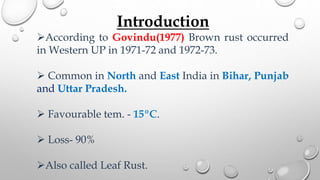
According to Govindu(1977) Brown rust occurred
in Western UP in 1971-72 and 1972-73.
 Common in North and East India in Bihar, Punjab
and Uttar Pradesh.
 Favourable tem. - 15ºC.
 Loss- 90%
Also called Leaf Rust.
Symptoms
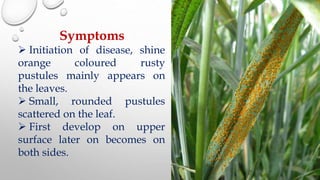
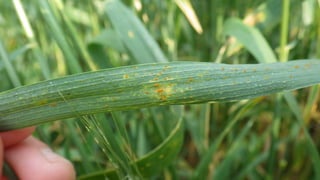
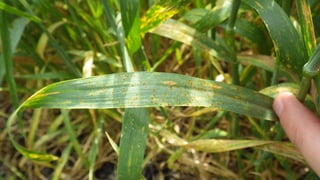
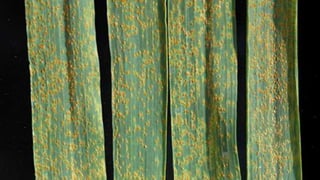
 Initiation of disease, shine
orange coloured rusty
pustules mainly appears on
the leaves.
 Small, rounded pustules
scattered on the leaf.
 First develop on upper
surface later on becomes on
both sides.
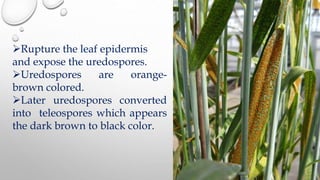
Rupture the leaf epidermis
and expose the uredospores.
Uredospores are orange-
brown colored.
Later uredospores converted
into teleospores which appears
the dark brown to black color.
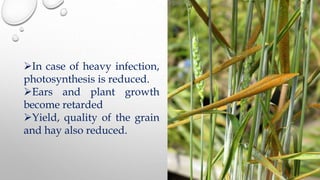
In case of heavy infection,
photosynthesis is reduced.
Ears and plant growth
become retarded
Yield, quality of the grain
and hay also reduced.
Pathogen Name:- Puccinia recondita
Heteroecious and macrocylic fungus
Uredospores are grouped in small irregularly scattered clusters.
Not established in India as annual reccurence.
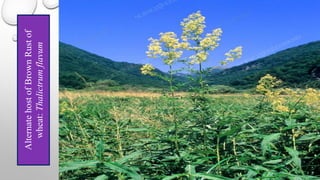
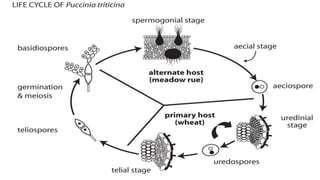
Thalictrum flavum is the alternate host.
Pathogen survive on self grown wheat in hills.
Alternate
host
of
Brown
Rust
of
wheat:
Thalictrum
flavum
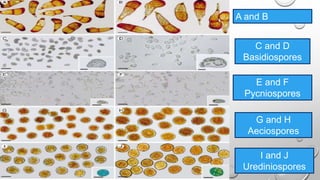
A and B
Teliospores
C and D
Basidiospores
E and F
Pycniospores
G and H
Aeciospores
E and F
Pycniospores
I and J
Urediniospores
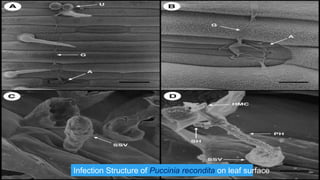
Infection Structure of Puccinia recondita on leaf surface
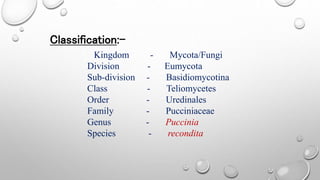
Classification:-
Kingdom - Mycota/Fungi
Division - Eumycota
Sub-division - Basidiomycotina
Class - Teliomycetes
Order - Uredinales
Family - Pucciniaceae
Genus - Puccinia
Species - recondita
Management:-
Early sowing
Mixed cropping
Avoid excess use of nitrogen and apply optimum amount of
potassium.
Avoid excess irrigation.
2-4 spray of Dithane Z 78 or Dithane M45 or Tilt @0.2%
Resistant varieties:- PBW154, HS277, Malviya wheat 318,
Pusa Gold
Brown Rust of Wheat
Brown Rust of Wheat

Brown Rust of Wheat

  • 1.
    Brown Rust ofWheat Presented by:- Vikas Kumar 3rd year Student of B.Sc.(Agriculture) Gochar Mahavidyalya Rampur Maniharan, Saharanpur
  • 2.
    Introduction According to Govindu(1977)Brown rust occurred in Western UP in 1971-72 and 1972-73.  Common in North and East India in Bihar, Punjab and Uttar Pradesh.  Favourable tem. - 15ºC.  Loss- 90% Also called Leaf Rust.
  • 3.
    Symptoms  Initiation ofdisease, shine orange coloured rusty pustules mainly appears on the leaves.  Small, rounded pustules scattered on the leaf.  First develop on upper surface later on becomes on both sides.
  • 4.
    Rupture the leafepidermis and expose the uredospores. Uredospores are orange- brown colored. Later uredospores converted into teleospores which appears the dark brown to black color.
  • 5.
    In case ofheavy infection, photosynthesis is reduced. Ears and plant growth become retarded Yield, quality of the grain and hay also reduced.
  • 9.
    Pathogen Name:- Pucciniarecondita Heteroecious and macrocylic fungus Uredospores are grouped in small irregularly scattered clusters. Not established in India as annual reccurence. Thalictrum flavum is the alternate host. Pathogen survive on self grown wheat in hills.
  • 10.
  • 11.
    A and B Teliospores Cand D Basidiospores E and F Pycniospores G and H Aeciospores E and F Pycniospores I and J Urediniospores
  • 12.
    Infection Structure ofPuccinia recondita on leaf surface
  • 13.
    Classification:- Kingdom - Mycota/Fungi Division- Eumycota Sub-division - Basidiomycotina Class - Teliomycetes Order - Uredinales Family - Pucciniaceae Genus - Puccinia Species - recondita
  • 14.
    Management:- Early sowing Mixed cropping Avoidexcess use of nitrogen and apply optimum amount of potassium. Avoid excess irrigation. 2-4 spray of Dithane Z 78 or Dithane M45 or Tilt @0.2% Resistant varieties:- PBW154, HS277, Malviya wheat 318, Pusa Gold