Stroke Syndromes of
the Forebrain (SSoF)
    Hartmut Uschmann, MD
         Neurologist
SSoF


What is a stroke?

How do strokes happen?

Is stroke a common disorder?

SSoF I
What is a stroke?

Any acute CNS injury that has a vascular
cause.

Ergo: stroke is not a disease, but a collection of
disorders with a common cause.

Stroke = I don’t know what happened to you.
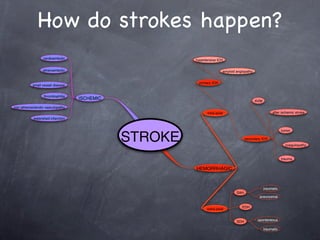
How do strokes happen?
                  cardioembolic                        hypertensive ICH

                  atheroembolic                                        amyloid angiopathy


                                                         primary ICH
           small vessel disease


                  thrombophilia
                                   ISCHEMIC                                                 AVM
non atherosclerotic vasculopathy
                                                             intra-axial                               after ischemic stroke
            watershed infarction


                                              STROKE
                                                                                                              tumor

                                                                                     secondary ICH
                                                                                                                coagulopathy


                                                                                                              trauma

                                                       HEMORRHAGIC


                                                                                                  traumatic
                                                                               SAH
                                                                                              aneurysmal

                                                                                  EDH
                                                             extra-axial


                                                                               SDH           spontaneous

                                                                                                  traumatic
Is stroke a common
        disease?
USA

 > 700,000 new and recurrent strokes annually
 (500,000 new, 200,000 recurrent)

 160,000 death annually

 Mortality declining

 Leading cause of disability

 Preventable disease !
Is stroke a common
          disease?
Aftermath:
  Leading cause for long-term disability

  In 1999 >1.1 million stroke survivors report difficulties with
  ADL’s secondary to stroke

  Annual recurrence rate 14% (after stroke or TIA)

  22% of men and 25% of women dye w/i the first year after
  stroke

  50-70% of stroke survivors regain functional independence

  20% require institutional care at 3 month post stroke
The Burden of Stroke
Exact incidence in Mississippi unknown-no
stroke registry

Estimate: 5000 new and 2000 recurrent
strokes/year

Approximately 1/3 die and 1/3 survive
severely disabled

Stroke: the leading cause of long-term
disability
The Burden of Stroke
Aftermath:

  Leading cause of long-term disability

  In 1999 >1.1 million stroke survivors nationally report difficulties
  with ADL’s secondary to stroke

  Annual recurrence rate 14% (after stroke or TIA)

  22% of men and 25% of women die w/i the first year after
  stroke

  50-70% of stroke survivors regain functional independence

  20% require institutional care at 3 months post stroke
The Burden of Stroke

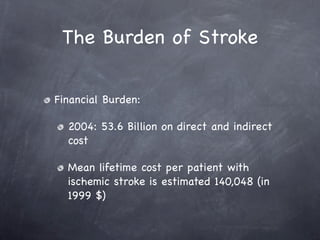
Financial Burden:

  2004: 53.6 Billion on direct and indirect
  cost

  Mean lifetime cost per patient with
  ischemic stroke is estimated 140,048 (in
  1999 $)
SSoF I
Stroke syndromes

  Large vessel

    Anterior circulation

    Posterior circulation

  Lacunar

    W/o localizing value

    With localizing value
SSoF I


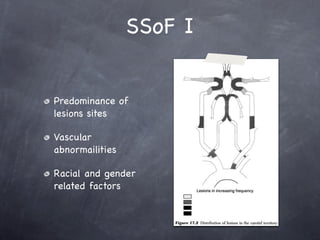
Predominance of
lesions sites

Vascular
abnormailities

Racial and gender
related factors
SSoF I
Carotid artery and branches

  TMD= transient monocular blindness (disturbance)

     Is the only distinguishing clue between carotid vs. MCA disease
     May signify carotid dz. vs. aortic or trunk dz.
     Ischemia (A. fugax,...)

     Optic disc elevation, ischemia

     Optic nerve ischemia (meningioma…)

     Mechanical effects (retina…)
SSoF I
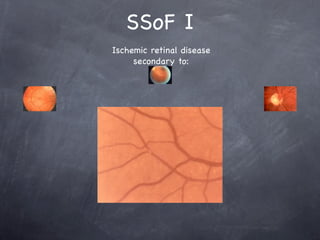
Ischemic retinal disease
     secondary to:
SSoF I
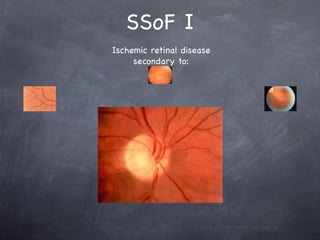
Ischemic retinal disease
     secondary to:
SSoF I
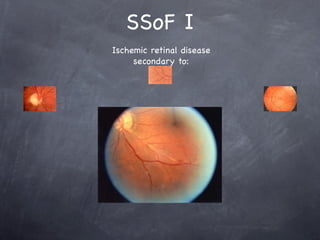
Ischemic retinal disease
     secondary to:
SSoF I
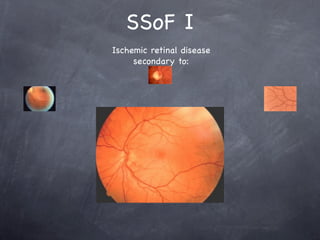
Ischemic retinal disease
     secondary to:
SSoF I

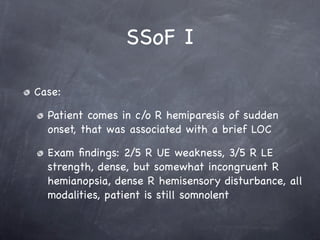
Case:

  Patient comes in c/o R hemiparesis of sudden
  onset, that was associated with a brief LOC

  Exam findings: 2/5 R UE weakness, 3/5 R LE
  strength, dense, but somewhat incongruent R
  hemianopsia, dense R hemisensory disturbance, all
  modalities, patient is still somnolent
SSoF I
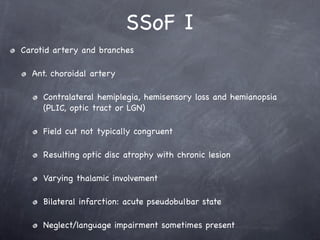
Carotid artery and branches

  Ant. choroidal artery

     Contralateral hemiplegia, hemisensory loss and hemianopsia
     (PLIC, optic tract or LGN)

     Field cut not typically congruent

     Resulting optic disc atrophy with chronic lesion

     Varying thalamic involvement

     Bilateral infarction: acute pseudobulbar state

     Neglect/language impairment sometimes present
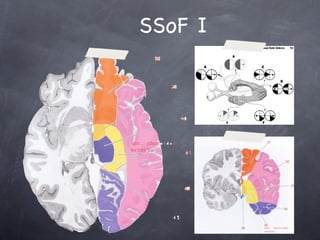
SSoF I
SSoF I

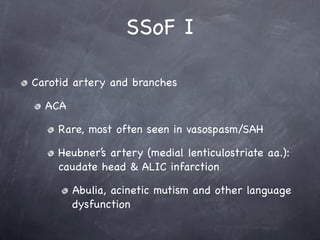
Carotid artery and branches

  ACA

    Rare, most often seen in vasospasm/SAH

    Heubner’s artery (medial lenticulostriate aa.):
    caudate head & ALIC infarction

        Abulia, acinetic mutism and other language
        dysfunction
SSoF I
Carotid artery and branches
  ACA
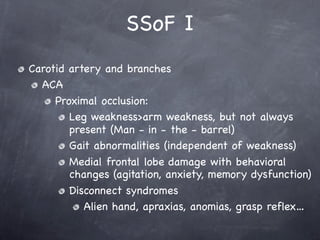
     Proximal occlusion:
        Leg weakness>arm weakness, but not always
        present (Man - in - the - barrel)
        Gait abnormalities (independent of weakness)
        Medial frontal lobe damage with behavioral
        changes (agitation, anxiety, memory dysfunction)
        Disconnect syndromes
           Alien hand, apraxias, anomias, grasp reflex…
SSoF I
SSoF I
Stroke Syndromes of
the Forebrain (SSoF) II
     Hartmut Uschmann, MD
          Neurologist
Clinical syndromes: AIS
 Carotid artery and branches

 ICA

   Ophthalmic artery

   Anterior choroidal artery

 ACA

   Aa. of Heubner

   Cortical branches of ACA
Clinical syndromes: AIS

 Carotid artery and branches

   MCA

     Most commonly affected end-vessel

     “hemispheric stroke”

     Diversity of symptoms, depending on
     lesion site
Clinical syndromes: AIS

Diversity of symptoms, depending on lesion site

  Contralateral hemiparesis Arm>Face>Leg

  Language dysfunction with dominant hemisphere
  involvement

  Neglect with non-dominant hemisphere
  involvement

  Apraxia syndromes
Clinical syndromes: AIS
 Carotid artery and branches

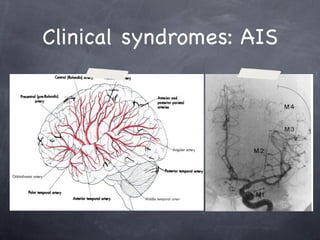
   MCA anatomy

     Main trunk (M1)

        Lateral lenticulostriate aa. (5-17)

     Divisions (M2)

     Branches (M3)
Clinical syndromes: AIS
Carotid artery and branches

  MCA TRUNK

    3mm on average, 18-26mm in length

    “Perforators” (lat. lenticulo-striate aa.)

       Supply N. lentiforme, N. caudatus, C. interna

       Larger perforators usually more lateral

       Endarteries
Clinical syndromes: AIS

 Carotid artery and branches

   MCA DIVISIONS

     Superior and inferior division

     Trifurcation

     Continuous vessel with consecutive
     branching
Clinical syndromes: AIS
Sup. Division

  Always gives of orbitofrontal and prefrontal
  branches

Inferior Division

  Always gives of temporo-polar, anterior
  temporal and middle temporal branches

Remaining branches inconsistent
Clinical syndromes: AIS

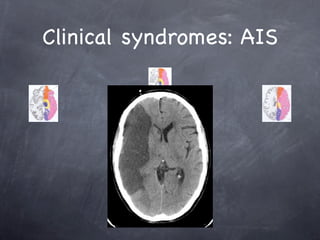
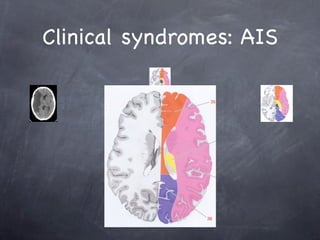
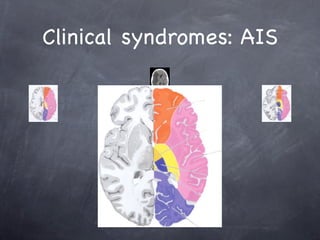
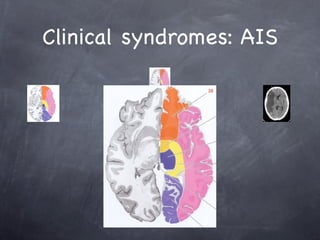
 MCA syndromes

   Perforator stroke (lacunar infarct)

   Branch

   Division

   Trunk
Clinical syndromes: AIS


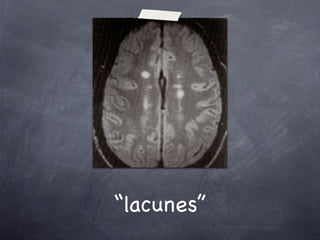
 Perforator stroke

   Usually mild, uni-or bimodal

   No “cortical” signs

   Good rehab potential
“lacunes”
Clinical syndromes: AIS

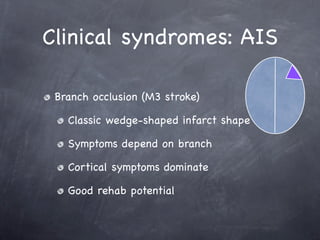
 Branch occlusion (M3 stroke)

   Classic wedge-shaped infarct shape

   Symptoms depend on branch

   Cortical symptoms dominate

   Good rehab potential
Clinical syndromes: AIS


 Division stroke

   Much more severe, multimodal symptoms

   Higher risk for adverse events

   Less recovery potential
Clinical syndromes: AIS
Division stroke: superior division

     Severe motor deficit, sensory variable

     Aphasia with dominant hemisphere, but mostly
     Broca’s type

     Neglect usually mild or undetectable

     Gaze preference: patient “looks at the lesion”

     Usually no visual field cut
Clinical syndromes: AIS

Division stroke: inferior division

  Prominent field cut

  Minor or no motor/sensory deficits

  Prominent aphasia of Wernicke type with dominant
  hemisphere

  Neglect/behavioral problems (sometimes in isolation)
Clinical syndromes: AIS

 Trunk occlusion

   “malignant stroke”

   Very severe deficits (“MCA syndrome”)

   High risk for complications and death

   Little functional recovery, worse with
   higher age
Clinical syndromes: AIS


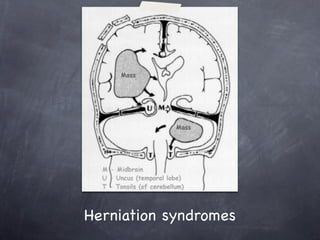
 Most stroke death occur from large MCA
 strokes

 Herniation syndromes
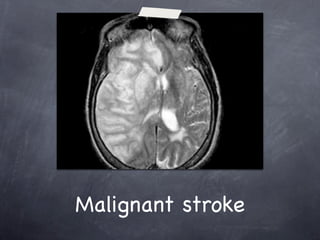
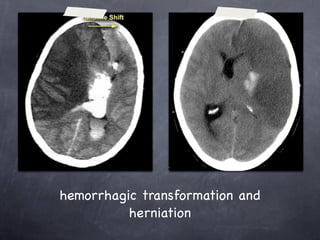
Malignant stroke
hemorrhagic transformation and
          herniation
Herniation syndromes

Tank Division

  • 1.
    Stroke Syndromes of theForebrain (SSoF) Hartmut Uschmann, MD Neurologist
  • 2.
    SSoF What is astroke? How do strokes happen? Is stroke a common disorder? SSoF I
  • 3.
    What is astroke? Any acute CNS injury that has a vascular cause. Ergo: stroke is not a disease, but a collection of disorders with a common cause. Stroke = I don’t know what happened to you.
  • 4.
    How do strokeshappen? cardioembolic hypertensive ICH atheroembolic amyloid angiopathy primary ICH small vessel disease thrombophilia ISCHEMIC AVM non atherosclerotic vasculopathy intra-axial after ischemic stroke watershed infarction STROKE tumor secondary ICH coagulopathy trauma HEMORRHAGIC traumatic SAH aneurysmal EDH extra-axial SDH spontaneous traumatic
  • 5.
    Is stroke acommon disease? USA > 700,000 new and recurrent strokes annually (500,000 new, 200,000 recurrent) 160,000 death annually Mortality declining Leading cause of disability Preventable disease !
  • 6.
    Is stroke acommon disease? Aftermath: Leading cause for long-term disability In 1999 >1.1 million stroke survivors report difficulties with ADL’s secondary to stroke Annual recurrence rate 14% (after stroke or TIA) 22% of men and 25% of women dye w/i the first year after stroke 50-70% of stroke survivors regain functional independence 20% require institutional care at 3 month post stroke
  • 7.
    The Burden ofStroke Exact incidence in Mississippi unknown-no stroke registry Estimate: 5000 new and 2000 recurrent strokes/year Approximately 1/3 die and 1/3 survive severely disabled Stroke: the leading cause of long-term disability
  • 8.
    The Burden ofStroke Aftermath: Leading cause of long-term disability In 1999 >1.1 million stroke survivors nationally report difficulties with ADL’s secondary to stroke Annual recurrence rate 14% (after stroke or TIA) 22% of men and 25% of women die w/i the first year after stroke 50-70% of stroke survivors regain functional independence 20% require institutional care at 3 months post stroke
  • 9.
    The Burden ofStroke Financial Burden: 2004: 53.6 Billion on direct and indirect cost Mean lifetime cost per patient with ischemic stroke is estimated 140,048 (in 1999 $)
  • 10.
    SSoF I Stroke syndromes Large vessel Anterior circulation Posterior circulation Lacunar W/o localizing value With localizing value
  • 11.
    SSoF I Predominance of lesionssites Vascular abnormailities Racial and gender related factors
  • 12.
    SSoF I Carotid arteryand branches TMD= transient monocular blindness (disturbance) Is the only distinguishing clue between carotid vs. MCA disease May signify carotid dz. vs. aortic or trunk dz. Ischemia (A. fugax,...) Optic disc elevation, ischemia Optic nerve ischemia (meningioma…) Mechanical effects (retina…)
  • 13.
    SSoF I Ischemic retinaldisease secondary to:
  • 14.
    SSoF I Ischemic retinaldisease secondary to:
  • 15.
    SSoF I Ischemic retinaldisease secondary to:
  • 16.
    SSoF I Ischemic retinaldisease secondary to:
  • 17.
    SSoF I Case: Patient comes in c/o R hemiparesis of sudden onset, that was associated with a brief LOC Exam findings: 2/5 R UE weakness, 3/5 R LE strength, dense, but somewhat incongruent R hemianopsia, dense R hemisensory disturbance, all modalities, patient is still somnolent
  • 18.
    SSoF I Carotid arteryand branches Ant. choroidal artery Contralateral hemiplegia, hemisensory loss and hemianopsia (PLIC, optic tract or LGN) Field cut not typically congruent Resulting optic disc atrophy with chronic lesion Varying thalamic involvement Bilateral infarction: acute pseudobulbar state Neglect/language impairment sometimes present
  • 19.
  • 20.
    SSoF I Carotid arteryand branches ACA Rare, most often seen in vasospasm/SAH Heubner’s artery (medial lenticulostriate aa.): caudate head & ALIC infarction Abulia, acinetic mutism and other language dysfunction
  • 21.
    SSoF I Carotid arteryand branches ACA Proximal occlusion: Leg weakness>arm weakness, but not always present (Man - in - the - barrel) Gait abnormalities (independent of weakness) Medial frontal lobe damage with behavioral changes (agitation, anxiety, memory dysfunction) Disconnect syndromes Alien hand, apraxias, anomias, grasp reflex…
  • 22.
  • 23.
  • 24.
    Stroke Syndromes of theForebrain (SSoF) II Hartmut Uschmann, MD Neurologist
  • 25.
    Clinical syndromes: AIS Carotid artery and branches ICA Ophthalmic artery Anterior choroidal artery ACA Aa. of Heubner Cortical branches of ACA
  • 26.
    Clinical syndromes: AIS Carotid artery and branches MCA Most commonly affected end-vessel “hemispheric stroke” Diversity of symptoms, depending on lesion site
  • 27.
    Clinical syndromes: AIS Diversityof symptoms, depending on lesion site Contralateral hemiparesis Arm>Face>Leg Language dysfunction with dominant hemisphere involvement Neglect with non-dominant hemisphere involvement Apraxia syndromes
  • 28.
    Clinical syndromes: AIS Carotid artery and branches MCA anatomy Main trunk (M1) Lateral lenticulostriate aa. (5-17) Divisions (M2) Branches (M3)
  • 29.
    Clinical syndromes: AIS Carotidartery and branches MCA TRUNK 3mm on average, 18-26mm in length “Perforators” (lat. lenticulo-striate aa.) Supply N. lentiforme, N. caudatus, C. interna Larger perforators usually more lateral Endarteries
  • 30.
    Clinical syndromes: AIS Carotid artery and branches MCA DIVISIONS Superior and inferior division Trifurcation Continuous vessel with consecutive branching
  • 31.
    Clinical syndromes: AIS Sup.Division Always gives of orbitofrontal and prefrontal branches Inferior Division Always gives of temporo-polar, anterior temporal and middle temporal branches Remaining branches inconsistent
  • 32.
  • 33.
  • 34.
  • 35.
  • 36.
  • 37.
    Clinical syndromes: AIS MCA syndromes Perforator stroke (lacunar infarct) Branch Division Trunk
  • 38.
    Clinical syndromes: AIS Perforator stroke Usually mild, uni-or bimodal No “cortical” signs Good rehab potential
  • 39.
  • 40.
    Clinical syndromes: AIS Branch occlusion (M3 stroke) Classic wedge-shaped infarct shape Symptoms depend on branch Cortical symptoms dominate Good rehab potential
  • 41.
    Clinical syndromes: AIS Division stroke Much more severe, multimodal symptoms Higher risk for adverse events Less recovery potential
  • 42.
    Clinical syndromes: AIS Divisionstroke: superior division Severe motor deficit, sensory variable Aphasia with dominant hemisphere, but mostly Broca’s type Neglect usually mild or undetectable Gaze preference: patient “looks at the lesion” Usually no visual field cut
  • 43.
    Clinical syndromes: AIS Divisionstroke: inferior division Prominent field cut Minor or no motor/sensory deficits Prominent aphasia of Wernicke type with dominant hemisphere Neglect/behavioral problems (sometimes in isolation)
  • 44.
    Clinical syndromes: AIS Trunk occlusion “malignant stroke” Very severe deficits (“MCA syndrome”) High risk for complications and death Little functional recovery, worse with higher age
  • 45.
    Clinical syndromes: AIS Most stroke death occur from large MCA strokes Herniation syndromes
  • 46.
  • 47.
  • 48.