STROKE
Dr.Navaneethakrishnan PharmD.,
Assistant Professor
Department of Pharmacology
 Cerebrovascular disease (CVD), or stroke, is the third leading
cause of death in the United States and the second most
common cause of death worldwide.
 Stroke is the leading cause of long-term disability in adults
 Strokes can either be ischemic(88% of all strokes) or
hemorrhagic (12% of all strokes).
 A stroke is the sudden death of brain cells in a localized area
due to inadequate blood flow.
 TIA (Transient Ischaemic Attack) recovery is complete within
24 hours. 10% of patients will go on to have a stroke.
 Most often, this is due to a thrombotic or embolic arterial
occlusion leading to cerebral infarction.
 A thrombotic occlusion occurs when a thrombus forms inside
an artery in the brain.
 An embolism refers to a clot originating outside of the brain in
which a piece of the clot breaks loose and is carried to the brain.
 As a result, the affected area of the brain is unable to function,
leading to inability to move one or more limbs on one side of
the body, inability to understand or formulate speech, or an
inability to see one side of the visual field.
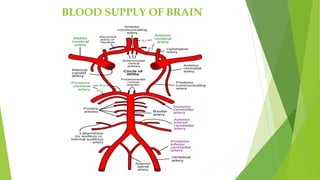
BLOOD SUPPLY OF BRAIN
 Internal Carotid Arteries: Transfer oxygenated blood from the
common carotid arteries of the neck to the circle of Willis.
 Circle of Willis: Transfers oxygenated blood from incoming
arteries to deep internal arteries of the brain.
 Vertebral Arteries: Transfer oxygenated blood from the
subclavian arteries, up through the transverse foraminae of the
cervical vertebrae and to the basilar artery of the brain.
 Basilar Artery: Transfers oxygenated blood from the vertebral
arteries to the circle of Willis of the brain.
BLOOD SUPPLY OF BRAIN
RISK FACTORS
Non modifiable
 Age
 Male sex
 Race
 Heredity
Modifiable
 Hypertension
 Diabetes
 Smoking
 Hyperlipidemia
 Excess Alcohol
 Heart disease (AF)
 Oral contraceptives
 Hypercoagulability
CLINICAL PRESENTATION OF STROKE
 Sudden weakness or numbness of the face, arm, and leg on one
side of the body
 Loss of speech, or trouble speaking or understanding speech
 Dimness or loss of vision, particularly in only one eye or half of
both eyes
 Sudden onset of blurred or double vision
 Unexplained dizziness
 Sudden onset of unsteadiness, lack of coordination, difficulty
walking, or falling
 Sudden excruciating headache
 Recent change in personality or mentalabilities, including
memory loss
A thrombus or embolus blocks
blood flow to part of the brain
Blood spills out from break
In blood vessel in brain
ISCHEMIC STROKE
 Ischemic stroke occurs when a blood vessel that supplies blood
to the brain is blocked by a blood clot.
 This may happen in two ways:
 A clot may form in an artery that is already very narrow.
This is called a thrombus. If it completely blocks the artery,
it is called a thrombotic stroke.
 A clot may break off from another place in the blood vessels
of the brain, or some other part of the body, and travel up to
the brain to block a smaller artery. This is called an
embolism. It causes an embolic stroke.
 Ischemic necrosis – caused by considerable reduction or
complete interruption of blood supply to the neural tissue
 Neural tissue has only limited stores of energy reserves = 3-4
min cessation of blood supply cause permanent damage to
neurons.
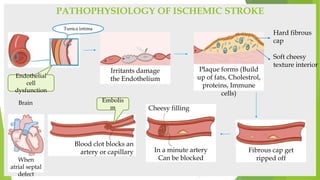
PATHOPHYSIOLOGY OF ISCHEMIC STROKE
Irritants damage
the Endothelium
Plaque forms (Build
up of fats, Cholestrol,
proteins, Immune
cells)
Tunica intima
Soft cheesy
texture interior
Hard fibrous
cap
In a minute artery
Can be blocked
Cheesy filling
Blood clot blocks an
artery or capillary Fibrous cap get
ripped off
Endothelial
cell
dysfunction
Embolis
m
Brain
When
atrial septal
defect
Classification
Cerebral hypoxia is typically grouped into four categories
depending on the severity and location of the brain’s oxygen
deprivation
Diffuse cerebral hypoxia:
A mild to moderate impairment of brain function due to low
oxygen levels in the blood.
Global cerebral ischemia:
A complete stoppage of blood flow to the brain.
Focal cerebral ischemia:
It is a stroke occurring in a localized area that can either be acute
(sudden onset) and/ or transient (of short duration).
This may be due to a variety of medical conditions such as an
aneuryrsm which causes a hemorrhagic stroke, or an occlusion
occurring in the affected blood vessel/s due to a thrombus (thrombotic
stroke) or embolus (embolic stroke)
Massive Cerebral infarction:
It is a "stroke", caused by complete oxygen deprivation due to an
interference in cerebral blood flow which affects multiple areas of the
HEMORRHAGIC STROKE
 Hemorrhagic stroke happens when a blood vessel to
the brain bursts. Blood from this vessel can leak into the
brain and cause damage.
Two types
 Intracerebral hemorrhage (ICH) means that the
bleeding is directly into the brain.
 Subarachnoid hemorrhage (SAH) means that the
bleeding is in between the brain and the skull.
CAUSES OF HEMORRHAGIC STROKE
 cocaine and methamphetamine increases the risk of
hemorrhagic stroke.
 Smoking doubles the risk for stroke.
 High blood pressure is the most common cause of a stroke.
 It damages the heart, brain and other organs.
Thankyou..

Stroke.pptx

  • 1.
  • 2.
     Cerebrovascular disease(CVD), or stroke, is the third leading cause of death in the United States and the second most common cause of death worldwide.  Stroke is the leading cause of long-term disability in adults  Strokes can either be ischemic(88% of all strokes) or hemorrhagic (12% of all strokes).  A stroke is the sudden death of brain cells in a localized area due to inadequate blood flow.  TIA (Transient Ischaemic Attack) recovery is complete within 24 hours. 10% of patients will go on to have a stroke.
  • 3.
     Most often,this is due to a thrombotic or embolic arterial occlusion leading to cerebral infarction.  A thrombotic occlusion occurs when a thrombus forms inside an artery in the brain.  An embolism refers to a clot originating outside of the brain in which a piece of the clot breaks loose and is carried to the brain.  As a result, the affected area of the brain is unable to function, leading to inability to move one or more limbs on one side of the body, inability to understand or formulate speech, or an inability to see one side of the visual field.
  • 4.
    BLOOD SUPPLY OFBRAIN  Internal Carotid Arteries: Transfer oxygenated blood from the common carotid arteries of the neck to the circle of Willis.  Circle of Willis: Transfers oxygenated blood from incoming arteries to deep internal arteries of the brain.  Vertebral Arteries: Transfer oxygenated blood from the subclavian arteries, up through the transverse foraminae of the cervical vertebrae and to the basilar artery of the brain.  Basilar Artery: Transfers oxygenated blood from the vertebral arteries to the circle of Willis of the brain.
  • 5.
  • 6.
    RISK FACTORS Non modifiable Age  Male sex  Race  Heredity Modifiable  Hypertension  Diabetes  Smoking  Hyperlipidemia  Excess Alcohol  Heart disease (AF)  Oral contraceptives  Hypercoagulability
  • 7.
    CLINICAL PRESENTATION OFSTROKE  Sudden weakness or numbness of the face, arm, and leg on one side of the body  Loss of speech, or trouble speaking or understanding speech  Dimness or loss of vision, particularly in only one eye or half of both eyes  Sudden onset of blurred or double vision  Unexplained dizziness  Sudden onset of unsteadiness, lack of coordination, difficulty walking, or falling  Sudden excruciating headache  Recent change in personality or mentalabilities, including memory loss
  • 9.
    A thrombus orembolus blocks blood flow to part of the brain Blood spills out from break In blood vessel in brain
  • 10.
    ISCHEMIC STROKE  Ischemicstroke occurs when a blood vessel that supplies blood to the brain is blocked by a blood clot.  This may happen in two ways:  A clot may form in an artery that is already very narrow. This is called a thrombus. If it completely blocks the artery, it is called a thrombotic stroke.
  • 11.
     A clotmay break off from another place in the blood vessels of the brain, or some other part of the body, and travel up to the brain to block a smaller artery. This is called an embolism. It causes an embolic stroke.  Ischemic necrosis – caused by considerable reduction or complete interruption of blood supply to the neural tissue  Neural tissue has only limited stores of energy reserves = 3-4 min cessation of blood supply cause permanent damage to neurons.
  • 13.
    PATHOPHYSIOLOGY OF ISCHEMICSTROKE Irritants damage the Endothelium Plaque forms (Build up of fats, Cholestrol, proteins, Immune cells) Tunica intima Soft cheesy texture interior Hard fibrous cap In a minute artery Can be blocked Cheesy filling Blood clot blocks an artery or capillary Fibrous cap get ripped off Endothelial cell dysfunction Embolis m Brain When atrial septal defect
  • 14.
    Classification Cerebral hypoxia istypically grouped into four categories depending on the severity and location of the brain’s oxygen deprivation Diffuse cerebral hypoxia: A mild to moderate impairment of brain function due to low oxygen levels in the blood. Global cerebral ischemia: A complete stoppage of blood flow to the brain.
  • 15.
    Focal cerebral ischemia: Itis a stroke occurring in a localized area that can either be acute (sudden onset) and/ or transient (of short duration). This may be due to a variety of medical conditions such as an aneuryrsm which causes a hemorrhagic stroke, or an occlusion occurring in the affected blood vessel/s due to a thrombus (thrombotic stroke) or embolus (embolic stroke) Massive Cerebral infarction: It is a "stroke", caused by complete oxygen deprivation due to an interference in cerebral blood flow which affects multiple areas of the
  • 16.
    HEMORRHAGIC STROKE  Hemorrhagicstroke happens when a blood vessel to the brain bursts. Blood from this vessel can leak into the brain and cause damage. Two types  Intracerebral hemorrhage (ICH) means that the bleeding is directly into the brain.  Subarachnoid hemorrhage (SAH) means that the bleeding is in between the brain and the skull.
  • 18.
    CAUSES OF HEMORRHAGICSTROKE  cocaine and methamphetamine increases the risk of hemorrhagic stroke.  Smoking doubles the risk for stroke.  High blood pressure is the most common cause of a stroke.  It damages the heart, brain and other organs.
  • 19.