Outline of presentation
 Introduction
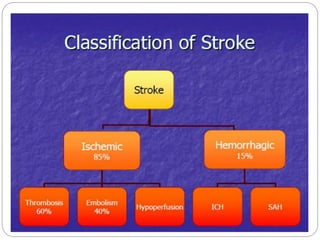
 Classification
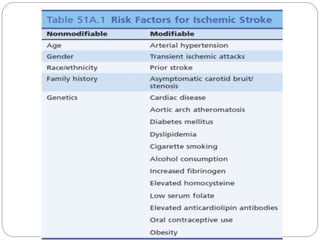
 Risk Factors
 Phatophysiology of stroke
 Signs and Symptoms of stroke
 Differential Diagnosis
 Approach to the Patient
Stroke
 A stroke, or cerebrovascular accident
 Thus, the definition of stroke is clinical, and brain
imaging are used to support the diagnosis
 Stroke/CVA include some of the most common
and devastating disorders
 There are approximately 785,000 new or
recurrent strokes annually in the United States;
Incidence increases with age
 Worldwide, stroke is also a leading cause of
death, with stroke mortality being particularly high
in Eastern Europe and Asia.
 200,000 deaths /year in the US
 By 2020, 19 out of 25 million annual stroke
deaths will be in developing countries .
 Stroke is also the leading cause of disability in
adults.
 Of the hundreds of thousands of stroke
survivors each year, approximately
 30% require assistance with activities of
daily living,
 20% require assistance with ambulation,
and
incidence
 AGE : ↑se
Causes of Ischemic Stroke - Common
Causes
 Thrombosis (60%)
 Lacunar stroke (small
vessel)-20% of all
stroke
 Large vessel
thrombosis
 Dehydration
 Embolic occlusion
(40%)
 Artery-to-artery
 Carotid bifurcation
 Aortic arch
 Arterial dissection
 Cardioembolic (20%)
 Atrial fibrillation
 Mural thrombus
 Myocardial
infarction
 Dilated
cardiomyopathy
 Valvular lesions
 Mitral stenosis
 Mechanical valve
 Bacterial
endocarditis
 Paradoxical
embolus
 Atrial septal
defect
Uncommon
Causes
Hypercoagulable disorders
 Protein C deficiency
 Protein S deficiency
 Antithrombin III deficiency
 Antiphospholipid syndrome
 Factor V Leiden mutationa
 Prothrombin G20210 mutationa
 Systemic malignancy
 Sickle cell anemia
 Systemic lupus erythematosu
 DIC
 Nephrotic syndrome
 Inflammatory bowel disease
 Oral contraceptives
 Venous sinus thrombosisb
 Vasculitis
 Systemic vasculitis [PAN,
granulomatosis with polyangiitis
(Wegener's), Takayasu's, & giant
cell arteritis]
 Primary CNS vasculitis
 Meningitis (syphilis, tuberculosis,
fungal, bacterial, zoster)
 Cardiogenic
 Mitral valve calcification
 Atrial myxoma
 Intracardiac tumor
 Libman-Sacks endocarditis
 Subarachnoid hemorrhage
vasospasm
 Drugs: cocaine, amphetamin
 Eclampsia
Pathogenesis of Ischemic
Stroke
11
Cerebral Blood Flow and
Pathophysiology
 Cerebral blood flow is normally maintained at a
relatively constant rate of approximately 50 to 70
mL/100 g brain tissue per minute.
 A process called autoregulation helps maintain
perfusion pressure despite fluctuations in blood
pressure and cerebrovascular resistance
 A decrease in blood flow below a critical threshold
level results in ischemia and infarction.
CBF & Ischemic Thresholds
13
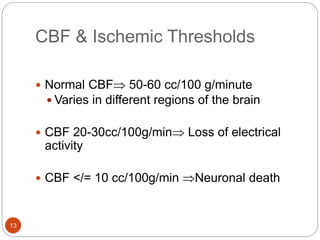
 Normal CBF 50-60 cc/100 g/minute
 Varies in different regions of the brain
 CBF 20-30cc/100g/min Loss of electrical
activity
 CBF </= 10 cc/100g/min Neuronal death
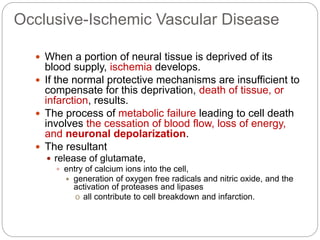
Occlusive-Ischemic Vascular Disease
 When a portion of neural tissue is deprived of its
blood supply, ischemia develops.
 If the normal protective mechanisms are insufficient to
compensate for this deprivation, death of tissue, or
infarction, results.
 The process of metabolic failure leading to cell death
involves the cessation of blood flow, loss of energy,
and neuronal depolarization.
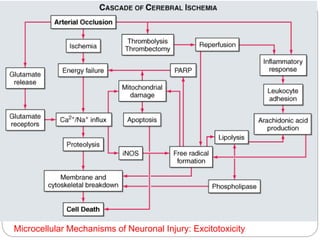
 The resultant
 release of glutamate,
 entry of calcium ions into the cell,
 generation of oxygen free radicals and nitric oxide, and the
activation of proteases and lipases
o all contribute to cell breakdown and infarction.
Microcellular Mechanisms of Neuronal Injury: Excitotoxicity
Acute Ischemic Injury
16
 The occlusion of a large vessel (such as MCA) is
rarely complete and cerebral blood flow (CBF)
depends on the degree of obstruction, and
collateral circulation
 Many factors influence progression and extent of
ischemic injury
Conditions influencing progression and
extent of ischemic injury
17
 Rate & duration of the ischemic event
 Collateral circulation in the involved area of the
brain
 Systemic circulation & arterial blood pressure
 Temperature
 Glucose
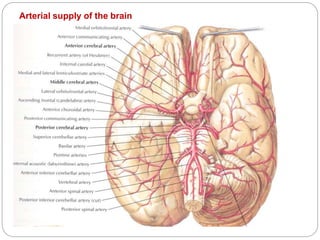
Major arteries supplying the supratentorial and posterior fossa levels.
Arterial supply of the brain
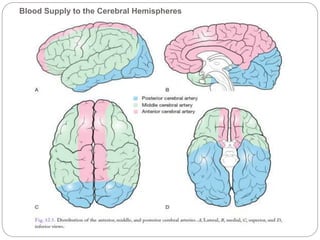
Blood Supply to the Cerebral Hemispheres
Ischemic Stroke – Signs and
Symptoms…
 Carotid Circulation
 Unilateral paralysis (opposite side)
 Numbness (opposite side)
 Language disturbance
 Aphasia – difficult comprehension, nonsense,
difficult reading/writing
 Dysarthria – slurred speech, abnormal
pronunciation.
 Visual disturbance (opposite side)
Ischemic Stroke – Signs and
Symptoms…
• Vertebrobasilar Circulation
 Vertigo & Hearing loss
 Visual disturbance
 Diplopia
 Ocular palsy – inability to move to one side
 Paralysis
 Numbness
 Dysarthria
 Ataxia
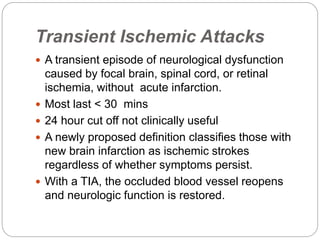
Transient Ischemic Attacks
 A transient episode of neurological dysfunction
caused by focal brain, spinal cord, or retinal
ischemia, without acute infarction.
 Most last < 30 mins
 24 hour cut off not clinically useful
 A newly proposed definition classifies those with
new brain infarction as ischemic strokes
regardless of whether symptoms persist.
 With a TIA, the occluded blood vessel reopens
and neurologic function is restored.
Transient Ischemic Attacks…
 The causes of TIA are similar to the causes of
ischemic stroke, but because TIAs may herald
stroke they are an important risk factor that
should be considered separately.
 Early risk of stroke is very high
11.5% after 1 week
15% after 1 month
18.5% after 3 months
Intracranial Hemorrhage
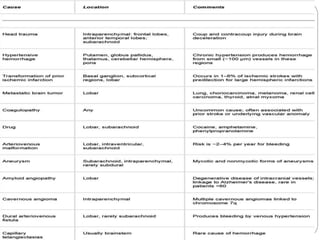
 Hemorrhages are classified by their location
and the underlying vascular pathology.
 Intracerebral (10%)
 Hypertension (most common)
 Amyloid angiopathy in elderly
 Trauma
 Subarachnoid (5%)
 Aneurysm (most common)
 Arteriovenous malformation
26
Intracerebral Hemorrhage
 The most common type ; ~10% of all strokes and
is associated with a 50% case fatality rate
 Hypertension, trauma, and cerebral amyloid
angiopathy cause the majority of these
hemorrhages
 A growing body of evidence suggests that genetic
factors such as possessing the E2 and E4 alleles
of the apolipoprotein E gene play an important
EPIDEMIOLOGY
 Nontraumatic intracerebral hemorrhage (ICH) causes 8 -
15% (10%) of all first-ever strokes in Australia, England,
and the United States ; it accounts for 25 % of strokes in
Japan .
 The overall incidence of ICH ranges from 12 to 31 per
100,000 people, and it varies by race .
 The rate of occurrence is highest in Asians, intermediate
in blacks, and lowest in whites.
 The higher rate of ICH in black compared with white
Americans is predominately attributable to excess ICH in
deep cerebral and brainstem locations where
hypertension is the major risk factor .
EPIDEMIOLOGY …
 The incidence of ICH increases with age,
doubling every 10 years after age 35 .
 As the population ages, the incidence of ICH may
rise in the future due to amyloid angiopathy.
 Gender does not appear to have a significant
impact on risk
Hypertensive Intraparenchymal Hemorrhage
 Pathophysiology
 Results from spontaneous rupture of a small penetrating
artery deep in the brain that branch off major intracerebral arteries,
often at 90º angles with the parent vessel;
 These small(100micro m) penetrating arteries may be particularly
susceptible to the effects of hypertension, as they are directly exposed to
the pressure of the much larger parent vessel, without the protection of a
preceding gradual decrease in vessel caliber
 Site : Putamen, Globus pallidus, Thalamus, Cerebellar
hemisphere, Pons
 In both hypertensive and nonhypertensive patients, the
circadian rhythm of ICH onset, with peaks at 8 am and 8 pm
Risk factors
 Hypertension is the most important risk factor for the
development of ICH , hypertension more than
doubled the risk of ICH
 Hypertension has also been shown to be a risk
factor for ICH in the setting of other underlying
etiologies for ICH (eg, cerebral amyloid angiopathy,
antithrombotic-associated ICH) .
 In addition to hypertension, a systematic review and
a large population-based study identified the
following risk factors for ICH:
 Older age
 High alcohol intake
 Black ethnicity
 Lower cholesterol and lower LDL cholesterol
 Lower triglycerides
Clinical Manifestations
 The hemorrhage generally presents as the
abrupt onset of focal neurologic deficit
 The neurologic symptoms usually increase
gradually over minutes or a few hours (30–90
min).
 Some hypertensive hemorrhages occur with
exertion or intense emotional activity.
 However, most cases take place during routine
Clinical Manifestations…
 Signs of
increased ICP,
such as headache
, vomiting and a
decreased level of
consciousness –
is more common
in hemorrhagic
stroke than
ischemic stroke .
Neurologic signs
 Neurologic signs vary depending upon the
location of the hemorrhage. Bleeding into
 Basal ganglia; putamen occurs in
approximately 35 percent of cases,
 subcortex in 30 percent,
 cerebellum in 16 percent,
 thalamus in 15 percent, and
 pons in 5 to 12 percent .
Putamenal hemorrhage
 Spread of hemorrhage into the putamen most
commonly occurs along white matter fiber
tracts, causing
 hemiplegia,
 hemisensory loss,
 homonymous hemianopsia,
 gaze palsy,
 stupor, and coma.
Cerebellar hemorrhage
 Cerebellar hemorrhages usually originate in the
dentate nucleus, extend into the hemisphere and
fourth ventricle, and possibly into the pon.
 These bleeds cause an inability to walk due to
 ataxia,
 vomiting,
 headache (which may be referred to the neck or shoulder,
usually occipital), and
 facial weakness.
 There is notably no weakness.
 The patient may become stuporous due to brainstem
compression
 Cerebellar hemorrhage is a crucial diagnosis to
make since these patients frequently deteriorate
and require surgery.
Thalamic hemorrhage
 A thalamic hemorrhage may extend in a
transverse direction to the posterior limb of the
internal capsule, downward to put pressure on
the midbrain, or may rupture into the third
ventricle.
 Symptoms include hemiparesis, hemisensory
loss, and occasionally transient homonymous
hemianopsia.
 There may also be an upgaze palsy with miotic
pupils that are unreactive.
 Aphasia may occur if the bleed affects the
dominant hemisphere or neglect in the
nondominant hemisphere.
Lobar hemorrhage
 Lobar hemorrhages vary in their neurologic signs
depending upon location.
 They most often affect the parietal and occipital
lobes.
 These bleeds are associated with a higher
incidence of seizures.
 Occipital hemorrhages frequently present with a
very dense contralateral homonymous
hemianopsia.
 Hemorrhages in the frontal region will bring about
a contralateral weakness.
Pontine hemorrhage
 Pontine hemorrhage lead to deep coma over
the first few minutes following the
hemorrhage, probably due to disruption of the
reticular activating system.
 The motor examination is marked by total
paralysis.
 The pupils are pinpoint and react to a strong
light source.
 Horizontal eye movements are absent, and
there may be, facial palsy, deafness, and
dysarthria when the patient is awake.
 Locked in syndrome
SAH
40
 Causes
Saccular
aneurysm
(80%)
Trauma
AVM
Extension from
an
intraparenchy
mal Hg
Saccular (Berry) Aneurysm
Annual risk of rupture of ASxic Aneurysm
o<1 cm -0.1 % ,
o >1 cm 0.5-1 %
o>2.5 cm (Giant )--6%
 risk factors for rupture : smoking , HTN ,
Alcohol..
 C/F :
 Sign & symptoms of raised ICP
 “The worst headache of my life” is described by ~80% of
patients , high index of suspicion
41
Delayed Complications
 Rerupture- highest in the 1st 72hrs
 Hydrocephalus : Acute, Subacute , Chronic
 Vasospasm : ischemia , @ 4- 14 days
usually @ 7 days
 Hyponatremia : “Cerebral Salt Wasting
Syndrome”
 Dx : Hallmark– Blood in the CSF
Investigations
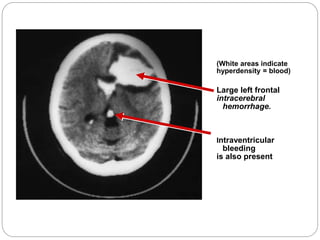
(White areas indicate
hyperdensity = blood)
Large left frontal
intracerebral
hemorrhage.
Intraventricular
bleeding
is also present
Hypodense area:
• Ischemic area
• Indicates >24 hours old
• No fibrinolytics!
Acute subarachnoid
hemorrhage
Diffuse areas of white
(hyperdense) images
Blood visible in
ventricles
and multiple areas on
surface of brain
Investigations …
 Establishing a cause is essential in reducing the risk
of recurrence
 A chest x-ray
 Electrocardiogram (ECG) & Echocardiography
 Carotid dopler
 Urinalysis
 Complete blood count
 Erythrocyte sedimentation rate
 Serum electrolytes
 Blood urea nitrogen
 Creatinine
 Blood sugar
 Serologic test for syphilis
 Serum lipid profile
 Prothrombin time, and partial thromboplastin time (PTT)
Differential Diagnosis of Stroke
 Head/Cervical trauma
 Meningitis/encephalitis
 Hypertensive encephalopathy
 Intracranial mass
 Tumor
 Sub/epi dural hematoma
 Todd’s paralysis
 Migraine
 Metabolic
 Hyper/hypo glycemia
 Electrolyte disterbances
 Hepatic / Uremic encephalopathy
 Post arrest ischemia
 Drug OD
Reference
Harrison’s
Uptodate
WWW.com
2. stroke

2. stroke

  • 2.
    Outline of presentation Introduction  Classification  Risk Factors  Phatophysiology of stroke  Signs and Symptoms of stroke  Differential Diagnosis  Approach to the Patient
  • 3.
    Stroke  A stroke,or cerebrovascular accident  Thus, the definition of stroke is clinical, and brain imaging are used to support the diagnosis
  • 4.
     Stroke/CVA includesome of the most common and devastating disorders  There are approximately 785,000 new or recurrent strokes annually in the United States; Incidence increases with age  Worldwide, stroke is also a leading cause of death, with stroke mortality being particularly high in Eastern Europe and Asia.  200,000 deaths /year in the US  By 2020, 19 out of 25 million annual stroke deaths will be in developing countries .
  • 5.
     Stroke isalso the leading cause of disability in adults.  Of the hundreds of thousands of stroke survivors each year, approximately  30% require assistance with activities of daily living,  20% require assistance with ambulation, and
  • 6.
  • 8.
    Causes of IschemicStroke - Common Causes  Thrombosis (60%)  Lacunar stroke (small vessel)-20% of all stroke  Large vessel thrombosis  Dehydration  Embolic occlusion (40%)  Artery-to-artery  Carotid bifurcation  Aortic arch  Arterial dissection  Cardioembolic (20%)  Atrial fibrillation  Mural thrombus  Myocardial infarction  Dilated cardiomyopathy  Valvular lesions  Mitral stenosis  Mechanical valve  Bacterial endocarditis  Paradoxical embolus  Atrial septal defect
  • 10.
    Uncommon Causes Hypercoagulable disorders  ProteinC deficiency  Protein S deficiency  Antithrombin III deficiency  Antiphospholipid syndrome  Factor V Leiden mutationa  Prothrombin G20210 mutationa  Systemic malignancy  Sickle cell anemia  Systemic lupus erythematosu  DIC  Nephrotic syndrome  Inflammatory bowel disease  Oral contraceptives  Venous sinus thrombosisb  Vasculitis  Systemic vasculitis [PAN, granulomatosis with polyangiitis (Wegener's), Takayasu's, & giant cell arteritis]  Primary CNS vasculitis  Meningitis (syphilis, tuberculosis, fungal, bacterial, zoster)  Cardiogenic  Mitral valve calcification  Atrial myxoma  Intracardiac tumor  Libman-Sacks endocarditis  Subarachnoid hemorrhage vasospasm  Drugs: cocaine, amphetamin  Eclampsia
  • 11.
  • 12.
    Cerebral Blood Flowand Pathophysiology  Cerebral blood flow is normally maintained at a relatively constant rate of approximately 50 to 70 mL/100 g brain tissue per minute.  A process called autoregulation helps maintain perfusion pressure despite fluctuations in blood pressure and cerebrovascular resistance  A decrease in blood flow below a critical threshold level results in ischemia and infarction.
  • 13.
    CBF & IschemicThresholds 13  Normal CBF 50-60 cc/100 g/minute  Varies in different regions of the brain  CBF 20-30cc/100g/min Loss of electrical activity  CBF </= 10 cc/100g/min Neuronal death
  • 14.
    Occlusive-Ischemic Vascular Disease When a portion of neural tissue is deprived of its blood supply, ischemia develops.  If the normal protective mechanisms are insufficient to compensate for this deprivation, death of tissue, or infarction, results.  The process of metabolic failure leading to cell death involves the cessation of blood flow, loss of energy, and neuronal depolarization.  The resultant  release of glutamate,  entry of calcium ions into the cell,  generation of oxygen free radicals and nitric oxide, and the activation of proteases and lipases o all contribute to cell breakdown and infarction.
  • 15.
    Microcellular Mechanisms ofNeuronal Injury: Excitotoxicity
  • 16.
    Acute Ischemic Injury 16 The occlusion of a large vessel (such as MCA) is rarely complete and cerebral blood flow (CBF) depends on the degree of obstruction, and collateral circulation  Many factors influence progression and extent of ischemic injury
  • 17.
    Conditions influencing progressionand extent of ischemic injury 17  Rate & duration of the ischemic event  Collateral circulation in the involved area of the brain  Systemic circulation & arterial blood pressure  Temperature  Glucose
  • 18.
    Major arteries supplyingthe supratentorial and posterior fossa levels.
  • 19.
  • 20.
    Blood Supply tothe Cerebral Hemispheres
  • 21.
    Ischemic Stroke –Signs and Symptoms…  Carotid Circulation  Unilateral paralysis (opposite side)  Numbness (opposite side)  Language disturbance  Aphasia – difficult comprehension, nonsense, difficult reading/writing  Dysarthria – slurred speech, abnormal pronunciation.  Visual disturbance (opposite side)
  • 22.
    Ischemic Stroke –Signs and Symptoms… • Vertebrobasilar Circulation  Vertigo & Hearing loss  Visual disturbance  Diplopia  Ocular palsy – inability to move to one side  Paralysis  Numbness  Dysarthria  Ataxia
  • 23.
    Transient Ischemic Attacks A transient episode of neurological dysfunction caused by focal brain, spinal cord, or retinal ischemia, without acute infarction.  Most last < 30 mins  24 hour cut off not clinically useful  A newly proposed definition classifies those with new brain infarction as ischemic strokes regardless of whether symptoms persist.  With a TIA, the occluded blood vessel reopens and neurologic function is restored.
  • 24.
    Transient Ischemic Attacks… The causes of TIA are similar to the causes of ischemic stroke, but because TIAs may herald stroke they are an important risk factor that should be considered separately.  Early risk of stroke is very high 11.5% after 1 week 15% after 1 month 18.5% after 3 months
  • 25.
    Intracranial Hemorrhage  Hemorrhagesare classified by their location and the underlying vascular pathology.  Intracerebral (10%)  Hypertension (most common)  Amyloid angiopathy in elderly  Trauma  Subarachnoid (5%)  Aneurysm (most common)  Arteriovenous malformation
  • 26.
  • 27.
    Intracerebral Hemorrhage  Themost common type ; ~10% of all strokes and is associated with a 50% case fatality rate  Hypertension, trauma, and cerebral amyloid angiopathy cause the majority of these hemorrhages  A growing body of evidence suggests that genetic factors such as possessing the E2 and E4 alleles of the apolipoprotein E gene play an important
  • 28.
    EPIDEMIOLOGY  Nontraumatic intracerebralhemorrhage (ICH) causes 8 - 15% (10%) of all first-ever strokes in Australia, England, and the United States ; it accounts for 25 % of strokes in Japan .  The overall incidence of ICH ranges from 12 to 31 per 100,000 people, and it varies by race .  The rate of occurrence is highest in Asians, intermediate in blacks, and lowest in whites.  The higher rate of ICH in black compared with white Americans is predominately attributable to excess ICH in deep cerebral and brainstem locations where hypertension is the major risk factor .
  • 29.
    EPIDEMIOLOGY …  Theincidence of ICH increases with age, doubling every 10 years after age 35 .  As the population ages, the incidence of ICH may rise in the future due to amyloid angiopathy.  Gender does not appear to have a significant impact on risk
  • 30.
    Hypertensive Intraparenchymal Hemorrhage Pathophysiology  Results from spontaneous rupture of a small penetrating artery deep in the brain that branch off major intracerebral arteries, often at 90º angles with the parent vessel;  These small(100micro m) penetrating arteries may be particularly susceptible to the effects of hypertension, as they are directly exposed to the pressure of the much larger parent vessel, without the protection of a preceding gradual decrease in vessel caliber  Site : Putamen, Globus pallidus, Thalamus, Cerebellar hemisphere, Pons  In both hypertensive and nonhypertensive patients, the circadian rhythm of ICH onset, with peaks at 8 am and 8 pm
  • 31.
    Risk factors  Hypertensionis the most important risk factor for the development of ICH , hypertension more than doubled the risk of ICH  Hypertension has also been shown to be a risk factor for ICH in the setting of other underlying etiologies for ICH (eg, cerebral amyloid angiopathy, antithrombotic-associated ICH) .  In addition to hypertension, a systematic review and a large population-based study identified the following risk factors for ICH:  Older age  High alcohol intake  Black ethnicity  Lower cholesterol and lower LDL cholesterol  Lower triglycerides
  • 32.
    Clinical Manifestations  Thehemorrhage generally presents as the abrupt onset of focal neurologic deficit  The neurologic symptoms usually increase gradually over minutes or a few hours (30–90 min).  Some hypertensive hemorrhages occur with exertion or intense emotional activity.  However, most cases take place during routine
  • 33.
    Clinical Manifestations…  Signsof increased ICP, such as headache , vomiting and a decreased level of consciousness – is more common in hemorrhagic stroke than ischemic stroke .
  • 34.
    Neurologic signs  Neurologicsigns vary depending upon the location of the hemorrhage. Bleeding into  Basal ganglia; putamen occurs in approximately 35 percent of cases,  subcortex in 30 percent,  cerebellum in 16 percent,  thalamus in 15 percent, and  pons in 5 to 12 percent .
  • 35.
    Putamenal hemorrhage  Spreadof hemorrhage into the putamen most commonly occurs along white matter fiber tracts, causing  hemiplegia,  hemisensory loss,  homonymous hemianopsia,  gaze palsy,  stupor, and coma.
  • 36.
    Cerebellar hemorrhage  Cerebellarhemorrhages usually originate in the dentate nucleus, extend into the hemisphere and fourth ventricle, and possibly into the pon.  These bleeds cause an inability to walk due to  ataxia,  vomiting,  headache (which may be referred to the neck or shoulder, usually occipital), and  facial weakness.  There is notably no weakness.  The patient may become stuporous due to brainstem compression  Cerebellar hemorrhage is a crucial diagnosis to make since these patients frequently deteriorate and require surgery.
  • 37.
    Thalamic hemorrhage  Athalamic hemorrhage may extend in a transverse direction to the posterior limb of the internal capsule, downward to put pressure on the midbrain, or may rupture into the third ventricle.  Symptoms include hemiparesis, hemisensory loss, and occasionally transient homonymous hemianopsia.  There may also be an upgaze palsy with miotic pupils that are unreactive.  Aphasia may occur if the bleed affects the dominant hemisphere or neglect in the nondominant hemisphere.
  • 38.
    Lobar hemorrhage  Lobarhemorrhages vary in their neurologic signs depending upon location.  They most often affect the parietal and occipital lobes.  These bleeds are associated with a higher incidence of seizures.  Occipital hemorrhages frequently present with a very dense contralateral homonymous hemianopsia.  Hemorrhages in the frontal region will bring about a contralateral weakness.
  • 39.
    Pontine hemorrhage  Pontinehemorrhage lead to deep coma over the first few minutes following the hemorrhage, probably due to disruption of the reticular activating system.  The motor examination is marked by total paralysis.  The pupils are pinpoint and react to a strong light source.  Horizontal eye movements are absent, and there may be, facial palsy, deafness, and dysarthria when the patient is awake.  Locked in syndrome
  • 40.
  • 41.
    Saccular (Berry) Aneurysm Annualrisk of rupture of ASxic Aneurysm o<1 cm -0.1 % , o >1 cm 0.5-1 % o>2.5 cm (Giant )--6%  risk factors for rupture : smoking , HTN , Alcohol..  C/F :  Sign & symptoms of raised ICP  “The worst headache of my life” is described by ~80% of patients , high index of suspicion 41
  • 42.
    Delayed Complications  Rerupture-highest in the 1st 72hrs  Hydrocephalus : Acute, Subacute , Chronic  Vasospasm : ischemia , @ 4- 14 days usually @ 7 days  Hyponatremia : “Cerebral Salt Wasting Syndrome”  Dx : Hallmark– Blood in the CSF
  • 43.
  • 44.
    (White areas indicate hyperdensity= blood) Large left frontal intracerebral hemorrhage. Intraventricular bleeding is also present
  • 45.
    Hypodense area: • Ischemicarea • Indicates >24 hours old • No fibrinolytics!
  • 46.
    Acute subarachnoid hemorrhage Diffuse areasof white (hyperdense) images Blood visible in ventricles and multiple areas on surface of brain
  • 47.
    Investigations …  Establishinga cause is essential in reducing the risk of recurrence  A chest x-ray  Electrocardiogram (ECG) & Echocardiography  Carotid dopler  Urinalysis  Complete blood count  Erythrocyte sedimentation rate  Serum electrolytes  Blood urea nitrogen  Creatinine  Blood sugar  Serologic test for syphilis  Serum lipid profile  Prothrombin time, and partial thromboplastin time (PTT)
  • 48.
    Differential Diagnosis ofStroke  Head/Cervical trauma  Meningitis/encephalitis  Hypertensive encephalopathy  Intracranial mass  Tumor  Sub/epi dural hematoma  Todd’s paralysis  Migraine  Metabolic  Hyper/hypo glycemia  Electrolyte disterbances  Hepatic / Uremic encephalopathy  Post arrest ischemia  Drug OD
  • 50.

Editor's Notes

  • #4 Thus, the definition of stroke is clinical, and laboratory studies including brain imaging are used to support the diagnosis
  • #5 Despite any decrease in mortality in developed countries, stroke mortality and incidence are increasing in the rapidly industrializing developing nations.Socioeconomic factors, dietary and lifestyle behaviors, different patterns of risk factors, and environmental conditions may explain the different incidences of stroke observed in different parts of The world. There are approximately 785,000 new or recurrent strokes annually in the United States (600,000 being first events and 185,000 being recurrent events).
  • #7 The incidence of cerebrovascular diseases increases with age, and the number of strokes is projected to increase as the elderly population grows
  • #8 Modifiable risk factors may be subdivided into lifestyle and behavioral risk factors and non-lifestyle factors, although these two subgroups are interrelated. Presumed modifiable lifestyle risk factors include cigarette consumption and illicit drug use. Non-lifestyle risk factors include low socioeconomic status, arterial hypertension, dyslipidemia, heart disease, and asymptomatic carotid artery disease. Stroke secondary to sickle cell disease is also a modifiable non-lifestyle risk factor. Potentially modifiable risk factors (that have yet to be shown to decrease risk when modified, however) include diabetes mellitus (DM), hyperhomocysteinemia, and left ventricular hypertrophy. Less well-documented risk factors include blood markers (i.e., C-reactive protein), ankle-brachial blood pressure ratios, silent cerebral infarcts, white-matter hyperintensities on magnetic resonance imaging (MRI), and degree of carotid artery intima-media thickness.
  • #10  (1) occlusion of an intracranial vessel by an embolus that arises at a distant site (e.g., cardiogenic sources such as atrial fibrillation or artery-to-artery emboli from carotid atherosclerotic plaque), often affecting the large intracranial vessels; (2) in situ thrombosis of an intracranial vessel, typically affecting the small penetrating arteries that arise from the major intracranial arteries; (3) hypoperfusion caused by flow-limiting stenosis of a major extracranial (e.g., internal carotid) or intracranial vessel, often producing "watershed" ischemia
  • #11 Polyarterites nodusa (PAN)
  • #12 In an ischemic stroke lack of circulating blood …. And in a hemorrhagic stroke extravasculaar release of blood Hemorrhage: Extravascular release of blood causes damage by cutting off connecting pathways, resulting in local or generalized pressure injury
  • #15 Atherosclerosis is the most important disease process responsible for thromboembolic disease;
  • #16 PARP, poly-A ribose polymerase; iNOS, inducible nitric oxide synthase
  • #18 Coagulation abnormalities
  • #19 All the arteries that supply the supratentorial and posterior fossa levels arise from the aortic arch . The innominate (brachiocephalic) artery divides into the right common carotid and right subclavian arteries. The left common carotid artery arises directly from the apex of the aortic arch. The right and left common carotid arteries ascend in the neck lateral to the trachea. Slightly below the angle of the jaw, the common carotid artery bifurcates into the internal and external carotid arteries.
  • #21 The anterior cerebral artery (Fig. 12.6) supplies the medial surface of the cerebral hemisphere and the superior Border of the frontal and parietal lobes. The middle cerebral artery (Fig. 12.7) supplies most of the lateral surface of the cerebral hemisphere, including the lateral portions of the frontal lobe, the superior and lateral portions of the temporal lobe, and the deep structures of the frontal and parietal lobes. The posterior cerebral artery supplies the entire occipital lobe and the inferior and medial portions of the temporal lobe
  • #22 Monocular blindness (same side)
  • #24 The standard definition of TIA requires that all neurologic signs and symptoms resolve within 24 h …
  • #26 Clinical diagnosis of hemorrhagic stroke and ischemic stroke accounted for 57% and 43% respectively. hemorrhagic stroke 80.8 % intraparenchymal and 19.2% subarachioid
  • #28 Care of ICH patients in a dedicated neuroscience intensive care unit is associated with a lower mortality rate
  • #31 Hypertensive hemorrhages occur in the territory of penetrator arteries. When hemorrhages occur in other brain areas or in nonhypertensive patients, greater consideration should be given to hemorrhagic disorders, neoplasms, vascular malformations, and other causes Hemorrhage enlargement — Serial CT scans in patients with hypertensive hemorrhage have shown that the hemorrhage enlarges in the first six hours after presentation in a subset of patients
  • #32  A number of additional studies have found an inverse relationship between total and LDL-cholesterol and the risk of ICH [74-81]. At least one study suggested that the association is stronger for subcortical or hypertensive ICH than lobar hemorrhage [78]. However, treatment with statins does not appear to increase the risk of primary ICH or to negatively impact prognosis Most cases of ICH are not believed to have a genetic component. One exception is cerebral amyloid angiopathy-related ICH which has been shown to have an association with APOE genotype. However, a large-scale genetic association study of 2189 ICH cases and 4041 controls revealed that APOE allele ε4 was also associated with deep ICH (OR = 1.21), a location not typical for cerebral amyloid angiopathy
  • #33 Most hypertensive intraparenchymal hemorrhages develop over 30–90 min In contrast to brain embolism and subarachnoid hemorrhage, the neurologic symptoms do not begin abruptly and are not maximal at onset.
  • #34 Signs of increased ICP, such as headache , vomiting and a decreased level of consciousness develop if the hematoma becomes sufficiently large. Headache may be due to traction on meningeal pain fibers, increased intracranial pressure (ICP), or blood in the cerebrospinal fluid (CSF); it is most common with cerebellar and lobar hemorrhages.
  • #39 Hemorrhages in the frontal region will bring about a contralateral plegia or paresis of the leg with relative sparing of the arm.
  • #43 95 % - Detected by CT Scan within 72 hrs -ve CT scan – LP Yellow (xanthochromic CSF)- within 6-12 hrs Peak @ 48 hrs Stays for 1-4 wks X-ray, CT angiography EKG Electrolytes
  • #48 …prothrombin time, and partial thromboplastin time (PTT) are often useful and should be considered in all patients
  • #49 Stroke mimics : There are several common causes of sudden-onset neurologic symptoms that may mimic stroke, including seizure, intracranial tumor, migraine, and metabolic encephalopathy
  • #50 Intravenous Recombinant Tissue Plasminogen Activator (rtPA)