STROBE CHECKLIST
STrengthening the Reporting of OBservational
studies in Epidemiology
Presenter: Dr. Sujitha
Moderator: Dr. Eesha B Rao
1
Contents
• Introduction
• Observational Studies
-Cohort studies
-Case Control
-Cross-Sectional Studies
• Extension to strobe
-STREGA
-STROBE ME
-STROBE abstract
• Contents of STROBE
checklist
• Conclusion
• References
2
Introduction
The STROBE checklist: widely used tool in epidemiology for reporting observational
studies
D
eveloped in 2004
By following the STROBE checklist, researchers can ensure transparency and
completeness in reporting observational studies in pharmacology & in fields of research
Used as guidelines for reporting observational studies, specifically cohort, case-control
and cross-sectional studies
3
Introduction (Contd..)
• STROBE statement consists of a 22-item checklist under the following Headings:
• Title and abstract
• Introduction
• Methods,
• Results,
• Discussion and other information
4
Introduction (Contd..)
• As like CONSORT, this guideline is meant to be followed strictly, and
presentation of information should depend on the journal style,
authors' preferences, and traditions in research area
• STREGA (STrengthening the REporting of Genetic Association studies)
is an extension to STROBE where it is used for reporting genetic
association studies
5
6
STROBE
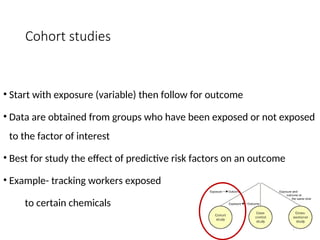
Cohort studies
• Start with exposure (variable) then follow for outcome
• Data are obtained from groups who have been exposed or not exposed
to the factor of interest
• Best for study the effect of predictive risk factors on an outcome
• Example- tracking workers exposed
to certain chemicals
7
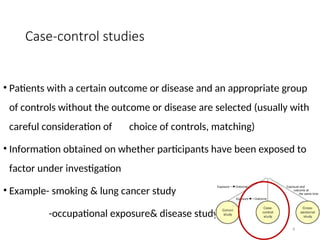
Case-control studies
• Patients with a certain outcome or disease and an appropriate group
of controls without the outcome or disease are selected (usually with
careful consideration of choice of controls, matching)
• Information obtained on whether participants have been exposed to
factor under investigation
• Example- smoking & lung cancer study
-occupational exposure& disease study
8
Cross-sectional studies
Examine relationship between diseases (or other health-related characteristics)&
other variable of interest as they exist in a defined population at one particular time
(outcomes and exposures are measured at same time)
Best for quantifying the prevalence of a disease or risk factor, and for quantifying
the accuracy of a diagnostic test
Example- prevalence of obesity study
- health behaviour survey
9
STROBE Statement
 Guidance on how to report observational studies well
 Focus on 3 main study designs:
1. Cohort
2. Case-control
3. Cross-sectional studies
10
STROBE extensions (1)
STREGA
Reporting of genetic association studies
• The STREGA checklist, also known as the Strengthening the Reporting
of Genetic Association Studies
• Guideline developed to improve reporting quality of genetic
association studies
• It helps researchers ensure that they include all relevant information
in their publications, aiding in transparency, reproducibility &
interpretation of study findings 11
STREGA (Contd..)
Reporting of genetic association studies
Here's a simplified version of the checklist:
1.Title and Abstract:
Clearly state the aim of the study, including the population, phenotype, and genetic variants investigated.
2. Introduction:
Provide background information on the disease or phenotype under study.
- Explain the rationale for the genetic variants chosen for investigation.
3. Methods:
Describe the study design, including the population/sample source and size.
-Detail the genotyping or sequencing methods used.
-- Specify the statistical methods employed for data analysis, including adjustments for multiple testing.
- - Report any ethical considerations or approvals obtained.
12
4. Results: Present descriptive data on the study population.
- Report results of genetic association analyses, including effect sizes, confidence intervals, and p-values.
- Address issues such as population stratification, if applicable.
- Provide details on any secondary analyses or subgroup analyses conducted.
5. Discussion: Interpret the findings in the context of previous research.
- Discuss the strengths and limitations of the study, including potential sources of bias.
- Consider the implications of the findings for future research or clinical practice.
6. Conclusion: Summarize the main findings and their significance.
- Avoid overgeneralization or extrapolation beyond the scope of the study.
7. *Other Considerations*:
-Acknowledge sources of funding and potential conflicts of interest.
- Provide supplementary materials, such as tables or figures, as needed.
13
STREGA
Reporting of genetic association studies
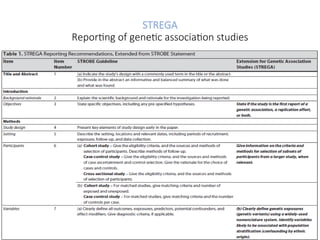
STREGA (2009)
 reporting of genetic association studies
14
• STROBE – ME (Oct 2011)
• Reporting molecular epidemiology (biomarker studies)
15
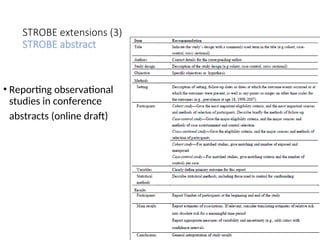
STROBE extensions (3)
STROBE abstract
• Reporting observational
studies in conference
abstracts (online draft)
16
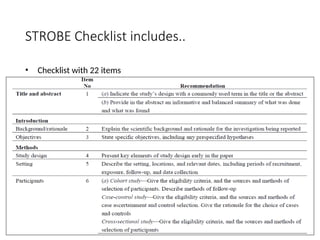
STROBE Checklist includes..
• Checklist with 22 items
• Heading (where in paper), item No
• Recommendation, divided into:
cohort, case-control, cross-sectional study
17
STROBE Checklist(Contd..)
Title and abstract:
1. a) Indicate the study’s design with a commonly used term in the title or the abstract
b) Provide in the abstract an informative and balanced summary of what was done and
what was found
Introduction
Background/Rationale
2. Explain scientific background & rationale for the investigation being reported
Objectives
3. State specific objectives, including any prespecified hypothesis
18
STROBE Checklist(Contd..)
Methods:
Study Design
4. Present key elements of study design early in the paper
(what design, what was compared, which controls and why...etc)
Setting
5. Describe the setting, locations, and relevant dates, including periods of recruitment,
exposure, follow-up, and data collection
19
STROBE Checklist(Contd..)
Methods - continued
Participants
6.a) Cohort study:
eligibility criteria
sources and methods of participant selection
follow-up methods
Case-control study:
eligibility criteria
sources and methods of case ascertainment and control selection
rationale for the choices of cases and controls
Cross-sectional study:
eligibility criteria
sources and methods of participant selection
20
STROBE Checklist(Contd..)
Methods - continued
Participants
6. b) Cohort study:
For matched studies, give matching criteria and number of exposed and unexposed
Case-control:
For matched studies, give matching criteria and the number of controls per case
Variables
7. Clearly define all outcomes, exposures, predictors, potential confounders, and effect modifiers. Give
diagnostic criteria, if applicable
21
STROBE Checklist(Contd..)
Methods - continued
Data sources/measurement
8. For each variable of interest, give sources of data and details of
methods of assessment (measurement)
Describe comparability of assessment methods if there is more than
one group
22
STROBE Checklist(Contd..)
Methods - continued
Bias
9. Describe any efforts to address potential sources of bias
(i,e systematic deviation of a result from the true value)
e.g: recall bias, detection bias, interviewer bias, selection bias
23
STROBE Checklist(Contd..)
Methods - continued
Study size
10. Explains how the study size was arrived at
(should be large enough to arrive at a point estimate with a reasonably narrow
confidence interval)
Quantitative variables
11. Explains how quantitative variables were handled in the analyses. If applicable,
describe which groupings were chosen and why
24
STROBE Checklist(Contd..)
Methods - continued
Statistical methods
12. a) Describes all statistical methods, including those used to control
confounding
(≠bias, confounding: association true but caused by something else)
b) Describes any methods used to examine subgroups and interactions
c) Explains how missing data were addressed
25
STROBE Checklist(Contd..)
Methods - continued
Statistical methods - continued
12. d) Cohort study:
If applicable, explain how loss to follow-up was addressed
Case-control:
If applicable, explain how matching of cases and controls was addressed
Cross-sectional:
If applicable, describe analytical methods including sampling strategy
e) Describe any sensitivity analyses
26
STROBE Checklist(Contd..)
Results
Participants
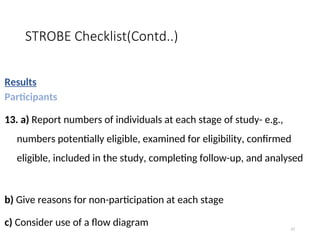
13. a) Report numbers of individuals at each stage of study- e.g.,
numbers potentially eligible, examined for eligibility, confirmed
eligible, included in the study, completing follow-up, and analysed
b) Give reasons for non-participation at each stage
c) Consider use of a flow diagram 27
STROBE Checklist(Contd..)
Results - continued
Descriptive data
14. a) Give characteristics of study participants (e.g. demographic, clinical, social) and
information on exposures and potential confounders
b) Indicate number of participants with missing data for each variable of interest
c) Cohort study:
Summarise follow up time (e.g. average and total amount)
28
STROBE Checklist(Contd..)
Results - continued
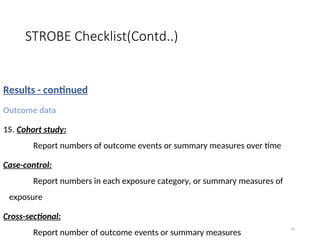
Outcome data
15. Cohort study:
Report numbers of outcome events or summary measures over time
Case-control:
Report numbers in each exposure category, or summary measures of
exposure
Cross-sectional:
Report number of outcome events or summary measures
29
STROBE Checklist(Contd..)
Results - continued
Main results
16. a) Give unadjusted estimates and, if applicable, confounder-adjusted estimates and
their precision. Make clear which confounders were adjusted for and why they were
included
b) Report category boundaries when continuous variables were categorised
c) If relevant, consider translating estimates of relative risk into absolute risk for a
meaningful time period
30
STROBE Checklist(Contd..)
Results - continued
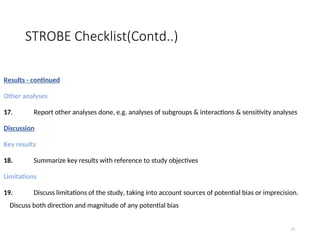
Other analyses
17. Report other analyses done, e.g. analyses of subgroups & interactions & sensitivity analyses
Discussion
Key results
18. Summarize key results with reference to study objectives
Limitations
19. Discuss limitations of the study, taking into account sources of potential bias or imprecision.
Discuss both direction and magnitude of any potential bias
31
STROBE Checklist(Contd..)
Discussion - continued
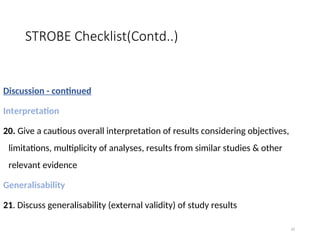
Interpretation
20. Give a cautious overall interpretation of results considering objectives,
limitations, multiplicity of analyses, results from similar studies & other
relevant evidence
Generalisability
21. Discuss generalisability (external validity) of study results
32
Other information
Funding
22. Give the source of funding and the role of the funders for the
present study and, if applicable, for the original study on which the
present article is based
33
Conclusion
• The STROBE checklist is typically used to ensure transparent and
comprehensive reporting in observational studies
• Including it in conclusion of a research paper could involve summarizing how
the study adhered to each item on the checklist, highlighting strengths,
limitations, and implications for future research
34
References
• www.equator-network.org
• www.strobe-statement.org
• Vandenbroucke, J. P., von Elm, E., Altman, D. G., Gøtzsche, P. C., Mulrow, C. D.,
Pocock, S. J., ... & STROBE Initiative. (2007).
• Strengthening the Reporting of Observational Studies in Epidemiology (STROBE):
Explanation and elaboration. Annals of internal medicine, 147(8), W-163.
• Postgraduate Pharmacology by Sougata Sarkar
35

STROBE checklist for research article Copy.ppt

  • 1.
    STROBE CHECKLIST STrengthening theReporting of OBservational studies in Epidemiology Presenter: Dr. Sujitha Moderator: Dr. Eesha B Rao 1
  • 2.
    Contents • Introduction • ObservationalStudies -Cohort studies -Case Control -Cross-Sectional Studies • Extension to strobe -STREGA -STROBE ME -STROBE abstract • Contents of STROBE checklist • Conclusion • References 2
  • 3.
    Introduction The STROBE checklist:widely used tool in epidemiology for reporting observational studies D eveloped in 2004 By following the STROBE checklist, researchers can ensure transparency and completeness in reporting observational studies in pharmacology & in fields of research Used as guidelines for reporting observational studies, specifically cohort, case-control and cross-sectional studies 3
  • 4.
    Introduction (Contd..) • STROBEstatement consists of a 22-item checklist under the following Headings: • Title and abstract • Introduction • Methods, • Results, • Discussion and other information 4
  • 5.
    Introduction (Contd..) • Aslike CONSORT, this guideline is meant to be followed strictly, and presentation of information should depend on the journal style, authors' preferences, and traditions in research area • STREGA (STrengthening the REporting of Genetic Association studies) is an extension to STROBE where it is used for reporting genetic association studies 5
  • 6.
  • 7.
    Cohort studies • Startwith exposure (variable) then follow for outcome • Data are obtained from groups who have been exposed or not exposed to the factor of interest • Best for study the effect of predictive risk factors on an outcome • Example- tracking workers exposed to certain chemicals 7
  • 8.
    Case-control studies • Patientswith a certain outcome or disease and an appropriate group of controls without the outcome or disease are selected (usually with careful consideration of choice of controls, matching) • Information obtained on whether participants have been exposed to factor under investigation • Example- smoking & lung cancer study -occupational exposure& disease study 8
  • 9.
    Cross-sectional studies Examine relationshipbetween diseases (or other health-related characteristics)& other variable of interest as they exist in a defined population at one particular time (outcomes and exposures are measured at same time) Best for quantifying the prevalence of a disease or risk factor, and for quantifying the accuracy of a diagnostic test Example- prevalence of obesity study - health behaviour survey 9
  • 10.
    STROBE Statement  Guidanceon how to report observational studies well  Focus on 3 main study designs: 1. Cohort 2. Case-control 3. Cross-sectional studies 10
  • 11.
    STROBE extensions (1) STREGA Reportingof genetic association studies • The STREGA checklist, also known as the Strengthening the Reporting of Genetic Association Studies • Guideline developed to improve reporting quality of genetic association studies • It helps researchers ensure that they include all relevant information in their publications, aiding in transparency, reproducibility & interpretation of study findings 11
  • 12.
    STREGA (Contd..) Reporting ofgenetic association studies Here's a simplified version of the checklist: 1.Title and Abstract: Clearly state the aim of the study, including the population, phenotype, and genetic variants investigated. 2. Introduction: Provide background information on the disease or phenotype under study. - Explain the rationale for the genetic variants chosen for investigation. 3. Methods: Describe the study design, including the population/sample source and size. -Detail the genotyping or sequencing methods used. -- Specify the statistical methods employed for data analysis, including adjustments for multiple testing. - - Report any ethical considerations or approvals obtained. 12
  • 13.
    4. Results: Presentdescriptive data on the study population. - Report results of genetic association analyses, including effect sizes, confidence intervals, and p-values. - Address issues such as population stratification, if applicable. - Provide details on any secondary analyses or subgroup analyses conducted. 5. Discussion: Interpret the findings in the context of previous research. - Discuss the strengths and limitations of the study, including potential sources of bias. - Consider the implications of the findings for future research or clinical practice. 6. Conclusion: Summarize the main findings and their significance. - Avoid overgeneralization or extrapolation beyond the scope of the study. 7. *Other Considerations*: -Acknowledge sources of funding and potential conflicts of interest. - Provide supplementary materials, such as tables or figures, as needed. 13
  • 14.
    STREGA Reporting of geneticassociation studies STREGA (2009)  reporting of genetic association studies 14
  • 15.
    • STROBE –ME (Oct 2011) • Reporting molecular epidemiology (biomarker studies) 15
  • 16.
    STROBE extensions (3) STROBEabstract • Reporting observational studies in conference abstracts (online draft) 16
  • 17.
    STROBE Checklist includes.. •Checklist with 22 items • Heading (where in paper), item No • Recommendation, divided into: cohort, case-control, cross-sectional study 17
  • 18.
    STROBE Checklist(Contd..) Title andabstract: 1. a) Indicate the study’s design with a commonly used term in the title or the abstract b) Provide in the abstract an informative and balanced summary of what was done and what was found Introduction Background/Rationale 2. Explain scientific background & rationale for the investigation being reported Objectives 3. State specific objectives, including any prespecified hypothesis 18
  • 19.
    STROBE Checklist(Contd..) Methods: Study Design 4.Present key elements of study design early in the paper (what design, what was compared, which controls and why...etc) Setting 5. Describe the setting, locations, and relevant dates, including periods of recruitment, exposure, follow-up, and data collection 19
  • 20.
    STROBE Checklist(Contd..) Methods -continued Participants 6.a) Cohort study: eligibility criteria sources and methods of participant selection follow-up methods Case-control study: eligibility criteria sources and methods of case ascertainment and control selection rationale for the choices of cases and controls Cross-sectional study: eligibility criteria sources and methods of participant selection 20
  • 21.
    STROBE Checklist(Contd..) Methods -continued Participants 6. b) Cohort study: For matched studies, give matching criteria and number of exposed and unexposed Case-control: For matched studies, give matching criteria and the number of controls per case Variables 7. Clearly define all outcomes, exposures, predictors, potential confounders, and effect modifiers. Give diagnostic criteria, if applicable 21
  • 22.
    STROBE Checklist(Contd..) Methods -continued Data sources/measurement 8. For each variable of interest, give sources of data and details of methods of assessment (measurement) Describe comparability of assessment methods if there is more than one group 22
  • 23.
    STROBE Checklist(Contd..) Methods -continued Bias 9. Describe any efforts to address potential sources of bias (i,e systematic deviation of a result from the true value) e.g: recall bias, detection bias, interviewer bias, selection bias 23
  • 24.
    STROBE Checklist(Contd..) Methods -continued Study size 10. Explains how the study size was arrived at (should be large enough to arrive at a point estimate with a reasonably narrow confidence interval) Quantitative variables 11. Explains how quantitative variables were handled in the analyses. If applicable, describe which groupings were chosen and why 24
  • 25.
    STROBE Checklist(Contd..) Methods -continued Statistical methods 12. a) Describes all statistical methods, including those used to control confounding (≠bias, confounding: association true but caused by something else) b) Describes any methods used to examine subgroups and interactions c) Explains how missing data were addressed 25
  • 26.
    STROBE Checklist(Contd..) Methods -continued Statistical methods - continued 12. d) Cohort study: If applicable, explain how loss to follow-up was addressed Case-control: If applicable, explain how matching of cases and controls was addressed Cross-sectional: If applicable, describe analytical methods including sampling strategy e) Describe any sensitivity analyses 26
  • 27.
    STROBE Checklist(Contd..) Results Participants 13. a)Report numbers of individuals at each stage of study- e.g., numbers potentially eligible, examined for eligibility, confirmed eligible, included in the study, completing follow-up, and analysed b) Give reasons for non-participation at each stage c) Consider use of a flow diagram 27
  • 28.
    STROBE Checklist(Contd..) Results -continued Descriptive data 14. a) Give characteristics of study participants (e.g. demographic, clinical, social) and information on exposures and potential confounders b) Indicate number of participants with missing data for each variable of interest c) Cohort study: Summarise follow up time (e.g. average and total amount) 28
  • 29.
    STROBE Checklist(Contd..) Results -continued Outcome data 15. Cohort study: Report numbers of outcome events or summary measures over time Case-control: Report numbers in each exposure category, or summary measures of exposure Cross-sectional: Report number of outcome events or summary measures 29
  • 30.
    STROBE Checklist(Contd..) Results -continued Main results 16. a) Give unadjusted estimates and, if applicable, confounder-adjusted estimates and their precision. Make clear which confounders were adjusted for and why they were included b) Report category boundaries when continuous variables were categorised c) If relevant, consider translating estimates of relative risk into absolute risk for a meaningful time period 30
  • 31.
    STROBE Checklist(Contd..) Results -continued Other analyses 17. Report other analyses done, e.g. analyses of subgroups & interactions & sensitivity analyses Discussion Key results 18. Summarize key results with reference to study objectives Limitations 19. Discuss limitations of the study, taking into account sources of potential bias or imprecision. Discuss both direction and magnitude of any potential bias 31
  • 32.
    STROBE Checklist(Contd..) Discussion -continued Interpretation 20. Give a cautious overall interpretation of results considering objectives, limitations, multiplicity of analyses, results from similar studies & other relevant evidence Generalisability 21. Discuss generalisability (external validity) of study results 32
  • 33.
    Other information Funding 22. Givethe source of funding and the role of the funders for the present study and, if applicable, for the original study on which the present article is based 33
  • 34.
    Conclusion • The STROBEchecklist is typically used to ensure transparent and comprehensive reporting in observational studies • Including it in conclusion of a research paper could involve summarizing how the study adhered to each item on the checklist, highlighting strengths, limitations, and implications for future research 34
  • 35.
    References • www.equator-network.org • www.strobe-statement.org •Vandenbroucke, J. P., von Elm, E., Altman, D. G., Gøtzsche, P. C., Mulrow, C. D., Pocock, S. J., ... & STROBE Initiative. (2007). • Strengthening the Reporting of Observational Studies in Epidemiology (STROBE): Explanation and elaboration. Annals of internal medicine, 147(8), W-163. • Postgraduate Pharmacology by Sougata Sarkar 35