Guidelines for
Reporting
Scientific
Studies: Why
do you need
them?
Reporting of Scientific Studies
Accurate reporting of scientific studies is most
important. Researchers use the studies as a base for
their own research.
Clinicians use them to plan the right treatment for
the patients.
The government health agencies use them to
design impactful preventive and treatment strategies.
Thus, if you don’t report the results accurately in
the scientific publications, they won’t provide any
value to the society and all your hard work will go
waste.
So, several guidelines are introduced to
ensure the results are reported in an accurate
manner. Here, we will discuss the
eleven guidelines that are commonly used for
reporting various types of scientific studies.
1) PRISMA
PRISMA (Preferred Reporting Items for Systematic
Reviews and Meta-analyses) is a guideline for proper
reporting of systematic reviews and meta-analyses.
It is also useful for critical appraisal of a published
systematic review.
The PRISMA statement comprises a checklist of 27
items, which are divided into the categories of title,
abstract, introduction, methods, results, discussion and
funding.
It also advocates the use of a flow diagram to present
the results in an effective manner.
2) CONSORT
CONSORT (Consolidated Standards of
Reporting Trials) is a statement that guides the
reporting of randomized controlled trials.
The statement was first developed in 1996 to
remove any bias in reporting the results of randomized
clinical trials.
It comprises a 25-item checklist and is divided into
categories like title and abstract, introduction,
methods, results, discussion, and other information.
3) STROBE
STROBE (Strengthening the Reporting of
Observational studies in Epidemiology) is a
guideline for reporting observational studies like
cohort, case-control, and cross-sectional studies.
The observational studies previous to the
development of STROBE didn’t explain the
confounding variables nor had any reporting on the
method of selecting the study and control groups.
To overcome this inadequacy, STROBE came
into being in 2004.
It comprises a 22-item checklist under the
headings of title and abstract, introduction,
methods, results, discussion, and other information.
For genetic association studies, STROBE has
been extended to STREGA (Strengthening the
Reporting of Genetic Association studies).
4) STARD
STARD (Standards for the Reporting of
Diagnostic accuracy studies) has been
developed for accurate reporting of diagnostic
and prognostic studies.
A survey about the diagnostic studies published
in medical journals between 1978 and 1993
revealed poor or mediocre quality.
They lacked a proper study design, proper
method, and difficulty in evaluating their results.
Thereafter, STARD came forth with the
checklist of 25 items under the following
headlines: title/abstract/keywords, introduction,
methods, results, and discussion.
A flow diagram is recommended to report the
methods used for patient recruitment and the
order in which the tests are carried out.
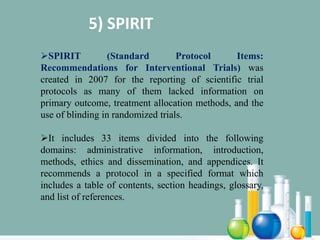
5) SPIRIT
SPIRIT (Standard Protocol Items:
Recommendations for Interventional Trials) was
created in 2007 for the reporting of scientific trial
protocols as many of them lacked information on
primary outcome, treatment allocation methods, and the
use of blinding in randomized trials.
It includes 33 items divided into the following
domains: administrative information, introduction,
methods, ethics and dissemination, and appendices. It
recommends a protocol in a specified format which
includes a table of contents, section headings, glossary,
and list of references.
6) CARE
CARE (Consensus-based Clinical
Case Reporting) is developed to
increase the accuracy, transparency, and
usefulness of case reports.
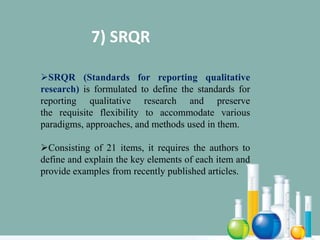
7) SRQR
SRQR (Standards for reporting qualitative
research) is formulated to define the standards for
reporting qualitative research and preserve
the requisite flexibility to accommodate various
paradigms, approaches, and methods used in them.
Consisting of 21 items, it requires the authors to
define and explain the key elements of each item and
provide examples from recently published articles.
8) SQUIRE
SQUIRE (Standards for Quality
Improvement Reporting Excellence) guidelines
provide a framework to report any new study
conducted for improving the healthcare of the
community.
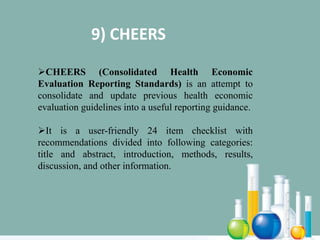
9) CHEERS
CHEERS (Consolidated Health Economic
Evaluation Reporting Standards) is an attempt to
consolidate and update previous health economic
evaluation guidelines into a useful reporting guidance.
It is a user-friendly 24 item checklist with
recommendations divided into following categories:
title and abstract, introduction, methods, results,
discussion, and other information.
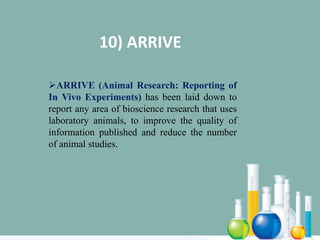
10) ARRIVE
ARRIVE (Animal Research: Reporting of
In Vivo Experiments) has been laid down to
report any area of bioscience research that uses
laboratory animals, to improve the quality of
information published and reduce the number
of animal studies.
11) AGREE Reporting Checklist
AGREE Reporting Checklist can be used
by practice guideline developers, guideline users,
funders, peer reviewers, and journal editors to
improve the comprehension, completeness, and
transparency of reporting in practice guidelines.
The purpose of having these reporting guidelines in
scientific research is to create a manual for the authors to
follow and promote total transparency, accurate reporting,
and easier assessment of the validity of reported research
findings.
Though it has been accomplished to some degree, but
still much needs to be done. It’s time that scientific
editors, authors, and journal reviewers assemble to figure
out how to best use these reporting guidelines.
For expert scientific manuscript preparation use
our scientific writing services team to get your
research published.
Know More
E-mail: project@cognibrain.com
Phone: 044-49595223
URL: https://www.cognibrain.com/

Scientific Studies Reporting Guidelines

  • 1.
  • 2.
    Reporting of ScientificStudies Accurate reporting of scientific studies is most important. Researchers use the studies as a base for their own research. Clinicians use them to plan the right treatment for the patients. The government health agencies use them to design impactful preventive and treatment strategies. Thus, if you don’t report the results accurately in the scientific publications, they won’t provide any value to the society and all your hard work will go waste.
  • 3.
    So, several guidelinesare introduced to ensure the results are reported in an accurate manner. Here, we will discuss the eleven guidelines that are commonly used for reporting various types of scientific studies.
  • 4.
    1) PRISMA PRISMA (PreferredReporting Items for Systematic Reviews and Meta-analyses) is a guideline for proper reporting of systematic reviews and meta-analyses. It is also useful for critical appraisal of a published systematic review. The PRISMA statement comprises a checklist of 27 items, which are divided into the categories of title, abstract, introduction, methods, results, discussion and funding. It also advocates the use of a flow diagram to present the results in an effective manner.
  • 5.
    2) CONSORT CONSORT (ConsolidatedStandards of Reporting Trials) is a statement that guides the reporting of randomized controlled trials. The statement was first developed in 1996 to remove any bias in reporting the results of randomized clinical trials. It comprises a 25-item checklist and is divided into categories like title and abstract, introduction, methods, results, discussion, and other information.
  • 6.
    3) STROBE STROBE (Strengtheningthe Reporting of Observational studies in Epidemiology) is a guideline for reporting observational studies like cohort, case-control, and cross-sectional studies. The observational studies previous to the development of STROBE didn’t explain the confounding variables nor had any reporting on the method of selecting the study and control groups.
  • 7.
    To overcome thisinadequacy, STROBE came into being in 2004. It comprises a 22-item checklist under the headings of title and abstract, introduction, methods, results, discussion, and other information. For genetic association studies, STROBE has been extended to STREGA (Strengthening the Reporting of Genetic Association studies).
  • 8.
    4) STARD STARD (Standardsfor the Reporting of Diagnostic accuracy studies) has been developed for accurate reporting of diagnostic and prognostic studies. A survey about the diagnostic studies published in medical journals between 1978 and 1993 revealed poor or mediocre quality.
  • 9.
    They lacked aproper study design, proper method, and difficulty in evaluating their results. Thereafter, STARD came forth with the checklist of 25 items under the following headlines: title/abstract/keywords, introduction, methods, results, and discussion. A flow diagram is recommended to report the methods used for patient recruitment and the order in which the tests are carried out.
  • 10.
    5) SPIRIT SPIRIT (StandardProtocol Items: Recommendations for Interventional Trials) was created in 2007 for the reporting of scientific trial protocols as many of them lacked information on primary outcome, treatment allocation methods, and the use of blinding in randomized trials. It includes 33 items divided into the following domains: administrative information, introduction, methods, ethics and dissemination, and appendices. It recommends a protocol in a specified format which includes a table of contents, section headings, glossary, and list of references.
  • 11.
    6) CARE CARE (Consensus-basedClinical Case Reporting) is developed to increase the accuracy, transparency, and usefulness of case reports.
  • 12.
    7) SRQR SRQR (Standardsfor reporting qualitative research) is formulated to define the standards for reporting qualitative research and preserve the requisite flexibility to accommodate various paradigms, approaches, and methods used in them. Consisting of 21 items, it requires the authors to define and explain the key elements of each item and provide examples from recently published articles.
  • 13.
    8) SQUIRE SQUIRE (Standardsfor Quality Improvement Reporting Excellence) guidelines provide a framework to report any new study conducted for improving the healthcare of the community.
  • 14.
    9) CHEERS CHEERS (ConsolidatedHealth Economic Evaluation Reporting Standards) is an attempt to consolidate and update previous health economic evaluation guidelines into a useful reporting guidance. It is a user-friendly 24 item checklist with recommendations divided into following categories: title and abstract, introduction, methods, results, discussion, and other information.
  • 15.
    10) ARRIVE ARRIVE (AnimalResearch: Reporting of In Vivo Experiments) has been laid down to report any area of bioscience research that uses laboratory animals, to improve the quality of information published and reduce the number of animal studies.
  • 16.
    11) AGREE ReportingChecklist AGREE Reporting Checklist can be used by practice guideline developers, guideline users, funders, peer reviewers, and journal editors to improve the comprehension, completeness, and transparency of reporting in practice guidelines.
  • 17.
    The purpose ofhaving these reporting guidelines in scientific research is to create a manual for the authors to follow and promote total transparency, accurate reporting, and easier assessment of the validity of reported research findings. Though it has been accomplished to some degree, but still much needs to be done. It’s time that scientific editors, authors, and journal reviewers assemble to figure out how to best use these reporting guidelines. For expert scientific manuscript preparation use our scientific writing services team to get your research published.
  • 18.
    Know More E-mail: project@cognibrain.com Phone:044-49595223 URL: https://www.cognibrain.com/