Stress Management
PRESENTED BY – SHASHI PRATAP SINGH
B.A- ECONOMICS (HONS.)
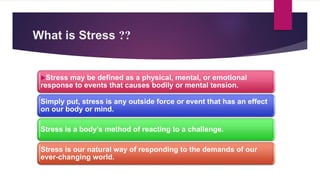
What is Stress ??
Stress may be defined as a physical, mental, or emotional
response to events that causes bodily or mental tension.
Simply put, stress is any outside force or event that has an effect
on our body or mind.
Stress is a body’s method of reacting to a challenge.
Stress is our natural way of responding to the demands of our
ever-changing world.
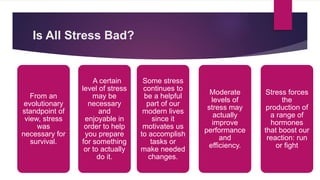
Is All Stress Bad?
A certain
level of stress
may be
necessary
and
enjoyable in
order to help
you prepare
for something
or to actually
do it.
From an
evolutionary
standpoint of
view, stress
was
necessary for
survival.
Some stress
continues to
be a helpful
part of our
modern lives
since it
motivates us
to accomplish
tasks or
make needed
changes.
Moderate
levels of
stress may
actually
improve
performance
and
efficiency.
Stress forces
the
production of
a range of
hormones
that boost our
reaction: run
or fight
How our body respond to stress ?
 Our body respond to stress or a threat situation by releasing adrenaline and cortisol
hormones into the blood. These are known as stress hormones.
 These hormones causes rapid changes to your blood flow and increases your breathing
and heart rate, to get you ready to defend yourself (fight) or to run away (flight). You
become pale, sweat more and your mouth becomes dry.
 These hormones helps our body to prepare for sudden danger that threatened us.
 This respond is known as “fight or flight” response.
TYPES OF STRESS
 Positive stress
 Negative stress
POSITIVE STRESS
 Positive stress is called eustress. It’s the short-lived, motivating kind of stress that
helps us to prepare for a test, a sporting competition or other challenge. It is
perceived as within our coping abilities.
 Stress can also have a positive effect, spurring motivation and awareness,
providing the stimulation to cope with challenging situations.
 Stress also provides the sense of urgency and alertness needed for survival when
confronting threatening situations.
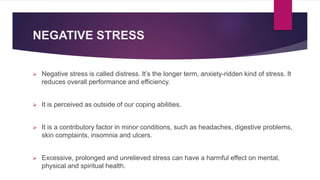
NEGATIVE STRESS
 Negative stress is called distress. It’s the longer term, anxiety-ridden kind of stress. It
reduces overall performance and efficiency.
 It is perceived as outside of our coping abilities.
 It is a contributory factor in minor conditions, such as headaches, digestive problems,
skin complaints, insomnia and ulcers.
 Excessive, prolonged and unrelieved stress can have a harmful effect on mental,
physical and spiritual health.
Signs & Symptoms of Stress
• Decreased concentration, comprehension, & memory, poor judgementCognitive
• Anger, Irritability, withdrawal, violence, nervous habits like nail biting etc.Behavioral
• Fear, anxiety, depression, moodiness, short temper, feeling overwhelmed
Emotional
• Increased Blood Pressure, Heart Rate, Respirations, etc.
• Fatigue, Headache, Gastrointestinal problems
• Decreased immune response
• Insomnia
Physiological
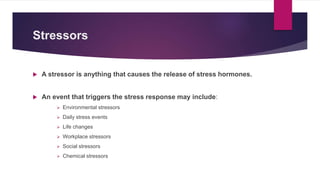
Stressors
 A stressor is anything that causes the release of stress hormones.
 An event that triggers the stress response may include:
 Environmental stressors
 Daily stress events
 Life changes
 Workplace stressors
 Social stressors
 Chemical stressors
Types of Stressors
 Internal stressors
 External stressors
Internal Stressors
 Internal stressors comes from inside of us and determine how you cope and
handle external stressors. These include :-
 Expectations
 Fear
 Uncertainty and lack of control
 Overall health and fitness levels
 Pessimistic thinking
 Lack of Sleep
 Lifestyles/Habits
External Stressors
 External stressors are forces from outside that stress you out.
These could be :-
 Physical environment
 Social interaction
 Workplace
 Major life changes
 Relationship conflicts
 Career and family
Effects of Stress
Headache—or
gastrointestinal
upset.
Somber Mood—
humorless,
difficulty smiling,
laughing or
lightening up.
Tiredness—lack
of energy or
enthusiasm.
Sleep—difficulty
sleeping, or
difficultly going
back to sleep.
Temperament—
irritable, easily
angered, anti-
social behavior.
Emotional—
inappropriate
outbursts.
Anxiety—
excessive,
unable to move
on.
Stress Management
Get moving
Engage
socially
Avoid
unnecessary
stress
Alter the
situation
Accept the
things you
can’t change
Make time for
fun and
relaxation
Adopt a
healthy
lifestyle
Get moving
 Physical activity plays a key role in reducing and preventing
the effects of stress.
 It helps relieve stress and burn away anger, tension, and
frustration.
 The first step is to get yourself up and moving. Here are a
few easy ways:
 Put on some music and dance around
 Take your dog out for a walk
 Use the stairs rather than an elevator
Engage Socially
 It is the quickest, most efficient way to rein in stress and avoid overreacting
to internal or external events that you perceive as threatening.
 The more lonely and isolated you are, the greater your vulnerability to stress.
 Reach out and build relationships :-
 Reach out to a colleague at work
 Help someone else by volunteering
 Have lunch or coffee with friend
 Call or email an old friend
 Meet new people by taking a class or joining a club
Avoid unnecessary stress
 Some stressors arise at predictable times- your commute to work , a meeting
with your boss, family gathering, for example. So, you can change your reaction
to reduce the stress level.
 Learn how to say “no”- Know your limits and stick to them. Distinguish
between the “should” and the “musts” and, when possible, say “no” to taking on
too much.
 Avoid people who stress you out
 Take control of your environment
Alter the situation
 If you cant avoid a stressful situation, try to alter it. Often, this involves changing the
way you communicate and operate in daily life.
 Express your feelings instead of bottling them up- If you don’t voice your
feelings, resentment will build and the stress will increase.
 Be willing to compromise- When you ask someone to change their behavior, be
willing to do the same.
 Manage your time better- Poor time management can cause a lot of stress. But if
you plan ahead, you’ll find it easier to stay calm and focused.
Accept the things you cant change
 Many sources of stress are unavoidable. You can’t prevent or change stressors,
such as the death of a loved one. A serious illness, or a national recession.
 In such cases, the best way to cope with stress is to accept things as they are.
 Look for the upside- When facing major challenges, try to look at them as
opportunities for personal growth.
 Learn to forgive- Accept the fact that we live in an imperfect world and that
people make mistakes. Free yourself from negative energy by forgiving and
moving on.
Make time for fun and relaxation
 Set aside relaxation time
 Do something you enjoy everyday
 Keep your sense of humor
Adopt a healthy lifestyle
 Eat a healthy diet
 Reduce caffeine and sugar
 Avoid alcohol, cigarette and drugs
 Get enough sleep
Stress management

Stress management

  • 1.
    Stress Management PRESENTED BY– SHASHI PRATAP SINGH B.A- ECONOMICS (HONS.)
  • 2.
    What is Stress?? Stress may be defined as a physical, mental, or emotional response to events that causes bodily or mental tension. Simply put, stress is any outside force or event that has an effect on our body or mind. Stress is a body’s method of reacting to a challenge. Stress is our natural way of responding to the demands of our ever-changing world.
  • 3.
    Is All StressBad? A certain level of stress may be necessary and enjoyable in order to help you prepare for something or to actually do it. From an evolutionary standpoint of view, stress was necessary for survival. Some stress continues to be a helpful part of our modern lives since it motivates us to accomplish tasks or make needed changes. Moderate levels of stress may actually improve performance and efficiency. Stress forces the production of a range of hormones that boost our reaction: run or fight
  • 4.
    How our bodyrespond to stress ?  Our body respond to stress or a threat situation by releasing adrenaline and cortisol hormones into the blood. These are known as stress hormones.  These hormones causes rapid changes to your blood flow and increases your breathing and heart rate, to get you ready to defend yourself (fight) or to run away (flight). You become pale, sweat more and your mouth becomes dry.  These hormones helps our body to prepare for sudden danger that threatened us.  This respond is known as “fight or flight” response.
  • 5.
    TYPES OF STRESS Positive stress  Negative stress
  • 6.
    POSITIVE STRESS  Positivestress is called eustress. It’s the short-lived, motivating kind of stress that helps us to prepare for a test, a sporting competition or other challenge. It is perceived as within our coping abilities.  Stress can also have a positive effect, spurring motivation and awareness, providing the stimulation to cope with challenging situations.  Stress also provides the sense of urgency and alertness needed for survival when confronting threatening situations.
  • 7.
    NEGATIVE STRESS  Negativestress is called distress. It’s the longer term, anxiety-ridden kind of stress. It reduces overall performance and efficiency.  It is perceived as outside of our coping abilities.  It is a contributory factor in minor conditions, such as headaches, digestive problems, skin complaints, insomnia and ulcers.  Excessive, prolonged and unrelieved stress can have a harmful effect on mental, physical and spiritual health.
  • 8.
    Signs & Symptomsof Stress • Decreased concentration, comprehension, & memory, poor judgementCognitive • Anger, Irritability, withdrawal, violence, nervous habits like nail biting etc.Behavioral • Fear, anxiety, depression, moodiness, short temper, feeling overwhelmed Emotional • Increased Blood Pressure, Heart Rate, Respirations, etc. • Fatigue, Headache, Gastrointestinal problems • Decreased immune response • Insomnia Physiological
  • 9.
    Stressors  A stressoris anything that causes the release of stress hormones.  An event that triggers the stress response may include:  Environmental stressors  Daily stress events  Life changes  Workplace stressors  Social stressors  Chemical stressors
  • 10.
    Types of Stressors Internal stressors  External stressors
  • 11.
    Internal Stressors  Internalstressors comes from inside of us and determine how you cope and handle external stressors. These include :-  Expectations  Fear  Uncertainty and lack of control  Overall health and fitness levels  Pessimistic thinking  Lack of Sleep  Lifestyles/Habits
  • 12.
    External Stressors  Externalstressors are forces from outside that stress you out. These could be :-  Physical environment  Social interaction  Workplace  Major life changes  Relationship conflicts  Career and family
  • 13.
    Effects of Stress Headache—or gastrointestinal upset. SomberMood— humorless, difficulty smiling, laughing or lightening up. Tiredness—lack of energy or enthusiasm. Sleep—difficulty sleeping, or difficultly going back to sleep. Temperament— irritable, easily angered, anti- social behavior. Emotional— inappropriate outbursts. Anxiety— excessive, unable to move on.
  • 14.
    Stress Management Get moving Engage socially Avoid unnecessary stress Alterthe situation Accept the things you can’t change Make time for fun and relaxation Adopt a healthy lifestyle
  • 15.
    Get moving  Physicalactivity plays a key role in reducing and preventing the effects of stress.  It helps relieve stress and burn away anger, tension, and frustration.  The first step is to get yourself up and moving. Here are a few easy ways:  Put on some music and dance around  Take your dog out for a walk  Use the stairs rather than an elevator
  • 16.
    Engage Socially  Itis the quickest, most efficient way to rein in stress and avoid overreacting to internal or external events that you perceive as threatening.  The more lonely and isolated you are, the greater your vulnerability to stress.  Reach out and build relationships :-  Reach out to a colleague at work  Help someone else by volunteering  Have lunch or coffee with friend  Call or email an old friend  Meet new people by taking a class or joining a club
  • 17.
    Avoid unnecessary stress Some stressors arise at predictable times- your commute to work , a meeting with your boss, family gathering, for example. So, you can change your reaction to reduce the stress level.  Learn how to say “no”- Know your limits and stick to them. Distinguish between the “should” and the “musts” and, when possible, say “no” to taking on too much.  Avoid people who stress you out  Take control of your environment
  • 18.
    Alter the situation If you cant avoid a stressful situation, try to alter it. Often, this involves changing the way you communicate and operate in daily life.  Express your feelings instead of bottling them up- If you don’t voice your feelings, resentment will build and the stress will increase.  Be willing to compromise- When you ask someone to change their behavior, be willing to do the same.  Manage your time better- Poor time management can cause a lot of stress. But if you plan ahead, you’ll find it easier to stay calm and focused.
  • 19.
    Accept the thingsyou cant change  Many sources of stress are unavoidable. You can’t prevent or change stressors, such as the death of a loved one. A serious illness, or a national recession.  In such cases, the best way to cope with stress is to accept things as they are.  Look for the upside- When facing major challenges, try to look at them as opportunities for personal growth.  Learn to forgive- Accept the fact that we live in an imperfect world and that people make mistakes. Free yourself from negative energy by forgiving and moving on.
  • 20.
    Make time forfun and relaxation  Set aside relaxation time  Do something you enjoy everyday  Keep your sense of humor
  • 21.
    Adopt a healthylifestyle  Eat a healthy diet  Reduce caffeine and sugar  Avoid alcohol, cigarette and drugs  Get enough sleep