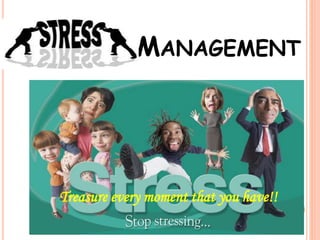
MANAGEMENT
Treasure every moment that you have!!
OUR GOAL IS NOT TO
ELIMINATE STRESS,
BUT TO LEARN HOW
TO MANAGE IT AND
HOW TO USE IT TO
HELP US !
WHAT IS STRESS?
 Stress is your mind and body’s response or
reaction to a real or imagined threat,
event or change.
 The threat, event or change are commonly
called stressors. Stressors can be
internal (thoughts, beliefs, attitudes or
external (loss, tragedy, change).
STRESS: WHAT IS IT?
 Although we all talk about stress, it often isn’t
clear what stress is really about.
 Many people consider stress to be something
that happens to them, as a negative event such
as an injury or a job loss. Others think that
stress is what happens to our body, mind, and
behavior in response to an event (E.g. heart
thumping, anxiety, or nail biting).
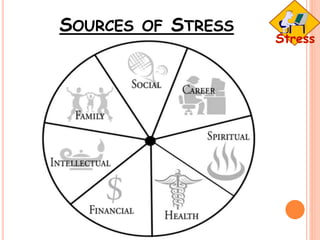
SOURCES OF STRESS
LEVELS OF STRESS
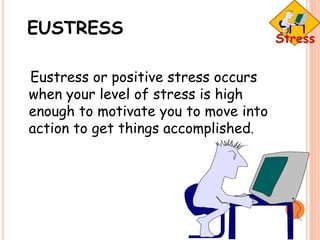
EUSTRESS
Eustress or positive stress occurs
when your level of stress is high
enough to motivate you to move into
action to get things accomplished.
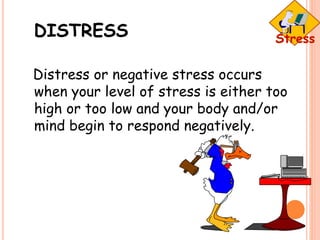
DISTRESS
Distress or negative stress occurs
when your level of stress is either too
high or too low and your body and/or
mind begin to respond negatively.
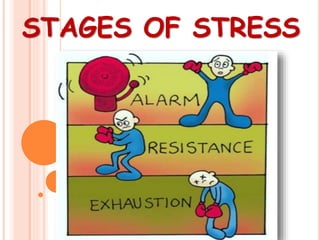
STAGES OF STRESS
ALARM STAGE
As you begin to experience a stressful
event or perceive something to be
stressful psychological changes occur
in your body. This experience or
perception disrupts your body’s
normal balance.
EXAMPLES
 Cardiac - increased heart rate
 Respiratory - increased respiration
 Skin - decreased temperature
 Hormonal - increased stimulation
of adrenal genes which produce an
adrenal rush.
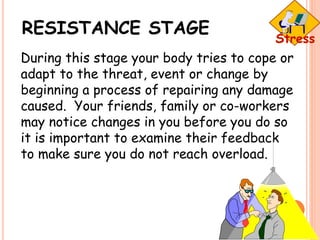
RESISTANCE STAGE
During this stage your body tries to cope or
adapt to the threat, event or change by
beginning a process of repairing any damage
caused. Your friends, family or co-workers
may notice changes in you before you do so
it is important to examine their feedback
to make sure you do not reach overload.
EXAMPLES
 Behavior indicators include: lack of
enthusiasm for family, school, work or
life in general, withdrawal, change in
eating habits, insomnia, hypersomnia,
anger, fatigue.
 Cognitive Indicators include: poor
problem solving, confusion, nightmares,
hyper-vigilance.
RESISTANCE STAGE
MORE EXAMPLES
Emotional indicators include:
 Tearfulness
 Fear
 Anxiety
 Panic
 Guilt
 Agitation
 Depression
 Overwhelmed.
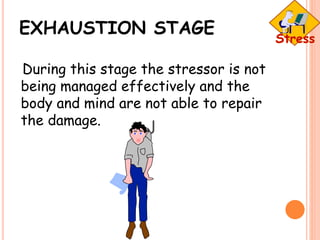
EXHAUSTION STAGE
During this stage the stressor is not
being managed effectively and the
body and mind are not able to repair
the damage.
EXAMPLES
Digestive disorders, withdrawal,
headaches, tension, insomnia, loss
of temper.
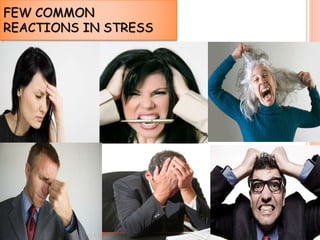
FEW COMMON
REACTIONS IN STRESS
WHAT MAKES YOU STRESSED.
The only thing constant in life is change. The
moment you adjust yourself to the changed
environment, another change rolls in.
New bosses or colleagues, promotions, new
offices, New residence, new policies,
directions or procedures can cause the
stress to rise.
SYMPTOMS OF STRESS
 Feeling tense
 Depression
 Poor memory
 Poor concentration
 Increased alcohol consumption
 Anger/hostility
 Difficulty making decisions
 Frequent mood swings
 Negative thinking
 Distractibility
 Excess smoking or eating
 Feeling overwhelmed or helpless
INTELLECTUAL PROBLEMS.
 Memory problems.
 Difficulty making decisions.
 Inability to concentrate.
 Confusion.
 Seeing only the negative.
 Repetitive or racing thoughts.
 Poor judgment.
 Loss of objectivity.
 Desire to escape or run away….
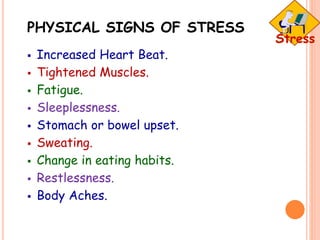
PHYSICAL SIGNS OF STRESS
 Increased Heart Beat.
 Tightened Muscles.
 Fatigue.
 Sleeplessness.
 Stomach or bowel upset.
 Sweating.
 Change in eating habits.
 Restlessness.
 Body Aches.
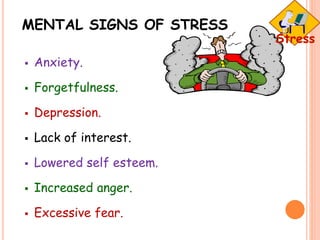
MENTAL SIGNS OF STRESS
 Anxiety.
 Forgetfulness.
 Depression.
 Lack of interest.
 Lowered self esteem.
 Increased anger.
 Excessive fear.
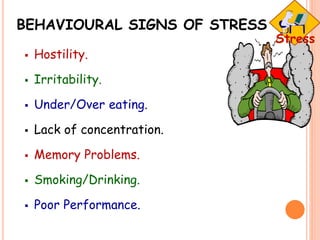
BEHAVIOURAL SIGNS OF STRESS
 Hostility.
 Irritability.
 Under/Over eating.
 Lack of concentration.
 Memory Problems.
 Smoking/Drinking.
 Poor Performance.
MENTAL TECHNIQUES
There are few mental techniques which can
help to over come from Stress.
 Manage time
 Give priority to the most important tasks
and do those first
 Schedule time for both work and
recreation
 Delegate tasks and break up big projects ,,,
STRESS INCREASES THE RISK
 Accidents
 Headaches
 Bowel disorders
 Poor digestion
 Skin disorders
 Eating disorders
 Emotional disorders
 Asthma attacks
 High blood pressure/strokes
 Colds/infections
 Backache
 Arthritis/immune disorders
 Heart attacks/recovery
 Cancer
 Ulcers
 Sexual dysfunction
COMMON EXTERNAL CAUSES
OF STRESS
 Major life changes
 Work or school
 Relationship difficulties
 Financial problems
 Being too busy
 Children and family
COMMON INTERNAL CAUSES
OF STRESS
 Chronic worry
 Pessimism
 Negative self-talk
 Unrealistic expectations/ Perfectionism
 Rigid thinking, lack of flexibility
 All-or-nothing attitude
WHAT ACTIVITIES CAN HELP
RELIEVE STRESS?
Here are some examples of activities that can help to refresh the
body and mind.
 Taking baths
 Reading
 Doing breathing exercises
 Receiving back rubs/massages
 Listening to relaxation tapes
 Writing in a journal
 Meeting with a friend
 Napping
 Walking
 Dancing
 Engaging in spiritual reflection
 Stretching
 Listening to music
A smile says
the same
thing in any
language.

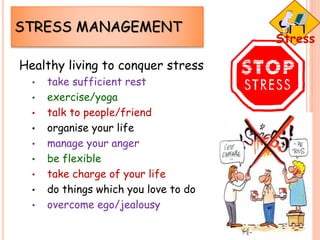
STRESS MANAGEMENT
Healthy living to conquer stress
• take sufficient rest
• exercise/yoga
• talk to people/friend
• organise your life
• manage your anger
• be flexible
• take charge of your life
• do things which you love to do
• overcome ego/jealousy
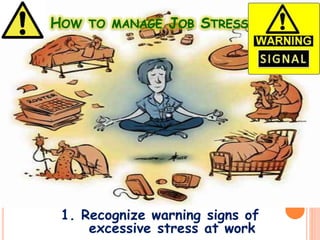
HOW TO MANAGE JOB STRESS
1. Recognize warning signs of
excessive stress at work
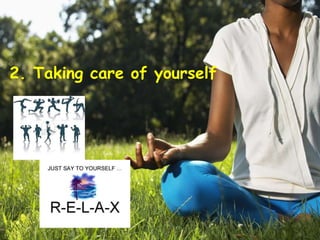
2. Taking care of yourself
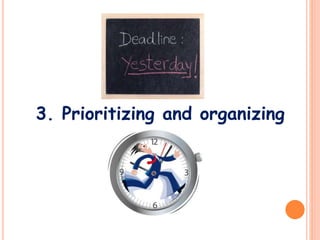
3. Prioritizing and organizing
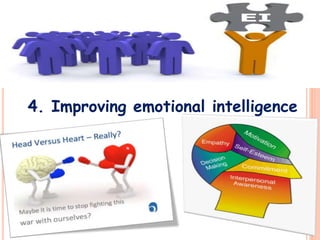
4. Improving emotional intelligence
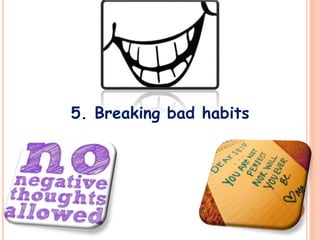
5. Breaking bad habits
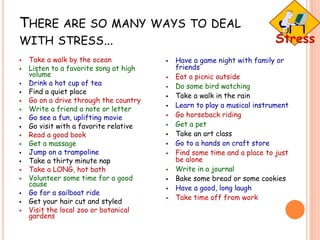
THERE ARE SO MANY WAYS TO DEAL
WITH STRESS…
 Take a walk by the ocean
 Listen to a favorite song at high
volume
 Drink a hot cup of tea
 Find a quiet place
 Go on a drive through the country
 Write a friend a note or letter
 Go see a fun, uplifting movie
 Go visit with a favorite relative
 Read a good book
 Get a massage
 Jump on a trampoline
 Take a thirty minute nap
 Take a LONG, hot bath
 Volunteer some time for a good
cause
 Go for a sailboat ride
 Get your hair cut and styled
 Visit the local zoo or botanical
gardens
 Have a game night with family or
friends
 Eat a picnic outside
 Do some bird watching
 Take a walk in the rain
 Learn to play a musical instrument
 Go horseback riding
 Get a pet
 Take an art class
 Go to a hands on craft store
 Find some time and a place to just
be alone
 Write in a journal
 Bake some bread or some cookies
 Have a good, long laugh
 Take time off from work
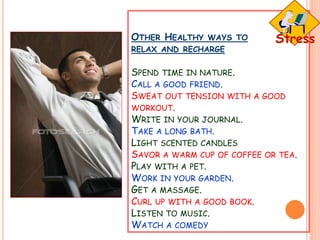
OTHER HEALTHY WAYS TO
RELAX AND RECHARGE
SPEND TIME IN NATURE.
CALL A GOOD FRIEND.
SWEAT OUT TENSION WITH A GOOD
WORKOUT.
WRITE IN YOUR JOURNAL.
TAKE A LONG BATH.
LIGHT SCENTED CANDLES
SAVOR A WARM CUP OF COFFEE OR TEA.
PLAY WITH A PET.
WORK IN YOUR GARDEN.
GET A MASSAGE.
CURL UP WITH A GOOD BOOK.
LISTEN TO MUSIC.
WATCH A COMEDY
YESTERDAY is history.
TOMORROW is a mystery.
TODAY is a gift.
That's why it's called the
PRESENT!!
LET’S LOOK AT EXAMPLES OF
STRESSFUL SITUATIONS
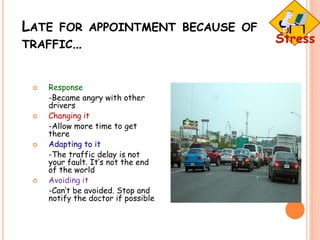
LATE FOR APPOINTMENT BECAUSE OF
TRAFFIC…
 Response
-Became angry with other
drivers
 Changing it
-Allow more time to get
there
 Adapting to it
-The traffic delay is not
your fault. It’s not the end
of the world
 Avoiding it
-Can’t be avoided. Stop and
notify the doctor if possible
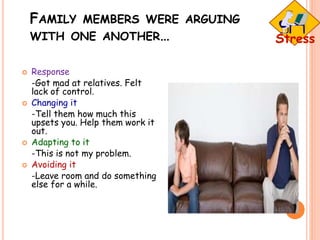
FAMILY MEMBERS WERE ARGUING
WITH ONE ANOTHER…
 Response
-Got mad at relatives. Felt
lack of control.
 Changing it
-Tell them how much this
upsets you. Help them work it
out.
 Adapting to it
-This is not my problem.
 Avoiding it
-Leave room and do something
else for a while.
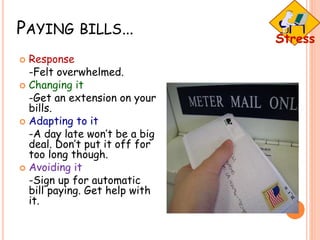
PAYING BILLS…
 Response
-Felt overwhelmed.
 Changing it
-Get an extension on your
bills.
 Adapting to it
-A day late won’t be a big
deal. Don’t put it off for
too long though.
 Avoiding it
-Sign up for automatic
bill paying. Get help with
it.
GIVE YOUR STRESS
WINGS, AND, LET IT
FLY AWAY !
Sree Kumar K

Stress management Sree

  • 1.
  • 2.
    OUR GOAL ISNOT TO ELIMINATE STRESS, BUT TO LEARN HOW TO MANAGE IT AND HOW TO USE IT TO HELP US !
  • 3.
    WHAT IS STRESS? Stress is your mind and body’s response or reaction to a real or imagined threat, event or change.  The threat, event or change are commonly called stressors. Stressors can be internal (thoughts, beliefs, attitudes or external (loss, tragedy, change).
  • 4.
    STRESS: WHAT ISIT?  Although we all talk about stress, it often isn’t clear what stress is really about.  Many people consider stress to be something that happens to them, as a negative event such as an injury or a job loss. Others think that stress is what happens to our body, mind, and behavior in response to an event (E.g. heart thumping, anxiety, or nail biting).
  • 5.
  • 6.
  • 7.
    EUSTRESS Eustress or positivestress occurs when your level of stress is high enough to motivate you to move into action to get things accomplished.
  • 8.
    DISTRESS Distress or negativestress occurs when your level of stress is either too high or too low and your body and/or mind begin to respond negatively.
  • 9.
  • 10.
    ALARM STAGE As youbegin to experience a stressful event or perceive something to be stressful psychological changes occur in your body. This experience or perception disrupts your body’s normal balance.
  • 11.
    EXAMPLES  Cardiac -increased heart rate  Respiratory - increased respiration  Skin - decreased temperature  Hormonal - increased stimulation of adrenal genes which produce an adrenal rush.
  • 12.
    RESISTANCE STAGE During thisstage your body tries to cope or adapt to the threat, event or change by beginning a process of repairing any damage caused. Your friends, family or co-workers may notice changes in you before you do so it is important to examine their feedback to make sure you do not reach overload.
  • 13.
    EXAMPLES  Behavior indicatorsinclude: lack of enthusiasm for family, school, work or life in general, withdrawal, change in eating habits, insomnia, hypersomnia, anger, fatigue.  Cognitive Indicators include: poor problem solving, confusion, nightmares, hyper-vigilance.
  • 14.
    RESISTANCE STAGE MORE EXAMPLES Emotionalindicators include:  Tearfulness  Fear  Anxiety  Panic  Guilt  Agitation  Depression  Overwhelmed.
  • 15.
    EXHAUSTION STAGE During thisstage the stressor is not being managed effectively and the body and mind are not able to repair the damage.
  • 16.
    EXAMPLES Digestive disorders, withdrawal, headaches,tension, insomnia, loss of temper.
  • 17.
  • 18.
    WHAT MAKES YOUSTRESSED. The only thing constant in life is change. The moment you adjust yourself to the changed environment, another change rolls in. New bosses or colleagues, promotions, new offices, New residence, new policies, directions or procedures can cause the stress to rise.
  • 19.
    SYMPTOMS OF STRESS Feeling tense  Depression  Poor memory  Poor concentration  Increased alcohol consumption  Anger/hostility  Difficulty making decisions  Frequent mood swings  Negative thinking  Distractibility  Excess smoking or eating  Feeling overwhelmed or helpless
  • 20.
    INTELLECTUAL PROBLEMS.  Memoryproblems.  Difficulty making decisions.  Inability to concentrate.  Confusion.  Seeing only the negative.  Repetitive or racing thoughts.  Poor judgment.  Loss of objectivity.  Desire to escape or run away….
  • 21.
    PHYSICAL SIGNS OFSTRESS  Increased Heart Beat.  Tightened Muscles.  Fatigue.  Sleeplessness.  Stomach or bowel upset.  Sweating.  Change in eating habits.  Restlessness.  Body Aches.
  • 22.
    MENTAL SIGNS OFSTRESS  Anxiety.  Forgetfulness.  Depression.  Lack of interest.  Lowered self esteem.  Increased anger.  Excessive fear.
  • 23.
    BEHAVIOURAL SIGNS OFSTRESS  Hostility.  Irritability.  Under/Over eating.  Lack of concentration.  Memory Problems.  Smoking/Drinking.  Poor Performance.
  • 24.
    MENTAL TECHNIQUES There arefew mental techniques which can help to over come from Stress.  Manage time  Give priority to the most important tasks and do those first  Schedule time for both work and recreation  Delegate tasks and break up big projects ,,,
  • 25.
    STRESS INCREASES THERISK  Accidents  Headaches  Bowel disorders  Poor digestion  Skin disorders  Eating disorders  Emotional disorders  Asthma attacks  High blood pressure/strokes  Colds/infections  Backache  Arthritis/immune disorders  Heart attacks/recovery  Cancer  Ulcers  Sexual dysfunction
  • 26.
    COMMON EXTERNAL CAUSES OFSTRESS  Major life changes  Work or school  Relationship difficulties  Financial problems  Being too busy  Children and family
  • 27.
    COMMON INTERNAL CAUSES OFSTRESS  Chronic worry  Pessimism  Negative self-talk  Unrealistic expectations/ Perfectionism  Rigid thinking, lack of flexibility  All-or-nothing attitude
  • 28.
    WHAT ACTIVITIES CANHELP RELIEVE STRESS? Here are some examples of activities that can help to refresh the body and mind.  Taking baths  Reading  Doing breathing exercises  Receiving back rubs/massages  Listening to relaxation tapes  Writing in a journal  Meeting with a friend  Napping  Walking  Dancing  Engaging in spiritual reflection  Stretching  Listening to music A smile says the same thing in any language. 
  • 29.
    STRESS MANAGEMENT Healthy livingto conquer stress • take sufficient rest • exercise/yoga • talk to people/friend • organise your life • manage your anger • be flexible • take charge of your life • do things which you love to do • overcome ego/jealousy
  • 30.
    HOW TO MANAGEJOB STRESS 1. Recognize warning signs of excessive stress at work
  • 31.
    2. Taking careof yourself
  • 32.
  • 33.
  • 34.
  • 35.
    THERE ARE SOMANY WAYS TO DEAL WITH STRESS…  Take a walk by the ocean  Listen to a favorite song at high volume  Drink a hot cup of tea  Find a quiet place  Go on a drive through the country  Write a friend a note or letter  Go see a fun, uplifting movie  Go visit with a favorite relative  Read a good book  Get a massage  Jump on a trampoline  Take a thirty minute nap  Take a LONG, hot bath  Volunteer some time for a good cause  Go for a sailboat ride  Get your hair cut and styled  Visit the local zoo or botanical gardens  Have a game night with family or friends  Eat a picnic outside  Do some bird watching  Take a walk in the rain  Learn to play a musical instrument  Go horseback riding  Get a pet  Take an art class  Go to a hands on craft store  Find some time and a place to just be alone  Write in a journal  Bake some bread or some cookies  Have a good, long laugh  Take time off from work
  • 36.
    OTHER HEALTHY WAYSTO RELAX AND RECHARGE SPEND TIME IN NATURE. CALL A GOOD FRIEND. SWEAT OUT TENSION WITH A GOOD WORKOUT. WRITE IN YOUR JOURNAL. TAKE A LONG BATH. LIGHT SCENTED CANDLES SAVOR A WARM CUP OF COFFEE OR TEA. PLAY WITH A PET. WORK IN YOUR GARDEN. GET A MASSAGE. CURL UP WITH A GOOD BOOK. LISTEN TO MUSIC. WATCH A COMEDY
  • 37.
    YESTERDAY is history. TOMORROWis a mystery. TODAY is a gift. That's why it's called the PRESENT!!
  • 38.
    LET’S LOOK ATEXAMPLES OF STRESSFUL SITUATIONS
  • 39.
    LATE FOR APPOINTMENTBECAUSE OF TRAFFIC…  Response -Became angry with other drivers  Changing it -Allow more time to get there  Adapting to it -The traffic delay is not your fault. It’s not the end of the world  Avoiding it -Can’t be avoided. Stop and notify the doctor if possible
  • 40.
    FAMILY MEMBERS WEREARGUING WITH ONE ANOTHER…  Response -Got mad at relatives. Felt lack of control.  Changing it -Tell them how much this upsets you. Help them work it out.  Adapting to it -This is not my problem.  Avoiding it -Leave room and do something else for a while.
  • 41.
    PAYING BILLS…  Response -Feltoverwhelmed.  Changing it -Get an extension on your bills.  Adapting to it -A day late won’t be a big deal. Don’t put it off for too long though.  Avoiding it -Sign up for automatic bill paying. Get help with it.
  • 42.
    GIVE YOUR STRESS WINGS,AND, LET IT FLY AWAY !
  • 44.