McGraw-Hill/Irwin
McGraw-Hill/Irwin    Copyright ©© 2008, The McGraw-Hill Companies, Inc. All rights reserved.
                      Copyright 2008 by The McGraw-Hill Companies, Inc. All rights reserved.
Chapter

                    7
                        Electronic Business Systems


McGraw-Hill/Irwin            Copyright © 2008, The McGraw-Hill Companies, Inc. All rights reserved.
Learning Objectives

• Identify the following cross-functional enterprise
  systems, and give examples of how they can
  provide significant business value to a company
   • Enterprise application integration
   • Transaction processing systems
   • Enterprise collaboration systems
Learning Objectives

• Give examples of how Internet and other
  information technologies support business
  processes within the business functions of
  • Accounting
  • Finance
  • Human resource management
  • Marketing
  • Production
  • Operations management
Enterprise Business Systems

• E-business means using the Internet, other
  networks, and IT to support
  • Electronic commerce
  • Enterprise communications and collaboration
  • Web-enabled business processes
• E-commerce is the buying, selling, and
  marketing of products, services, and information
  over the Internet and other networks
Case 1: Hilton’s Data-Driven Hospitality

• OnQ is part of Hilton Hotel Corp.’s customer-
  relationship-management strategy
  • Give employees a clearer idea of who the
    customers are
  • Track customer experiences
  • Combine with frequent-guest program to build
    loyalty across eight hotel brands
  • Measure of success is “share of wallet”
• About 70 percent of OnQ is custom coded
Case Study Questions

• What are the benefits and drawbacks of the
  OnQ system at Hilton?

• What does Hilton have to do to create a
  competitive advantage through OnQ?

• Is it possible to have too much information
  about a customer?
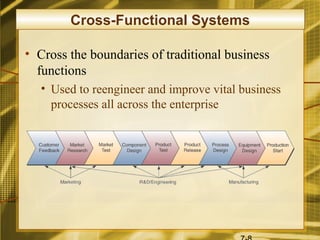
Cross-Functional Systems

• Cross the boundaries of traditional business
  functions
   • Used to reengineer and improve vital business
     processes all across the enterprise
Enterprise Application Architecture

• Provides a conceptual framework
  • Helps visualize the basic components, processes,
    and interfaces of major e-business applications
• Focuses on accomplishing fundamental
  business processes in concert with
  •   Customers
  •   Suppliers
  •   Partners
  •   Employees
Enterprise Application Architecture

• Enterprise Resource Planning (ERP)
  • Concentrates on the efficiency of internal
    production, distribution, and financial processes
• Customer Relationship Management (CRM)
  • Focuses on acquiring and retaining profitable
    customers via marketing, sales, and services
• Partner Relationship Management (PRM)
  • Aims at acquiring and retaining partners who
    can enhance the selling and distribution of
    products and services
Enterprise Application Architecture

• Supply Chain Management (SCM)
  • Focuses on developing the most efficient and
    effective sourcing and procurement processes
• Knowledge Management (KM)
  • Focuses on facilitating internal group
    collaboration and decision support
Enterprise Application Integration

• EAI software connects cross-functional systems
• Serves as middleware to provide
  • Data conversion
  • Communication between systems
  • Access to system interfaces
How EAI Works
Transaction Processing Systems

• Cross-functional information systems that
  process data resulting from the occurrence of
  business transactions
  • Transactions include sales, purchases, deposits,
    withdrawals, refunds, and payments
  • Online transaction processing (OLTP) is a real-
    time system that captures transactions
    immediately
Transaction Processing Systems
The Transaction Processing Cycle
Enterprise Collaboration Systems (ECS)

• EC systems are cross-functional information
  systems that enhance team and workgroup
  • Communication
  • Coordination
  • Collaboration
• Systems may include
  •   Networked PC workstations
  •   Servers
  •   Databases
  •   Groupware and application packages
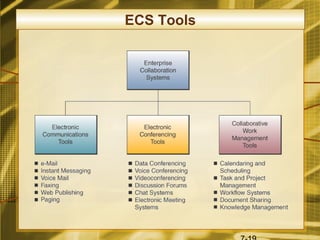
ECS Tools
Functional Business Systems

• A variety of types of information systems
  that support the business functions of
  •   Accounting
  •   Finance
  •   Marketing
  •   Operations management
  •   Human resource management
Case 2: Advertising & Marketing
                Changes
• The Internet is causing a paradigm shift in
  advertising
   • Advertisers are moving away from TV,
     newspapers, and magazine ads
   • Soaring profits from selling online targeted ads
     are boosting company values
   • The Web is the first global advertising medium
• Broadband
   • Encourages uses to spend more time surfing
   • Allows more creative ad formats
Case Study Questions

• Why are companies like Chrysler now looking
  more favorably at the Internet as a great medium
  for their advertising dollars?
  • What has happened to change their view?
• How do Google’s online ad revenue sources
  and strategy differ from Yahoo’s?
  • Which online ad strategy is superior for
    attracting advertising from small companies?
  • For attracting large companies?
Case Study Questions

• If you were in Julie Roehm’s position at
  Chrysler, how would you distribute Chrysler’s
  advertising dollars among online and traditional
  TV and print media?
IT in Business
Marketing Systems

• Marketing systems are concerned with
  • Planning, promotion, and sale of existing
    products in existing markets
  • Development of new products and new markets
  • Better attracting and serving present and
    potential customers
Marketing Information Systems
Interactive Marketing

• Interactive Marketing
  • A customer-focused marketing process
  • Uses the Internet, intranets, and extranets
  • Establishes two-way transactions between a
    business and its customers or potential customers
• Goal
  • Profitably use networks to attract and keep
    customers
  • Get customers to help create, purchase, and
    improve products and services
Targeted Marketing

• An advertising and promotion management
  concept with five targeting components
Targeted Marketing Components

• Community: customized ads to appeal to specific
  virtual communities
• Content: ads placed on a variety of selected
  websites, aimed at a specific audience
• Context: ads placed on web pages that are
  relevant to a product or service
• Demographic/Psychographic: web marketing
  aimed at specific types or classes of people
• Online behavior: promotions tailored to each
  visit to a site by an individual
Sales Force Automation

• Outfit sales force with notebook computers,
  web browsers, and sales contact software
  • Connect them to marketing websites and the
    company intranet
• Goals
  • Increase personal productivity
  • Speed up capture and analysis of sales data
  • Gain strategic advantage
Manufacturing Information Systems

• Supports the production/operations functions
  • Includes all activities concerned with planning
    and control of the processes producing goods
    or services
Computer-Integrated Manufacturing
CIM Objectives

• Simplify production processes, product designs,
  and factory organization
• Automate production processes and the
  business functions that support them
• Integrate all production and support
  processes using
  • Networks
  • Cross-functional business software
  • Other information technologies
CIM Systems

• Computer-aided manufacturing (CAM)
  • Automate the production process
• Manufacturing execution systems (MES)
  • Performance monitoring information systems
    for factory floor operations
• Process control
  • Control ongoing physical processes
• Machine control
  • Controls the actions of machines
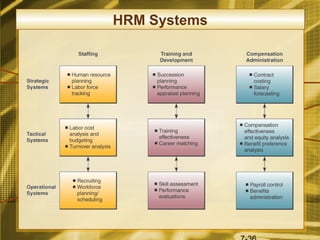
Human Resource Management (HRM)

• Information systems designed to support
  • Planning to meet personnel needs
  • Development of employees to their full potential
  • Control of all personnel policies and programs
HRM Systems
HRM and the Internet

• Recruiting employees using the corporate
  website and commercial recruiting services
• Posting messages in selected Internet
  newsgroups
• Communicating with job applicants via e-mail
HRM and Corporate Intranets

• Corporate intranet uses
  • Process common HRM transactions
  • Allow around-the-clock HRM services
  • Disseminate information faster than through
    previous company channels
  • Collect information from employees online
  • Allow HRM tasks to be performed with little
    HRM department intervention
  • Training
Employee Self-Service

• Intranet applications can allow employees to
  • View benefits
  • Enter travel and expense reports
  • Verify employment and salary information
  • Access and update personal information
  • Enter time-sensitive data
Accounting Information Systems

• The oldest and most widely used information
  system in business
  • Records and reports business transactions and
    economic events
  • Produces financial statements
  • Forecasts future conditions
Accounting Information Systems

• Typically consists of
  • Order processing
  • Inventory control
  • Accounts receivable
  • Accounts payable
  • Payroll
  • General ledger systems
Accounting Information Systems
Financial Management Systems

• Supports business managers and professionals
  making decisions concerning
  • The financing of a business
  • The allocation and control of financial
    resources within a business
Financial Management System Example
Case 3: Improving Supply-Chain Results

• Supply chains are a kludge of systems
  • Internal manufacturing, warehousing, inventory
    control, planning, shipping, and logistics
  • Relationships with suppliers and partners
  • Increasing dependence on customer input
• Now being replace with two state-of-the-art,
  major software types
  • Supply-chain execution
  • Supply-chain planning
Case Study Questions

• What is the business value of SCM systems for
  Brunswick and Whirlpool?
• Does the business value of SCM depend upon
  what type of business a company is in?
• How does Brunswick’s approach to SCM differ
  from that of Whirlpool?
  • Is one approach superior to all others?
Case 4: The Business Case for EAI

• EAI involves using software to connect a
  variety of applications into a cohesive unit
   • Helps align systems more closely with
     business processes
• EAI Projects
   • Costly and complex ($200,000 to $400,000)
   • Technical staff need lots of training
Case Study Questions

• Why has EAI recently “become a critical part
  of the IT strategy at many organizations,” and
  a high-ranking project of top IT executives?
   • Use Baxter International, GE Power, and
     Corporate Express as examples
• What is the major difference in the business
  value of the EAI projects at Baxter International,
  GE Power, and Corporate Express?
Case Study Questions

• What are some of the challenges in developing
  and implementing EAI systems?
  • How can companies meet these challenges?

Chap007

  • 1.
    McGraw-Hill/Irwin McGraw-Hill/Irwin Copyright ©© 2008, The McGraw-Hill Companies, Inc. All rights reserved. Copyright 2008 by The McGraw-Hill Companies, Inc. All rights reserved.
  • 2.
    Chapter 7 Electronic Business Systems McGraw-Hill/Irwin Copyright © 2008, The McGraw-Hill Companies, Inc. All rights reserved.
  • 3.
    Learning Objectives • Identifythe following cross-functional enterprise systems, and give examples of how they can provide significant business value to a company • Enterprise application integration • Transaction processing systems • Enterprise collaboration systems
  • 4.
    Learning Objectives • Giveexamples of how Internet and other information technologies support business processes within the business functions of • Accounting • Finance • Human resource management • Marketing • Production • Operations management
  • 5.
    Enterprise Business Systems •E-business means using the Internet, other networks, and IT to support • Electronic commerce • Enterprise communications and collaboration • Web-enabled business processes • E-commerce is the buying, selling, and marketing of products, services, and information over the Internet and other networks
  • 6.
    Case 1: Hilton’sData-Driven Hospitality • OnQ is part of Hilton Hotel Corp.’s customer- relationship-management strategy • Give employees a clearer idea of who the customers are • Track customer experiences • Combine with frequent-guest program to build loyalty across eight hotel brands • Measure of success is “share of wallet” • About 70 percent of OnQ is custom coded
  • 7.
    Case Study Questions •What are the benefits and drawbacks of the OnQ system at Hilton? • What does Hilton have to do to create a competitive advantage through OnQ? • Is it possible to have too much information about a customer?
  • 8.
    Cross-Functional Systems • Crossthe boundaries of traditional business functions • Used to reengineer and improve vital business processes all across the enterprise
  • 9.
  • 10.
    Enterprise Application Architecture •Provides a conceptual framework • Helps visualize the basic components, processes, and interfaces of major e-business applications • Focuses on accomplishing fundamental business processes in concert with • Customers • Suppliers • Partners • Employees
  • 11.
    Enterprise Application Architecture •Enterprise Resource Planning (ERP) • Concentrates on the efficiency of internal production, distribution, and financial processes • Customer Relationship Management (CRM) • Focuses on acquiring and retaining profitable customers via marketing, sales, and services • Partner Relationship Management (PRM) • Aims at acquiring and retaining partners who can enhance the selling and distribution of products and services
  • 12.
    Enterprise Application Architecture •Supply Chain Management (SCM) • Focuses on developing the most efficient and effective sourcing and procurement processes • Knowledge Management (KM) • Focuses on facilitating internal group collaboration and decision support
  • 13.
    Enterprise Application Integration •EAI software connects cross-functional systems • Serves as middleware to provide • Data conversion • Communication between systems • Access to system interfaces
  • 14.
  • 15.
    Transaction Processing Systems •Cross-functional information systems that process data resulting from the occurrence of business transactions • Transactions include sales, purchases, deposits, withdrawals, refunds, and payments • Online transaction processing (OLTP) is a real- time system that captures transactions immediately
  • 16.
  • 17.
  • 18.
    Enterprise Collaboration Systems(ECS) • EC systems are cross-functional information systems that enhance team and workgroup • Communication • Coordination • Collaboration • Systems may include • Networked PC workstations • Servers • Databases • Groupware and application packages
  • 19.
  • 20.
    Functional Business Systems •A variety of types of information systems that support the business functions of • Accounting • Finance • Marketing • Operations management • Human resource management
  • 21.
    Case 2: Advertising& Marketing Changes • The Internet is causing a paradigm shift in advertising • Advertisers are moving away from TV, newspapers, and magazine ads • Soaring profits from selling online targeted ads are boosting company values • The Web is the first global advertising medium • Broadband • Encourages uses to spend more time surfing • Allows more creative ad formats
  • 22.
    Case Study Questions •Why are companies like Chrysler now looking more favorably at the Internet as a great medium for their advertising dollars? • What has happened to change their view? • How do Google’s online ad revenue sources and strategy differ from Yahoo’s? • Which online ad strategy is superior for attracting advertising from small companies? • For attracting large companies?
  • 23.
    Case Study Questions •If you were in Julie Roehm’s position at Chrysler, how would you distribute Chrysler’s advertising dollars among online and traditional TV and print media?
  • 24.
  • 25.
    Marketing Systems • Marketingsystems are concerned with • Planning, promotion, and sale of existing products in existing markets • Development of new products and new markets • Better attracting and serving present and potential customers
  • 26.
  • 27.
    Interactive Marketing • InteractiveMarketing • A customer-focused marketing process • Uses the Internet, intranets, and extranets • Establishes two-way transactions between a business and its customers or potential customers • Goal • Profitably use networks to attract and keep customers • Get customers to help create, purchase, and improve products and services
  • 28.
    Targeted Marketing • Anadvertising and promotion management concept with five targeting components
  • 29.
    Targeted Marketing Components •Community: customized ads to appeal to specific virtual communities • Content: ads placed on a variety of selected websites, aimed at a specific audience • Context: ads placed on web pages that are relevant to a product or service • Demographic/Psychographic: web marketing aimed at specific types or classes of people • Online behavior: promotions tailored to each visit to a site by an individual
  • 30.
    Sales Force Automation •Outfit sales force with notebook computers, web browsers, and sales contact software • Connect them to marketing websites and the company intranet • Goals • Increase personal productivity • Speed up capture and analysis of sales data • Gain strategic advantage
  • 31.
    Manufacturing Information Systems •Supports the production/operations functions • Includes all activities concerned with planning and control of the processes producing goods or services
  • 32.
  • 33.
    CIM Objectives • Simplifyproduction processes, product designs, and factory organization • Automate production processes and the business functions that support them • Integrate all production and support processes using • Networks • Cross-functional business software • Other information technologies
  • 34.
    CIM Systems • Computer-aidedmanufacturing (CAM) • Automate the production process • Manufacturing execution systems (MES) • Performance monitoring information systems for factory floor operations • Process control • Control ongoing physical processes • Machine control • Controls the actions of machines
  • 35.
    Human Resource Management(HRM) • Information systems designed to support • Planning to meet personnel needs • Development of employees to their full potential • Control of all personnel policies and programs
  • 36.
  • 37.
    HRM and theInternet • Recruiting employees using the corporate website and commercial recruiting services • Posting messages in selected Internet newsgroups • Communicating with job applicants via e-mail
  • 38.
    HRM and CorporateIntranets • Corporate intranet uses • Process common HRM transactions • Allow around-the-clock HRM services • Disseminate information faster than through previous company channels • Collect information from employees online • Allow HRM tasks to be performed with little HRM department intervention • Training
  • 39.
    Employee Self-Service • Intranetapplications can allow employees to • View benefits • Enter travel and expense reports • Verify employment and salary information • Access and update personal information • Enter time-sensitive data
  • 40.
    Accounting Information Systems •The oldest and most widely used information system in business • Records and reports business transactions and economic events • Produces financial statements • Forecasts future conditions
  • 41.
    Accounting Information Systems •Typically consists of • Order processing • Inventory control • Accounts receivable • Accounts payable • Payroll • General ledger systems
  • 42.
  • 43.
    Financial Management Systems •Supports business managers and professionals making decisions concerning • The financing of a business • The allocation and control of financial resources within a business
  • 44.
  • 45.
    Case 3: ImprovingSupply-Chain Results • Supply chains are a kludge of systems • Internal manufacturing, warehousing, inventory control, planning, shipping, and logistics • Relationships with suppliers and partners • Increasing dependence on customer input • Now being replace with two state-of-the-art, major software types • Supply-chain execution • Supply-chain planning
  • 46.
    Case Study Questions •What is the business value of SCM systems for Brunswick and Whirlpool? • Does the business value of SCM depend upon what type of business a company is in? • How does Brunswick’s approach to SCM differ from that of Whirlpool? • Is one approach superior to all others?
  • 47.
    Case 4: TheBusiness Case for EAI • EAI involves using software to connect a variety of applications into a cohesive unit • Helps align systems more closely with business processes • EAI Projects • Costly and complex ($200,000 to $400,000) • Technical staff need lots of training
  • 48.
    Case Study Questions •Why has EAI recently “become a critical part of the IT strategy at many organizations,” and a high-ranking project of top IT executives? • Use Baxter International, GE Power, and Corporate Express as examples • What is the major difference in the business value of the EAI projects at Baxter International, GE Power, and Corporate Express?
  • 49.
    Case Study Questions •What are some of the challenges in developing and implementing EAI systems? • How can companies meet these challenges?