ss analysisStre-
1
Index
Title Page
-Overview on stress analysis 2
-Stress strain curve 4
-Mohr's circle 5
Cylinder stress-
(Thin & Thick vessel) 8
-References 10
ss analysisStre-
2
Stress analysis
Overview:
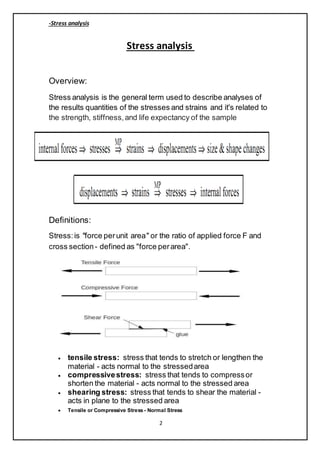
Stress analysis is the general term used to describe analyses of
and it's related tothe results quantities of the stresses and strains
the strength, stiffness,and life expectancy of the sample
Definitions:
Stress:is "force perunit area" or the ratio of applied force F and
cross section- defined as "force perarea".
 tensile stress: stress that tends to stretch or lengthen the
material - acts normal to the stressedarea
 compressivestress: stress that tends to compressor
shorten the material - acts normal to the stressed area
 shearing stress: stress that tends to shear the material -
acts in plane to the stressed area
 Tensile or Compressive Stress - Normal Stress
ss analysisStre-
3
Tensile orcompressive stress normal to the plane is usually
denoted "normalstress" or"directstress" and can be
expressedas
σ = Fn / A
where
σ = normal stress ((Pa) N/m2
, psi)
Fn = normal componentforce (N, lbf )
A = area (m2
)
Shear Stress:
Stress parallel to the plane is usually denoted "shear stress" and
can be expressed as
τ = Fp / A
where
τ = shear stress ((Pa) N/m2
)
Fp = parallel component force (N, lbf)
A = area (m2
)
Strain:
Strain is defined as "deformationof a solid due to stress" and can
be expressedas
ε = dl / lo
= σ / E
where
dl = changeof length (m,in)
lo = initiallength (m,in)
ε = unit less measure of engineering strain
ss analysisStre-
4
E = Young's modulus (Modulus of Elasticity) (N/m2
(Pa),
lb/in2
(psi))
(Young's modulus can be used to predictthe elongation or
compressionof an object)
E = stress / strain
= σ / ε
= (Fn / A) / (dl / lo)
Shear Modulus:
S = stress / strain
= τ / γ
= (Fp / A) / (s / d)
Where
S = shear modulus (N/m2
) (lb/in2
, psi)
τ = shear stress ((Pa) N/m2
, psi)
γ = unit less measure of shear strain
Fp = force parallel to the faces which they act
A = area (m2
, in2
)
s = displacement of the faces (m, in)
d = distance between the faces displaced (m, in)
Stress Strain curve :
It describes the relationship between
the stress and strain that a particular material displays is
known as that particular material's stress–strain curve. It
is unique for each material and is found by recording the
amount of deformation(strain) at distinct intervals of
tensile or compressive loading (stress)
ss analysisStre-
5
For metals, it is often, butthe proportional limit.Yield strength:
and compressionat which thenot always the same in tension
linear-strain curve becomes non-stress
is the maximum engineering stress on the:ultimate strengthThe
Sample
Mohr's circle
D-Mohr's circle is a geometric representationof the 2
is then used tocircleThe Mohransformation of stresses.tr
determine graphically the stress components acting on the system
ss analysisStre-
6
Stress transformation equations
e:circlSteps of drawing Mohr's
ss analysisStre-
7
ss analysisStre-
8
Cylinder stress
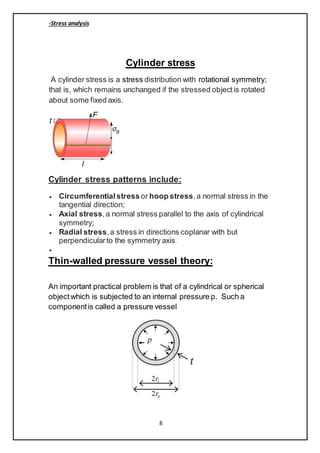
;rotational symmetrydistribution withstressis acylinder stressA
that is, which remains unchanged if the stressed objectis rotated
about some fixed axis.
Cylinder stress patterns include:
 Circumferentialstressor hoop stress,a normal stress in the
tangential direction;
 Axial stress,a normal stress parallel to the axis of cylindrical
symmetry;
 Radial stress,a stress in directions coplanar with but
perpendicularto the symmetry axis.

Thin-walled pressure vessel theory:
An important practical problem is that of a cylindrical or spherical
objectwhich is subjected to an internal pressure p. Such a
componentis called a pressure vessel
ss analysisStre-
9
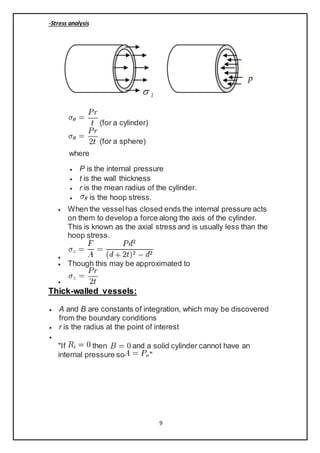
(for a cylinder)
(for a sphere)
where
 P is the internal pressure
 t is the wall thickness
 r is the mean radius of the cylinder.
 is the hoop stress.
 When the vesselhas closed ends the internal pressure acts
on them to develop a force along the axis of the cylinder.
This is known as the axial stress and is usually less than the
hoop stress.

 Though this may be approximated to

Thick-walled vessels:
 A and B are constants of integration, which may be discovered
from the boundary conditions
 r is the radius at the point of interest

"If then and a solid cylinder cannot have an
internal pressure so "
ss analysisStre-
10
References:
1. FEA Concepts J.E.Akin
2. NC state university
3. Solid Mechanics Part I Kelly
4. http://inventor.grantadesign.com/
5. http://www.engineeringtoolbox.com/
6. https://en.wikipedia.org

Stress analysis.

  • 1.
    ss analysisStre- 1 Index Title Page -Overviewon stress analysis 2 -Stress strain curve 4 -Mohr's circle 5 Cylinder stress- (Thin & Thick vessel) 8 -References 10
  • 2.
    ss analysisStre- 2 Stress analysis Overview: Stressanalysis is the general term used to describe analyses of and it's related tothe results quantities of the stresses and strains the strength, stiffness,and life expectancy of the sample Definitions: Stress:is "force perunit area" or the ratio of applied force F and cross section- defined as "force perarea".  tensile stress: stress that tends to stretch or lengthen the material - acts normal to the stressedarea  compressivestress: stress that tends to compressor shorten the material - acts normal to the stressed area  shearing stress: stress that tends to shear the material - acts in plane to the stressed area  Tensile or Compressive Stress - Normal Stress
  • 3.
    ss analysisStre- 3 Tensile orcompressivestress normal to the plane is usually denoted "normalstress" or"directstress" and can be expressedas σ = Fn / A where σ = normal stress ((Pa) N/m2 , psi) Fn = normal componentforce (N, lbf ) A = area (m2 ) Shear Stress: Stress parallel to the plane is usually denoted "shear stress" and can be expressed as τ = Fp / A where τ = shear stress ((Pa) N/m2 ) Fp = parallel component force (N, lbf) A = area (m2 ) Strain: Strain is defined as "deformationof a solid due to stress" and can be expressedas ε = dl / lo = σ / E where dl = changeof length (m,in) lo = initiallength (m,in) ε = unit less measure of engineering strain
  • 4.
    ss analysisStre- 4 E =Young's modulus (Modulus of Elasticity) (N/m2 (Pa), lb/in2 (psi)) (Young's modulus can be used to predictthe elongation or compressionof an object) E = stress / strain = σ / ε = (Fn / A) / (dl / lo) Shear Modulus: S = stress / strain = τ / γ = (Fp / A) / (s / d) Where S = shear modulus (N/m2 ) (lb/in2 , psi) τ = shear stress ((Pa) N/m2 , psi) γ = unit less measure of shear strain Fp = force parallel to the faces which they act A = area (m2 , in2 ) s = displacement of the faces (m, in) d = distance between the faces displaced (m, in) Stress Strain curve : It describes the relationship between the stress and strain that a particular material displays is known as that particular material's stress–strain curve. It is unique for each material and is found by recording the amount of deformation(strain) at distinct intervals of tensile or compressive loading (stress)
  • 5.
    ss analysisStre- 5 For metals,it is often, butthe proportional limit.Yield strength: and compressionat which thenot always the same in tension linear-strain curve becomes non-stress is the maximum engineering stress on the:ultimate strengthThe Sample Mohr's circle D-Mohr's circle is a geometric representationof the 2 is then used tocircleThe Mohransformation of stresses.tr determine graphically the stress components acting on the system
  • 6.
    ss analysisStre- 6 Stress transformationequations e:circlSteps of drawing Mohr's
  • 7.
  • 8.
    ss analysisStre- 8 Cylinder stress ;rotationalsymmetrydistribution withstressis acylinder stressA that is, which remains unchanged if the stressed objectis rotated about some fixed axis. Cylinder stress patterns include:  Circumferentialstressor hoop stress,a normal stress in the tangential direction;  Axial stress,a normal stress parallel to the axis of cylindrical symmetry;  Radial stress,a stress in directions coplanar with but perpendicularto the symmetry axis.  Thin-walled pressure vessel theory: An important practical problem is that of a cylindrical or spherical objectwhich is subjected to an internal pressure p. Such a componentis called a pressure vessel
  • 9.
    ss analysisStre- 9 (for acylinder) (for a sphere) where  P is the internal pressure  t is the wall thickness  r is the mean radius of the cylinder.  is the hoop stress.  When the vesselhas closed ends the internal pressure acts on them to develop a force along the axis of the cylinder. This is known as the axial stress and is usually less than the hoop stress.   Though this may be approximated to  Thick-walled vessels:  A and B are constants of integration, which may be discovered from the boundary conditions  r is the radius at the point of interest  "If then and a solid cylinder cannot have an internal pressure so "
  • 10.
    ss analysisStre- 10 References: 1. FEAConcepts J.E.Akin 2. NC state university 3. Solid Mechanics Part I Kelly 4. http://inventor.grantadesign.com/ 5. http://www.engineeringtoolbox.com/ 6. https://en.wikipedia.org