barangroup.com 
Stress Analysis 
Method and Emphasis points 
David Cohen – 29/09/14
• The Most important reason stress analysis is carried out is : SAFETY 
• This is achieved by designing a Code Compliant System. 
• There are also Financial Saving to be made: 
• Correct pipe support spans 
• Material sizes and thickness which are correctly specified. 
2 
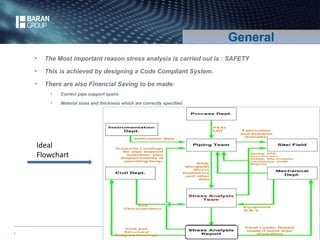
General 
Ideal 
Flowchart
3 
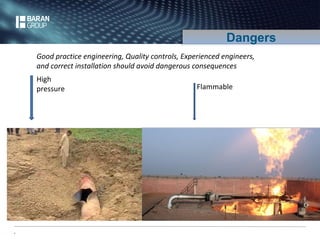
Dangers 
Good practice engineering, Quality controls, Experienced engineers, 
and correct installation should avoid dangerous consequences 
High 
pressure Flammable
4 
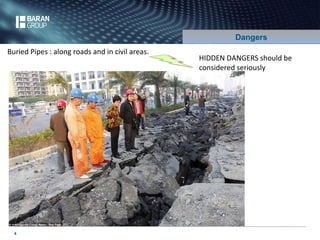
Dangers 
Buried Pipes : along roads and in civil areas. 
HIDDEN DANGERS should be 
considered seriously
5 
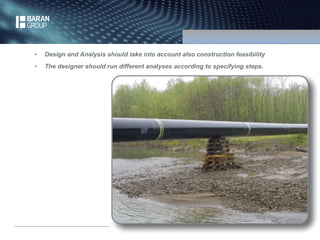
• Design and Analysis should take into account also construction feasibility 
• The designer should run different analyses according to specifying steps.
6 
Codes 
• Loading Codes: 
• Seismic Loads: SI-413 
• Wind Loads: SI-414 
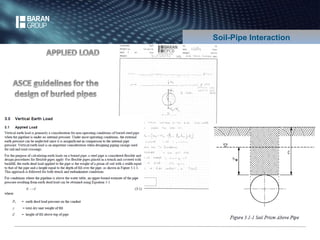
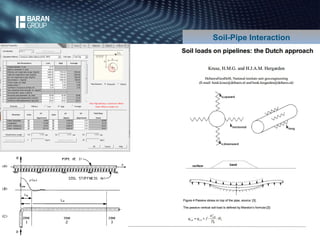
• Traffic and Earth Loads: ASCE-Guidelines for the design of buried steel pipe 
& Geotechnical Report 
• Piping Codes: 
• ASME B31.3 
• ASME B31.8 
• SI-5664 
• NEN 3650
7 
Sources for generation of stress in a Piping System: 
•Weight 
•Internal/External Pressure 
•Temperature change 
•Occasional Loads due to wind, seismic disturbances, PSV discharge etc. 
•Forces due to Vibration. 
1.Sustained Stresses are the stresses generated by sustained loads. (e.g. Pressure , Weight). These loads are present 
continuously throughout plant life. 
2.Resistive force arising out of sustained stresses balance the external forces keeping the system in equilibrium. Exceeding 
sustain allowable stress value causes catastrophic failure of the system. 
3.As per ASME B 31.3, (clause 302.3.5) “ The sum of the longitudinal stresses, SL, in any component in a piping system, 
due to sustained loads such as pressure and weight, shall not exceed the product Sh x W ”. Where, Sh=Basic allowable 
stress at maximum metal temperature expected during the displacement cycle and W=weld joint strength reduction factor. 
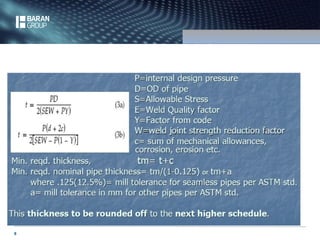
4.Pressure Stresses are taken care of by calculating and selecting proper pipe thickness. The pressure thickness (t) of a 
straight pipe can be obtained as per ASME B31.3 from the equation (Clause 304.1.2).
8
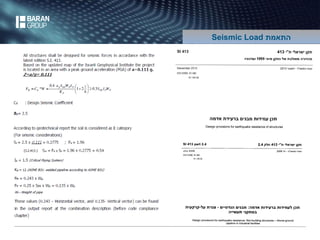
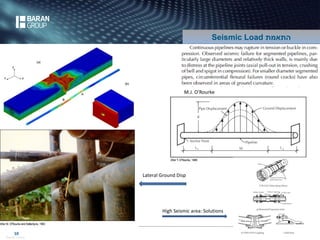
Seismic Load התאמת
10 
Seismic Load התאמת 
M.J. O’Rourke 
X. Liu 
Lateral Ground Disp 
High Seismic area: Solutions 
David Cohen
David Cohen 
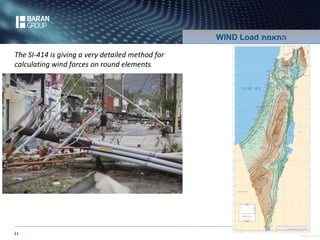
The SI-414 is giving a very detailed method for 
calculating wind forces on round elements 
11 
WIND Load התאמת
12 
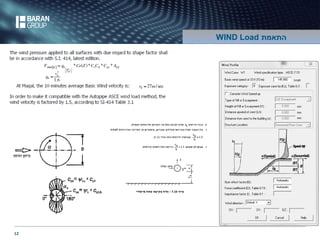
WIND Load התאמת
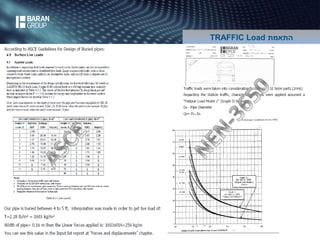
TRAFFIC Load התאמת
Soil-Pipe Interaction
15 
Soil-Pipe Interaction
16 
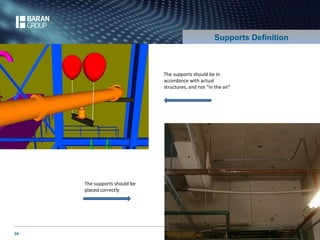
Supports Definition 
The supports should be in 
accordance with actual 
structures, and not “in the air” 
The supports should be 
placed correctly
17 
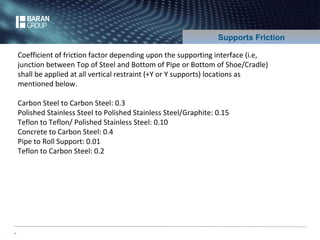
Supports Friction 
Coefficient of friction factor depending upon the supporting interface (i.e, 
junction between Top of Steel and Bottom of Pipe or Bottom of Shoe/Cradle) 
shall be applied at all vertical restraint (+Y or Y supports) locations as 
mentioned below. 
Carbon Steel to Carbon Steel: 0.3 
Polished Stainless Steel to Polished Stainless Steel/Graphite: 0.15 
Teflon to Teflon/ Polished Stainless Steel: 0.10 
Concrete to Carbon Steel: 0.4 
Pipe to Roll Support: 0.01 
Teflon to Carbon Steel: 0.2
18 
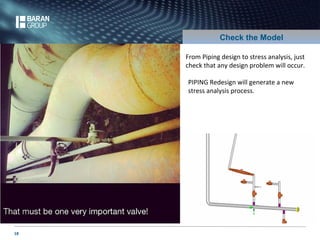
Check the Model 
From Piping design to stress analysis, just 
check that any design problem will occur. 
PIPING Redesign will generate a new 
stress analysis process.
19 
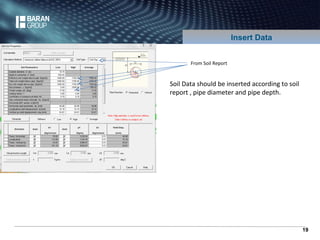
From Soil Report 
Insert Data 
Soil Data should be inserted according to soil 
report , pipe diameter and pipe depth.
20 
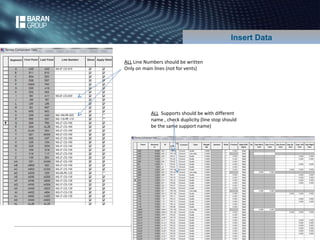
ALL Line Numbers should be written 
Only on main lines (not for vents) 
Insert Data 
ALL Supports should be with different 
name , check duplicity (line stop should 
be the same support name)
21 
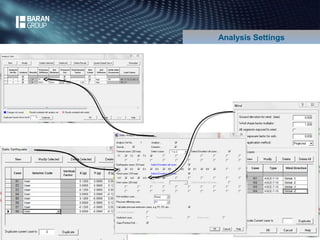
Analysis Settings
22 
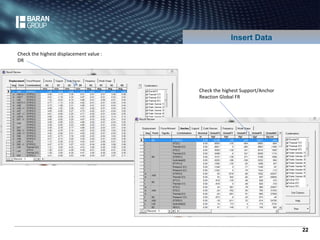
Check the highest displacement value : 
DR 
Insert Data 
Check the highest Support/Anchor 
Reaction Global FR

Stress analysis method

  • 1.
    barangroup.com Stress Analysis Method and Emphasis points David Cohen – 29/09/14
  • 2.
    • The Mostimportant reason stress analysis is carried out is : SAFETY • This is achieved by designing a Code Compliant System. • There are also Financial Saving to be made: • Correct pipe support spans • Material sizes and thickness which are correctly specified. 2 General Ideal Flowchart
  • 3.
    3 Dangers Goodpractice engineering, Quality controls, Experienced engineers, and correct installation should avoid dangerous consequences High pressure Flammable
  • 4.
    4 Dangers BuriedPipes : along roads and in civil areas. HIDDEN DANGERS should be considered seriously
  • 5.
    5 • Designand Analysis should take into account also construction feasibility • The designer should run different analyses according to specifying steps.
  • 6.
    6 Codes •Loading Codes: • Seismic Loads: SI-413 • Wind Loads: SI-414 • Traffic and Earth Loads: ASCE-Guidelines for the design of buried steel pipe & Geotechnical Report • Piping Codes: • ASME B31.3 • ASME B31.8 • SI-5664 • NEN 3650
  • 7.
    7 Sources forgeneration of stress in a Piping System: •Weight •Internal/External Pressure •Temperature change •Occasional Loads due to wind, seismic disturbances, PSV discharge etc. •Forces due to Vibration. 1.Sustained Stresses are the stresses generated by sustained loads. (e.g. Pressure , Weight). These loads are present continuously throughout plant life. 2.Resistive force arising out of sustained stresses balance the external forces keeping the system in equilibrium. Exceeding sustain allowable stress value causes catastrophic failure of the system. 3.As per ASME B 31.3, (clause 302.3.5) “ The sum of the longitudinal stresses, SL, in any component in a piping system, due to sustained loads such as pressure and weight, shall not exceed the product Sh x W ”. Where, Sh=Basic allowable stress at maximum metal temperature expected during the displacement cycle and W=weld joint strength reduction factor. 4.Pressure Stresses are taken care of by calculating and selecting proper pipe thickness. The pressure thickness (t) of a straight pipe can be obtained as per ASME B31.3 from the equation (Clause 304.1.2).
  • 8.
  • 9.
  • 10.
    10 Seismic Loadהתאמת M.J. O’Rourke X. Liu Lateral Ground Disp High Seismic area: Solutions David Cohen
  • 11.
    David Cohen TheSI-414 is giving a very detailed method for calculating wind forces on round elements 11 WIND Load התאמת
  • 12.
    12 WIND Loadהתאמת
  • 13.
  • 14.
  • 15.
  • 16.
    16 Supports Definition The supports should be in accordance with actual structures, and not “in the air” The supports should be placed correctly
  • 17.
    17 Supports Friction Coefficient of friction factor depending upon the supporting interface (i.e, junction between Top of Steel and Bottom of Pipe or Bottom of Shoe/Cradle) shall be applied at all vertical restraint (+Y or Y supports) locations as mentioned below. Carbon Steel to Carbon Steel: 0.3 Polished Stainless Steel to Polished Stainless Steel/Graphite: 0.15 Teflon to Teflon/ Polished Stainless Steel: 0.10 Concrete to Carbon Steel: 0.4 Pipe to Roll Support: 0.01 Teflon to Carbon Steel: 0.2
  • 18.
    18 Check theModel From Piping design to stress analysis, just check that any design problem will occur. PIPING Redesign will generate a new stress analysis process.
  • 19.
    19 From SoilReport Insert Data Soil Data should be inserted according to soil report , pipe diameter and pipe depth.
  • 20.
    20 ALL LineNumbers should be written Only on main lines (not for vents) Insert Data ALL Supports should be with different name , check duplicity (line stop should be the same support name)
  • 21.
  • 22.
    22 Check thehighest displacement value : DR Insert Data Check the highest Support/Anchor Reaction Global FR