Boston	
  CHI	
  Monthly	
  Mee>ng	
  
STRENGTHENING	
  DESIGN	
  RESEARCH	
  	
  
MODERATION	
  SKILLS	


APRIL	
  9,	
  2013	


Susan	
  Mercer	
  
Senior	
  Experience	
  Researcher	
  
smercer@madpow.com	
  
@susanamercer	
  
Strengthening Moderating and Interviewing Skills

§  Once I learned the basics
§  And ran a couple of studies,


§  Now what?
§  How do I strengthen my skills?


                                                   2	
  
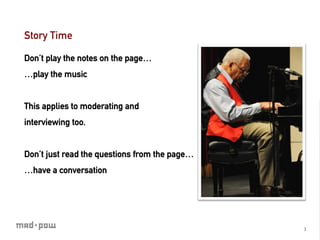
Story Time

Don’t play the notes on the page…
…play the music


This applies to moderating and
interviewing too.


Don’t just read the questions from the page…
…have a conversation


                                               3	
  
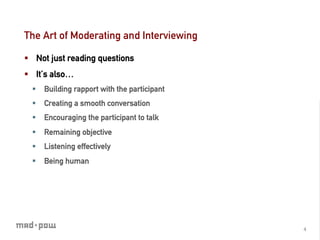
The Art of Moderating and Interviewing

§  Not just reading questions
§  It’s also…
  §  Building rapport with the participant
  §  Creating a smooth conversation
  §  Encouraging the participant to talk
  §  Remaining objective
  §  Listening effectively
  §  Being human


                                              4	
  
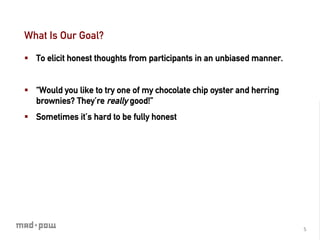
What Is Our Goal?

§  To elicit honest thoughts from participants in an unbiased manner.


§  “Would you like to try one of my chocolate chip oyster and herring
    brownies? They’re really good!”
§  Sometimes it’s hard to be fully honest


                                                                         5	
  
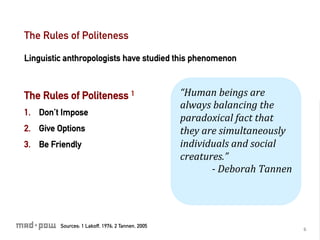
The Rules of Politeness

Linguistic anthropologists have studied this phenomenon


The Rules of Politeness 1                          “Human	
  beings	
  are	
  
                                                   always	
  balancing	
  the	
  
1.  Don’t Impose
                                                   paradoxical	
  fact	
  that	
  
2.  Give Options                                   they	
  are	
  simultaneously	
  
3.  Be Friendly                                    individuals	
  and	
  social	
  
                                                   creatures.”	
  
                                                             -­‐	
  Deborah	
  Tannen	


         Sources: 1 Lakoff, 1976; 2 Tannen, 2005
                                                                                            6	
  
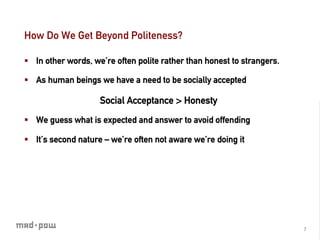
How Do We Get Beyond Politeness?

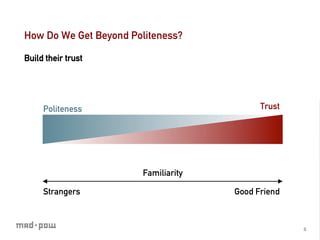
§  In other words, we’re often polite rather than honest to strangers.

§  As human beings we have a need to be socially accepted

                     Social Acceptance > Honesty
§  We guess what is expected and answer to avoid offending

§  It’s second nature – we’re often not aware we’re doing it


                                                                          7	
  
How Do We Get Beyond Politeness?

Build their trust


     Politeness                            Trust


                       Familiarity

     Strangers                       Good Friend


                                                   8	
  
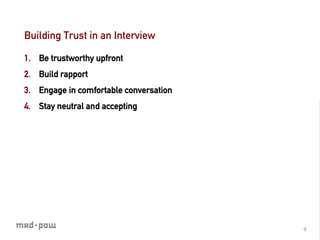
Building Trust in an Interview

1.  Be trustworthy upfront
2.  Build rapport
3.  Engage in comfortable conversation
4.  Stay neutral and accepting


                                         9	
  
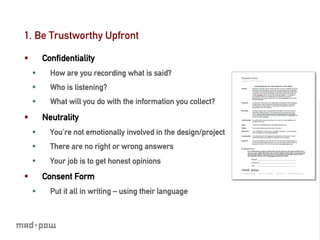
1. Be Trustworthy Upfront

§          Confidentiality
      §      How are you recording what is said?
      §      Who is listening?
      §      What will you do with the information you collect?

§          Neutrality
      §      You’re not emotionally involved in the design/project
      §      There are no right or wrong answers
      §      Your job is to get honest opinions
§          Consent Form
      §      Put it all in writing – using their language
2. Build Rapport
                                                              A	
  person's	
  name	
  is	
  
§          Greeting a Participant                            to	
  that	
  person	
  the	
  
      §      Smile                                           sweetest	
  and	
  most	
  
      §      Use their name                                  important	
  sound	
  in	
  
                                                              any	
  language.	
  
      §      Handshake / Warm phone greeting
                                                                       -­‐	
  Dale	
  Carnegie	
  
      §      Make them feel important - sincerely
§          Small Talk – Find Common Ground
      §      Safe topics: travel to office, traffic, weather
      §      Avoid asking direct questions
      §      Listen and look for shared experiences


                 Source: Carnegie, 1936.
2. Build Rapport

§          Be Empathetic
      §      Apologize if they had trouble finding the office
      §      Show you understand their point of view
      §      “Oh, it’s raining there? It is here too. I hate rainy days.”

§          Inject Some Humor
      §      Joke about yourself
      §      Joke about the situation
      §      Don’t joke about them


§          Short version – Show them that you are human too
3. Engage in Comfortable Conversation

Two schools of usability testing moderating techniques
§  Moderator keeps silent and says “Keep talking” 1
  §  Awkward feeling for participant
  §  Reminds them that they are in a “study”
§  Moderator creates conversation where participant is primary
    speaker 2
  §  Still accomplishes goals of gathering information
  §  Meets the participant’s expectations of a socially acceptable conversation
  §  Moderator can still be neutral and minimize bias


          Sources: 1 Ericsson and Simon, 1980, 2 Boren and Raney, 2000.
                                                                                   13	
  
3. Engage in Comfortable Conversation

What is a Comfortable Conversation?
§  Conversational cues and turn-taking are expected
§  Acknowledgement tokens – “Uh huh”, etc.
  §  Encourage the continuation of the other speaker’s talk
  §  Usually implies that the other speaker’s prior talk is incomplete
§  Some indicate change of speakership
  §  “Yeah” – more than half the time indicates changing turns in speaking
   §    “Yeah. I heard that the other day and…”

  §  “Oh!” - may indicate noticing something, then transitioning to another topic
   §    “Oh! That reminded me…”
3. Engage in Comfortable Conversation

§  Some may introduce bias
  §  “Oh!”, “Interesting” – indicating unexpected answer
  §  “Yes”, “Perfect”, “Great” – indicating agreement
  §  “Hmmm.”, “Really?” – indicating disagreement
  §  Notice that tone is key
§  Neutral is best
  §  “Mhmm”, “Uh huh”, “Continue”, “Tell me more”, “OK”
  §  “Mhmm” or “Uh huh” vs. silence à interviewees saying 31% more
      phrases. 1


          Source: 1 Matarazzo et. al., 1964
4. Stay Neutral and Accepting

§          Ask Open-ended Questions
      §      Start with Who, What, When, Where, Why, How?
§          Really Listen
      §      Pay attention – stay in the moment
      §      Look at the participant
      §      Take notes if you can
      §      Be quiet - give them time to say what they need to
4. Stay Neutral and Accepting

§            Watch Your Reactions
      §          Don’t show surprise
            §     May make them think that they are giving a wrong answer

      §          Don’t overly agree
            §     May make them think that they are giving the right answer

      §          Don’t be negative
            §     Watch your tone – stay neutral and accepting

      §          Try not to laugh
4. Stay Neutral and Accepting

§          Be yourself
§          No one is perfectly neutral
§          Recover gracefully and move on
      §      “Perfect” – “That’s the level of detailed feedback we’re looking for.”
      §      “Interesting!” – “I haven’t heard that perspective yet, tell me more.”
      §      (something surprising) – “I can understand that.”

§          Interject some Rapport-building comments when needed
      §      Quiet or uncomfortable participants
      §      “I hate it when that happens.”, “I can imagine that was challenging”, etc.
      §      Again, showing that you are human like them
5. Encourage them to talk

§  Be Quiet!
  §  Most agreements happen immediately. Most people delay before
      disagreeing.1
  §  If you don’t respond to their answer, it encourages them to talk more
  §  People often delay speaking before disagreeing – give them time
  §  Some people are uncomfortable with silence, so they will keep talking
  §  The best way to stay neutral J


          Source: 1 Goodwin and Heritage, 1990.
Building Trust in an Interview

1.  Be trustworthy upfront
2.  Build rapport
3.  Engage in comfortable conversation
4.  Stay neutral and accepting
5.  Be Quiet


                                         20	
  
KEEPING	
  YOUR	
  SKILLS	
  SHARP	


                                         21
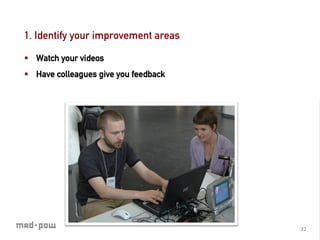
1. Identify your improvement areas

§  Watch your videos
§  Have colleagues give you feedback


                                        22	
  
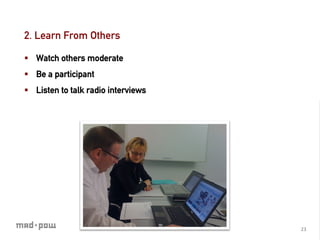
2. Learn From Others

§  Watch others moderate
§  Be a participant
§  Listen to talk radio interviews


                                      23	
  
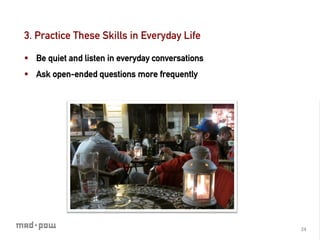
3. Practice These Skills in Everyday Life

§  Be quiet and listen in everyday conversations
§  Ask open-ended questions more frequently


                                                    24	
  
The most important thing is…


PRACTICE!

                               25	
  
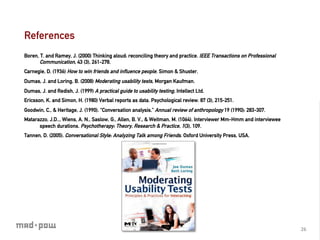
References
Boren, T. and Ramey, J. (2000) Thinking aloud: reconciling theory and practice. IEEE Transactions on Professional
       Communication, 43 (3), 261-278.
Carnegie, D. (1936) How to win friends and influence people. Simon & Shuster.
Dumas, J. and Loring, B. (2008) Moderating usability tests, Morgan Kaufman.
Dumas, J. and Redish, J. (1999) A practical guide to usability testing, Intellect Ltd.
Ericsson, K. and Simon, H. (1980) Verbal reports as data. Psychological review. 87 (3), 215-251.
Goodwin, C., & Heritage, J. (1990). “Conversation analysis.” Annual review of anthropology 19 (1990): 283-307.
Matarazzo, J.D.., Wiens, A. N., Saslow, G., Allen, B. V., & Weitman, M. (1064). Interviewer Mm-Hmm and interviewee
      speech durations. Psychotherapy: Theory, Research & Practice, 1(3), 109.
Tannen, D. (2005). Conversational Style: Analyzing Talk among Friends. Oxford University Press, USA.


                                                                                                                     26	
  
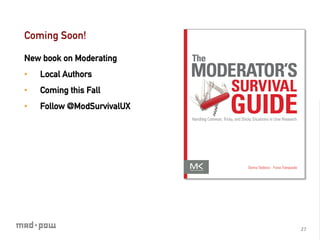
Coming Soon!

New book on Moderating
•    Local Authors
•    Coming this Fall
•    Follow @ModSurvivalUX


                             27	
  
Questions?

             28	
  
Thank You!


Susan	
  Mercer	
  
Senior	
  Experience	
  Researcher	
  
smercer@madpow.com	
  
@susanamercer	


                                         29	
  

Strengthening Design Research Moderating Skills

  • 1.
    Boston  CHI  Monthly  Mee>ng   STRENGTHENING  DESIGN  RESEARCH     MODERATION  SKILLS       APRIL  9,  2013         Susan  Mercer   Senior  Experience  Researcher   smercer@madpow.com   @susanamercer  
  • 2.
    Strengthening Moderating andInterviewing Skills §  Once I learned the basics §  And ran a couple of studies, §  Now what? §  How do I strengthen my skills? 2  
  • 3.
    Story Time Don’t playthe notes on the page… …play the music This applies to moderating and interviewing too. Don’t just read the questions from the page… …have a conversation 3  
  • 4.
    The Art ofModerating and Interviewing §  Not just reading questions §  It’s also… §  Building rapport with the participant §  Creating a smooth conversation §  Encouraging the participant to talk §  Remaining objective §  Listening effectively §  Being human 4  
  • 5.
    What Is OurGoal? §  To elicit honest thoughts from participants in an unbiased manner. §  “Would you like to try one of my chocolate chip oyster and herring brownies? They’re really good!” §  Sometimes it’s hard to be fully honest 5  
  • 6.
    The Rules ofPoliteness Linguistic anthropologists have studied this phenomenon The Rules of Politeness 1 “Human  beings  are   always  balancing  the   1.  Don’t Impose paradoxical  fact  that   2.  Give Options they  are  simultaneously   3.  Be Friendly individuals  and  social   creatures.”   -­‐  Deborah  Tannen   Sources: 1 Lakoff, 1976; 2 Tannen, 2005 6  
  • 7.
    How Do WeGet Beyond Politeness? §  In other words, we’re often polite rather than honest to strangers. §  As human beings we have a need to be socially accepted Social Acceptance > Honesty §  We guess what is expected and answer to avoid offending §  It’s second nature – we’re often not aware we’re doing it 7  
  • 8.
    How Do WeGet Beyond Politeness? Build their trust Politeness Trust Familiarity Strangers Good Friend 8  
  • 9.
    Building Trust inan Interview 1.  Be trustworthy upfront 2.  Build rapport 3.  Engage in comfortable conversation 4.  Stay neutral and accepting 9  
  • 10.
    1. Be TrustworthyUpfront §  Confidentiality §  How are you recording what is said? §  Who is listening? §  What will you do with the information you collect? §  Neutrality §  You’re not emotionally involved in the design/project §  There are no right or wrong answers §  Your job is to get honest opinions §  Consent Form §  Put it all in writing – using their language
  • 11.
    2. Build Rapport A  person's  name  is   §  Greeting a Participant to  that  person  the   §  Smile sweetest  and  most   §  Use their name important  sound  in   any  language.   §  Handshake / Warm phone greeting -­‐  Dale  Carnegie   §  Make them feel important - sincerely §  Small Talk – Find Common Ground §  Safe topics: travel to office, traffic, weather §  Avoid asking direct questions §  Listen and look for shared experiences Source: Carnegie, 1936.
  • 12.
    2. Build Rapport §  Be Empathetic §  Apologize if they had trouble finding the office §  Show you understand their point of view §  “Oh, it’s raining there? It is here too. I hate rainy days.” §  Inject Some Humor §  Joke about yourself §  Joke about the situation §  Don’t joke about them §  Short version – Show them that you are human too
  • 13.
    3. Engage inComfortable Conversation Two schools of usability testing moderating techniques §  Moderator keeps silent and says “Keep talking” 1 §  Awkward feeling for participant §  Reminds them that they are in a “study” §  Moderator creates conversation where participant is primary speaker 2 §  Still accomplishes goals of gathering information §  Meets the participant’s expectations of a socially acceptable conversation §  Moderator can still be neutral and minimize bias Sources: 1 Ericsson and Simon, 1980, 2 Boren and Raney, 2000. 13  
  • 14.
    3. Engage inComfortable Conversation What is a Comfortable Conversation? §  Conversational cues and turn-taking are expected §  Acknowledgement tokens – “Uh huh”, etc. §  Encourage the continuation of the other speaker’s talk §  Usually implies that the other speaker’s prior talk is incomplete §  Some indicate change of speakership §  “Yeah” – more than half the time indicates changing turns in speaking §  “Yeah. I heard that the other day and…” §  “Oh!” - may indicate noticing something, then transitioning to another topic §  “Oh! That reminded me…”
  • 15.
    3. Engage inComfortable Conversation §  Some may introduce bias §  “Oh!”, “Interesting” – indicating unexpected answer §  “Yes”, “Perfect”, “Great” – indicating agreement §  “Hmmm.”, “Really?” – indicating disagreement §  Notice that tone is key §  Neutral is best §  “Mhmm”, “Uh huh”, “Continue”, “Tell me more”, “OK” §  “Mhmm” or “Uh huh” vs. silence à interviewees saying 31% more phrases. 1 Source: 1 Matarazzo et. al., 1964
  • 16.
    4. Stay Neutraland Accepting §  Ask Open-ended Questions §  Start with Who, What, When, Where, Why, How? §  Really Listen §  Pay attention – stay in the moment §  Look at the participant §  Take notes if you can §  Be quiet - give them time to say what they need to
  • 17.
    4. Stay Neutraland Accepting §  Watch Your Reactions §  Don’t show surprise §  May make them think that they are giving a wrong answer §  Don’t overly agree §  May make them think that they are giving the right answer §  Don’t be negative §  Watch your tone – stay neutral and accepting §  Try not to laugh
  • 18.
    4. Stay Neutraland Accepting §  Be yourself §  No one is perfectly neutral §  Recover gracefully and move on §  “Perfect” – “That’s the level of detailed feedback we’re looking for.” §  “Interesting!” – “I haven’t heard that perspective yet, tell me more.” §  (something surprising) – “I can understand that.” §  Interject some Rapport-building comments when needed §  Quiet or uncomfortable participants §  “I hate it when that happens.”, “I can imagine that was challenging”, etc. §  Again, showing that you are human like them
  • 19.
    5. Encourage themto talk §  Be Quiet! §  Most agreements happen immediately. Most people delay before disagreeing.1 §  If you don’t respond to their answer, it encourages them to talk more §  People often delay speaking before disagreeing – give them time §  Some people are uncomfortable with silence, so they will keep talking §  The best way to stay neutral J Source: 1 Goodwin and Heritage, 1990.
  • 20.
    Building Trust inan Interview 1.  Be trustworthy upfront 2.  Build rapport 3.  Engage in comfortable conversation 4.  Stay neutral and accepting 5.  Be Quiet 20  
  • 21.
  • 22.
    1. Identify yourimprovement areas §  Watch your videos §  Have colleagues give you feedback 22  
  • 23.
    2. Learn FromOthers §  Watch others moderate §  Be a participant §  Listen to talk radio interviews 23  
  • 24.
    3. Practice TheseSkills in Everyday Life §  Be quiet and listen in everyday conversations §  Ask open-ended questions more frequently 24  
  • 25.
    The most importantthing is… PRACTICE! 25  
  • 26.
    References Boren, T. andRamey, J. (2000) Thinking aloud: reconciling theory and practice. IEEE Transactions on Professional Communication, 43 (3), 261-278. Carnegie, D. (1936) How to win friends and influence people. Simon & Shuster. Dumas, J. and Loring, B. (2008) Moderating usability tests, Morgan Kaufman. Dumas, J. and Redish, J. (1999) A practical guide to usability testing, Intellect Ltd. Ericsson, K. and Simon, H. (1980) Verbal reports as data. Psychological review. 87 (3), 215-251. Goodwin, C., & Heritage, J. (1990). “Conversation analysis.” Annual review of anthropology 19 (1990): 283-307. Matarazzo, J.D.., Wiens, A. N., Saslow, G., Allen, B. V., & Weitman, M. (1064). Interviewer Mm-Hmm and interviewee speech durations. Psychotherapy: Theory, Research & Practice, 1(3), 109. Tannen, D. (2005). Conversational Style: Analyzing Talk among Friends. Oxford University Press, USA. 26  
  • 27.
    Coming Soon! New bookon Moderating •  Local Authors •  Coming this Fall •  Follow @ModSurvivalUX 27  
  • 28.
  • 29.
    Thank You!         Susan  Mercer   Senior  Experience  Researcher   smercer@madpow.com   @susanamercer   29