LE 4700 INTERVIEWS
Group 3
• Hakim • Haikal • Attiullah • Aida • Adirah • Ruhanee
Introduction
• An interview is a psychological and
sociological instrument.
• It is an interaction between two or
more persons for a specific purpose.
• It can be a meeting in which a journalist
asks somebody question to determine
their opinions.
2
Objectives of
Interview
• To select a person for a specific task
• To monitor performance
• To collect information
• To exchange information
• To counsel
3
Types of Interviews
• Job
• Persuasive
• Evaluation
• Conflict resolution
• Termination
• Information
• Exit
• Counselling
• Disciplinary
• Media
4
Interview can be divided into three
types
5
Telling
Telling and listening
Problem solving
Job Interview
• Campus Interview
• On-site Interview
• Telephonic Interview
• Video conferencing Interview
6
Stages of Interview
Appraisal of
Resume
Tests
Group
Discussion
Presentation
Face-to-face
Interview
Video-
conferencing
Interview
Negotiations
Medical Test
Interview can be divided into three types
8
Telling
Telling and
listening
Problem
solving
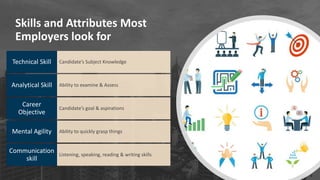
Skills and Attributes Most
Employers look for
Candidate’s Subject KnowledgeTechnical Skill
Ability to examine & AssessAnalytical Skill
Candidate’s goal & aspirations
Career
Objective
Ability to quickly grasp thingsMental Agility
Listening, speaking, reading & writing skills
Communication
skill
Skills and Attributes Most
Employers look for
Skills to build up relationship with team
Interpersonal
Skill
Multi-tasking & adaptive
Flexibility /
Adaptability
Ability to plan, organize, motivate, inspire,
manage and lead teams
Management &
Leadership Skill
Out of the box thinkingCreativity
Positivity of ways looking at things
Positive / Can-
do Attitude
Skills and Attributes Most
Employers look for
How a person conduct their own with peopleSocial Skills
Trustworthy & candidness
Honesty &
Integrity
Ability to accomplish assignment despite several
odds
Determination /
Steadfastness
Maturity & fairness in business activityProfessionalism
Willing to learn and open minded
Inclination to
learn
Arrogance Apathy
Uninhibited
Nervousness
Lack of Crispness
Lack of
Concentration
Equivocation
Inadequate
Inter/Intrapersonal
Skill
Lack of Social Skills Lack of Firmness
Unsuitable
Personality
Failure Factors
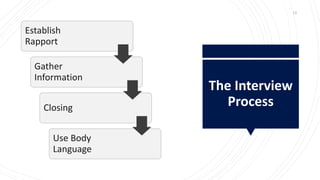
The Interview
Process
13
Establish
Rapport
Gather
Information
Closing
Use Body
Language
Preparation for INTERVIEW
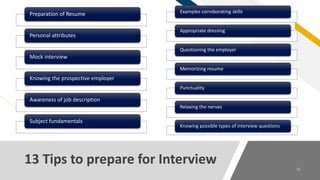
13 Tips to prepare for Interview
Preparation of Resume
Personal attributes
Mock interview
Knowing the prospective employer
Awareness of job description
Subject fundamentals
Examples corroborating skills
Appropriate dressing
Questioning the employer
Memorizing resume
Punctuality
Relaxing the nerves
Knowing possible types of interview questions
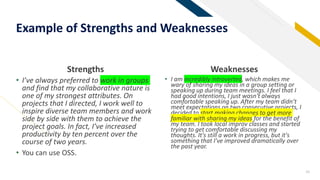
Strengths
• I’ve always preferred to work in groups
and find that my collaborative nature is
one of my strongest attributes. On
projects that I directed, I work well to
inspire diverse team members and work
side by side with them to achieve the
project goals. In fact, I’ve increased
productivity by ten percent over the
course of two years.
• You can use OSS.
Weaknesses
• I am incredibly introverted, which makes me
wary of sharing my ideas in a group setting or
speaking up during team meetings. I feel that I
had good intentions, I just wasn't always
comfortable speaking up. After my team didn’t
meet expectations on two consecutive projects, I
decided to start making changes to get more
familiar with sharing my ideas for the benefit of
my team. I took local improv classes and started
trying to get comfortable discussing my
thoughts. It's still a work in progress, but it's
something that I've improved dramatically over
the past year.
16
Example of Strengths and Weaknesses
17
STAR method
18
Objectively measures the features
of your background
Anticipate future responses based
upon past behavior
How you stand out from other
candidates
Subjectively evaluating features of
your background
Analyzing subjectively how would
you respond
Original Thought
GOOD interview vs BAD interview
20
Preparation
• Keep the documents within
easy reach
• Have a notepad and pen
• Keep a mirror nearby
• Stand up when talking
• Turn off television
• Warm up your voice
• Have a glass of water
Guidelines
• Take a surprise call in your
stride
• Be enthusiastic
• Beware of giving yes/no
answers
• Speak directly into the
telephone
• Take notes
BE HAV IO R A L A NSW E R ING TECHNIQUE
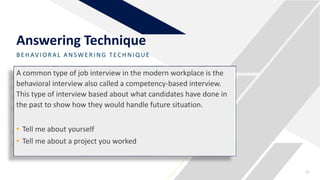
Answering Technique
21
A common type of job interview in the modern workplace is the
behavioral interview also called a competency-based interview.
This type of interview based about what candidates have done in
the past to show how they would handle future situation.
• Tell me about yourself
• Tell me about a project you worked
Create Behavioral
Profile
Create a profile of behaviors that allows a
person to be successful in that job
• How they learn new things
• How they make decisions
• How they detect and solve problems
• How they communicate
• What motivates them personally
• How they organize their work
22
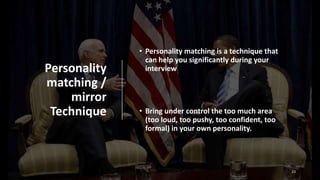
Personality
matching /
mirror
Technique
• Personality matching is a technique that
can help you significantly during your
interview
• Bring under control the too much area
(too loud, too pushy, too confident, too
formal) in your own personality.
23
Parroting Technique
24
• Do not assume or make a best guess of what the
interviewer is looking for.
• If a question is unclear to you, it is absolutely
appropriate to ‘parrot back’ the question in your own
words to make sure you have the correct meaning
Reframing Technique
25
• Always try to answer the questions as
straightforwardly as possible initially.
• E.g.
Answer Problem
Questions
Answer to problem question carefully because this situation
identifies your strong problem-solving skills can be hugely
beneficial for you are hiring to company.
• What was the most stressful situation you faced at work?
• How did you handle it?
Overcoming
Nervousness
• Don’t speak too fast
• Stop your voice shaking
• Find your best sitting position
• Listen
Intelligent listening
at Interview
Assume that during your interview you
have to listen to interviewer.
• Be a good listener
• Be interested and interesting.
• Maintain good eye contact
• Smile
• Speak clearly and simply.
• Don’t be a Know-it-All.
28
Add a footer 29
Follow
up
Call the
interviewers to
thank them
Immediately
write the
interviewers a
short note-mail
Telephonic Interviews
• Call hiring manager
• Company calls you
• Have pre-set time with company representatives
30
QUIZ TIME
LINK
Add a footer 31
LE 4700 THANK YOU
Group 3
• Hakim • Haikal • Attiullah • Aida • Adirah • Ruhanee

Job Interview

  • 1.
    LE 4700 INTERVIEWS Group3 • Hakim • Haikal • Attiullah • Aida • Adirah • Ruhanee
  • 2.
    Introduction • An interviewis a psychological and sociological instrument. • It is an interaction between two or more persons for a specific purpose. • It can be a meeting in which a journalist asks somebody question to determine their opinions. 2
  • 3.
    Objectives of Interview • Toselect a person for a specific task • To monitor performance • To collect information • To exchange information • To counsel 3
  • 4.
    Types of Interviews •Job • Persuasive • Evaluation • Conflict resolution • Termination • Information • Exit • Counselling • Disciplinary • Media 4
  • 5.
    Interview can bedivided into three types 5 Telling Telling and listening Problem solving
  • 6.
    Job Interview • CampusInterview • On-site Interview • Telephonic Interview • Video conferencing Interview 6
  • 7.
    Stages of Interview Appraisalof Resume Tests Group Discussion Presentation Face-to-face Interview Video- conferencing Interview Negotiations Medical Test
  • 8.
    Interview can bedivided into three types 8 Telling Telling and listening Problem solving
  • 9.
    Skills and AttributesMost Employers look for Candidate’s Subject KnowledgeTechnical Skill Ability to examine & AssessAnalytical Skill Candidate’s goal & aspirations Career Objective Ability to quickly grasp thingsMental Agility Listening, speaking, reading & writing skills Communication skill
  • 10.
    Skills and AttributesMost Employers look for Skills to build up relationship with team Interpersonal Skill Multi-tasking & adaptive Flexibility / Adaptability Ability to plan, organize, motivate, inspire, manage and lead teams Management & Leadership Skill Out of the box thinkingCreativity Positivity of ways looking at things Positive / Can- do Attitude
  • 11.
    Skills and AttributesMost Employers look for How a person conduct their own with peopleSocial Skills Trustworthy & candidness Honesty & Integrity Ability to accomplish assignment despite several odds Determination / Steadfastness Maturity & fairness in business activityProfessionalism Willing to learn and open minded Inclination to learn
  • 12.
    Arrogance Apathy Uninhibited Nervousness Lack ofCrispness Lack of Concentration Equivocation Inadequate Inter/Intrapersonal Skill Lack of Social Skills Lack of Firmness Unsuitable Personality Failure Factors
  • 13.
  • 14.
  • 15.
    13 Tips toprepare for Interview Preparation of Resume Personal attributes Mock interview Knowing the prospective employer Awareness of job description Subject fundamentals Examples corroborating skills Appropriate dressing Questioning the employer Memorizing resume Punctuality Relaxing the nerves Knowing possible types of interview questions
  • 16.
    Strengths • I’ve alwayspreferred to work in groups and find that my collaborative nature is one of my strongest attributes. On projects that I directed, I work well to inspire diverse team members and work side by side with them to achieve the project goals. In fact, I’ve increased productivity by ten percent over the course of two years. • You can use OSS. Weaknesses • I am incredibly introverted, which makes me wary of sharing my ideas in a group setting or speaking up during team meetings. I feel that I had good intentions, I just wasn't always comfortable speaking up. After my team didn’t meet expectations on two consecutive projects, I decided to start making changes to get more familiar with sharing my ideas for the benefit of my team. I took local improv classes and started trying to get comfortable discussing my thoughts. It's still a work in progress, but it's something that I've improved dramatically over the past year. 16 Example of Strengths and Weaknesses
  • 17.
  • 18.
    18 Objectively measures thefeatures of your background Anticipate future responses based upon past behavior How you stand out from other candidates Subjectively evaluating features of your background Analyzing subjectively how would you respond Original Thought
  • 19.
    GOOD interview vsBAD interview
  • 20.
    20 Preparation • Keep thedocuments within easy reach • Have a notepad and pen • Keep a mirror nearby • Stand up when talking • Turn off television • Warm up your voice • Have a glass of water Guidelines • Take a surprise call in your stride • Be enthusiastic • Beware of giving yes/no answers • Speak directly into the telephone • Take notes
  • 21.
    BE HAV IOR A L A NSW E R ING TECHNIQUE Answering Technique 21 A common type of job interview in the modern workplace is the behavioral interview also called a competency-based interview. This type of interview based about what candidates have done in the past to show how they would handle future situation. • Tell me about yourself • Tell me about a project you worked
  • 22.
    Create Behavioral Profile Create aprofile of behaviors that allows a person to be successful in that job • How they learn new things • How they make decisions • How they detect and solve problems • How they communicate • What motivates them personally • How they organize their work 22
  • 23.
    Personality matching / mirror Technique • Personalitymatching is a technique that can help you significantly during your interview • Bring under control the too much area (too loud, too pushy, too confident, too formal) in your own personality. 23
  • 24.
    Parroting Technique 24 • Donot assume or make a best guess of what the interviewer is looking for. • If a question is unclear to you, it is absolutely appropriate to ‘parrot back’ the question in your own words to make sure you have the correct meaning
  • 25.
    Reframing Technique 25 • Alwaystry to answer the questions as straightforwardly as possible initially. • E.g.
  • 26.
    Answer Problem Questions Answer toproblem question carefully because this situation identifies your strong problem-solving skills can be hugely beneficial for you are hiring to company. • What was the most stressful situation you faced at work? • How did you handle it?
  • 27.
    Overcoming Nervousness • Don’t speaktoo fast • Stop your voice shaking • Find your best sitting position • Listen
  • 28.
    Intelligent listening at Interview Assumethat during your interview you have to listen to interviewer. • Be a good listener • Be interested and interesting. • Maintain good eye contact • Smile • Speak clearly and simply. • Don’t be a Know-it-All. 28
  • 29.
    Add a footer29 Follow up Call the interviewers to thank them Immediately write the interviewers a short note-mail
  • 30.
    Telephonic Interviews • Callhiring manager • Company calls you • Have pre-set time with company representatives 30
  • 31.
  • 32.
    LE 4700 THANKYOU Group 3 • Hakim • Haikal • Attiullah • Aida • Adirah • Ruhanee