





Communication Skills
as
You Build Your Personal Brand

© 2013, Nierenberg Consulting Group
All rights reserved, worldwide.
420 East 51St. Street, Suite 12d
New York, NY 10022
www.nierenberggroup.com
Cell: 917 626 8494
Email: andrea@NierenbergGroup.com
AHAS
Your Take Aways and Reminders of What You Know
1.

2.

3.

4.

5.

6.

7.

8.

9.

10.

2
THE ART OF PERSUASION

 Talk in “word pictures.” Tune into all of the senses and figure out which type
of person your prospect is—audio, visual, or kinesthetic. Use words that take
the prospect on a “mental journey.”
 Talk with spice and variety in your voice, inflection, and pause. Enthusiasm—
means “I am sold myself!”
 Image counts and speaks volumes—make a good first impression. Your posture
and movement say a lot about your self-confidence, energy and personality.
Smile—and shake hands firmly—confidence projects—even on the phone.
 Build rapport through body language and gestures.
 Adopt an assumptive attitude—“When we go forward….”
 Show a future need— “As the business grows, you’ll want this….”
 Pinpoint buying style: “How did you decide in the past…?”
 Restate the prospect’s statement to show empathy; “I understand how you feel
at this time, however….” — (feel, felt, found theory)

3
STRATEGIES TO PROPOSE NEW IDEAS
AND RECOMMENDATIONS

When you present an idea to a client you have 3 things going in your favor:
 Your research, planning and preparation
 Your ability to ask high gain, open ended questions
 Your ability to LISTEN

Why does someone buy from Baccarat?
They see the benefits.
 Anticipate objections
 Discuss options
 Re-focus benefits
 Always get a commitment or an answer with each point you make. Bring
closure and stop.

4
YOUR PRESENTATION


Limit your own talking.



Put yourself in their shoes.



Ask open-ended questions.



Hold your thought—don’t interrupt.



Use positive interjections.



Use persuasive, positive selling words.



Body Language—Be Present

THE SKILL OF QUESTIONING
Develop the Art and Skill of Continual Questioning
 Questions are like a road map…
 You can’t get the right answers if you don’t ask questions.
 The most powerful words in selling: “What Do You Think?

5
POWERFUL QUESTIONS


Be prepared to answer all questions



Questions are opportunities to move forward

How to Prepare for Questions:
 Before your sales presentation, ask yourself all the questions you think could be
asked, then review the answers.
 Be 150% PREPARED!
How to Answer Questions:


Listen. Make sure you understand the question. Look at the person who is
asking it.



Pause and think before speaking.



Repeat the question if you need to clarify.



Keep your tone and style of delivery even.



Give reasons and examples to support your answers.



Summarize your points.

6
STEPS TO CLOSING THE SALE

 Get your prospect to say “yes”. As you talk to a prospect, ask questions
that he or she will answer “yes” to. This helps to establish the right frame of
mind. (Minor agreement.)
 Keep digging for reasons behind your prospect’s objections. Probe and
question your prospect. To every objection ask “tell me more”. Tell me
what the ideal situation would be.
 Find out what the client wants. Show him or her how Baccarat is the right
product line.
 Sell benefits, not features.
 Concentrate on a single point.
 Know when to stop. Many sales are lost because the salesperson keeps
talking past the point where the prospect is willing to buy. Learn how to
read people and recognize when they’re ready.
 Surround the account. Enlist the support of the people who make final
decisions. Surround the account—get to know all people who make the
decisions.
 Be persistent. Keep building and developing the relationship with the
prospect and client.
 Close the sale. Always be asking for the next step….
 Stay in touch. Stress the benefits to them. The relationship has just begun.

7
WHY WE DON’T HEAR OTHERS 
When you want to listen so you really hear what others say, make sure you’re not
a:

 Mind reader. You’ll hear little or nothing as you think, “What is this
person really thinking or feeling?”
 Rehearser. Your mental tryouts for “Here’s what I’ll say next time” tune
out the speaker.
 Filterer. Some call this selective listening—hearing only what you want to
hear.
 Dreamer. Drifting off during face-to-face or telephone conversation can
lead to an embarrassing “What did you say?” or “Could you repeat that?”
 Identifier. If you refer everything you hear to your experience, you
probably didn’t really hear what was said.
 Comparer. When you get sidetracked assessing the messenger, you’re sure
to miss the message.
 Derailer. Changing the subject too quickly soon tells others you’re not
interested in anything they have to say.
 Placater. Agreeing with everything you hear just to be nice or to avoid
conflict does not mean you are a good listener.

8
LISTENING GUIDES
Do:

Clear your mind of distractions.

Do:

Observe non-verbal messages.

Do:

Wait until the speaker stops before you respond.

Do:

Listen for meaning.

Do:

Listen for what is not being said.

Do:

Ask as many questions as necessary to understand a speaker’s message.

Do:

Look directly at the speaker.

Do:

Take notes if it helps you concentrate.

Do:

Say you don’t understand if you need more clarification.

Do:

Relate your responses to what the speaker has said.

Do:

Respond non-verbally until the speaker finishes.

9
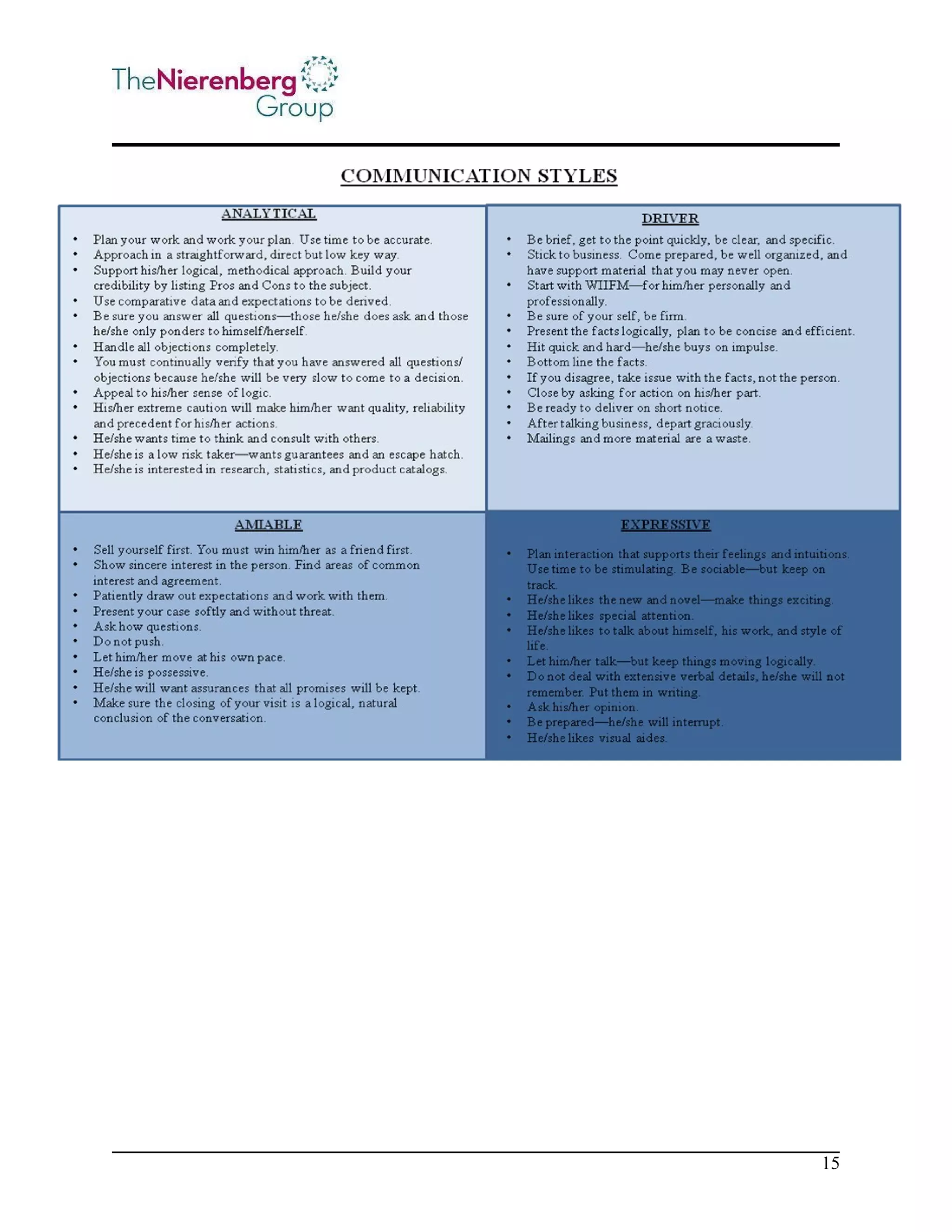
COMMUNICATION STYLES
Find your natural or primary communication style below. Even though you have
one dominant style, you use all styles, some more than others. On a 1-4 scale, with
1 being your Primary style, and 4 being the style you use the least rate the
following:
Expressive

Rating: ____

You are animated, energetic, and spontaneous. You easily communicate your
ideas, sometimes throwing out half-formed ideas to gather more input. You enjoy
involving people. You like variety, are curious and sometimes impulsive. You
could overlook details. People say you are expressive, innovative, persuasive and
outgoing.
Amiable

Rating: _____

You are empathetic, sympathetic and friendly. You have a warm tone of voice and
frequently show concern for the people for whom you work. You are very steady
and caring. You are good at anticipating people’s needs. You are often described
as being patient, controlled, concerned and cooperative.
Analytical

Rating: _____

You live in the world of the mind and like to keep your ideas private. You are
quite deliberate. When solving a problem you like to weigh each alternative and
consider all the facts. You are organized and systematic. You tend toward
perfectionism. You are detail oriented, thorough and orderly.
Driver

Rating: _____

You are a possibilities thinker. You value action, get impatient, and are easily
bored. You are results oriented. It is relatively easy for you to make decisions and
take calculated risks. You do not like to spend time considering a lot of
alternatives. People say you have a lot of drive, make a good leader, and are
assertive and outspoken.

10
Driver
 Be brief, get to the point quickly, and be clear and specific.
 Stick to business. Come prepared, be well organized and have support
material that you may never open.
 Start with WIIFM—for him/her personally and professionally.
 Be sure of yourself, be firm.
 Present the facts logically and plan to be concise and efficient.
 Hit quick and hard—he buys on impulse.
 Bottom line the facts.
 If you disagree, take issue with the facts, not the person.
 Close by asking for action on his part.
 Be ready to deliver on short notice.
 After talking business, depart graciously.
 Mailings and more material are a waste.
Expressive
 Plan interaction that supports their feelings and intuitions. Use time to be
stimulating. Be sociable—but keep on track.
 He likes the new and novel—make things exciting.
 He likes special attention.
 He likes to talk about himself, his work, style of life.
 Let him talk—yet keep things moving logically.
 Do not deal with extensive verbal details, he will not remember. Put them in
writing.
 Ask his opinion.
 Be prepared—he will interrupt.

11
 He likes visual aides.

12
Amiable
 Sell yourself first. You must win him as a friend first.
 Show sincere interest in him as a person. Find areas of common interest and
agreement.
 Patiently draw out his expectations and work with them.
 Present your case softly and without threat.
 Ask “how” questions.
 Do not push.
 Let him move at his own pace.
 He is possessive.
 He will want assurances that all promises will be kept.
 Make sure the closing of your visit is a logical, natural conclusion of the
conversation.
Analytical
 Plan your work and work your plan. Use time to be accurate.
 Approach him in a straightforward, direct but low key way.
 Support his logical, methodical approach. Build your credibility by listing
Pros and Cons to the subject.
 Use comparative data and expectations to be derived.
 Be sure you answer all of his questions—those he does ask and those he
only ponders to himself.
 Handle all objections completely.
 You must continually verify that you have answered all of his
questions/objections because he will be very slow to come to a decision.
 Appeal to his sense of logic.
 His extreme caution will make him want quality, reliability and precedent
for his actions.
 He wants time to think and consult with others.
13
 He is a low risk taker—wants guarantees and an escape hatch.
 He is interested in research and statistics.

14
15
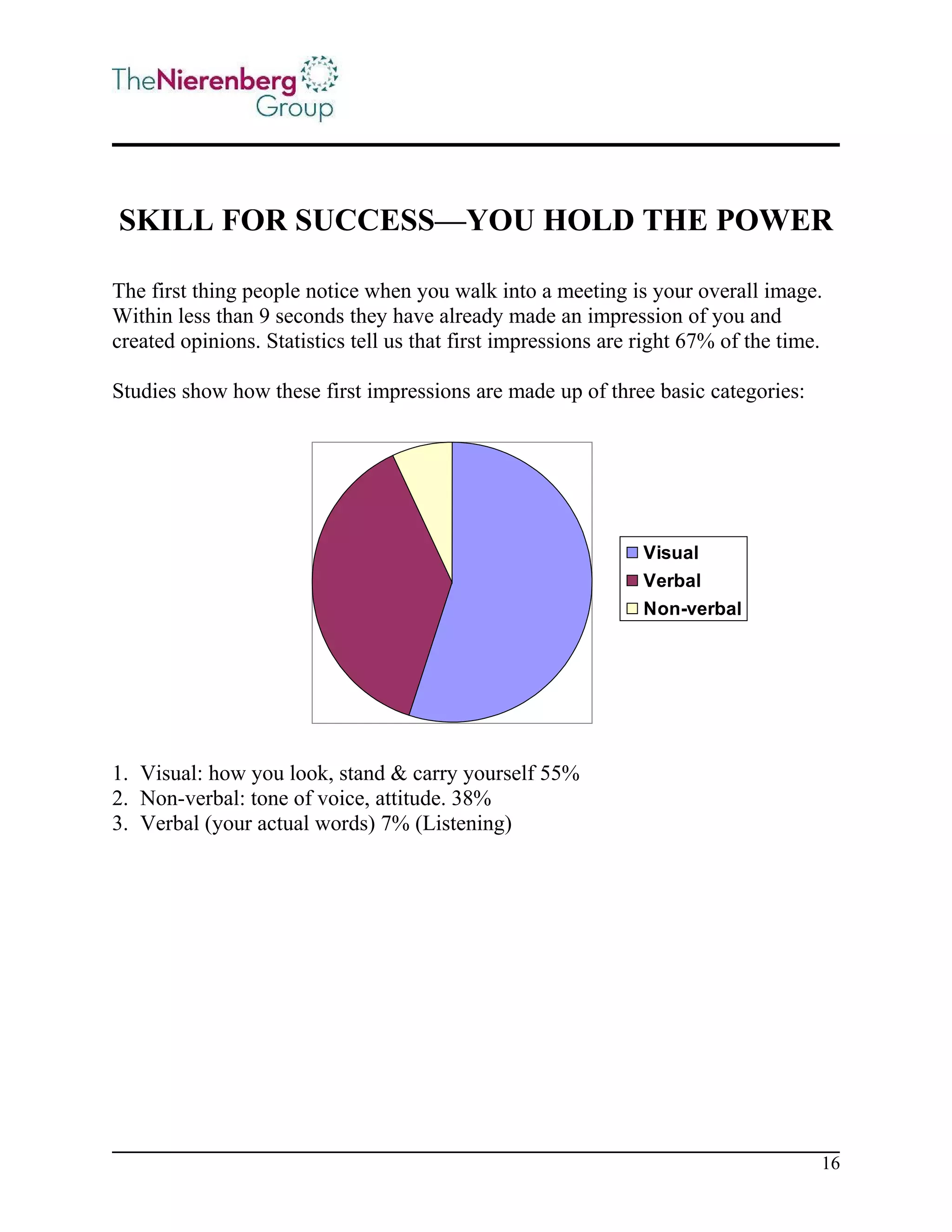
SKILL FOR SUCCESS—YOU HOLD THE POWER
The first thing people notice when you walk into a meeting is your overall image.
Within less than 9 seconds they have already made an impression of you and
created opinions. Statistics tell us that first impressions are right 67% of the time.
Studies show how these first impressions are made up of three basic categories:

Visual
Verbal
Non-verbal

1. Visual: how you look, stand & carry yourself 55%
2. Non-verbal: tone of voice, attitude. 38%
3. Verbal (your actual words) 7% (Listening)

16
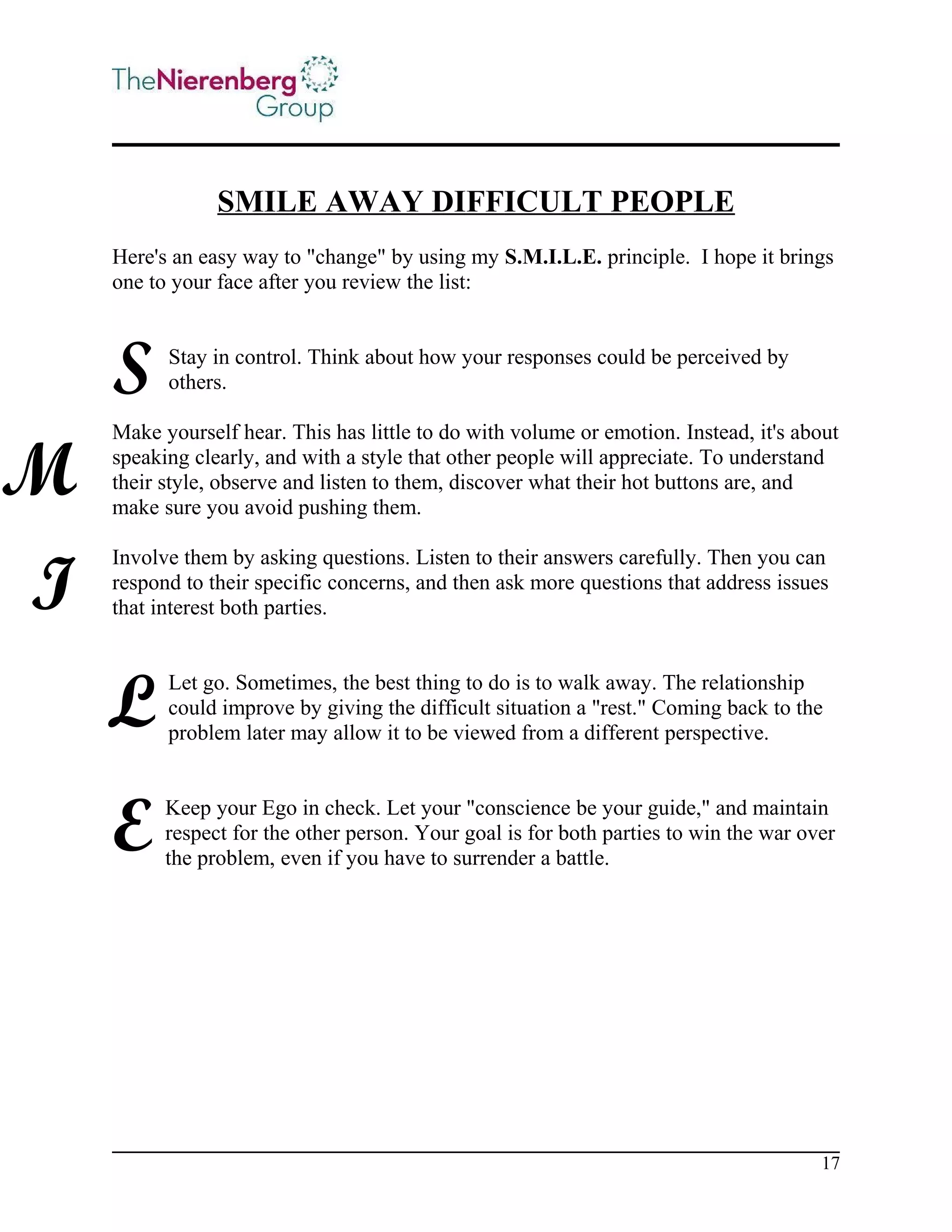
SMILE AWAY DIFFICULT PEOPLE
Here's an easy way to "change" by using my S.M.I.L.E. principle. I hope it brings
one to your face after you review the list:

S
M
I

Stay in control. Think about how your responses could be perceived by
others.

Make yourself hear. This has little to do with volume or emotion. Instead, it's about
speaking clearly, and with a style that other people will appreciate. To understand
their style, observe and listen to them, discover what their hot buttons are, and
make sure you avoid pushing them.
Involve them by asking questions. Listen to their answers carefully. Then you can
respond to their specific concerns, and then ask more questions that address issues
that interest both parties.

L

Let go. Sometimes, the best thing to do is to walk away. The relationship
could improve by giving the difficult situation a "rest." Coming back to the
problem later may allow it to be viewed from a different perspective.

E

Keep your Ego in check. Let your "conscience be your guide," and maintain
respect for the other person. Your goal is for both parties to win the war over
the problem, even if you have to surrender a battle.

17
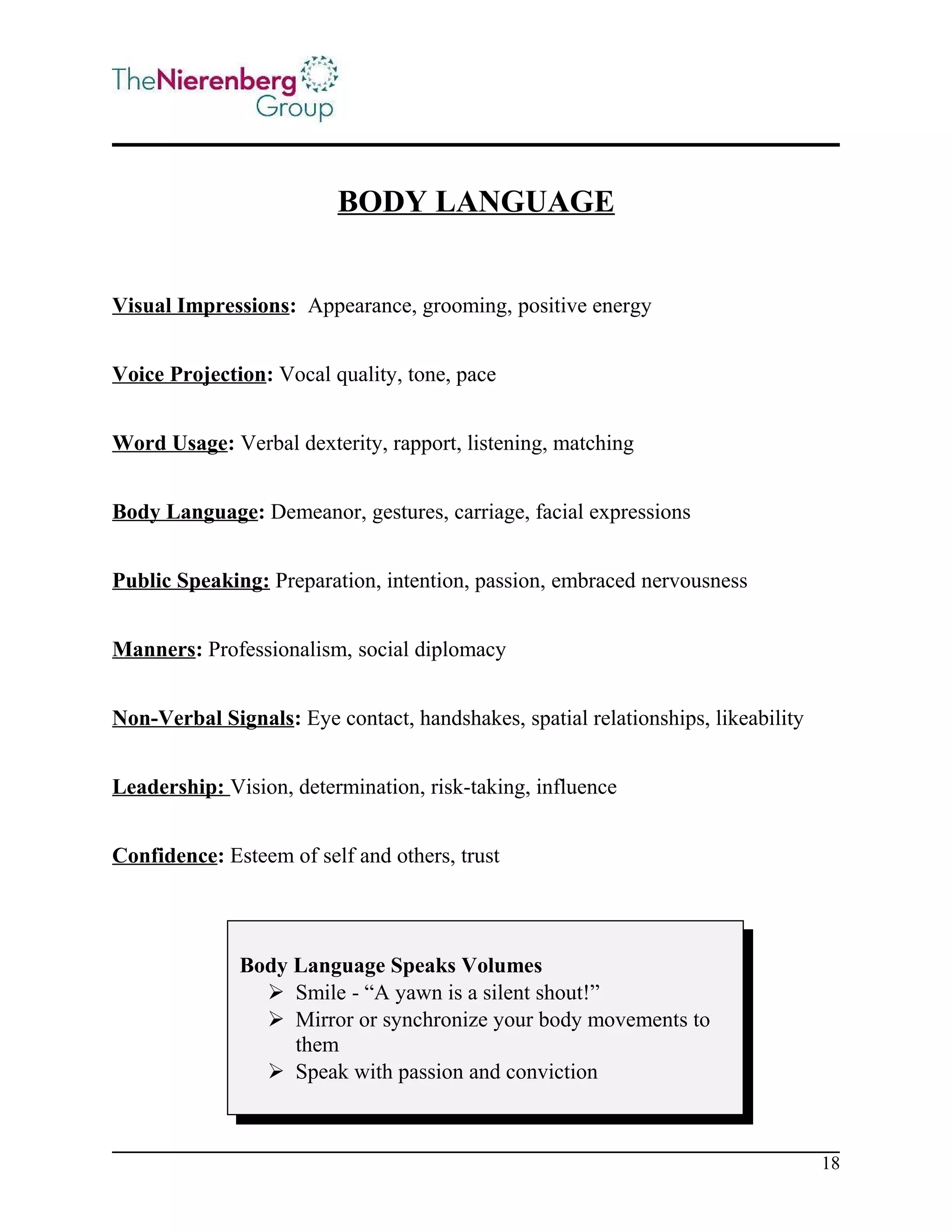
BODY LANGUAGE
Visual Impressions: Appearance, grooming, positive energy
Voice Projection: Vocal quality, tone, pace
Word Usage: Verbal dexterity, rapport, listening, matching
Body Language: Demeanor, gestures, carriage, facial expressions
Public Speaking: Preparation, intention, passion, embraced nervousness
Manners: Professionalism, social diplomacy
Non-Verbal Signals: Eye contact, handshakes, spatial relationships, likeability
Leadership: Vision, determination, risk-taking, influence
Confidence: Esteem of self and others, trust

Body Language Speaks Volumes
 Smile - “A yawn is a silent shout!”
 Mirror or synchronize your body movements to
them
 Speak with passion and conviction

18
INTERPRET THE MESSAGE
WORDS
Words themselves have little meaning. They are merely vehicles for the thoughts
and feelings of the speaker. Words are not actual experience, but a means of
explaining experiences. It is people who give meaning to words.
FILTERS
Both listeners and speakers have filters, which help or hinder the interpreting
process. These filters are in our brains “data base,” and they attach personal
meaning to information as it is presented. Some examples of filters include the
following; can you add others?
memories
current attention span
language and vocabulary
perceptions
past experiences
needs and motives
biases
values
age
attitudes
knowledge and intelligence
sensory acuity
expectations
feelings
assumptions
emotional hot-buttons
TONE OF VOICE
Voice conveys approximately 30 percent of the meaning of a message. Voices can
be insistent, pleading, questioning, whining, demanding, etc. Tom speaks in a
quiet monotone. Even though he is intelligent, his voice lacks conviction, and
people don’t take him seriously.
NONVERBAL CUES
A nonverbal cue, or body language, is a message sent by such things as a speaker’s
gestures, facial expressions, eyes and posture. Good listeners interpret a speaker’s
nonverbal feedback through five channels: ears, eyes, heart, mind and intuition.
Nonverbal cues, along with tone of voice, confirm or deny the message of the
words. More than half of most human interaction is through nonverbal
communication.

19
LEADERSHIP SKILLS FOR MANAGERS
 Make others feel important ― emphasize their strengths and Contributions
 Promote a vision ― let people know where you’re leading them and how
that goal is valuable to them.
 Follow the Platinum Rule ― talk to your people in their language.
Understand the way to communicate with them.
 Admit mistakes― It’s the secure person who can do this and will in effect
create more loyalty.
 Criticize only in private ― Public praise encourages others to excel-however criticism only embarrasses and alienates
 Stay close to the Action ― Be visible to the members of your team. Talk to
them, visit their offices, ask questions and observe how business is being
handled.
 Create a healthy competition ― it’s valuable when used correctly. Set team
goals, and rewards. Examine your setback and celebrate your group’s
successes.

20
MANAGEMENT BY DELEGATION
 Stress Results ― empower them to do the day to day and deliver results.
 Enlist Creative Thinking ― teach your people how to solve their challenges.
In the long run, this saves time and money.
 Turn Questions Around ― ask for possible solutions and answers.
 Establish Measurable and Concrete Objectives ― be both clear and specific.
Think of creating a plan like a road map.
 Give Realistic and Firm Deadlines ― encourage accountability.
 Keep a Delegation Log ― know who you’re delegating to and write it down.
You’re then able to monitor progress.
 Recognize the Talents and Personalities ― become a good coach. You have
to know what projects each person can handle and what they can’t.

21
SKILLS TO IMPROVE CONVERSATION
 The Benefits of Pausing
 Ask Questions
 Paraphrase the Speaker's Words
 Demonstrate Attentiveness
 Listening Builds Trust
 Listening Develops Discipline

CLIENT-PROSPECT PROFILE
Topics to Learn Over Time
 Name
 Company/Firm
 Phones-Company, Home and Cell
 Assistant’s Name
 Address—Work and Home
 Job Promotions/Moves
 Professional Associations
 Active in Community
 Birthday
 Education-High School, College, Degrees

22
 Fraternity or Sorority, Military Service

23
 What they said when you ask them: “Why do you work with me?” or “Why
do you give to our cause?”
 Hobbies/Interests
 Favorite Foods/Restaurants
 How do you receive your information and news—online or print editions
 Vacation Interests
 Spouse name and occupation and interests
 Children—names and education-schools, interest
 Pets
 Preferred method of communication-email/phone/text/--other
 Special Holidays
 Who you refer to them
 Who they refer you to
 His or her immediate business objective
 What kind of personality or communication style does this person have:
– Dominant, Expressive, Amiable, Analytical
 How you met
 Specific Likes
 Specific Dislikes
 Previous Work experience and business background
 Anniversary of doing business together
 Professional Organizations
 Clubs or other special interests
 Know what ‘motivates’ them
 Any achievement about this person that you know that makes them proud
 Ask for their advice and information given
24
 How you have handled any problems that have arisen with their account
 How do you like to receive your news? Internet; print; media; etc?

5 DRIVERS FOR NETWORKING
SUCCESS



Meet People and Nurture Your Networks



Listen and Learn



Create Advocacy



Follow Up with a Plan



Stay in Touch Creatively

25
ACTION PLAN
TODAY,
As a result of today’s session, I have learned my key strengths are:

As a result of today’s session, I will work on:
Goal #1

Goal #2

As a result of today’s session, I want to learn more about:
Goal #1

Goal #2

As a result of today’s session, an exercise I will commit to practice is:

26
I WILL REEVALUATE MY PROGRESS IN 3 MONTHS, ON:

27
ACTION PLAN - 3 MONTH UPDATE
As a result of the workshop on

, I have made progress on:

1. Capitalizing on my key strengths:

2. Taking steps towards my goals:
Goal #1

Goal #2

3. Continuing to find additional resources for:
Goal #1

Goal #2

Evaluate your experience practicing your chosen exercise and decide if you want
to continue with it, or select another to practice:

28
MY NEXT PROGRESS REVIEW WILL BE:

29

Building your personal brand with everyday communication skills

  • 1.
    Communication Skills as You BuildYour Personal Brand © 2013, Nierenberg Consulting Group All rights reserved, worldwide. 420 East 51St. Street, Suite 12d New York, NY 10022 www.nierenberggroup.com Cell: 917 626 8494 Email: andrea@NierenbergGroup.com
  • 3.
    AHAS Your Take Awaysand Reminders of What You Know 1. 2. 3. 4. 5. 6. 7. 8. 9. 10. 2
  • 4.
    THE ART OFPERSUASION  Talk in “word pictures.” Tune into all of the senses and figure out which type of person your prospect is—audio, visual, or kinesthetic. Use words that take the prospect on a “mental journey.”  Talk with spice and variety in your voice, inflection, and pause. Enthusiasm— means “I am sold myself!”  Image counts and speaks volumes—make a good first impression. Your posture and movement say a lot about your self-confidence, energy and personality. Smile—and shake hands firmly—confidence projects—even on the phone.  Build rapport through body language and gestures.  Adopt an assumptive attitude—“When we go forward….”  Show a future need— “As the business grows, you’ll want this….”  Pinpoint buying style: “How did you decide in the past…?”  Restate the prospect’s statement to show empathy; “I understand how you feel at this time, however….” — (feel, felt, found theory) 3
  • 5.
    STRATEGIES TO PROPOSENEW IDEAS AND RECOMMENDATIONS When you present an idea to a client you have 3 things going in your favor:  Your research, planning and preparation  Your ability to ask high gain, open ended questions  Your ability to LISTEN Why does someone buy from Baccarat? They see the benefits.  Anticipate objections  Discuss options  Re-focus benefits  Always get a commitment or an answer with each point you make. Bring closure and stop. 4
  • 6.
    YOUR PRESENTATION  Limit yourown talking.  Put yourself in their shoes.  Ask open-ended questions.  Hold your thought—don’t interrupt.  Use positive interjections.  Use persuasive, positive selling words.  Body Language—Be Present THE SKILL OF QUESTIONING Develop the Art and Skill of Continual Questioning  Questions are like a road map…  You can’t get the right answers if you don’t ask questions.  The most powerful words in selling: “What Do You Think? 5
  • 7.
    POWERFUL QUESTIONS  Be preparedto answer all questions  Questions are opportunities to move forward How to Prepare for Questions:  Before your sales presentation, ask yourself all the questions you think could be asked, then review the answers.  Be 150% PREPARED! How to Answer Questions:  Listen. Make sure you understand the question. Look at the person who is asking it.  Pause and think before speaking.  Repeat the question if you need to clarify.  Keep your tone and style of delivery even.  Give reasons and examples to support your answers.  Summarize your points. 6
  • 8.
    STEPS TO CLOSINGTHE SALE  Get your prospect to say “yes”. As you talk to a prospect, ask questions that he or she will answer “yes” to. This helps to establish the right frame of mind. (Minor agreement.)  Keep digging for reasons behind your prospect’s objections. Probe and question your prospect. To every objection ask “tell me more”. Tell me what the ideal situation would be.  Find out what the client wants. Show him or her how Baccarat is the right product line.  Sell benefits, not features.  Concentrate on a single point.  Know when to stop. Many sales are lost because the salesperson keeps talking past the point where the prospect is willing to buy. Learn how to read people and recognize when they’re ready.  Surround the account. Enlist the support of the people who make final decisions. Surround the account—get to know all people who make the decisions.  Be persistent. Keep building and developing the relationship with the prospect and client.  Close the sale. Always be asking for the next step….  Stay in touch. Stress the benefits to them. The relationship has just begun. 7
  • 9.
    WHY WE DON’THEAR OTHERS  When you want to listen so you really hear what others say, make sure you’re not a:  Mind reader. You’ll hear little or nothing as you think, “What is this person really thinking or feeling?”  Rehearser. Your mental tryouts for “Here’s what I’ll say next time” tune out the speaker.  Filterer. Some call this selective listening—hearing only what you want to hear.  Dreamer. Drifting off during face-to-face or telephone conversation can lead to an embarrassing “What did you say?” or “Could you repeat that?”  Identifier. If you refer everything you hear to your experience, you probably didn’t really hear what was said.  Comparer. When you get sidetracked assessing the messenger, you’re sure to miss the message.  Derailer. Changing the subject too quickly soon tells others you’re not interested in anything they have to say.  Placater. Agreeing with everything you hear just to be nice or to avoid conflict does not mean you are a good listener. 8
  • 10.
    LISTENING GUIDES Do: Clear yourmind of distractions. Do: Observe non-verbal messages. Do: Wait until the speaker stops before you respond. Do: Listen for meaning. Do: Listen for what is not being said. Do: Ask as many questions as necessary to understand a speaker’s message. Do: Look directly at the speaker. Do: Take notes if it helps you concentrate. Do: Say you don’t understand if you need more clarification. Do: Relate your responses to what the speaker has said. Do: Respond non-verbally until the speaker finishes. 9
  • 11.
    COMMUNICATION STYLES Find yournatural or primary communication style below. Even though you have one dominant style, you use all styles, some more than others. On a 1-4 scale, with 1 being your Primary style, and 4 being the style you use the least rate the following: Expressive Rating: ____ You are animated, energetic, and spontaneous. You easily communicate your ideas, sometimes throwing out half-formed ideas to gather more input. You enjoy involving people. You like variety, are curious and sometimes impulsive. You could overlook details. People say you are expressive, innovative, persuasive and outgoing. Amiable Rating: _____ You are empathetic, sympathetic and friendly. You have a warm tone of voice and frequently show concern for the people for whom you work. You are very steady and caring. You are good at anticipating people’s needs. You are often described as being patient, controlled, concerned and cooperative. Analytical Rating: _____ You live in the world of the mind and like to keep your ideas private. You are quite deliberate. When solving a problem you like to weigh each alternative and consider all the facts. You are organized and systematic. You tend toward perfectionism. You are detail oriented, thorough and orderly. Driver Rating: _____ You are a possibilities thinker. You value action, get impatient, and are easily bored. You are results oriented. It is relatively easy for you to make decisions and take calculated risks. You do not like to spend time considering a lot of alternatives. People say you have a lot of drive, make a good leader, and are assertive and outspoken. 10
  • 12.
    Driver  Be brief,get to the point quickly, and be clear and specific.  Stick to business. Come prepared, be well organized and have support material that you may never open.  Start with WIIFM—for him/her personally and professionally.  Be sure of yourself, be firm.  Present the facts logically and plan to be concise and efficient.  Hit quick and hard—he buys on impulse.  Bottom line the facts.  If you disagree, take issue with the facts, not the person.  Close by asking for action on his part.  Be ready to deliver on short notice.  After talking business, depart graciously.  Mailings and more material are a waste. Expressive  Plan interaction that supports their feelings and intuitions. Use time to be stimulating. Be sociable—but keep on track.  He likes the new and novel—make things exciting.  He likes special attention.  He likes to talk about himself, his work, style of life.  Let him talk—yet keep things moving logically.  Do not deal with extensive verbal details, he will not remember. Put them in writing.  Ask his opinion.  Be prepared—he will interrupt. 11
  • 13.
     He likesvisual aides. 12
  • 14.
    Amiable  Sell yourselffirst. You must win him as a friend first.  Show sincere interest in him as a person. Find areas of common interest and agreement.  Patiently draw out his expectations and work with them.  Present your case softly and without threat.  Ask “how” questions.  Do not push.  Let him move at his own pace.  He is possessive.  He will want assurances that all promises will be kept.  Make sure the closing of your visit is a logical, natural conclusion of the conversation. Analytical  Plan your work and work your plan. Use time to be accurate.  Approach him in a straightforward, direct but low key way.  Support his logical, methodical approach. Build your credibility by listing Pros and Cons to the subject.  Use comparative data and expectations to be derived.  Be sure you answer all of his questions—those he does ask and those he only ponders to himself.  Handle all objections completely.  You must continually verify that you have answered all of his questions/objections because he will be very slow to come to a decision.  Appeal to his sense of logic.  His extreme caution will make him want quality, reliability and precedent for his actions.  He wants time to think and consult with others. 13
  • 15.
     He isa low risk taker—wants guarantees and an escape hatch.  He is interested in research and statistics. 14
  • 16.
  • 17.
    SKILL FOR SUCCESS—YOUHOLD THE POWER The first thing people notice when you walk into a meeting is your overall image. Within less than 9 seconds they have already made an impression of you and created opinions. Statistics tell us that first impressions are right 67% of the time. Studies show how these first impressions are made up of three basic categories: Visual Verbal Non-verbal 1. Visual: how you look, stand & carry yourself 55% 2. Non-verbal: tone of voice, attitude. 38% 3. Verbal (your actual words) 7% (Listening) 16
  • 18.
    SMILE AWAY DIFFICULTPEOPLE Here's an easy way to "change" by using my S.M.I.L.E. principle. I hope it brings one to your face after you review the list: S M I Stay in control. Think about how your responses could be perceived by others. Make yourself hear. This has little to do with volume or emotion. Instead, it's about speaking clearly, and with a style that other people will appreciate. To understand their style, observe and listen to them, discover what their hot buttons are, and make sure you avoid pushing them. Involve them by asking questions. Listen to their answers carefully. Then you can respond to their specific concerns, and then ask more questions that address issues that interest both parties. L Let go. Sometimes, the best thing to do is to walk away. The relationship could improve by giving the difficult situation a "rest." Coming back to the problem later may allow it to be viewed from a different perspective. E Keep your Ego in check. Let your "conscience be your guide," and maintain respect for the other person. Your goal is for both parties to win the war over the problem, even if you have to surrender a battle. 17
  • 19.
    BODY LANGUAGE Visual Impressions:Appearance, grooming, positive energy Voice Projection: Vocal quality, tone, pace Word Usage: Verbal dexterity, rapport, listening, matching Body Language: Demeanor, gestures, carriage, facial expressions Public Speaking: Preparation, intention, passion, embraced nervousness Manners: Professionalism, social diplomacy Non-Verbal Signals: Eye contact, handshakes, spatial relationships, likeability Leadership: Vision, determination, risk-taking, influence Confidence: Esteem of self and others, trust Body Language Speaks Volumes  Smile - “A yawn is a silent shout!”  Mirror or synchronize your body movements to them  Speak with passion and conviction 18
  • 20.
    INTERPRET THE MESSAGE WORDS Wordsthemselves have little meaning. They are merely vehicles for the thoughts and feelings of the speaker. Words are not actual experience, but a means of explaining experiences. It is people who give meaning to words. FILTERS Both listeners and speakers have filters, which help or hinder the interpreting process. These filters are in our brains “data base,” and they attach personal meaning to information as it is presented. Some examples of filters include the following; can you add others? memories current attention span language and vocabulary perceptions past experiences needs and motives biases values age attitudes knowledge and intelligence sensory acuity expectations feelings assumptions emotional hot-buttons TONE OF VOICE Voice conveys approximately 30 percent of the meaning of a message. Voices can be insistent, pleading, questioning, whining, demanding, etc. Tom speaks in a quiet monotone. Even though he is intelligent, his voice lacks conviction, and people don’t take him seriously. NONVERBAL CUES A nonverbal cue, or body language, is a message sent by such things as a speaker’s gestures, facial expressions, eyes and posture. Good listeners interpret a speaker’s nonverbal feedback through five channels: ears, eyes, heart, mind and intuition. Nonverbal cues, along with tone of voice, confirm or deny the message of the words. More than half of most human interaction is through nonverbal communication. 19
  • 21.
    LEADERSHIP SKILLS FORMANAGERS  Make others feel important ― emphasize their strengths and Contributions  Promote a vision ― let people know where you’re leading them and how that goal is valuable to them.  Follow the Platinum Rule ― talk to your people in their language. Understand the way to communicate with them.  Admit mistakes― It’s the secure person who can do this and will in effect create more loyalty.  Criticize only in private ― Public praise encourages others to excel-however criticism only embarrasses and alienates  Stay close to the Action ― Be visible to the members of your team. Talk to them, visit their offices, ask questions and observe how business is being handled.  Create a healthy competition ― it’s valuable when used correctly. Set team goals, and rewards. Examine your setback and celebrate your group’s successes. 20
  • 22.
    MANAGEMENT BY DELEGATION Stress Results ― empower them to do the day to day and deliver results.  Enlist Creative Thinking ― teach your people how to solve their challenges. In the long run, this saves time and money.  Turn Questions Around ― ask for possible solutions and answers.  Establish Measurable and Concrete Objectives ― be both clear and specific. Think of creating a plan like a road map.  Give Realistic and Firm Deadlines ― encourage accountability.  Keep a Delegation Log ― know who you’re delegating to and write it down. You’re then able to monitor progress.  Recognize the Talents and Personalities ― become a good coach. You have to know what projects each person can handle and what they can’t. 21
  • 23.
    SKILLS TO IMPROVECONVERSATION  The Benefits of Pausing  Ask Questions  Paraphrase the Speaker's Words  Demonstrate Attentiveness  Listening Builds Trust  Listening Develops Discipline CLIENT-PROSPECT PROFILE Topics to Learn Over Time  Name  Company/Firm  Phones-Company, Home and Cell  Assistant’s Name  Address—Work and Home  Job Promotions/Moves  Professional Associations  Active in Community  Birthday  Education-High School, College, Degrees 22
  • 24.
     Fraternity orSorority, Military Service 23
  • 25.
     What theysaid when you ask them: “Why do you work with me?” or “Why do you give to our cause?”  Hobbies/Interests  Favorite Foods/Restaurants  How do you receive your information and news—online or print editions  Vacation Interests  Spouse name and occupation and interests  Children—names and education-schools, interest  Pets  Preferred method of communication-email/phone/text/--other  Special Holidays  Who you refer to them  Who they refer you to  His or her immediate business objective  What kind of personality or communication style does this person have: – Dominant, Expressive, Amiable, Analytical  How you met  Specific Likes  Specific Dislikes  Previous Work experience and business background  Anniversary of doing business together  Professional Organizations  Clubs or other special interests  Know what ‘motivates’ them  Any achievement about this person that you know that makes them proud  Ask for their advice and information given 24
  • 26.
     How youhave handled any problems that have arisen with their account  How do you like to receive your news? Internet; print; media; etc? 5 DRIVERS FOR NETWORKING SUCCESS  Meet People and Nurture Your Networks  Listen and Learn  Create Advocacy  Follow Up with a Plan  Stay in Touch Creatively 25
  • 27.
    ACTION PLAN TODAY, As aresult of today’s session, I have learned my key strengths are: As a result of today’s session, I will work on: Goal #1 Goal #2 As a result of today’s session, I want to learn more about: Goal #1 Goal #2 As a result of today’s session, an exercise I will commit to practice is: 26
  • 28.
    I WILL REEVALUATEMY PROGRESS IN 3 MONTHS, ON: 27
  • 29.
    ACTION PLAN -3 MONTH UPDATE As a result of the workshop on , I have made progress on: 1. Capitalizing on my key strengths: 2. Taking steps towards my goals: Goal #1 Goal #2 3. Continuing to find additional resources for: Goal #1 Goal #2 Evaluate your experience practicing your chosen exercise and decide if you want to continue with it, or select another to practice: 28
  • 30.
    MY NEXT PROGRESSREVIEW WILL BE: 29