Presented by Tania Aslam
“If speaking is silver, then listening is gold.”
                 Turkish Proverb
Hearing Vs Listening
 Do not get confused between hearing and listening.
 Hearing: If you are not deaf, then you hear. It is
 simply the act of perceiving sound by the ear. If you
 are not hearing-impaired, hearing simply happens

 Listening: includes paying real attention and
 focusing with the intention of understanding and
 responding appropriately.
 Listening requires concentration so that your brain
 processes meaning from words and sentences.
 Listening leads to learning.
"We were given two ears but only one mouth.
 This is because God knew that listening was
           twice as hard as talking.“
BARRIERS TO LISTENING
 Environmental
    Adverse conditions like hot weather
 Semantic
    Speaker’s style of speaking & mannerisms.
    Use of difficult words, jargon & repetition.
 Personal
    Fear, Anger & Anxiety.
    Boredom
    Beliefs, Attitudes and Pre-conceived Ideas.
    Hunger ,Tiredness & Pain.
 Socio-Cultural
    Different cultural backgrounds – personal space, sense of
     time, etc.
Essential Listening Skills
 Focus
 Be Able to read one's emotional state
 Ask questions
 Show that you are listening
 Listen to your Customer Point of View
 Listen with your Eyes
Essential Listening Skills
Focus
     Accept that listening is hard work.
     Prepare to listen & have a positive attitude.
     Start with an open mind
     Focus and listen carefully to what the speaker has to say.
      Don't get distracted by what's happening around you. The
      speakers tone and accent. The kind of words being used
      and the way he is behaving

Remember:
 “You cannot truly listen to anyone and do anything else
                     at the same time.”
                                               - M. Scott Peck
Essential Listening Skills
Listen with your Eyes and Heart
   Attention on not only what is being said, but also the
    manner in which it is being said, should be noted
   Recognize that people communicate on many levels.
    Watch their facial expressions, eye contact, posture,
    hand and feet movements, body movement and
    placement, and appearance and passage as they walk
    toward you. Every gesture is communicating something
    if you listen with your eyes.
Remember:
   “The most important thing in communication is
               hearing what isn't said.”
                                           Peter F. Drucker
Essential Listening Skills
Ask Questions
   To seek information and gather facts and rationale
   Be patient. Don't interrupt the speaker. This is
    disrespectful and suggests you want to talk instead of
    listen. Be courteous and allow plenty of time for the
    speaker to convey ideas and meaning.
   Use a language that is acceptable and will help you
    gather data. Do not jump the gun, Assumptions are
    dangerous
   Hold your tongue & delay judgment.

Remember:
  "We do not grow by knowing all of the answers, but
          rather by living with the questions."
                                           — Max De Pree
Essential Listening Skills
Show that you are Listening
   Maintaining eye contact with the speaker
   Using effective body language to convey attentiveness
   Keeping hands at side and not folded
   Nodding to indicate approval or recognition
   Leaning toward the speaker to indicate interest in the
    content
   Showing empathy for the speaker
   Taking notes on the information

Remember:
"You learn when you listen. You earn when you listen—
             not just money, but respect."
                                         — Harvey Mackay
Essential Listening Skills
Listen to your Customer Point of View
   By understanding things from the customer's point of
    view
   People don't buy what you wish to sell. They buy what
    they need. Selling is not happening when you are
    talking. Selling is happening when your prospect is
    talking, and you are listening actively and passionately.

Remember:
  "A bore is a person who talks when you wish him to
                         listen."
                                            Ambrose Bierce
Essential Listening Skills
Listen with your Eyes
 An authority on nonverbal language says that 55 percent
 of the message meaning is nonverbal, 38 percent is
 indicated by tone of voice, and only 7 percent is conveyed
 by the words used in a spoken message. Few people know
 how to listen to the eyes; what a tapping foot means; a
 furrowed brow; clenched fist; the biting of nails. These
 often reveal the key feelings behind the words.
Remember:
     “Words have no meaning - People have
             meaning." Larry Barker
Ten Commandments of Effective
Listening
1.   Stop talking! You cannot listen when you are talking.
     You will only be thinking about what you are going to
     say next instead of paying attention to what the other
     person is trying to say.

2. Put the speaker at ease: Relax, smile, look at the
     speaker and help that person feel free to talk. Look
     and act interested. Remove distractions: playing with
     papers on table etc

3. Pay attention to the nonverbal language of physical
     gestures, facial expressions, tone of voice, and body
     posture.
Ten Commandments of Effective
Listening
4. Listen for what is not said. Ask questions to clarify the
   meaning of words and the feelings involved, or ask the
   speaker to enlarge on the statement. People often find
   it difficult to speak up about matters or experiences
   that are very important or highly emotional for them.

5. Know exactly what the other person is saying. Reflect
   back what the other person has said in a "shared
   meaning" experience so you completely understand
   the meaning and content of the message before you
   reply to it. A good listener does not assume they
   understand the other person. You, as the listener,
   should not express your views until you have
   summarized the speaker's message to his satisfaction.
Ten Commandments of Effective
Listening
6. Be aware of "tune out" words. These are words which
     appear in the media that strike an emotional chord in
     the listener and interferes with attentive listening (e.g.
     abortion, nuclear war, communism, homosexuality).
     Avoid arguing mentally.
7. Concentrate on "hidden" emotional meanings. What
     are the real feelings behind the words? What is the
     tone of voice saying? What does the emphasis on
     certain words mean

8.    Be patient. Don't interrupt the speaker. This is
     disrespectful and suggests you want to talk instead of
     listen. Be courteous and allow plenty of time for the
     speaker to convey ideas and meaning.
Ten Commandments of Effective
Listening
9. Hold your temper! Try to keep your own emotions
   from interfering with your listening efficiency. When
   emotions are high, there is a tendency to tune out the
   speaker, become defensive, or want to give advice. You
   don't have to agree to be a good listener. Don't argue!
   Even if you win, you lose.

10. Empathize with the speaker. Try to "walk in the other's
   moccasins" so you can feel what that person is feeling
   and understand the point of view the speaker is trying
   to convey.
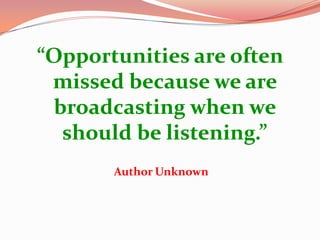
“Opportunities are often
 missed because we are
 broadcasting when we
  should be listening.”
       Author Unknown

Effective listening

  • 1.
  • 2.
    “If speaking issilver, then listening is gold.” Turkish Proverb
  • 3.
    Hearing Vs Listening Do not get confused between hearing and listening. Hearing: If you are not deaf, then you hear. It is simply the act of perceiving sound by the ear. If you are not hearing-impaired, hearing simply happens Listening: includes paying real attention and focusing with the intention of understanding and responding appropriately. Listening requires concentration so that your brain processes meaning from words and sentences. Listening leads to learning.
  • 4.
    "We were giventwo ears but only one mouth. This is because God knew that listening was twice as hard as talking.“
  • 5.
    BARRIERS TO LISTENING Environmental  Adverse conditions like hot weather  Semantic  Speaker’s style of speaking & mannerisms.  Use of difficult words, jargon & repetition.  Personal  Fear, Anger & Anxiety.  Boredom  Beliefs, Attitudes and Pre-conceived Ideas.  Hunger ,Tiredness & Pain.  Socio-Cultural  Different cultural backgrounds – personal space, sense of time, etc.
  • 6.
    Essential Listening Skills Focus  Be Able to read one's emotional state  Ask questions  Show that you are listening  Listen to your Customer Point of View  Listen with your Eyes
  • 7.
    Essential Listening Skills Focus  Accept that listening is hard work.  Prepare to listen & have a positive attitude.  Start with an open mind  Focus and listen carefully to what the speaker has to say. Don't get distracted by what's happening around you. The speakers tone and accent. The kind of words being used and the way he is behaving Remember: “You cannot truly listen to anyone and do anything else at the same time.” - M. Scott Peck
  • 8.
    Essential Listening Skills Listenwith your Eyes and Heart  Attention on not only what is being said, but also the manner in which it is being said, should be noted  Recognize that people communicate on many levels. Watch their facial expressions, eye contact, posture, hand and feet movements, body movement and placement, and appearance and passage as they walk toward you. Every gesture is communicating something if you listen with your eyes. Remember: “The most important thing in communication is hearing what isn't said.” Peter F. Drucker
  • 9.
    Essential Listening Skills AskQuestions  To seek information and gather facts and rationale  Be patient. Don't interrupt the speaker. This is disrespectful and suggests you want to talk instead of listen. Be courteous and allow plenty of time for the speaker to convey ideas and meaning.  Use a language that is acceptable and will help you gather data. Do not jump the gun, Assumptions are dangerous  Hold your tongue & delay judgment. Remember: "We do not grow by knowing all of the answers, but rather by living with the questions." — Max De Pree
  • 10.
    Essential Listening Skills Showthat you are Listening  Maintaining eye contact with the speaker  Using effective body language to convey attentiveness  Keeping hands at side and not folded  Nodding to indicate approval or recognition  Leaning toward the speaker to indicate interest in the content  Showing empathy for the speaker  Taking notes on the information Remember: "You learn when you listen. You earn when you listen— not just money, but respect." — Harvey Mackay
  • 11.
    Essential Listening Skills Listento your Customer Point of View  By understanding things from the customer's point of view  People don't buy what you wish to sell. They buy what they need. Selling is not happening when you are talking. Selling is happening when your prospect is talking, and you are listening actively and passionately. Remember: "A bore is a person who talks when you wish him to listen." Ambrose Bierce
  • 12.
    Essential Listening Skills Listenwith your Eyes  An authority on nonverbal language says that 55 percent of the message meaning is nonverbal, 38 percent is indicated by tone of voice, and only 7 percent is conveyed by the words used in a spoken message. Few people know how to listen to the eyes; what a tapping foot means; a furrowed brow; clenched fist; the biting of nails. These often reveal the key feelings behind the words. Remember: “Words have no meaning - People have meaning." Larry Barker
  • 13.
    Ten Commandments ofEffective Listening 1. Stop talking! You cannot listen when you are talking. You will only be thinking about what you are going to say next instead of paying attention to what the other person is trying to say. 2. Put the speaker at ease: Relax, smile, look at the speaker and help that person feel free to talk. Look and act interested. Remove distractions: playing with papers on table etc 3. Pay attention to the nonverbal language of physical gestures, facial expressions, tone of voice, and body posture.
  • 14.
    Ten Commandments ofEffective Listening 4. Listen for what is not said. Ask questions to clarify the meaning of words and the feelings involved, or ask the speaker to enlarge on the statement. People often find it difficult to speak up about matters or experiences that are very important or highly emotional for them. 5. Know exactly what the other person is saying. Reflect back what the other person has said in a "shared meaning" experience so you completely understand the meaning and content of the message before you reply to it. A good listener does not assume they understand the other person. You, as the listener, should not express your views until you have summarized the speaker's message to his satisfaction.
  • 15.
    Ten Commandments ofEffective Listening 6. Be aware of "tune out" words. These are words which appear in the media that strike an emotional chord in the listener and interferes with attentive listening (e.g. abortion, nuclear war, communism, homosexuality). Avoid arguing mentally. 7. Concentrate on "hidden" emotional meanings. What are the real feelings behind the words? What is the tone of voice saying? What does the emphasis on certain words mean 8. Be patient. Don't interrupt the speaker. This is disrespectful and suggests you want to talk instead of listen. Be courteous and allow plenty of time for the speaker to convey ideas and meaning.
  • 16.
    Ten Commandments ofEffective Listening 9. Hold your temper! Try to keep your own emotions from interfering with your listening efficiency. When emotions are high, there is a tendency to tune out the speaker, become defensive, or want to give advice. You don't have to agree to be a good listener. Don't argue! Even if you win, you lose. 10. Empathize with the speaker. Try to "walk in the other's moccasins" so you can feel what that person is feeling and understand the point of view the speaker is trying to convey.
  • 17.
    “Opportunities are often missed because we are broadcasting when we should be listening.” Author Unknown