Lexicon Networks
Communication and Presentation Skills
Rohit Bohra
What is Communication ????
Communication is simply a two way process of exchanging
ideas, information or transmitting verbal and non-verbal
messages.
Effective Communication
Effective Communication leads to Productive relationship
We communicate to…
 Get information
 Motivate
 Praise
 Get feedback
 Sell
 Greet
 Etc.
Barriers To Communication
 Premature evaluation
 Inattention
 Assumption
 Poor listening skills
 Low self confidence
 Ignoring information contrary to our belief
 Emotions
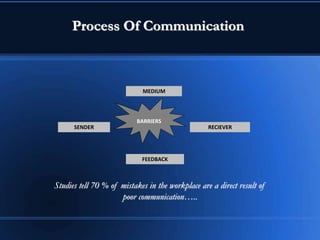
Process Of Communication
SENDER
MEDIUM
RECIEVER
FEEDBACK
BARRIERS
Studies tell 70 % of mistakes in the workplace are a direct result of
poor communication…..
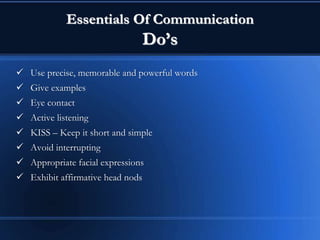
Essentials Of Communication
Do’s
 Use precise, memorable and powerful words
 Give examples
 Eye contact
 Active listening
 KISS – Keep it short and simple
 Avoid interrupting
 Appropriate facial expressions
 Exhibit affirmative head nods
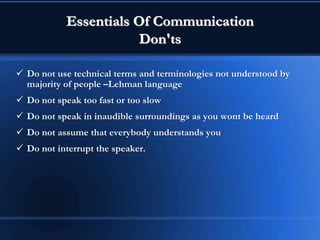
Essentials Of Communication
Don'ts
 Do not use technical terms and terminologies not understood by
majority of people –Lehman language
 Do not speak too fast or too slow
 Do not speak in inaudible surroundings as you wont be heard
 Do not assume that everybody understands you
 Do not interrupt the speaker.
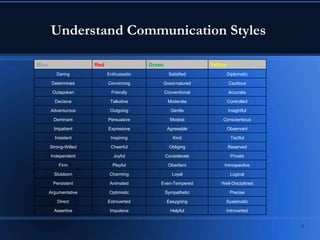
Blue Red Green Yellow
Daring Enthusiastic Satisfied Diplomatic
Determined Convincing Good-natured Cautious
Outspoken Friendly Conventional Accurate
Decisive Talkative Moderate Controlled
Adventurous Outgoing Gentle Insightful
Dominant Persuasive Modest Conscientious
Impatient Expressive Agreeable Observant
Insistent Inspiring Kind Tactful
Strong-Willed Cheerful Obliging Reserved
Independent Joyful Considerate Private
Firm Playful Obedient Introspective
Stubborn Charming Loyal Logical
Persistent Animated Even-Tempered Well-Disciplined
Argumentative Optimistic Sympathetic Precise
Direct Extroverted Easygoing Systematic
Assertive Impulsive Helpful Introverted
Understand Communication Styles
8
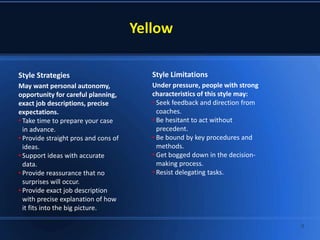
Style Strategies
May want personal autonomy,
opportunity for careful planning,
exact job descriptions, precise
expectations.
• Take time to prepare your case
in advance.
• Provide straight pros and cons of
ideas.
• Support ideas with accurate
data.
• Provide reassurance that no
surprises will occur.
• Provide exact job description
with precise explanation of how
it fits into the big picture.
Style Limitations
Under pressure, people with strong
characteristics of this style may:
• Seek feedback and direction from
coaches.
• Be hesitant to act without
precedent.
• Be bound by key procedures and
methods.
• Get bogged down in the decision-
making process.
• Resist delegating tasks.
9
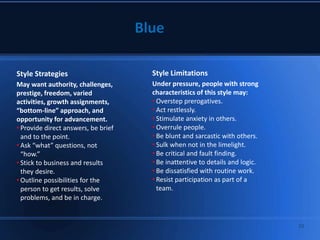
Style Strategies
May want authority, challenges,
prestige, freedom, varied
activities, growth assignments,
“bottom-line” approach, and
opportunity for advancement.
• Provide direct answers, be brief
and to the point.
• Ask “what” questions, not
“how.”
• Stick to business and results
they desire.
• Outline possibilities for the
person to get results, solve
problems, and be in charge.
Style Limitations
Under pressure, people with strong
characteristics of this style may:
• Overstep prerogatives.
• Act restlessly.
• Stimulate anxiety in others.
• Overrule people.
• Be blunt and sarcastic with others.
• Sulk when not in the limelight.
• Be critical and fault finding.
• Be inattentive to details and logic.
• Be dissatisfied with routine work.
• Resist participation as part of a
team.
10
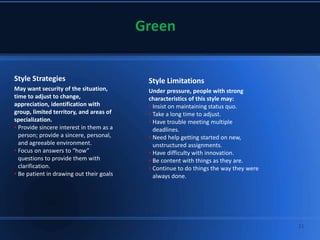
Style Strategies
May want security of the situation,
time to adjust to change,
appreciation, identification with
group, limited territory, and areas of
specialization.
• Provide sincere interest in them as a
person; provide a sincere, personal,
and agreeable environment.
• Focus on answers to “how”
questions to provide them with
clarification.
• Be patient in drawing out their goals.
Style Limitations
Under pressure, people with strong
characteristics of this style may:
• Insist on maintaining status quo.
• Take a long time to adjust.
• Have trouble meeting multiple
deadlines.
• Need help getting started on new,
unstructured assignments.
• Have difficulty with innovation.
• Be content with things as they are.
• Continue to do things the way they were
always done.
11
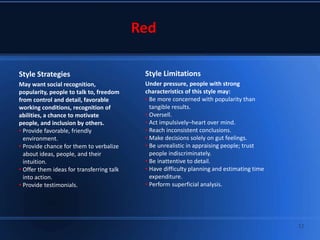
Style Strategies
May want social recognition,
popularity, people to talk to, freedom
from control and detail, favorable
working conditions, recognition of
abilities, a chance to motivate
people, and inclusion by others.
• Provide favorable, friendly
environment.
• Provide chance for them to verbalize
about ideas, people, and their
intuition.
• Offer them ideas for transferring talk
into action.
• Provide testimonials.
Style Limitations
Under pressure, people with strong
characteristics of this style may:
• Be more concerned with popularity than
tangible results.
• Oversell.
• Act impulsively–heart over mind.
• Reach inconsistent conclusions.
• Make decisions solely on gut feelings.
• Be unrealistic in appraising people; trust
people indiscriminately.
• Be inattentive to detail.
• Have difficulty planning and estimating time
expenditure.
• Perform superficial analysis.
12
Written Communication
(Email Writing)
• Email should be short and crisp
• e-mail includes a courteous greeting and closing
• Grammer and punctuation should be correct
• Recheck twice for any spelling mistake
• Read your email out loud to ensure the tone is that which you desire
• Use words like (please ,,thanks)they go a long way
• Can=Could,,,,will= would, shall= should
• First complete the mail and then fill in receipts address
• CC,BCC
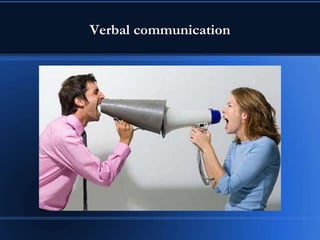
Verbal communication
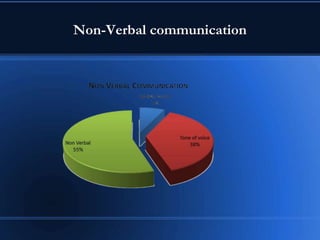
Non-Verbal communication
Non-Verbal Communication
Nonverbal Communication - all elements of communication that do not
involve words
Four basic types
1. Proxemics - an individual’s perception & use of space
2. Kinesics - study of body movements, including posture
3. Facial & Eye Behavior - movements that add cues for the
receiver
4. Paralanguage - variations in speech, such as pitch, loudness,
tempo, tone, duration, laughing, & crying
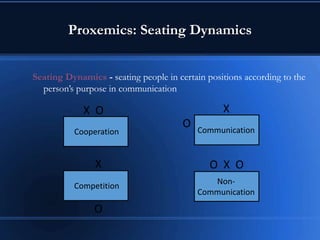
Proxemics: Seating Dynamics
Seating Dynamics - seating people in certain positions according to the
person’s purpose in communication
Cooperation
X O
Non-
Communication
O X O
Competition
X
O
X
Communication
O
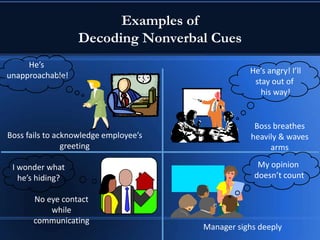
Examples of
Decoding Nonverbal Cues
Boss fails to acknowledge employee’s
greeting
No eye contact
while
communicating
Manager sighs deeply
Boss breathes
heavily & waves
arms
He’s
unapproachable!
My opinion
doesn’t count
I wonder what
he’s hiding?
He’s angry! I’ll
stay out of
his way!
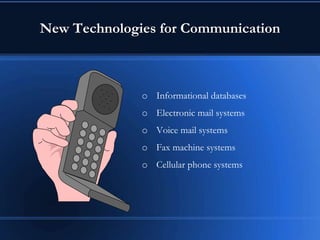
New Technologies for Communication
o Informational databases
o Electronic mail systems
o Voice mail systems
o Fax machine systems
o Cellular phone systems
Expectation from the technical team
• Listen and understand the customer points and thoughts
• Never interrupt in between
• The more the customer speaks, the more chance of conversion
• Never argue with the customer, move away from that point
• Body language should be confident- Prepare in advance
• The PPT should be made in a simple language, easy for the customer
to understand
• The communication should be clear n crisp
THANK YOU

Communication friday presentation 2

  • 1.
    Lexicon Networks Communication andPresentation Skills Rohit Bohra
  • 2.
    What is Communication???? Communication is simply a two way process of exchanging ideas, information or transmitting verbal and non-verbal messages.
  • 3.
    Effective Communication Effective Communicationleads to Productive relationship We communicate to…  Get information  Motivate  Praise  Get feedback  Sell  Greet  Etc.
  • 4.
    Barriers To Communication Premature evaluation  Inattention  Assumption  Poor listening skills  Low self confidence  Ignoring information contrary to our belief  Emotions
  • 5.
    Process Of Communication SENDER MEDIUM RECIEVER FEEDBACK BARRIERS Studiestell 70 % of mistakes in the workplace are a direct result of poor communication…..
  • 6.
    Essentials Of Communication Do’s Use precise, memorable and powerful words  Give examples  Eye contact  Active listening  KISS – Keep it short and simple  Avoid interrupting  Appropriate facial expressions  Exhibit affirmative head nods
  • 7.
    Essentials Of Communication Don'ts Do not use technical terms and terminologies not understood by majority of people –Lehman language  Do not speak too fast or too slow  Do not speak in inaudible surroundings as you wont be heard  Do not assume that everybody understands you  Do not interrupt the speaker.
  • 8.
    Blue Red GreenYellow Daring Enthusiastic Satisfied Diplomatic Determined Convincing Good-natured Cautious Outspoken Friendly Conventional Accurate Decisive Talkative Moderate Controlled Adventurous Outgoing Gentle Insightful Dominant Persuasive Modest Conscientious Impatient Expressive Agreeable Observant Insistent Inspiring Kind Tactful Strong-Willed Cheerful Obliging Reserved Independent Joyful Considerate Private Firm Playful Obedient Introspective Stubborn Charming Loyal Logical Persistent Animated Even-Tempered Well-Disciplined Argumentative Optimistic Sympathetic Precise Direct Extroverted Easygoing Systematic Assertive Impulsive Helpful Introverted Understand Communication Styles 8
  • 9.
    Style Strategies May wantpersonal autonomy, opportunity for careful planning, exact job descriptions, precise expectations. • Take time to prepare your case in advance. • Provide straight pros and cons of ideas. • Support ideas with accurate data. • Provide reassurance that no surprises will occur. • Provide exact job description with precise explanation of how it fits into the big picture. Style Limitations Under pressure, people with strong characteristics of this style may: • Seek feedback and direction from coaches. • Be hesitant to act without precedent. • Be bound by key procedures and methods. • Get bogged down in the decision- making process. • Resist delegating tasks. 9
  • 10.
    Style Strategies May wantauthority, challenges, prestige, freedom, varied activities, growth assignments, “bottom-line” approach, and opportunity for advancement. • Provide direct answers, be brief and to the point. • Ask “what” questions, not “how.” • Stick to business and results they desire. • Outline possibilities for the person to get results, solve problems, and be in charge. Style Limitations Under pressure, people with strong characteristics of this style may: • Overstep prerogatives. • Act restlessly. • Stimulate anxiety in others. • Overrule people. • Be blunt and sarcastic with others. • Sulk when not in the limelight. • Be critical and fault finding. • Be inattentive to details and logic. • Be dissatisfied with routine work. • Resist participation as part of a team. 10
  • 11.
    Style Strategies May wantsecurity of the situation, time to adjust to change, appreciation, identification with group, limited territory, and areas of specialization. • Provide sincere interest in them as a person; provide a sincere, personal, and agreeable environment. • Focus on answers to “how” questions to provide them with clarification. • Be patient in drawing out their goals. Style Limitations Under pressure, people with strong characteristics of this style may: • Insist on maintaining status quo. • Take a long time to adjust. • Have trouble meeting multiple deadlines. • Need help getting started on new, unstructured assignments. • Have difficulty with innovation. • Be content with things as they are. • Continue to do things the way they were always done. 11
  • 12.
    Style Strategies May wantsocial recognition, popularity, people to talk to, freedom from control and detail, favorable working conditions, recognition of abilities, a chance to motivate people, and inclusion by others. • Provide favorable, friendly environment. • Provide chance for them to verbalize about ideas, people, and their intuition. • Offer them ideas for transferring talk into action. • Provide testimonials. Style Limitations Under pressure, people with strong characteristics of this style may: • Be more concerned with popularity than tangible results. • Oversell. • Act impulsively–heart over mind. • Reach inconsistent conclusions. • Make decisions solely on gut feelings. • Be unrealistic in appraising people; trust people indiscriminately. • Be inattentive to detail. • Have difficulty planning and estimating time expenditure. • Perform superficial analysis. 12
  • 13.
    Written Communication (Email Writing) •Email should be short and crisp • e-mail includes a courteous greeting and closing • Grammer and punctuation should be correct • Recheck twice for any spelling mistake • Read your email out loud to ensure the tone is that which you desire • Use words like (please ,,thanks)they go a long way • Can=Could,,,,will= would, shall= should • First complete the mail and then fill in receipts address • CC,BCC
  • 14.
  • 15.
  • 16.
    Non-Verbal Communication Nonverbal Communication- all elements of communication that do not involve words Four basic types 1. Proxemics - an individual’s perception & use of space 2. Kinesics - study of body movements, including posture 3. Facial & Eye Behavior - movements that add cues for the receiver 4. Paralanguage - variations in speech, such as pitch, loudness, tempo, tone, duration, laughing, & crying
  • 17.
    Proxemics: Seating Dynamics SeatingDynamics - seating people in certain positions according to the person’s purpose in communication Cooperation X O Non- Communication O X O Competition X O X Communication O
  • 18.
    Examples of Decoding NonverbalCues Boss fails to acknowledge employee’s greeting No eye contact while communicating Manager sighs deeply Boss breathes heavily & waves arms He’s unapproachable! My opinion doesn’t count I wonder what he’s hiding? He’s angry! I’ll stay out of his way!
  • 19.
    New Technologies forCommunication o Informational databases o Electronic mail systems o Voice mail systems o Fax machine systems o Cellular phone systems
  • 20.
    Expectation from thetechnical team • Listen and understand the customer points and thoughts • Never interrupt in between • The more the customer speaks, the more chance of conversion • Never argue with the customer, move away from that point • Body language should be confident- Prepare in advance • The PPT should be made in a simple language, easy for the customer to understand • The communication should be clear n crisp
  • 21.