



COMMUNICATION IS THE ART OF TRANSMITTING
INFORMATION, IDEAS AND ATTITUDES FROM ONE PERSON TO
ANOTHER.COMMUNICATION IS THE PROCESS OF MEANINGFUL
INTERACTION AMONG HUMAN BEINGS.
ITS ESSENCES :
•PERSONAL PROCESS
•OCCURS BETWEEN PEOPLE
•INVOLVES CHANGE IN BEHAVIOUR
•MEANS TO INFLUENCE OTHERS
•EXPRESSION OF THOUGHTS AND
•EMOTIONS THROUGH WORDS & ACTIONS.
•TOOLS FOR CONTROLLING AND MOTIVATING PEOPLE.
•IT IS A SOCIAL AND EMOTIONAL PROCESS.
Listeneffectively.
Respond appropriately.
Read body langauge.
Ask questions to clarify.
Seek common grounds.
Focus  on the speaker.
Shut out external/internal noise.
Listen without bias.
Affirm or acknowledge statements.
Don’t interrupt.
•   Listening to others is an elegant art.
•   Good listening reflects courtesy and good manners.
•   Listening carefully to the instructions of superiors improve
    competence and
    performance.
•   The result of poor listening skill could be disastrous in business,
      employment and social relations.
•   Good listening can eliminate a number of imaginary
    grievances of employees.
•   Good listening skill can improve social relations and
    conversation.
•   Listening is a positive activity rather than a passive or
    negative activity.
Ask open-ended questions.
Repeat and reflect.
Don’t judge.
Be aware of your own biases.
Be courteous.
Be   aware of your own body language.
Look  for the body language which is
contradictory to the verbal message.
Respond    to the changes in the body
language.
Model   positive body language.
Be   courteous.
Be present with your whole body.
Extend an open invitation to converse.
Acknowledge messages from others.
Mirror, don’t mimic.

         signs –
     gestures            eye contact
     postures            movement
•   Keep appropriate distance
•   Touch only when appropriate
•   Take care of your appearance
•   Be aware - people may give false
    cues
•   Maintain eye contact
•   Smile genuinely
Focus   on the topic.
Begin with “how” or “what”.
Remember that “why” can cause
defensiveness.
Clarify the feelings behind the words.
Use the speaker’s words.
Use  similar verbal and body
language.
Respond and reflect.
Seek a win-win solution.
Check that all parties understand.
Compromise is better than conflict.
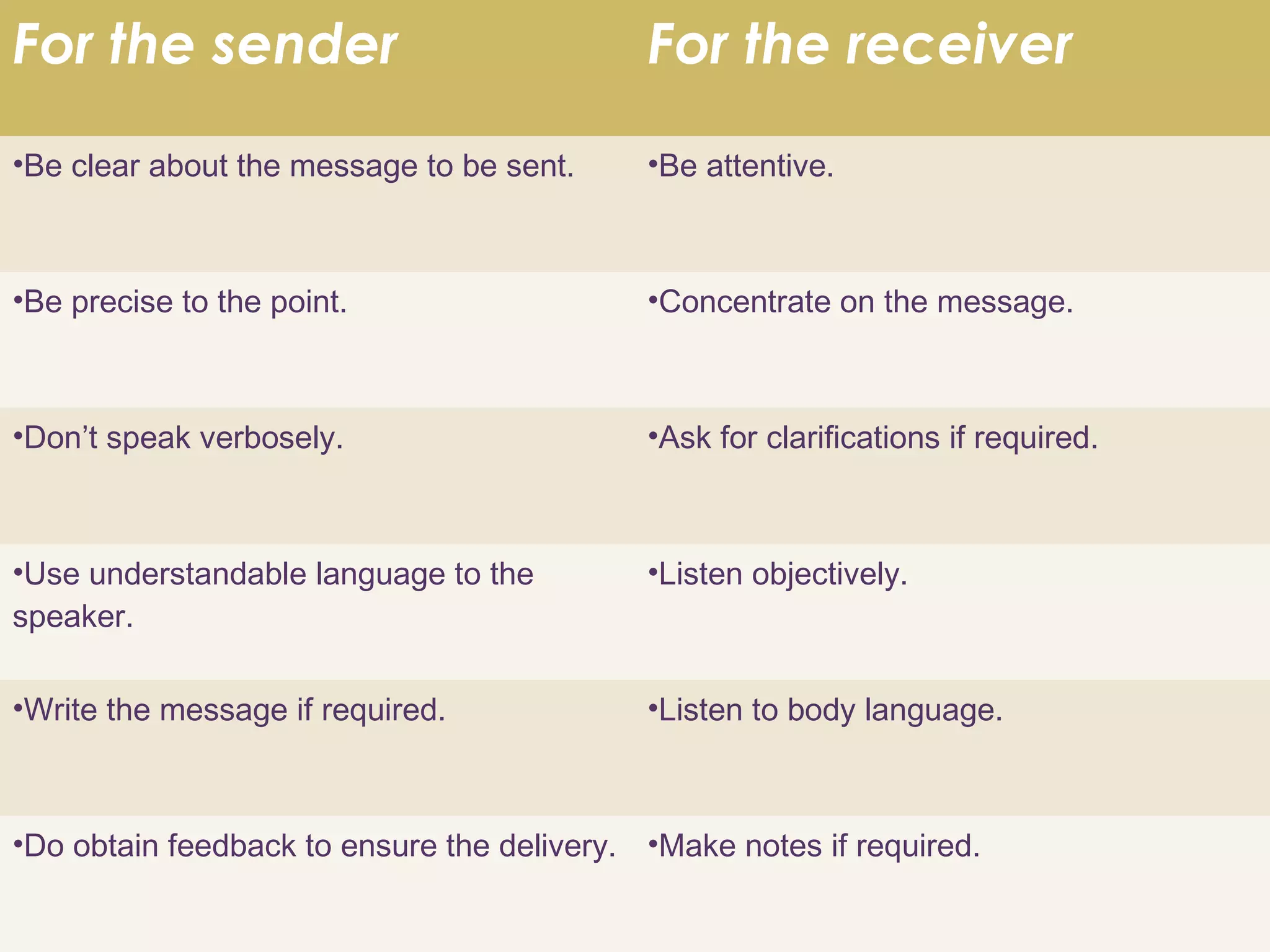
For the sender                              For the receiver
•Be clear about the message to be sent.     •Be attentive.


•Be precise to the point.                   •Concentrate on the message.


•Don’t speak verbosely.                     •Ask for clarifications if required.


•Use understandable language to the         •Listen objectively.
speaker.

•Write the message if required.             •Listen to body language.


•Do obtain feedback to ensure the delivery. •Make notes if required.
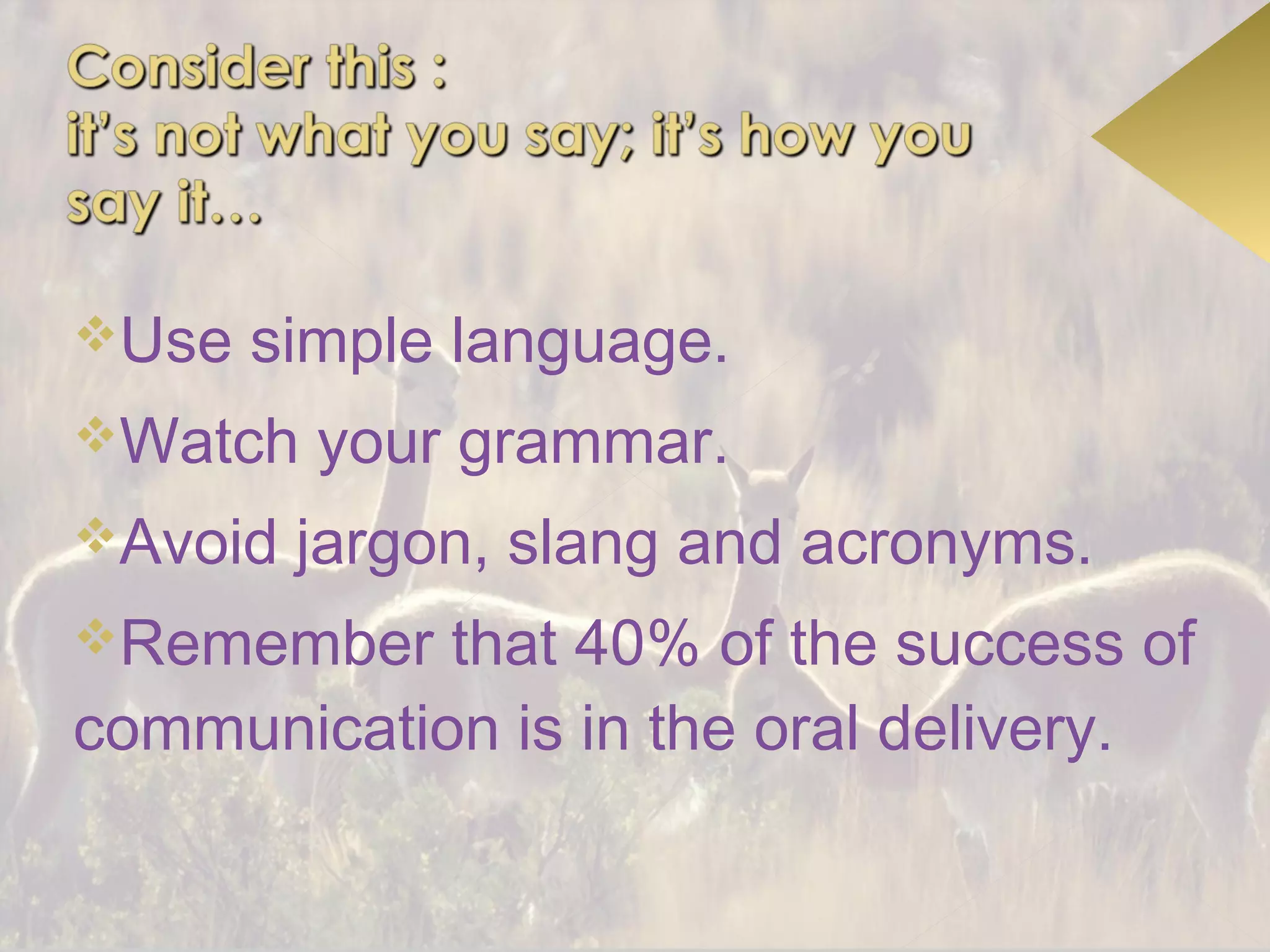
Use   simple language.
Watch   your grammar.
Avoid   jargon, slang and acronyms.
Remember   that 40% of the success of
communication is in the oral delivery.
“Speech   is the mirror of the soul” –
(socrates).
Vocal energy is vital for engaging an
audience.
Strengthen your voice.
Relax your body.
Be interactive.
Draw feedback
Let the communication grow.
•   Always think ahead about what you are going to say.
•   Use simple words and phrases that are understood by every
    body.
•   Increase your knowledge on all subjects you are required to
    speak.
•   Speak clearly and audibly.
•   Check twice with the listener whether you have been
    understood accurately or not
•   In case of an interruption, always do a little recap of what has
    been already said.
•   Always pay undivided attention to the speaker while listening.
•   While listening, always make notes of important points.
•   Always ask for clarification if you have failed to grasp other’s
    point of view.
•   Repeat what the speaker has said to check whether you have
    understood accurately.
•   Do not instantly react and mutter something in anger.
•   Do not use technical terms & terminologies not understood
    by majority of people.
•   Do not speak too fast or too slow.
•   Do not speak in inaudible surroundings, as you won’t be
    heard.
•   Do not assume that every body understands you.
•   While listening do not glance here and there as it might
    distract the speaker.
•   Do not interrupt the speaker.
•   Do not jump to the conclusion that you have understood
    every thing.
Communication
Communication

Communication

  • 3.
    COMMUNICATION IS THEART OF TRANSMITTING INFORMATION, IDEAS AND ATTITUDES FROM ONE PERSON TO ANOTHER.COMMUNICATION IS THE PROCESS OF MEANINGFUL INTERACTION AMONG HUMAN BEINGS. ITS ESSENCES : •PERSONAL PROCESS •OCCURS BETWEEN PEOPLE •INVOLVES CHANGE IN BEHAVIOUR •MEANS TO INFLUENCE OTHERS •EXPRESSION OF THOUGHTS AND •EMOTIONS THROUGH WORDS & ACTIONS. •TOOLS FOR CONTROLLING AND MOTIVATING PEOPLE. •IT IS A SOCIAL AND EMOTIONAL PROCESS.
  • 4.
    Listeneffectively. Respond appropriately. Read bodylangauge. Ask questions to clarify. Seek common grounds.
  • 5.
    Focus onthe speaker. Shut out external/internal noise. Listen without bias. Affirm or acknowledge statements. Don’t interrupt.
  • 6.
    Listening to others is an elegant art. • Good listening reflects courtesy and good manners. • Listening carefully to the instructions of superiors improve competence and performance. • The result of poor listening skill could be disastrous in business, employment and social relations. • Good listening can eliminate a number of imaginary grievances of employees. • Good listening skill can improve social relations and conversation. • Listening is a positive activity rather than a passive or negative activity.
  • 7.
    Ask open-ended questions. Repeatand reflect. Don’t judge. Be aware of your own biases. Be courteous.
  • 8.
    Be aware of your own body language. Look for the body language which is contradictory to the verbal message. Respond to the changes in the body language. Model positive body language. Be courteous.
  • 9.
    Be present withyour whole body. Extend an open invitation to converse. Acknowledge messages from others. Mirror, don’t mimic. signs – gestures eye contact postures movement
  • 10.
    Keep appropriate distance • Touch only when appropriate • Take care of your appearance • Be aware - people may give false cues • Maintain eye contact • Smile genuinely
  • 11.
    Focus on the topic. Begin with “how” or “what”. Remember that “why” can cause defensiveness. Clarify the feelings behind the words. Use the speaker’s words.
  • 12.
    Use similarverbal and body language. Respond and reflect. Seek a win-win solution. Check that all parties understand. Compromise is better than conflict.
  • 14.
    For the sender For the receiver •Be clear about the message to be sent. •Be attentive. •Be precise to the point. •Concentrate on the message. •Don’t speak verbosely. •Ask for clarifications if required. •Use understandable language to the •Listen objectively. speaker. •Write the message if required. •Listen to body language. •Do obtain feedback to ensure the delivery. •Make notes if required.
  • 15.
    Use simple language. Watch your grammar. Avoid jargon, slang and acronyms. Remember that 40% of the success of communication is in the oral delivery.
  • 19.
    “Speech is the mirror of the soul” – (socrates). Vocal energy is vital for engaging an audience. Strengthen your voice. Relax your body. Be interactive. Draw feedback Let the communication grow.
  • 20.
    Always think ahead about what you are going to say. • Use simple words and phrases that are understood by every body. • Increase your knowledge on all subjects you are required to speak. • Speak clearly and audibly. • Check twice with the listener whether you have been understood accurately or not • In case of an interruption, always do a little recap of what has been already said. • Always pay undivided attention to the speaker while listening. • While listening, always make notes of important points. • Always ask for clarification if you have failed to grasp other’s point of view. • Repeat what the speaker has said to check whether you have understood accurately.
  • 21.
    Do not instantly react and mutter something in anger. • Do not use technical terms & terminologies not understood by majority of people. • Do not speak too fast or too slow. • Do not speak in inaudible surroundings, as you won’t be heard. • Do not assume that every body understands you. • While listening do not glance here and there as it might distract the speaker. • Do not interrupt the speaker. • Do not jump to the conclusion that you have understood every thing.