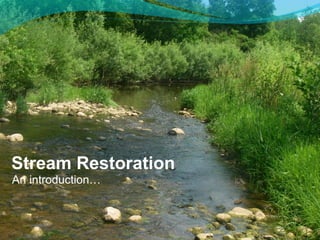
Stream Restoration
An introduction…
Evolution of “Restoration”
Long history of working on and manipulating
 streams and rivers
“Restoration”, “Rehabilitation”, “Stabilization” have
 all been used as justification to undertake restoration
We continue to learn about, and evolve the science
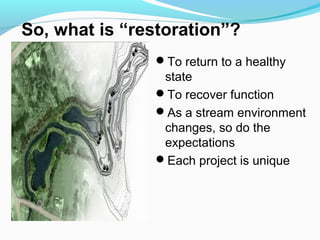
So, what is “restoration”?
               To return to a healthy
                state
               To recover function
               As a stream environment
                changes, so do the
                expectations
               Each project is unique
The Order of Restoration
In any stream restoration there is an order that
should be followed.

         • Protect
         • Maintain
         • Restore
         • Enhance

Consider passive vs. active restoration, such as
valley wide protection, floodplain restoration before
more intensive efforts such as channel restoration
and habitat enhancement structures.
A Restoration Philosophy
• Rivers, like most other natural systems, are highly
  dynamic and complex. The numerous processes and
  interactions that continually occur at varying scales are
  testaments to this natural complexity.

• This complexity provides and sustains the various niches
  and habitats for biological organisms.

• Recent advances in both physical and biological
  sciences, in addition to our growing understanding of
  these systems, has contributed to our ability to restore
  the natural dynamics and functions of rivers.
Restoration Objectives
•Must meet socio-economic,
ecological, physical,
engineering, and regulatory
goals of the project.

• Result should be stable,
not static.

• Be appropriate for the
physical setting (climate,
land use, development
restrictions, geology)
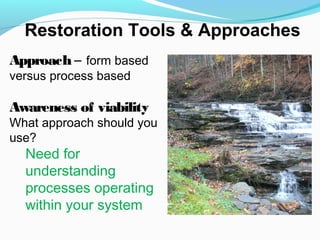
Restoration Tools & Approaches
Approach – form based
versus process based

Awareness of viability
What approach should you
use?
  Need for
  understanding
  processes operating
  within your system
Design Approaches
- Rational   / Cognitive
  - Reference Reach
  - PFC (Proper Functioning Condition)

- Deterministic / Analytical
  - Hydraulic Models
  - Permissible Tractive Force

- Other (Specific Approaches)
  - Rosgen
  - Newbury
  - EPA (Natural Channel Design)
Channel Evolution
              As a channel deepens, it
               reaches a limit, a hard
               layer that is harder to
               erode.
              If it cant move downward, it
               will move to the side
              When if moves to the side,
               banks will erode and the
               channel becomes wider
              The channel will then re-
               establish itself
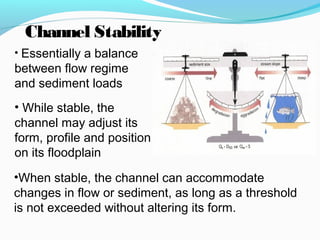
Channel Stability
• Essentially a balance
between flow regime
and sediment loads
• While stable, the
channel may adjust its
form, profile and position
on its floodplain
•When stable, the channel can accommodate
changes in flow or sediment, as long as a threshold
is not exceeded without altering its form.
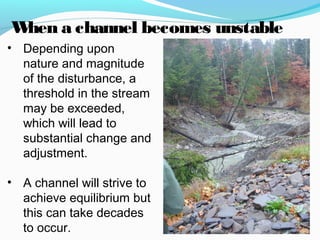
When a channel becomes unstable
• Depending upon
  nature and magnitude
  of the disturbance, a
  threshold in the stream
  may be exceeded,
  which will lead to
  substantial change and
  adjustment.

• A channel will strive to
  achieve equilibrium but
  this can take decades
  to occur.
“Natural Channel Design”
- Emphasizes
  geometry, plan,
  profile that will be
  stable under given
  flow/sediment
  regime with
  minimal
  armor/maintenanc
  e
- Assumes most
  functions follow
  from geomorphic
  condition
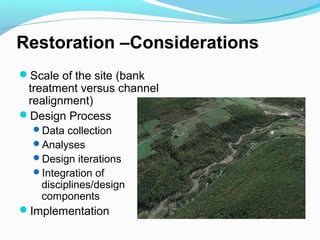
Restoration –Considerations
Scale of the site (bank
 treatment versus channel
 realignment)
Design Process
  Data collection
  Analyses
  Design iterations
  Integration of
    disciplines/design
    components
Implementation
Bank Erosion
• Bank material more variable than bed material
• Many factors involved in analysis
  –   Flow properties
  –   Bank composition
  –   Climate
  –   Subsurface conditions
  –   Channel geometry
  –   Mode of failure
  –   Biology
  –   Vegetation
Data Collection
• Reach and cross-
section scale

• Used to determine &
quantify channel
  processes

• Necessary for all
design approaches
Design Analyses
• Hydrology
• Sediment transport
• Geomorphic
relations
• System dynamics
Hydrology
Flow Duration Curves
 The flow duration curve is a
  plot that shows the
  percentage of time that flow
  in a stream is likely to equal
  or exceed some specified
  value of interest.
Flow Frequency
 The probability a given
  streamflow will be exceeded
  in any given year.
 Related to Return-Interval
  (e.g. 100-Year Flood)
Why do we care about Hydrology?
Properly developed statistical hydrology

  Allows for quantification of risk and success/failure
  Allows for the development of specific design criteria
  Provides tool for estimating bankfull discharges
  Critical link to understanding how physical conditions
    such as bank and bed shear stress and other
    sediment transport functions vary temporally.
Hydraulic Analysis
Used to determine the impacts of flow on the
channel, (how much and how fast), and other
relations essential to restoration designs.
Flow modeling
  • a simulation that represents the channel through geometry

Sediment transport modeling
  •To understand the amount of sediment moving through the
  system
  •Can help to determine long term stability of the channel
  •Can be used to estimate sediment yield, and for comparative
  analysis between reaches
Design Discharge

How do we select which flow to design for?

  • Low flow ~ habitat design
  • Bankfull Discharge ~ stable channel design
  • Flood Flows ~ regulatory compliance and
    flood hazard protection
Geomorphic Relations
• Hydraulic Geometry

• Regime Equations

• Regional Curve Information

• Meander Geometry

• Gradient relationships
Examples of Natural Design

      Typical dynamic meander pattern
Options to move or enhance the stream


             Existing Section


            Restoration Section
Construction Implementation
Erosion & Sediment Control
•How we keep the process
from impacting the valley
Constructability
•How can it be constructed?

Details on how to build it
•Where to access the work
•What are the soils like
•How are the flows in the
channel dealt with
Access Considerations
•Protect the channel
•Minimize disturbance
•Optimize materials delivery
Restoration Transitioning
Construction
 Techniques using hard materials
Construction
  Techniques using bioengineering
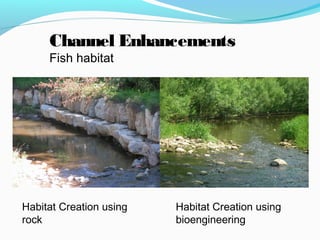
Channel Enhancements
     Fish habitat


Habitat Creation using   Habitat Creation using
rock                     bioengineering
Thank-you

Stream Restoration 101

  • 1.
  • 2.
    Evolution of “Restoration” Longhistory of working on and manipulating streams and rivers “Restoration”, “Rehabilitation”, “Stabilization” have all been used as justification to undertake restoration We continue to learn about, and evolve the science
  • 3.
    So, what is“restoration”? To return to a healthy state To recover function As a stream environment changes, so do the expectations Each project is unique
  • 4.
    The Order ofRestoration In any stream restoration there is an order that should be followed. • Protect • Maintain • Restore • Enhance Consider passive vs. active restoration, such as valley wide protection, floodplain restoration before more intensive efforts such as channel restoration and habitat enhancement structures.
  • 5.
    A Restoration Philosophy •Rivers, like most other natural systems, are highly dynamic and complex. The numerous processes and interactions that continually occur at varying scales are testaments to this natural complexity. • This complexity provides and sustains the various niches and habitats for biological organisms. • Recent advances in both physical and biological sciences, in addition to our growing understanding of these systems, has contributed to our ability to restore the natural dynamics and functions of rivers.
  • 6.
    Restoration Objectives •Must meetsocio-economic, ecological, physical, engineering, and regulatory goals of the project. • Result should be stable, not static. • Be appropriate for the physical setting (climate, land use, development restrictions, geology)
  • 7.
    Restoration Tools &Approaches Approach – form based versus process based Awareness of viability What approach should you use? Need for understanding processes operating within your system
  • 8.
    Design Approaches - Rational / Cognitive - Reference Reach - PFC (Proper Functioning Condition) - Deterministic / Analytical - Hydraulic Models - Permissible Tractive Force - Other (Specific Approaches) - Rosgen - Newbury - EPA (Natural Channel Design)
  • 9.
    Channel Evolution As a channel deepens, it reaches a limit, a hard layer that is harder to erode. If it cant move downward, it will move to the side When if moves to the side, banks will erode and the channel becomes wider The channel will then re- establish itself
  • 10.
    Channel Stability • Essentiallya balance between flow regime and sediment loads • While stable, the channel may adjust its form, profile and position on its floodplain •When stable, the channel can accommodate changes in flow or sediment, as long as a threshold is not exceeded without altering its form.
  • 11.
    When a channelbecomes unstable • Depending upon nature and magnitude of the disturbance, a threshold in the stream may be exceeded, which will lead to substantial change and adjustment. • A channel will strive to achieve equilibrium but this can take decades to occur.
  • 12.
    “Natural Channel Design” -Emphasizes geometry, plan, profile that will be stable under given flow/sediment regime with minimal armor/maintenanc e - Assumes most functions follow from geomorphic condition
  • 13.
    Restoration –Considerations Scale ofthe site (bank treatment versus channel realignment) Design Process Data collection Analyses Design iterations Integration of disciplines/design components Implementation
  • 14.
    Bank Erosion • Bankmaterial more variable than bed material • Many factors involved in analysis – Flow properties – Bank composition – Climate – Subsurface conditions – Channel geometry – Mode of failure – Biology – Vegetation
  • 15.
    Data Collection • Reachand cross- section scale • Used to determine & quantify channel processes • Necessary for all design approaches
  • 16.
    Design Analyses • Hydrology •Sediment transport • Geomorphic relations • System dynamics
  • 17.
    Hydrology Flow Duration Curves The flow duration curve is a plot that shows the percentage of time that flow in a stream is likely to equal or exceed some specified value of interest. Flow Frequency The probability a given streamflow will be exceeded in any given year. Related to Return-Interval (e.g. 100-Year Flood)
  • 18.
    Why do wecare about Hydrology? Properly developed statistical hydrology Allows for quantification of risk and success/failure Allows for the development of specific design criteria Provides tool for estimating bankfull discharges Critical link to understanding how physical conditions such as bank and bed shear stress and other sediment transport functions vary temporally.
  • 19.
    Hydraulic Analysis Used todetermine the impacts of flow on the channel, (how much and how fast), and other relations essential to restoration designs. Flow modeling • a simulation that represents the channel through geometry Sediment transport modeling •To understand the amount of sediment moving through the system •Can help to determine long term stability of the channel •Can be used to estimate sediment yield, and for comparative analysis between reaches
  • 20.
    Design Discharge How dowe select which flow to design for? • Low flow ~ habitat design • Bankfull Discharge ~ stable channel design • Flood Flows ~ regulatory compliance and flood hazard protection
  • 21.
    Geomorphic Relations • HydraulicGeometry • Regime Equations • Regional Curve Information • Meander Geometry • Gradient relationships
  • 22.
    Examples of NaturalDesign Typical dynamic meander pattern
  • 23.
    Options to moveor enhance the stream Existing Section Restoration Section
  • 24.
    Construction Implementation Erosion &Sediment Control •How we keep the process from impacting the valley Constructability •How can it be constructed? Details on how to build it •Where to access the work •What are the soils like •How are the flows in the channel dealt with
  • 25.
    Access Considerations •Protect thechannel •Minimize disturbance •Optimize materials delivery
  • 26.
  • 27.
  • 28.
    Construction Techniquesusing bioengineering
  • 29.
    Channel Enhancements Fish habitat Habitat Creation using Habitat Creation using rock bioengineering
  • 30.