PRESENTATION ON
GRAVITY DAM
INTRODUCTION
GRAVITY DAM
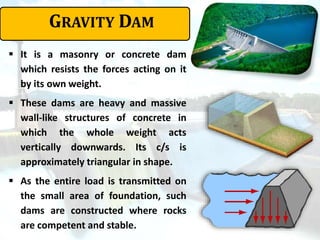
 It is a masonry or concrete dam
which resists the forces acting on it
by its own weight.
 These dams are heavy and massive
wall-like structures of concrete in
which the whole weight acts
vertically downwards. Its c/s is
approximately triangular in shape.
 As the entire load is transmitted on
the small area of foundation, such
dams are constructed where rocks
are competent and stable.
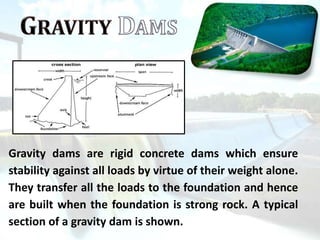
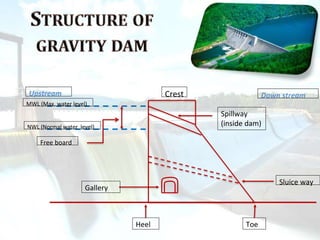
Gravity dams are rigid concrete dams which ensure
stability against all loads by virtue of their weight alone.
They transfer all the loads to the foundation and hence
are built when the foundation is strong rock. A typical
section of a gravity dam is shown.
FAMOUS GRAVITY DAMS
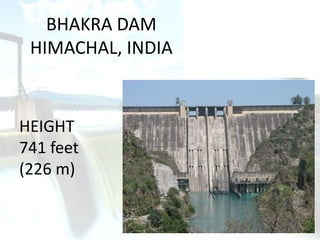
BHAKRA DAM
HIMACHAL, INDIA
HEIGHT
741 feet
(226 m)
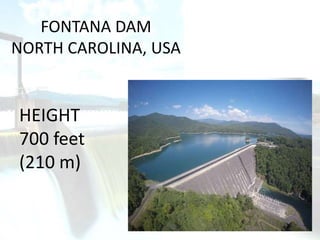
FONTANA DAM
NORTH CAROLINA, USA
HEIGHT
700 feet
(210 m)
LAKE VYRNWY DAM
LIVERPOOL, UK
HEIGHT
146 feet
(45 m)
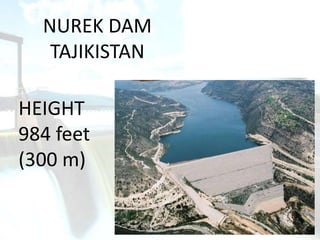
NUREK DAM
TAJIKISTAN
HEIGHT
984 feet
(300 m)
SHASTA DAM
NORTH CALIFORNIA,USA
HEIGHT
602 feet
(183 m)
Heel
Gallery
Toe
Spillway
(inside dam)
Crest
NWL (Normal water level)
MWL (Max. water level)
Free board
Sluice way
Upstream Down stream
Purpose of Gravity dam
ADVANTAGES OF GRAVITY DAM
• Strong, Stable and Durable
• Suitable for moderately wide valleys having steep
slope
• Loss of water by seepage in gravity dams is less.
• Can be constructed to very great heights
• Suitable for an overflow spillway section
• Maintenance cost is very low
• Does not fail suddenly
 Gravity dams of great height can be constructed only on sound
rock foundations
 Initial cost is more than earth dam
 Takes longer time in construction
 Require more skilled labor than earth dam
 Subsequent raise is not possible in a gravity dam
 Design of gravity dams is very complicated
DISADVANTAGES OF GRAVITY DAM
Forces Acting On Gravity
Dam
 Water Pressure
 Weight of the Dam
 Uplift Pressure
 Silt Pressure
 Wave Pressure
 Wind pressure
 Ice pressure
 Earthquake Pressure
Water Pressure is the most major external force acting on a
gravity dam.
On upstream face pressure exerted by water is stored upto the ful
reservoir level. The upstream face may either be vertical or inclined.
On downstream face the pressure is exerted by tail water. The
downstream face is always inclined
Water Pressure
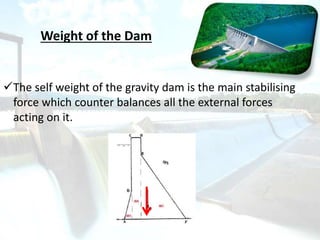
Weight of the Dam
The self weight of the gravity dam is the main stabilising
force which counter balances all the external forces
acting on it.
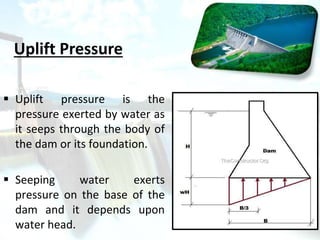
Uplift Pressure
 Uplift pressure is the
pressure exerted by water as
it seeps through the body of
the dam or its foundation.
 Seeping water exerts
pressure on the base of the
dam and it depends upon
water head.
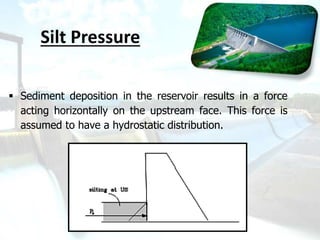
Silt Pressure
 Sediment deposition in the reservoir results in a force
acting horizontally on the upstream face. This force is
assumed to have a hydrostatic distribution.
Wave Pressure
 Waves are generated on the surface of the reservoir by
the blowing winds, which exert a pressure on the
upstream side. Wave pressure depends upon wave
height
Wind pressure
• The top exposed portion on the dam is small & hence
the wind pressure on this portion of dam is negligible.
 The ice which may be formed on the water surface of
the reservoir in cold countries may sometimes melt and
expand. The dam face is subjected to the thrust exerted
by the expanding ice.
Ice pressure
Dams are subjected to vibration during earthquakes.
Vibration affects both the body of the dam as well as the water
in the reservoir behind the dam.
The most danger effect occurs when the vibration is
perpendicular to the face of the dam.
Earthquake Pressure
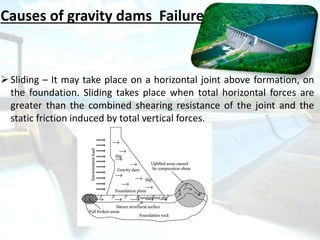
Sliding – It may take place on a horizontal joint above formation, on
the foundation. Sliding takes place when total horizontal forces are
greater than the combined shearing resistance of the joint and the
static friction induced by total vertical forces.
Causes of gravity dams Failure
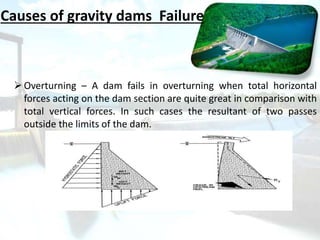
Overturning – A dam fails in overturning when total horizontal
forces acting on the dam section are quite great in comparison with
total vertical forces. In such cases the resultant of two passes
outside the limits of the dam.
Causes of gravity dams Failure
Dam may fail when tension is produced in the concrete.
Dam may fail in crushing due to compression.
Causes of gravity dams Failure
To prevent overturning, the resultant of all forces acting on
the dam should remain within the middle-third of the base
width of the dam.
 In the dam, the sliding should be fully resisted when the
condition for no sliding exists in the dam section.
In the dam section, the compressive stresses of concrete or
masonry should not exceed the permissible working stress
to avoid failure due to crushing.
There should be no tension in the dam section to avoid the
formation of cracks.
The factor of safety should be maintained between 4 to 5
Precaution against dams Failure
Gravity dam
Gravity dam

Gravity dam

  • 1.
  • 2.
  • 3.
    GRAVITY DAM  Itis a masonry or concrete dam which resists the forces acting on it by its own weight.  These dams are heavy and massive wall-like structures of concrete in which the whole weight acts vertically downwards. Its c/s is approximately triangular in shape.  As the entire load is transmitted on the small area of foundation, such dams are constructed where rocks are competent and stable.
  • 4.
    Gravity dams arerigid concrete dams which ensure stability against all loads by virtue of their weight alone. They transfer all the loads to the foundation and hence are built when the foundation is strong rock. A typical section of a gravity dam is shown.
  • 5.
  • 6.
  • 7.
    FONTANA DAM NORTH CAROLINA,USA HEIGHT 700 feet (210 m)
  • 8.
    LAKE VYRNWY DAM LIVERPOOL,UK HEIGHT 146 feet (45 m)
  • 9.
  • 10.
  • 11.
    Heel Gallery Toe Spillway (inside dam) Crest NWL (Normalwater level) MWL (Max. water level) Free board Sluice way Upstream Down stream
  • 12.
  • 13.
    ADVANTAGES OF GRAVITYDAM • Strong, Stable and Durable • Suitable for moderately wide valleys having steep slope • Loss of water by seepage in gravity dams is less. • Can be constructed to very great heights • Suitable for an overflow spillway section • Maintenance cost is very low • Does not fail suddenly
  • 14.
     Gravity damsof great height can be constructed only on sound rock foundations  Initial cost is more than earth dam  Takes longer time in construction  Require more skilled labor than earth dam  Subsequent raise is not possible in a gravity dam  Design of gravity dams is very complicated DISADVANTAGES OF GRAVITY DAM
  • 15.
    Forces Acting OnGravity Dam  Water Pressure  Weight of the Dam  Uplift Pressure  Silt Pressure  Wave Pressure  Wind pressure  Ice pressure  Earthquake Pressure
  • 16.
    Water Pressure isthe most major external force acting on a gravity dam. On upstream face pressure exerted by water is stored upto the ful reservoir level. The upstream face may either be vertical or inclined. On downstream face the pressure is exerted by tail water. The downstream face is always inclined Water Pressure
  • 17.
    Weight of theDam The self weight of the gravity dam is the main stabilising force which counter balances all the external forces acting on it.
  • 18.
    Uplift Pressure  Upliftpressure is the pressure exerted by water as it seeps through the body of the dam or its foundation.  Seeping water exerts pressure on the base of the dam and it depends upon water head.
  • 19.
    Silt Pressure  Sedimentdeposition in the reservoir results in a force acting horizontally on the upstream face. This force is assumed to have a hydrostatic distribution.
  • 20.
    Wave Pressure  Wavesare generated on the surface of the reservoir by the blowing winds, which exert a pressure on the upstream side. Wave pressure depends upon wave height
  • 21.
    Wind pressure • Thetop exposed portion on the dam is small & hence the wind pressure on this portion of dam is negligible.
  • 22.
     The icewhich may be formed on the water surface of the reservoir in cold countries may sometimes melt and expand. The dam face is subjected to the thrust exerted by the expanding ice. Ice pressure
  • 23.
    Dams are subjectedto vibration during earthquakes. Vibration affects both the body of the dam as well as the water in the reservoir behind the dam. The most danger effect occurs when the vibration is perpendicular to the face of the dam. Earthquake Pressure
  • 24.
    Sliding – Itmay take place on a horizontal joint above formation, on the foundation. Sliding takes place when total horizontal forces are greater than the combined shearing resistance of the joint and the static friction induced by total vertical forces. Causes of gravity dams Failure
  • 25.
    Overturning – Adam fails in overturning when total horizontal forces acting on the dam section are quite great in comparison with total vertical forces. In such cases the resultant of two passes outside the limits of the dam. Causes of gravity dams Failure
  • 26.
    Dam may failwhen tension is produced in the concrete. Dam may fail in crushing due to compression. Causes of gravity dams Failure
  • 27.
    To prevent overturning,the resultant of all forces acting on the dam should remain within the middle-third of the base width of the dam.  In the dam, the sliding should be fully resisted when the condition for no sliding exists in the dam section. In the dam section, the compressive stresses of concrete or masonry should not exceed the permissible working stress to avoid failure due to crushing. There should be no tension in the dam section to avoid the formation of cracks. The factor of safety should be maintained between 4 to 5 Precaution against dams Failure