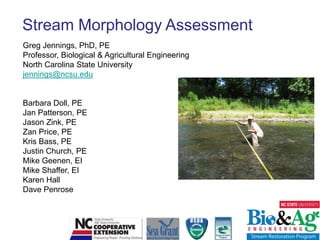
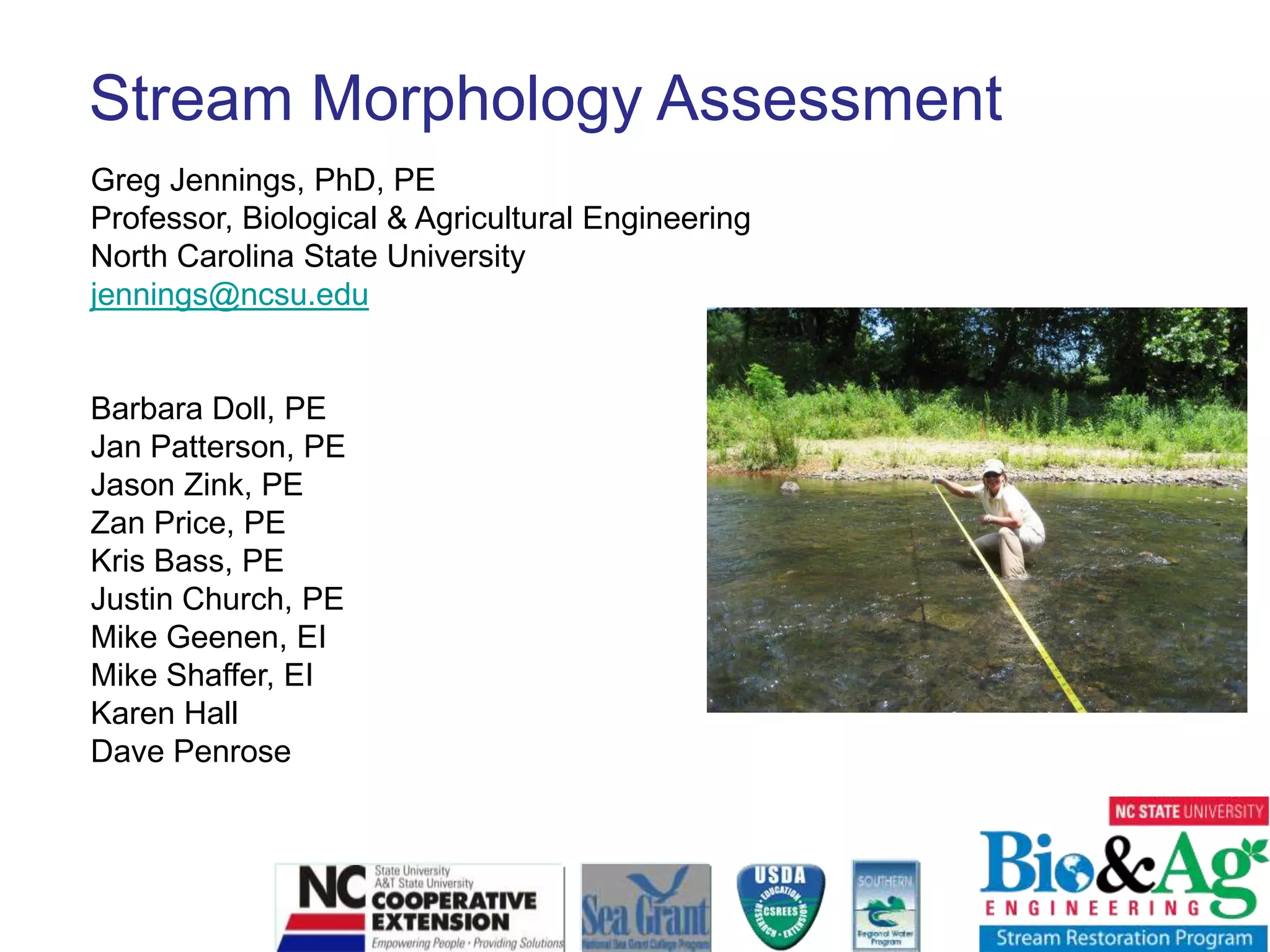
Stream Morphology AssessmentGreg Jennings, PhD, PEProfessor, Biological & Agricultural EngineeringNorth Carolina State Universityjennings@ncsu.eduBarbara Doll, PEJan Patterson, PEJason Zink, PEZan Price, PEKris Bass, PEJustin Church, PEMike Geenen, EIMike Shaffer, EIKaren HallDave Penrose
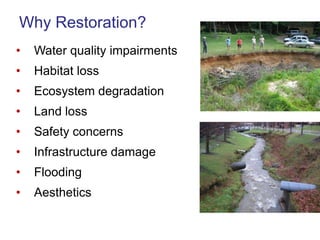
Why Restoration?Water quality impairments
Habitat loss
Ecosystem degradation
Land loss
Safety concerns
Infrastructure damage
Flooding
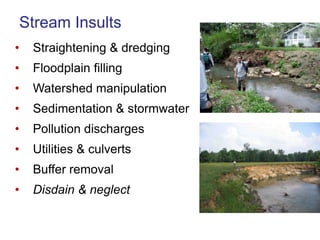
AestheticsStream InsultsStraightening & dredging
Floodplain filling
Watershed manipulation
Sedimentation & stormwater
Pollution discharges
Utilities & culverts
Buffer removal
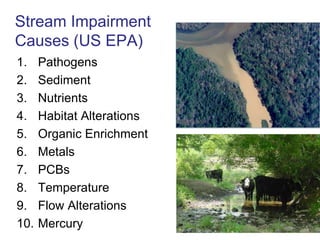
Disdain & neglectStream Impairment Causes (US EPA)PathogensSedimentNutrientsHabitat AlterationsOrganic EnrichmentMetalsPCBsTemperatureFlow AlterationsMercury
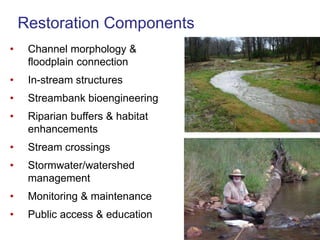
Restoration ComponentsChannel morphology & floodplain connection
In-stream structures
Streambank bioengineering
Riparian buffers & habitat enhancements
Stream crossings
Stormwater/watershed management
Monitoring & maintenance
Public access & educationStream Morphology AssessmentFluvial Processes & FormsStreams & WatershedsStream EcosystemsStream MorphologyStream ClassificationAssessment of Condition
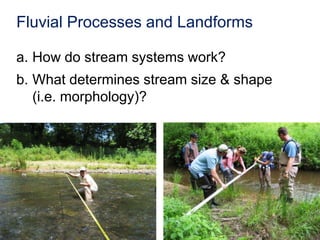
Fluvial Processes and LandformsHow do stream systems work?What determines stream size & shape (i.e. morphology)?
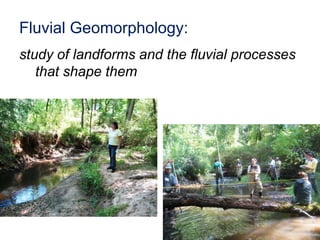
Fluvial Geomorphology:study of landforms and the fluvial processes that shape them
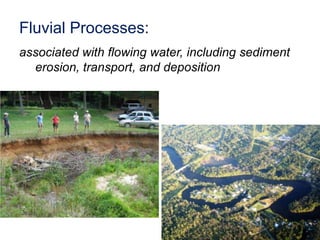
Fluvial Processes:associated with flowing water, including sediment erosion, transport, and deposition
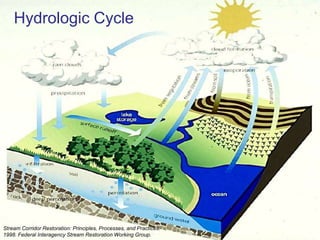
Hydrologic CycleStream Corridor Restoration: Principles, Processes, and Practices. 1998. Federal Interagency Stream Restoration Working Group.
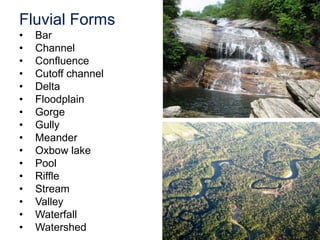
Fluvial FormsBar
Channel
Confluence
Cutoff channel
Delta
Floodplain
Gorge
Gully
Meander
Oxbow lake
Pool
Riffle
Stream
Valley
Waterfall
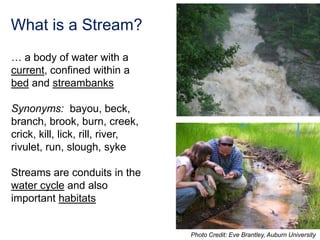
WatershedWhat is a Stream?… a body of water with a current, confined within a bed and streambanksSynonyms:  bayou, beck, branch, brook, burn, creek, crick, kill, lick, rill, river, rivulet, run, slough, sykeStreams are conduits in the water cycle and also important habitatsPhoto Credit: Eve Brantley, Auburn University
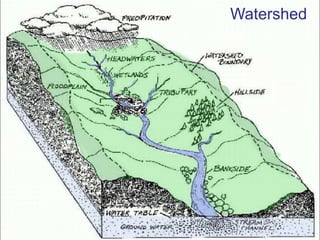
Watershed
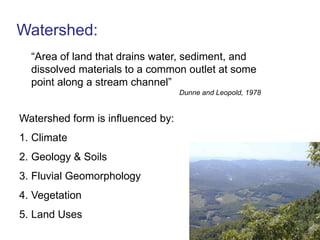
Watershed:	“Area of land that drains water, sediment, and dissolved materials to a common outlet at some point along a stream channel”						Dunne and Leopold, 1978Watershed form is influenced by:ClimateGeology & SoilsFluvial GeomorphologyVegetationLand Uses
From Webster's Revised Unabridged Dictionary (1913) :Watershed, n [Cf. G. wasserscheide; wasserwater + scheidea place where two things separate, fr. scheidento separate.]The whole region or extent of country which contributes to the supply of a river or lake.The line of division between two adjacent rivers or lakes with respect to the flow of water by natural channels into them; the natural boundary of a basin.Other Terms:  Catchment, Drainage basin, River basin
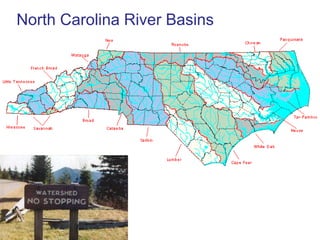
North Carolina River Basins
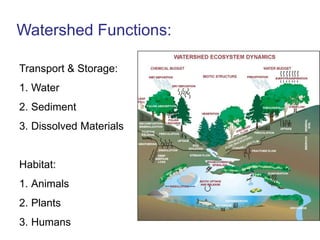
Watershed Functions:Transport & Storage:WaterSedimentDissolved MaterialsHabitat:AnimalsPlantsHumans
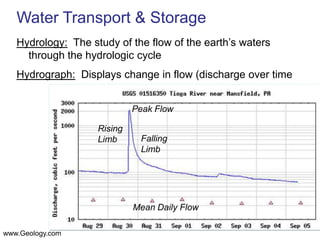
Water Transport & StorageHydrology:  The study of the flow of the earth’s waters through the hydrologic cycleHydrograph:  Displays change in flow (discharge over timePeak FlowRising LimbFalling LimbMean Daily Flowwww.Geology.com
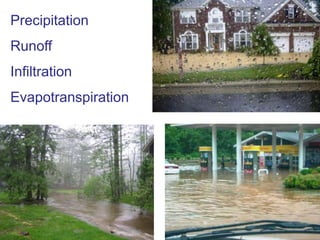
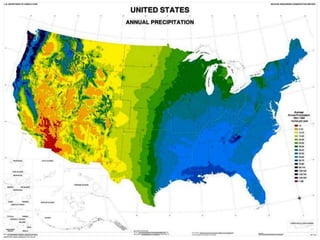
PrecipitationRunoffInfiltrationEvapotranspiration
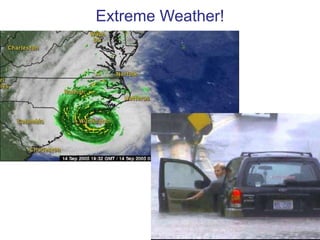
Extreme Weather!
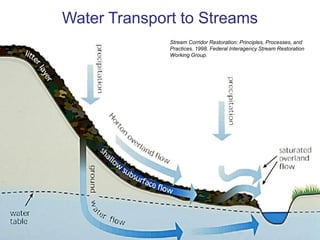
Water Transport to StreamsStream Corridor Restoration: Principles, Processes, and Practices. 1998. Federal Interagency Stream Restoration Working Group.
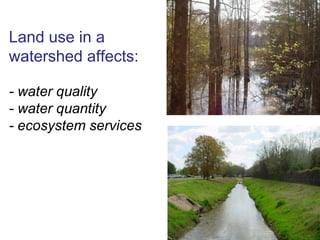
Land use in a watershed affects:- water quality- water quantity- ecosystem services
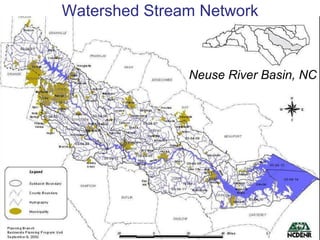
Watershed Stream NetworkNeuse River Basin, NC
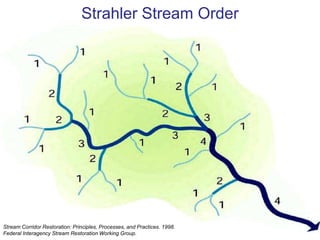
Strahler Stream OrderStream Corridor Restoration: Principles, Processes, and Practices. 1998. Federal Interagency Stream Restoration Working Group.
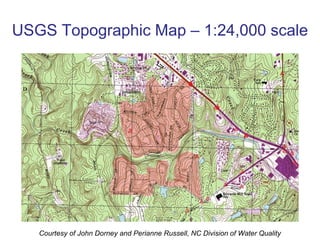
USGS Topographic Map – 1:24,000 scaleCourtesy of John Dorney and Perianne Russell, NC Division of Water Quality
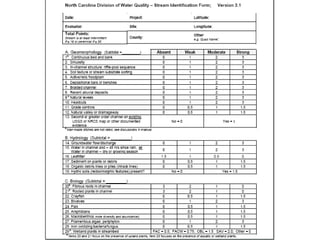
How to determine stream origins?h2o.enr.state.nc.us/ncwetlands
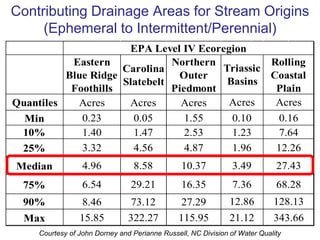
Contributing Drainage Areas for Stream Origins(Ephemeral to Intermittent/Perennial)Courtesy of John Dorney and Perianne Russell, NC Division of Water Quality
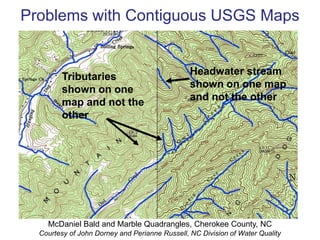
Problems with Contiguous USGS MapsHeadwater stream shown on one map and not the otherTributaries shown on one  map and not the otherMcDaniel Bald and Marble Quadrangles, Cherokee County, NCCourtesy of John Dorney and Perianne Russell, NC Division of Water Quality
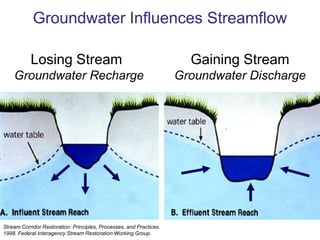
Groundwater Influences StreamflowLosing Stream			Gaining StreamGroundwater Recharge	Groundwater DischargeStream Corridor Restoration: Principles, Processes, and Practices. 1998. Federal Interagency Stream Restoration Working Group.
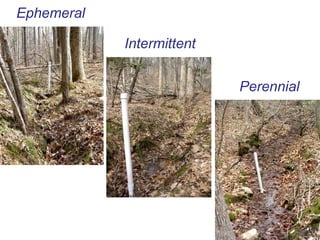
EphemeralIntermittentPerennial
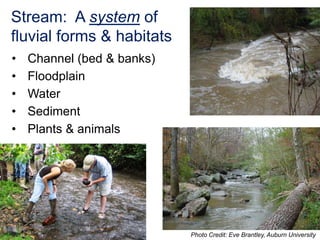
Stream:  A system of fluvial forms & habitatsChannel (bed & banks)
Floodplain
Water
Sediment
Plants & animalsPhoto Credit: Eve Brantley, Auburn University
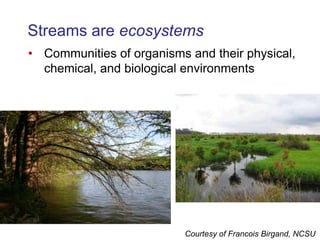
Streams are ecosystemsCommunities of organisms and their physical, chemical, and biological environmentsCourtesy of Francois Birgand, NCSU
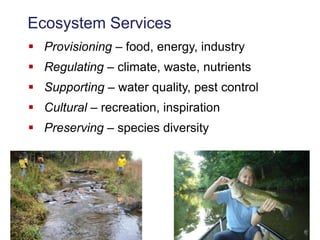
Ecosystem ServicesProvisioning – food, energy, industry
Regulating – climate, waste, nutrients
Supporting – water quality, pest control
Cultural – recreation, inspiration
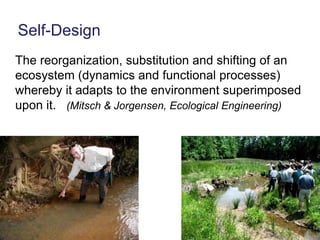
Preserving – species diversitySelf-Design	The reorganization, substitution and shifting of an ecosystem (dynamics and functional processes) whereby it adapts to the environment superimposed upon it.   (Mitsch & Jorgensen, Ecological Engineering)
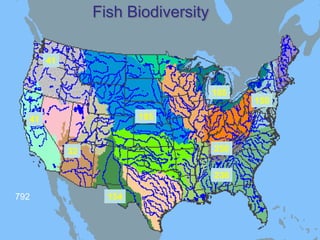
Fish Biodiversity411851501954125032236792154
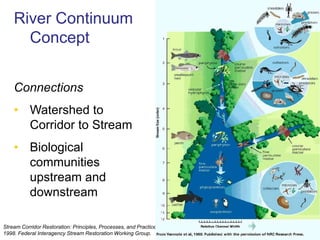
River Continuum ConceptConnectionsWatershed to Corridor to Stream
Biological communities upstream and downstreamStream Corridor Restoration: Principles, Processes, and Practices. 1998. Federal Interagency Stream Restoration Working Group.
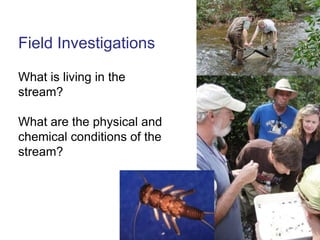
Field InvestigationsWhat is living in the stream?What are the physical and chemical conditions of the stream?
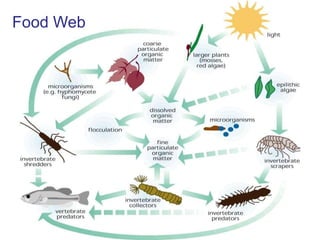
Food Web
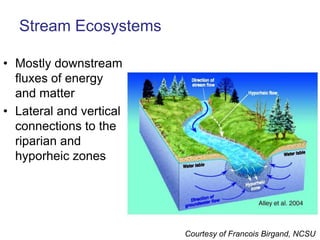
Stream EcosystemsMostly downstream fluxes of energy and matterLateral and vertical connections to the riparian and hyporheic zonesCourtesy of Francois Birgand, NCSU
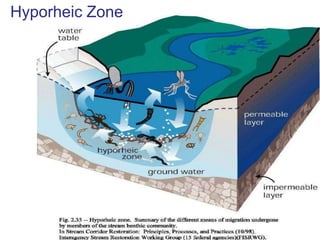
Hyporheic Zone
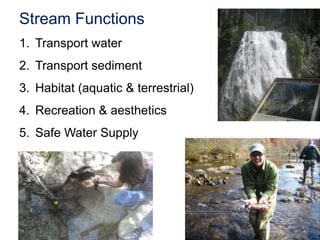
Stream FunctionsTransport waterTransport sedimentHabitat (aquatic & terrestrial)Recreation & aestheticsSafe Water Supply
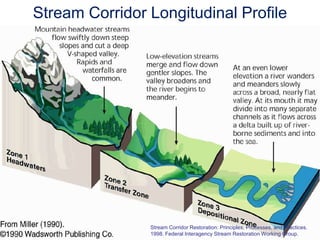
Stream Corridor Longitudinal ProfileStream Corridor Restoration: Principles, Processes, and Practices. 1998. Federal Interagency Stream Restoration Working Group.
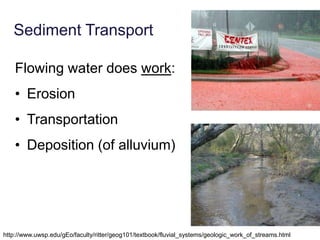
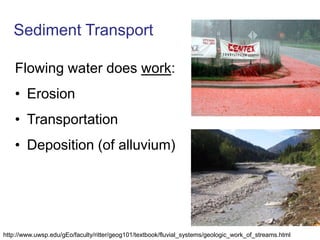
Sediment TransportFlowing water does work:Erosion
Transportation
Deposition (of alluvium)http://www.uwsp.edu/gEo/faculty/ritter/geog101/textbook/fluvial_systems/geologic_work_of_streams.html
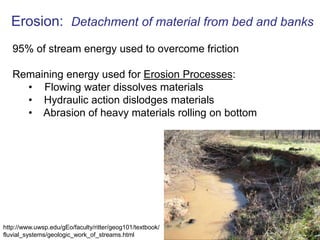
Erosion:  Detachment of material from bed and banks95% of stream energy used to overcome frictionRemaining energy used for Erosion Processes:	Flowing water dissolves materials
    Hydraulic action dislodges materials
    Abrasion of heavy materials rolling on bottomhttp://www.uwsp.edu/gEo/faculty/ritter/geog101/textbook/fluvial_systems/geologic_work_of_streams.html
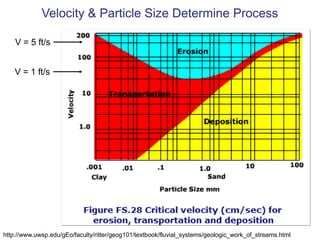
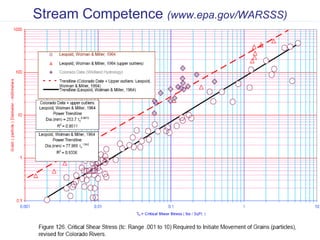
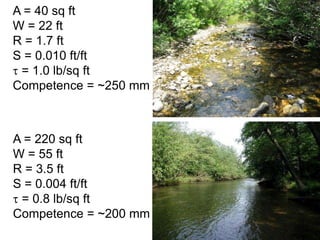
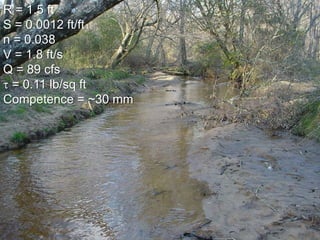
Transportation:  Movement of material by waterStream Load includes:dissolved + suspended + bed loadCapacity: maximum load that can be transported for a given discharge (increases with velocity and turbulence)Competence: largest size material that can be transported for a given dischargehttp://www.uwsp.edu/gEo/faculty/ritter/geog101/textbook/fluvial_systems/geologic_work_of_streams.html
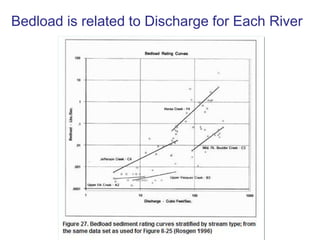
Bedload is related to Discharge for Each River
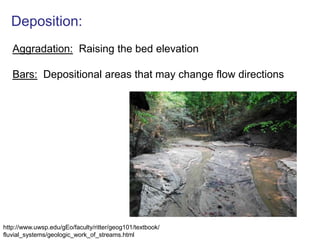
Deposition:Aggradation:  Raising the bed elevationBars:  Depositional areas that may change flow directionshttp://www.uwsp.edu/gEo/faculty/ritter/geog101/textbook/fluvial_systems/geologic_work_of_streams.html
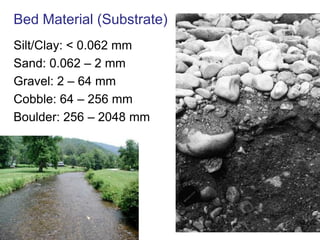
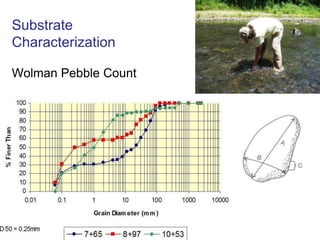
Bed Material (Substrate)Silt/Clay: < 0.062 mmSand: 0.062 – 2 mmGravel: 2 – 64 mmCobble: 64 – 256 mmBoulder: 256 – 2048 mm
Substrate CharacterizationWolman Pebble Count
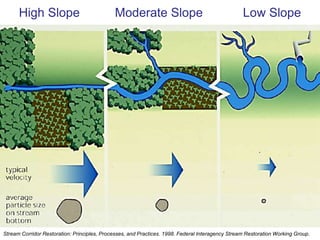
High Slope		Moderate Slope		Low SlopeStream Corridor Restoration: Principles, Processes, and Practices. 1998. Federal Interagency Stream Restoration Working Group.
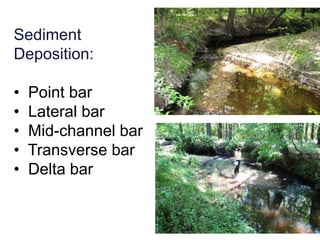
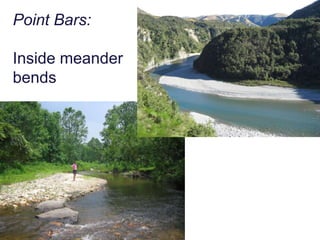
Sediment Deposition:  Point bar
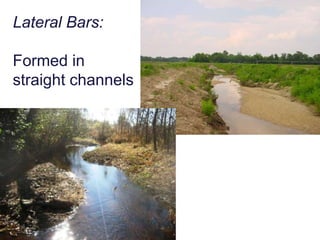
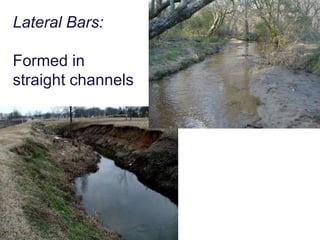
  Lateral bar
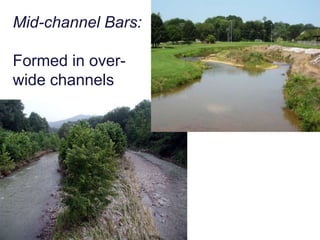
  Mid-channel bar
  Transverse bar
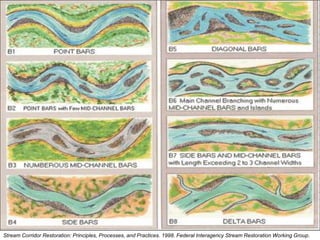
  Delta barStream Corridor Restoration: Principles, Processes, and Practices. 1998. Federal Interagency Stream Restoration Working Group.
Point Bars:  Inside meander bends
Lateral Bars:  Formed in straight channels
Mid-channel Bars:  Formed in over-wide channels
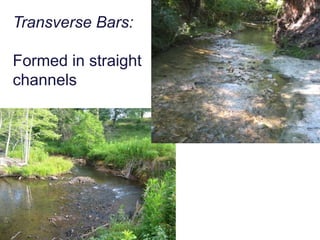
Transverse Bars:  Formed in straight channels
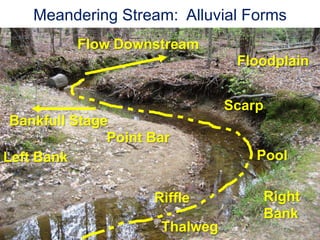
Meandering Stream:  Alluvial FormsFlow DownstreamFloodplainScarpBankfull StagePoint BarPoolLeft BankRight BankRiffleThalweg
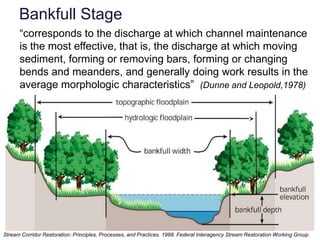
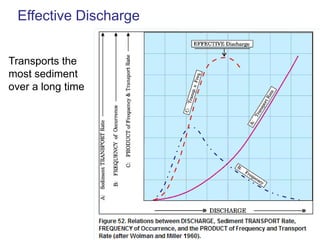
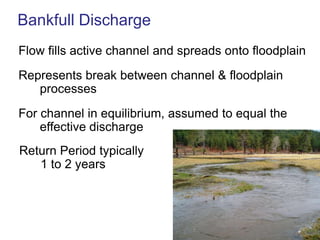
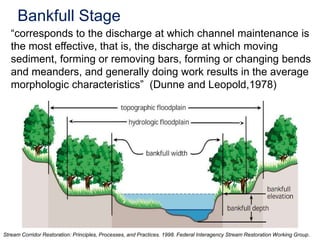
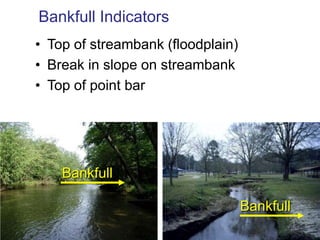
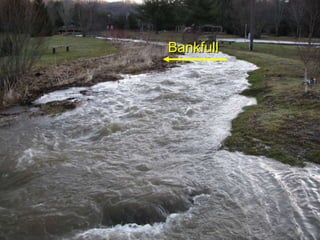
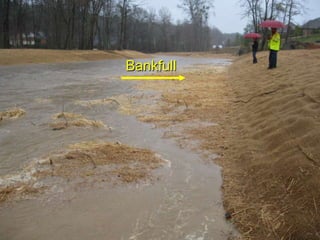
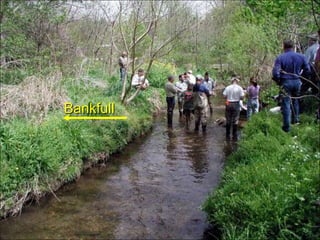
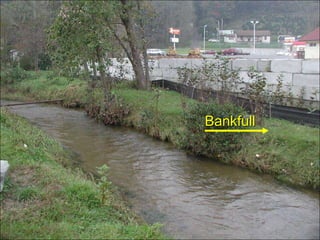
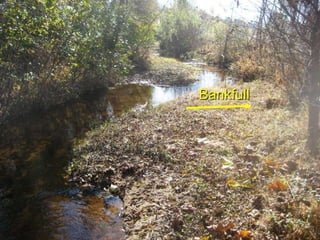
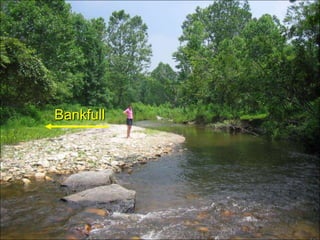
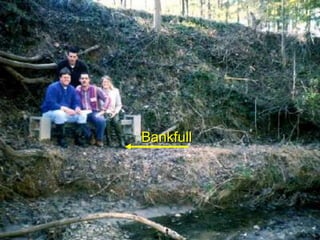
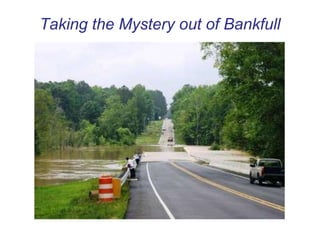
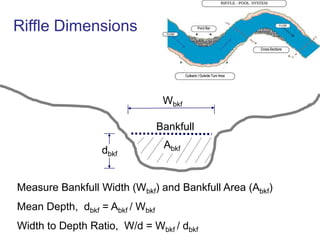
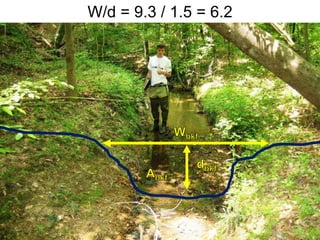
Bankfull Stage“corresponds to the discharge at which channel maintenance is the most effective, that is, the discharge at which moving sediment, forming or removing bars, forming or changing bends and meanders, and generally doing work results in the average morphologic characteristics”  (Dunne and Leopold,1978)Stream Corridor Restoration: Principles, Processes, and Practices. 1998. Federal Interagency Stream Restoration Working Group.
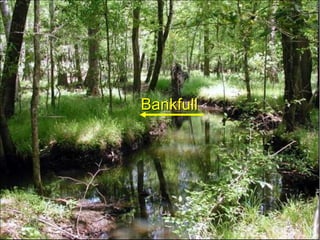
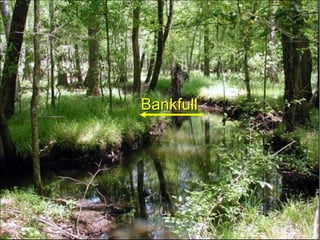
Bankfull
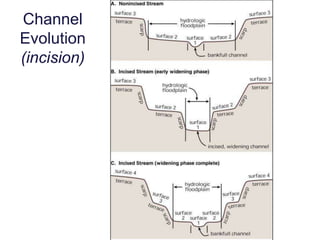
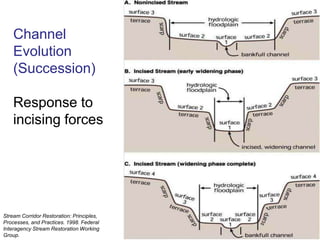
Channel Evolution (incision)
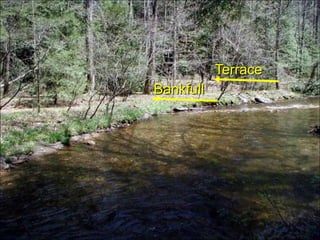
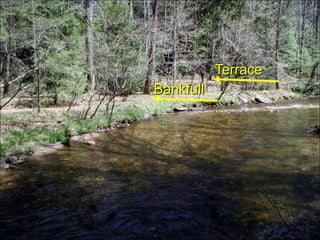
TerraceBankfull
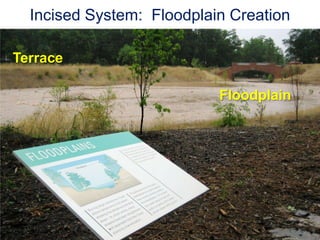
Incised System:  Floodplain CreationTerraceFloodplain
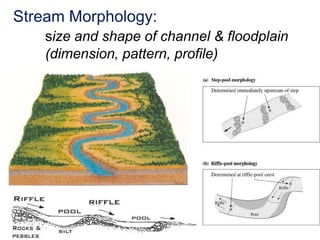
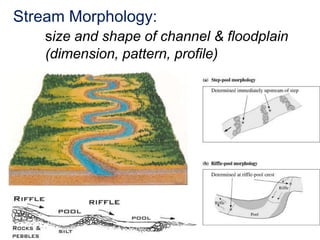
Stream Morphology:size and shape of channel & floodplain 	(dimension, pattern, profile)
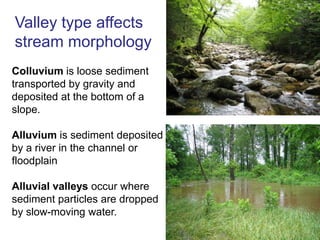
Valley type affects stream morphologyColluvium is loose sediment transported by gravity and deposited at the bottom of a slope.Alluvium is sediment deposited by a river in the channel or floodplainAlluvial valleys occur where sediment particles are dropped by slow-moving water.
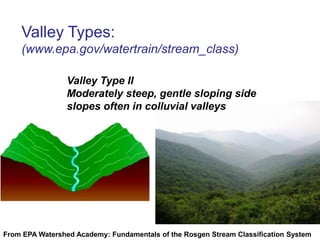
Valley Types:  (www.epa.gov/watertrain/stream_class)Valley Type II Moderately steep, gentle sloping side slopes often in colluvial valleysFrom EPA Watershed Academy: Fundamentals of the Rosgen Stream Classification System
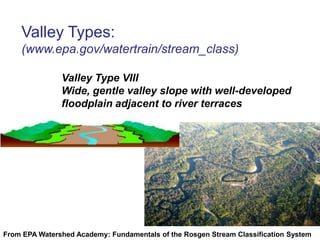
Valley Types:  (www.epa.gov/watertrain/stream_class)Valley Type VIII Wide, gentle valley slope with well-developed floodplain adjacent to river terracesFrom EPA Watershed Academy: Fundamentals of the Rosgen Stream Classification System
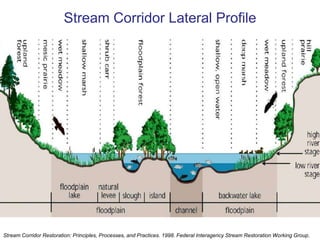
Stream Corridor Lateral ProfileStream Corridor Restoration: Principles, Processes, and Practices. 1998. Federal Interagency Stream Restoration Working Group.
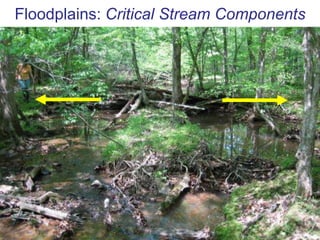
Floodplains: Critical Stream Components
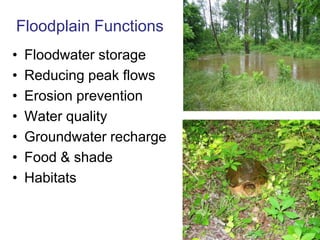
Floodplain FunctionsFloodwater storage
Reducing peak flows
Erosion prevention
Water quality
Groundwater recharge
Food & shade
Habitats
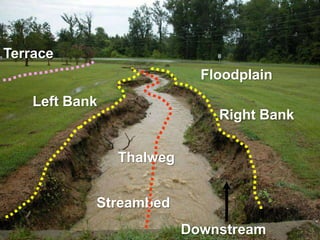
TerraceFloodplainLeft BankRight BankThalwegStreambedDownstream
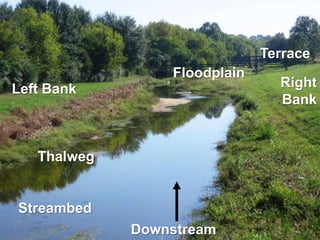
TerraceFloodplainRight BankLeft BankThalwegStreambedDownstream
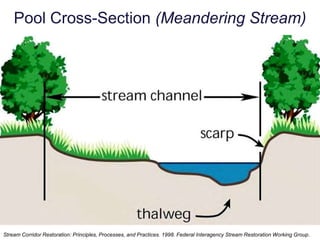
Pool Cross-Section (Meandering Stream)Stream Corridor Restoration: Principles, Processes, and Practices. 1998. Federal Interagency Stream Restoration Working Group.
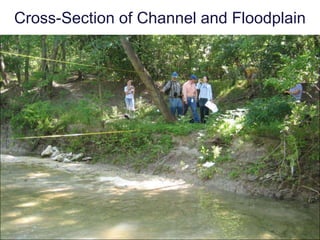
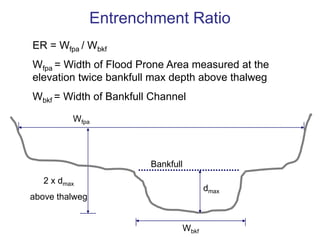
Cross-Section of Channel and Floodplain
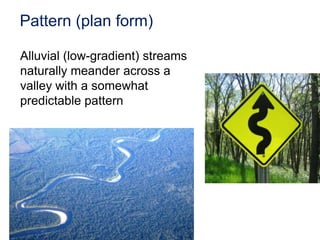
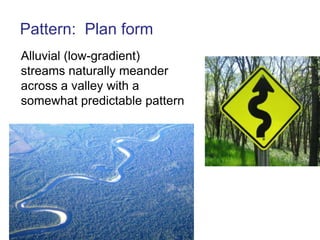
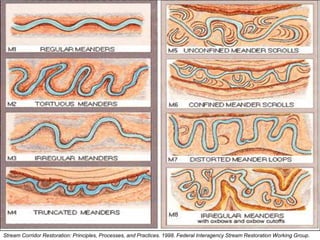
Pattern (plan form)Alluvial (low-gradient) streams naturally meander across a valley with a somewhat predictable pattern
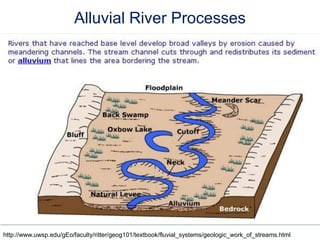
Alluvial River Processeshttp://www.uwsp.edu/gEo/faculty/ritter/geog101/textbook/fluvial_systems/geologic_work_of_streams.html
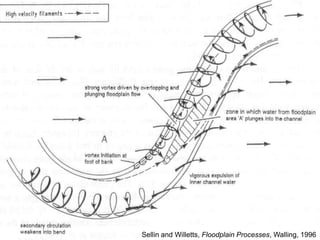
Sellin and Willetts, Floodplain Processes, Walling, 1996
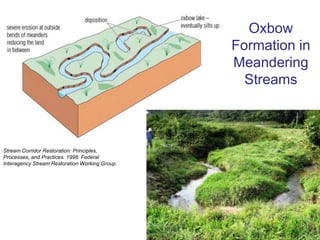
Oxbow Formation in Meandering StreamsStream Corridor Restoration: Principles, Processes, and Practices. 1998. Federal Interagency Stream Restoration Working Group.
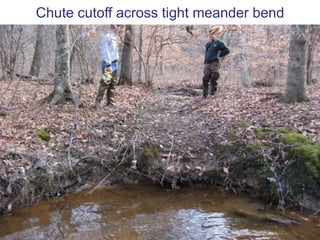
Chute cutoff across tight meander bend
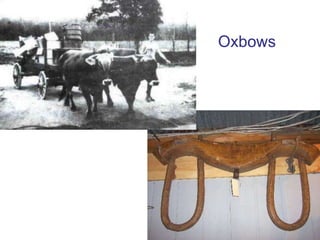
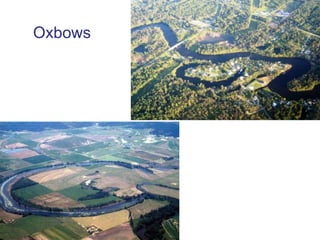
Oxbows
Oxbows
Stream Corridor Restoration: Principles, Processes, and Practices. 1998. Federal Interagency Stream Restoration Working Group.
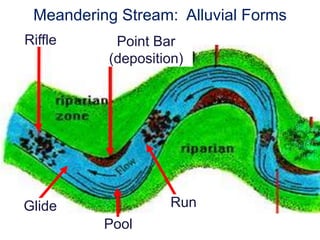
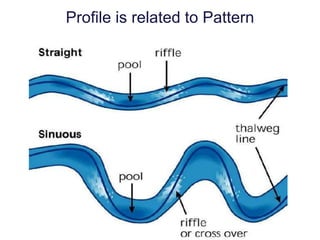
Meandering Stream:  Alluvial FormsRifflePoint Bar (deposition)RunGlidePool
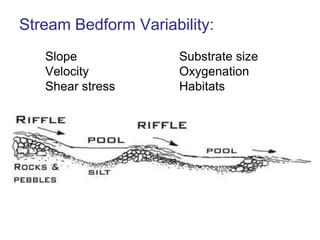
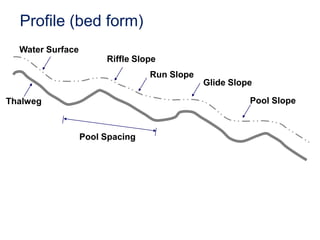
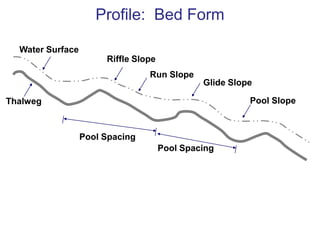
Stream Bedform Variability:Slope				Substrate size Velocity			OxygenationShear stress			Habitats
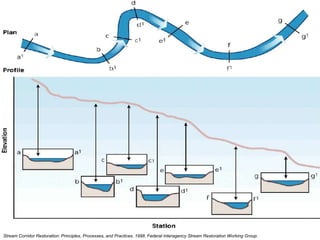
Profile (bed form)Water SurfaceRiffle SlopeRun SlopeGlide SlopePool SlopeThalwegPool Spacing
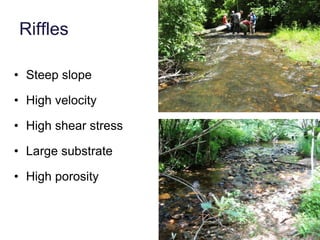
RifflesSteep slope
High velocity
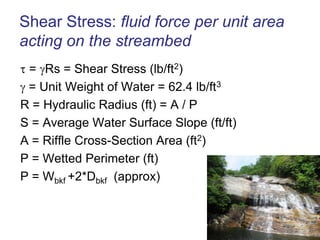
High shear stress
Large substrate
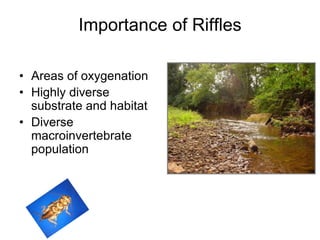
High porosityImportance of RifflesAreas of oxygenationHighly diverse substrate and habitatDiverse macroinvertebrate population
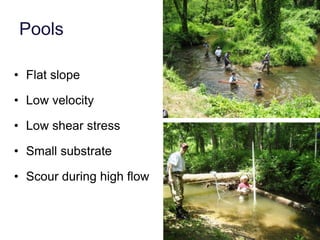
PoolsFlat slope
Low velocity
Low shear stress
Small substrate
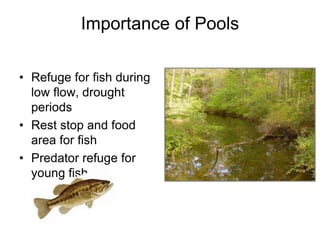
Scour during high flowImportance of PoolsRefuge for fish during low flow, drought periodsRest stop and food area for fishPredator refuge for young fish
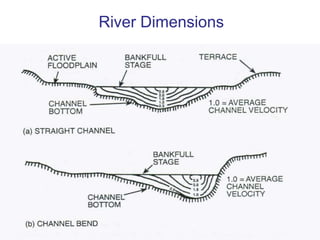
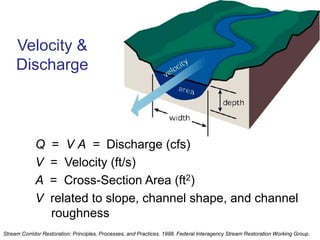
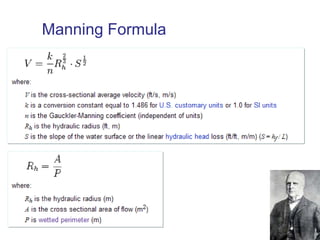
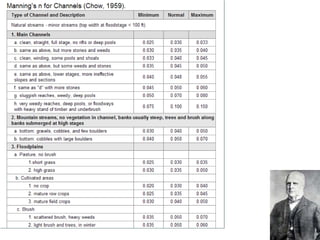
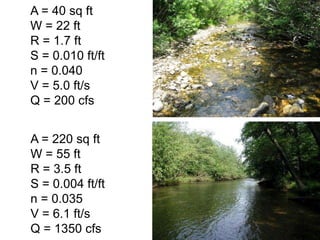
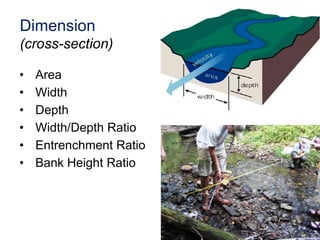
River Dimensions
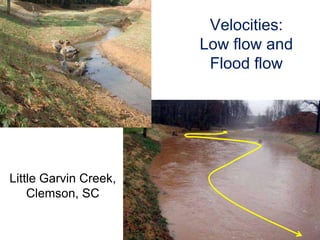
Velocities:Low flow and Flood flowLittle Garvin Creek, Clemson, SC
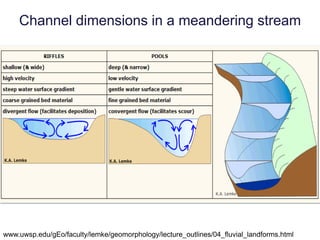
Channel dimensions in a meandering streamwww.uwsp.edu/gEo/faculty/lemke/geomorphology/lecture_outlines/04_fluvial_landforms.html
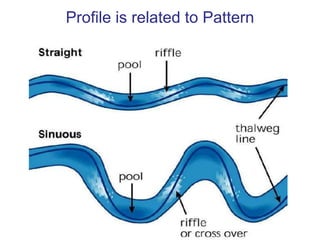
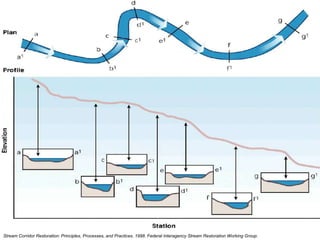
Profile is related to Pattern
Stream Corridor Restoration: Principles, Processes, and Practices. 1998. Federal Interagency Stream Restoration Working Group.
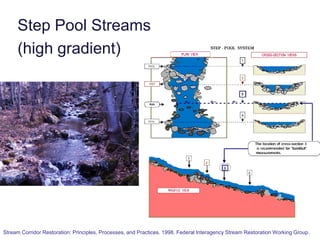
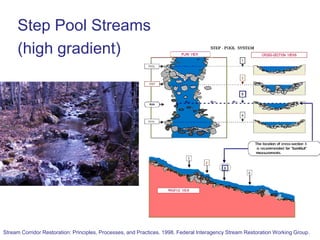
Step Pool Streams(high gradient)Stream Corridor Restoration: Principles, Processes, and Practices. 1998. Federal Interagency Stream Restoration Working Group.
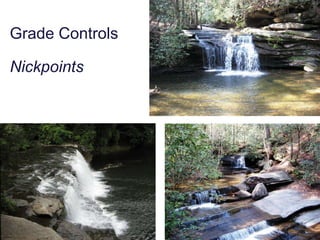
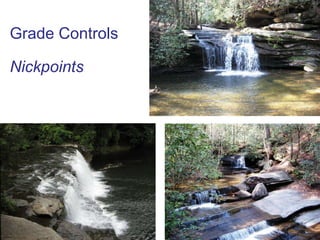
Grade ControlsNickpoints
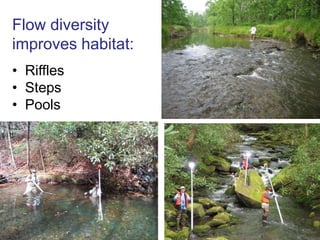
Flow diversity improves habitat:  Riffles
  Steps
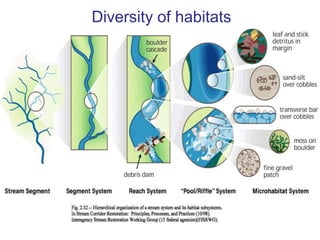
  PoolsDiversity of habitats
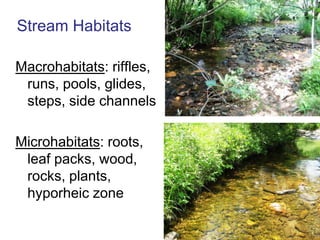
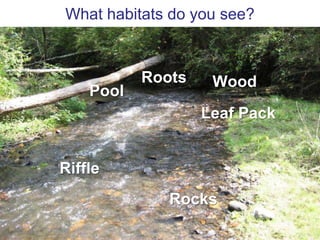
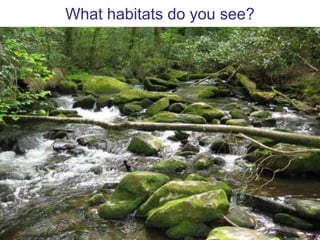
Stream HabitatsMacrohabitats: riffles, runs, pools, glides, steps, side channelsMicrohabitats: roots, leaf packs, wood, rocks, plants, hyporheic zone
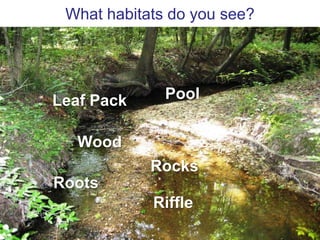
What habitats do you see?PoolLeaf PackWoodRocksRootsRiffle
What habitats do you see?RootsWoodPoolLeaf PackRiffleRocks
What habitats do you see?
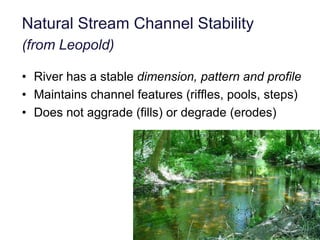
Natural Stream Channel Stability(from Leopold)River has a stable dimension, pattern and profileMaintains channel features (riffles, pools, steps)Does not aggrade (fills) or degrade (erodes)
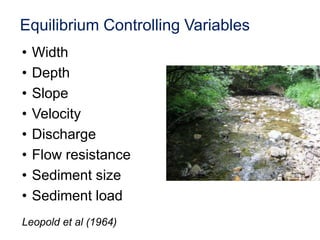
Equilibrium Controlling VariablesWidth

Rc101 Day 1 Jennings 10