Learning Objectives
• Bythe end of this session, students will be able to:
• Define stream ciphers and block ciphers
• Explain how each cipher works
• Compare security and performance
• Identify suitable cloud use cases
• Justify cipher selection in assignments
3.
What is aCipher?
• A cipher is a cryptographic algorithm
• Converts plaintext → ciphertext
• Uses a secret key
• Ensures confidentiality of data
• Core component of encryption systems
4.
Why Ciphers areimportant in Cloud
• Cloud data is stored remotely
• Shared infrastructure risks
• Data travels across networks
• Encryption protects data at:
• Rest
• Transit
• Processing
5.
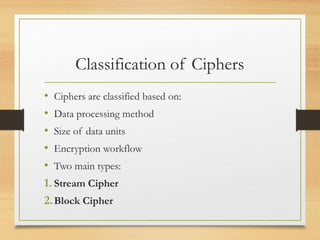
Classification of Ciphers
•Ciphers are classified based on:
• Data processing method
• Size of data units
• Encryption workflow
• Two main types:
1. Stream Cipher
2.Block Cipher
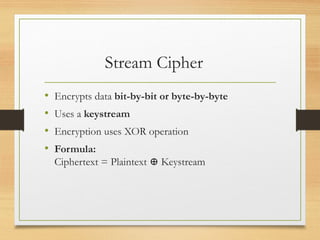
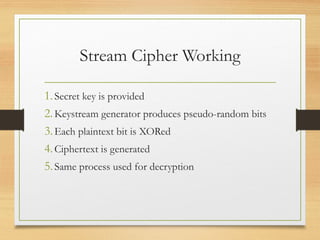
Stream Cipher Working
1.Secretkey is provided
2.Keystream generator produces pseudo-random bits
3.Each plaintext bit is XORed
4.Ciphertext is generated
5.Same process used for decryption
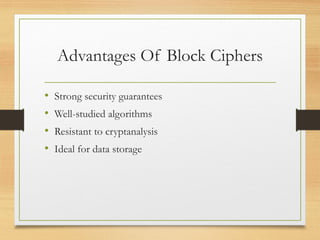
Advantages Of BlockCiphers
• Strong security guarantees
• Well-studied algorithms
• Resistant to cryptanalysis
• Ideal for data storage
19.
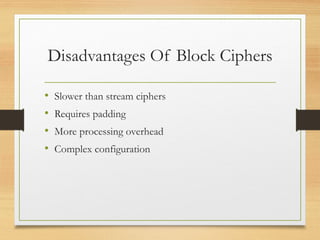
Disadvantages Of BlockCiphers
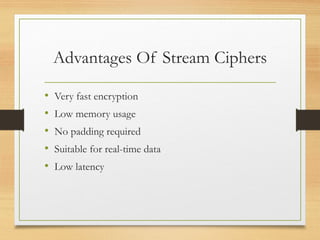
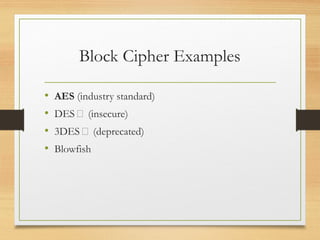
• Slower than stream ciphers
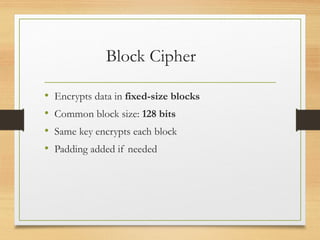
• Requires padding
• More processing overhead
• Complex configuration
20.
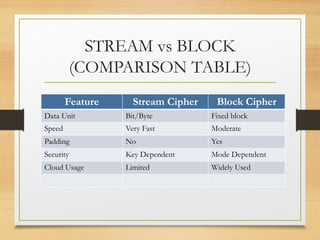
STREAM vs BLOCK
(COMPARISONTABLE)
Feature Stream Cipher Block Cipher
Data Unit Bit/Byte Fixed block
Speed Very Fast Moderate
Padding No Yes
Security Key Dependent Mode Dependent
Cloud Usage Limited Widely Used
21.
Security Comparison
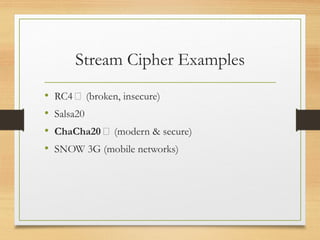
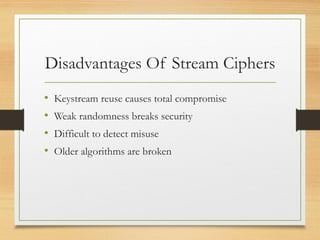
• Streamcipher security depends on keystream
randomness
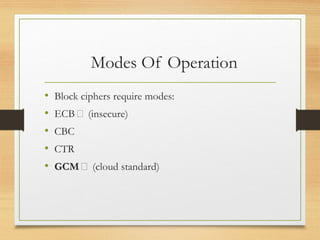
• Block cipher security depends on mode of operation
• AES-GCM provides strongest cloud security
• Misconfiguration = insecure system