Strategy 
dilemmas
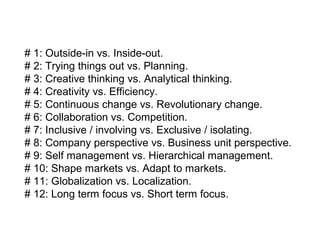
# 1: Outside-in vs. Inside-out. 
# 2: Trying things out vs. Planning. 
# 3: Creative thinking vs. Analytical thinking. 
# 4: Creativity vs. Efficiency. 
# 5: Continuous change vs. Revolutionary change. 
# 6: Collaboration vs. Competition. 
# 7: Inclusive / involving vs. Exclusive / isolating. 
# 8: Company perspective vs. Business unit perspective. 
# 9: Self management vs. Hierarchical management. 
# 10: Shape markets vs. Adapt to markets. 
# 11: Long term focus vs. Short term focus. 
# 12: Globalization vs. Localization.
Strategy dilemma # 1 
Outside-in 
vs. 
Inside-out
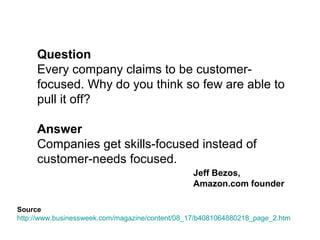
Question 
Every company claims to be customer-focused. 
Why do you think so few are able to pull it off? 
Answer 
Companies get skills-focused instead of 
customer-needs focused. 
Jeff Bezos 
http://www.businessweek.com/magazine/content/08_17/b4081064880218_page_2.htm
Do all of innovations come from inside of the 
firm, where we develop the new ideas 
internally and execute them ourselves? 
Or do we systems set up so that the ideas we 
execute can come from anywhere, and some 
of our own ideas end up being brought to 
market by someone else? 
http://timkastelle.org/blog/2011/12/ten-tensions-in-innovation-revised/
Further inspiration 
http://www.slideshare.net/frankcalberg/customer-needs 
http://www.slideshare.net/frankcalberg/pestel 
http://www.scribd.com/doc/36349465/Capital
Strategy dilemma # 2 
Trying things out 
vs. 
Planning
experiments Experimerenquitre sshorrt-teermq lousseisr foer lo nsgh-terom gratins- term 
losses for long-term gains. 
http://hbr.org/2010/04/column-why-businesses-dont-experiment/ar/1
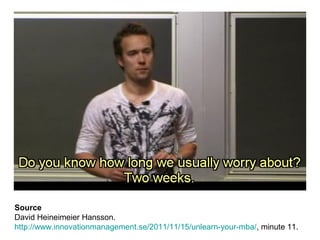
http://www.innovationmanagement.se/2011/11/15/unlearn-your-mba/, minute 11.
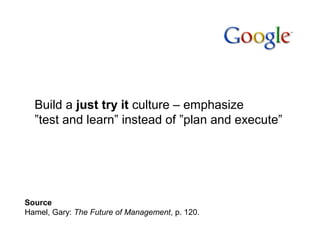
The “discovery” model reflects what a 
company is like in its start-up phase. In this 
period management is likely to be relatively 
informal, and even vague about how work 
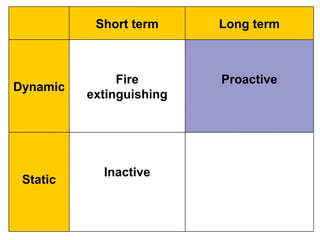
should get done and to what end. 
Google began life using the discovery 
model, and to some extent still does. 
http://www.ft.com/cms/s/0/6ce11196-35f3-11df-aa43-00144feabdc0.html
When pharmaceutical companies conduct clinical trials to test the 
safety and efficacy of their drugs as part of the process for 
obtaining regulatory approval, some patients receive the drug and 
others some standard existing treatment or a sugar pill (placebo). 
A comparison of the two sets of results tells us whether the drug 
improves patients’ symptoms and has side effects. 
Many potential changes in your organizations can be subjected to 
a similar experiment: implement the change in some places, 
but not in others, and compare performance in the two groups 
to learn whether the change is effective. 
http://blogs.hbr.org/2014/10/experiment-with-organizational-change-before-going-all-in/
Strategy dilemma # 3 
Creative thinking 
vs. 
Analytical thinking
Creative approach: 
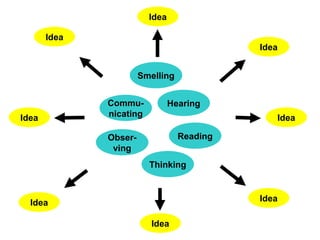
From few to many possibilities
Idea 
Thinking Hearing 
Communicating 
Observing 
Reading 
Smelling 
Idea 
Idea 
Idea 
Idea 
Idea 
Idea 
Idea
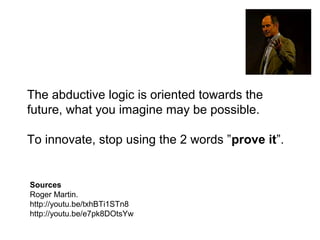
The abductive logic is oriented 
towards the future, what you 
imagine may be possible. 
To innovate, stop using the 2 
words ”prove it”. 
http://youtu.be/txhBTi1STn8 
http://youtu.be/e7pk8DOtsYw
Research by Marius Usher shows that when 
people made choices based only on instinct, 
they made the right call up to 90% of the time. 
http://blogs.hbr.org/hbr/nayar/2013/05/listening-to-your-inner-voice.html
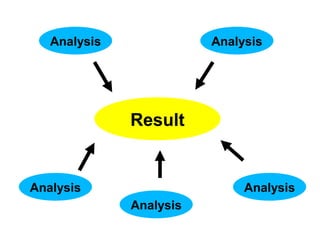
Analytic approach: 
From many to few possibilities
Analysis 
Result 
Analysis 
Analysis Analysis 
Analysis
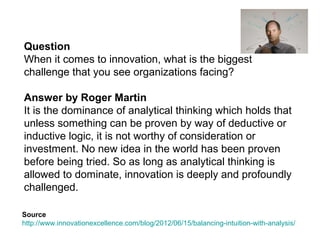
Question 
When it comes to innovation, what is the biggest 
challenge that you see organizations facing? 
Roger Martin 
It is the dominance of analytical thinking which holds that unless 
something can be proven by way of deductive or inductive logic, 
it is not worthy of consideration or investment. No new idea in 
the world has been proven before being tried. So as long as 
analytical thinking is allowed to dominate, innovation is deeply 
and profoundly challenged. 
http://www.innovationexcellence.com/blog/2012/06/15/balancing-intuition-with-analysis/
The inductive and deductive logic 
is based on the past experiences. 
Focus is on proving things. 
http://youtu.be/txhBTi1STn8 
http://youtu.be/e7pk8DOtsYw
Further inspiration 
http://www.slideshare.net/frankcalberg/creativity-exercises 
http://www.slideshare.net/frankcalberg/creativity-and-innovation-6546087
Strategy dilemma # 4 
Creativity 
vs. 
Efficiency
Industrial firms thrive on reducing variation 
(manufacturing errors); 
Creative firms thrive on increasing variation 
(innovation). 
http://hbr.org/2014/01/how-netflix-reinvented-hr/ar/1 
Reed Hastings
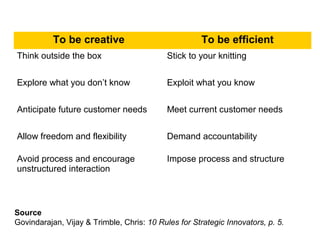
To be creative To be efficient 
Think outside the box. Stick to your knitting. 
Explore what you don’t know. Exploit what you know. 
Anticipate future customer needs. Meet current customer needs. 
Allow freedom and flexibility. Demand accountability. 
Avoid process and encourage 
unstructured interaction. 
Impose process and structure. 
Govindarajan, Vijay & Trimble, Chris: 10 Rules for Strategic Innovators, p. 5.
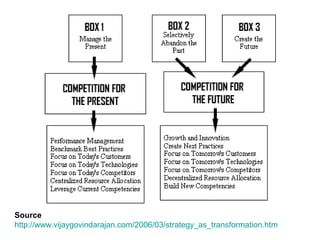
http://www.vijaygovindarajan.com/2006/03/strategy_as_transformation.htm
Strategy dilemma # 5 
Continuous change 
vs. 
Revolutinary change
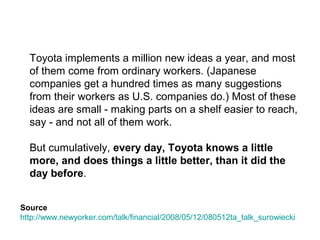
Toyota implements a million new ideas a year, and most of 
them come from ordinary workers. (Japanese companies get a 
hundred times as many suggestions from their workers as U.S. 
companies do.) Most of these ideas are small - making parts 
on a shelf easier to reach, say - and not all of them work. 
But cumulatively, every day, Toyota knows a little more, and 
does things a little better, than it did the day before. 
http://www.newyorker.com/talk/financial/2008/05/12/080512ta_talk_surowiecki
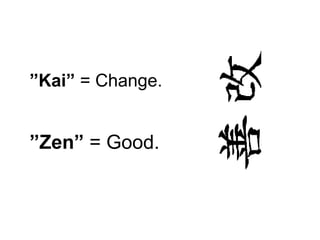
”Kai” = Change. 
”Zen” = Good.
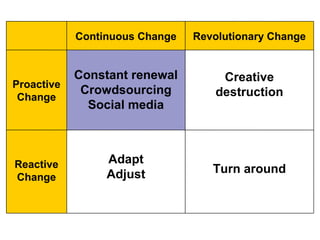
Continuous change Revolutionary change 
Continous improvement Creative destruction 
Proactive 
Change 
Reactive Adapt / adjust Turn around 
Change
Strategy dilemma # 6 
Collaboration 
vs. 
competition
Santander went into partnership with Funding 
Circle. The bank recognized that a segment of its 
customer base wanted access to peer-to-peer 
lending and acknowledged that it would be costly 
to build a world-class offering from scratch. 
http://www.mckinsey.com/insights/strategy/strategic_principles_for_competing_in_the_digital_age
Sharing information and expertise is a great 
way to build trust with your competitors. 
http://blogs.hbr.org/2014/02/use-co-opetition-to-build-new-lines-of-revenue/
Strategy dilemma # 7 
Inclusive / involving 
vs. 
Exclusive / isolating
How should companies react 
to creative external people?
Active Resist 
Actively restrain what creative 
customers do with product / 
service. 
Enable 
Actively facilitate what creative 
people do with product / 
service. 
Passive Discourage 
Ignore what creative customers do 
with product / service. 
Encourage 
But don’t actively 
facilitate. 
Degree of positive attitude towards customer innovation 
http://www.slideshare.net/IanMcCarthy/when-customers-get-clever-managerial-approaches-to-dealing-with-creative-consumers
Executives at organizations that are experimenting with more 
participatory modes of strategy development cite two major benefits: 
Benefit # 1 
Improving the quality of strategy by pulling in diverse and detailed 
frontline perspectives that are typically overlooked but can make the 
resulting plans more insightful and actionable. 
Benefit # 2 
The second is building enthusiasm and alignment behind a company’s 
strategic direction. 
https://www.mckinseyquarterly.com/Strategy/Strategy_in_Practice/The_social_side_of_strategy_2965
Further inspiration 
https://delicious.com/frankcalberg/crowdsourcing 
http://www.slideshare.net/frankcalberg/rethinking-recruitment-8077077
Strategy dilemma # 8 
Company perspective 
vs. 
Business unit perspective
Wal-Mart stores established its digital 
business away from corporate headquarters 
to allow a new culture and new skills to grow. 
http://www.mckinsey.com/insights/strategy/strategic_principles_for_competing_in_the_digital_age
In the long run, internal competition 
causes every participant to lose. 
When leaders look for ways to encourage 
cooperation and generate common goals, 
they become more successful. 
http://blogs.hbr.org/cs/2013/02/how_poor_leaders_become_good_l.html
Strategy dilemma # 9 
Self management 
vs. 
Hierarchical management
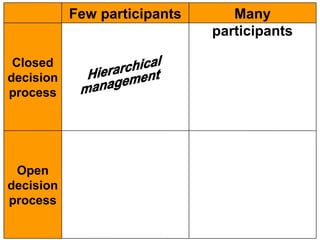
Use of crowdsourcing / 
social media 
Closed 
decision 
process 
Open 
decision 
process 
Few participants Many participants
Further inspiration 
http://www.slideshare.net/frankcalberg/3-ways-of-organizing 
http://www.slideshare.net/frankcalberg/good-leadership
Strategy dilemma # 10 
Shape markets 
vs. 
Adapt to markets
Adapting is preferable when key sources of 
value creation are relatively stable or 
outside the company’s control. 
https://www.mckinseyquarterly.com/Strategy/Strategic_Thinking/Making_the_most_of_uncertainty_1128
To put things simply, when it faces very high 
levels of uncertainty about variables it 
can influence, shaping makes most sense. 
https://www.mckinseyquarterly.com/Strategy/Strategic_Thinking/Making_the_most_of_uncertainty_1128
A shaping strategy is best in unpredictable 
environments that you have the power to change. 
In new or young high-growth industries where barriers to 
entry are low, innovation rates are high, demand is very hard 
to predict, and the relative positions of competitors are in flux, 
a company can often radically shift the course of industry 
development through some innovative move. 
http://blogs.hbr.org/cs/2012/09/know_which_strategy_style_is.html
A shaping strategy embraces short 
or continual planning cycles. 
Flexibility is paramount, little reliance is placed 
on elaborate prediction mechanisms, and the 
strategy is most commonly implemented as a 
portfolio of experiments. 
http://blogs.hbr.org/cs/2012/09/know_which_strategy_style_is.html
Strategy dilemma # 11 
Long term focus 
vs. 
Short term focus
Short term Long term 
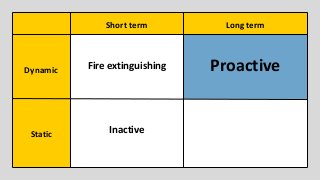
Dynamic Fire extinguishing Proactive 
Inactive Static
Further inspiration 
http://www.slideshare.net/frankcalberg/time-15259416
Strategy dilemma # 12 
Globalization 
vs. 
Localization
Further inspiration 
http://www.slideshare.net/frankcalberg/globalization-and-localization
Thank you for your interest. For further inspiration 
and personalized services, please feel welcome to visit 
http://frankcalberg.com 
Have a great day.

Strategy dilemmas

  • 1.
  • 2.
    # 1: Outside-invs. Inside-out. # 2: Trying things out vs. Planning. # 3: Creative thinking vs. Analytical thinking. # 4: Creativity vs. Efficiency. # 5: Continuous change vs. Revolutionary change. # 6: Collaboration vs. Competition. # 7: Inclusive / involving vs. Exclusive / isolating. # 8: Company perspective vs. Business unit perspective. # 9: Self management vs. Hierarchical management. # 10: Shape markets vs. Adapt to markets. # 11: Long term focus vs. Short term focus. # 12: Globalization vs. Localization.
  • 3.
    Strategy dilemma #1 Outside-in vs. Inside-out
  • 4.
    Question Every companyclaims to be customer-focused. Why do you think so few are able to pull it off? Answer Companies get skills-focused instead of customer-needs focused. Jeff Bezos http://www.businessweek.com/magazine/content/08_17/b4081064880218_page_2.htm
  • 5.
    Do all ofinnovations come from inside of the firm, where we develop the new ideas internally and execute them ourselves? Or do we systems set up so that the ideas we execute can come from anywhere, and some of our own ideas end up being brought to market by someone else? http://timkastelle.org/blog/2011/12/ten-tensions-in-innovation-revised/
  • 6.
    Further inspiration http://www.slideshare.net/frankcalberg/customer-needs http://www.slideshare.net/frankcalberg/pestel http://www.scribd.com/doc/36349465/Capital
  • 7.
    Strategy dilemma #2 Trying things out vs. Planning
  • 8.
    experiments Experimerenquitre sshorrt-teermqlousseisr foer lo nsgh-terom gratins- term losses for long-term gains. http://hbr.org/2010/04/column-why-businesses-dont-experiment/ar/1
  • 9.
  • 10.
    The “discovery” modelreflects what a company is like in its start-up phase. In this period management is likely to be relatively informal, and even vague about how work should get done and to what end. Google began life using the discovery model, and to some extent still does. http://www.ft.com/cms/s/0/6ce11196-35f3-11df-aa43-00144feabdc0.html
  • 11.
    When pharmaceutical companiesconduct clinical trials to test the safety and efficacy of their drugs as part of the process for obtaining regulatory approval, some patients receive the drug and others some standard existing treatment or a sugar pill (placebo). A comparison of the two sets of results tells us whether the drug improves patients’ symptoms and has side effects. Many potential changes in your organizations can be subjected to a similar experiment: implement the change in some places, but not in others, and compare performance in the two groups to learn whether the change is effective. http://blogs.hbr.org/2014/10/experiment-with-organizational-change-before-going-all-in/
  • 12.
    Strategy dilemma #3 Creative thinking vs. Analytical thinking
  • 13.
    Creative approach: Fromfew to many possibilities
  • 14.
    Idea Thinking Hearing Communicating Observing Reading Smelling Idea Idea Idea Idea Idea Idea Idea
  • 15.
    The abductive logicis oriented towards the future, what you imagine may be possible. To innovate, stop using the 2 words ”prove it”. http://youtu.be/txhBTi1STn8 http://youtu.be/e7pk8DOtsYw
  • 16.
    Research by MariusUsher shows that when people made choices based only on instinct, they made the right call up to 90% of the time. http://blogs.hbr.org/hbr/nayar/2013/05/listening-to-your-inner-voice.html
  • 17.
    Analytic approach: Frommany to few possibilities
  • 18.
    Analysis Result Analysis Analysis Analysis Analysis
  • 19.
    Question When itcomes to innovation, what is the biggest challenge that you see organizations facing? Roger Martin It is the dominance of analytical thinking which holds that unless something can be proven by way of deductive or inductive logic, it is not worthy of consideration or investment. No new idea in the world has been proven before being tried. So as long as analytical thinking is allowed to dominate, innovation is deeply and profoundly challenged. http://www.innovationexcellence.com/blog/2012/06/15/balancing-intuition-with-analysis/
  • 20.
    The inductive anddeductive logic is based on the past experiences. Focus is on proving things. http://youtu.be/txhBTi1STn8 http://youtu.be/e7pk8DOtsYw
  • 21.
    Further inspiration http://www.slideshare.net/frankcalberg/creativity-exercises http://www.slideshare.net/frankcalberg/creativity-and-innovation-6546087
  • 22.
    Strategy dilemma #4 Creativity vs. Efficiency
  • 23.
    Industrial firms thriveon reducing variation (manufacturing errors); Creative firms thrive on increasing variation (innovation). http://hbr.org/2014/01/how-netflix-reinvented-hr/ar/1 Reed Hastings
  • 24.
    To be creativeTo be efficient Think outside the box. Stick to your knitting. Explore what you don’t know. Exploit what you know. Anticipate future customer needs. Meet current customer needs. Allow freedom and flexibility. Demand accountability. Avoid process and encourage unstructured interaction. Impose process and structure. Govindarajan, Vijay & Trimble, Chris: 10 Rules for Strategic Innovators, p. 5.
  • 25.
  • 26.
    Strategy dilemma #5 Continuous change vs. Revolutinary change
  • 27.
    Toyota implements amillion new ideas a year, and most of them come from ordinary workers. (Japanese companies get a hundred times as many suggestions from their workers as U.S. companies do.) Most of these ideas are small - making parts on a shelf easier to reach, say - and not all of them work. But cumulatively, every day, Toyota knows a little more, and does things a little better, than it did the day before. http://www.newyorker.com/talk/financial/2008/05/12/080512ta_talk_surowiecki
  • 28.
    ”Kai” = Change. ”Zen” = Good.
  • 29.
    Continuous change Revolutionarychange Continous improvement Creative destruction Proactive Change Reactive Adapt / adjust Turn around Change
  • 30.
    Strategy dilemma #6 Collaboration vs. competition
  • 31.
    Santander went intopartnership with Funding Circle. The bank recognized that a segment of its customer base wanted access to peer-to-peer lending and acknowledged that it would be costly to build a world-class offering from scratch. http://www.mckinsey.com/insights/strategy/strategic_principles_for_competing_in_the_digital_age
  • 32.
    Sharing information andexpertise is a great way to build trust with your competitors. http://blogs.hbr.org/2014/02/use-co-opetition-to-build-new-lines-of-revenue/
  • 33.
    Strategy dilemma #7 Inclusive / involving vs. Exclusive / isolating
  • 34.
    How should companiesreact to creative external people?
  • 35.
    Active Resist Activelyrestrain what creative customers do with product / service. Enable Actively facilitate what creative people do with product / service. Passive Discourage Ignore what creative customers do with product / service. Encourage But don’t actively facilitate. Degree of positive attitude towards customer innovation http://www.slideshare.net/IanMcCarthy/when-customers-get-clever-managerial-approaches-to-dealing-with-creative-consumers
  • 36.
    Executives at organizationsthat are experimenting with more participatory modes of strategy development cite two major benefits: Benefit # 1 Improving the quality of strategy by pulling in diverse and detailed frontline perspectives that are typically overlooked but can make the resulting plans more insightful and actionable. Benefit # 2 The second is building enthusiasm and alignment behind a company’s strategic direction. https://www.mckinseyquarterly.com/Strategy/Strategy_in_Practice/The_social_side_of_strategy_2965
  • 37.
    Further inspiration https://delicious.com/frankcalberg/crowdsourcing http://www.slideshare.net/frankcalberg/rethinking-recruitment-8077077
  • 38.
    Strategy dilemma #8 Company perspective vs. Business unit perspective
  • 39.
    Wal-Mart stores establishedits digital business away from corporate headquarters to allow a new culture and new skills to grow. http://www.mckinsey.com/insights/strategy/strategic_principles_for_competing_in_the_digital_age
  • 40.
    In the longrun, internal competition causes every participant to lose. When leaders look for ways to encourage cooperation and generate common goals, they become more successful. http://blogs.hbr.org/cs/2013/02/how_poor_leaders_become_good_l.html
  • 41.
    Strategy dilemma #9 Self management vs. Hierarchical management
  • 42.
    Use of crowdsourcing/ social media Closed decision process Open decision process Few participants Many participants
  • 43.
    Further inspiration http://www.slideshare.net/frankcalberg/3-ways-of-organizing http://www.slideshare.net/frankcalberg/good-leadership
  • 44.
    Strategy dilemma #10 Shape markets vs. Adapt to markets
  • 45.
    Adapting is preferablewhen key sources of value creation are relatively stable or outside the company’s control. https://www.mckinseyquarterly.com/Strategy/Strategic_Thinking/Making_the_most_of_uncertainty_1128
  • 46.
    To put thingssimply, when it faces very high levels of uncertainty about variables it can influence, shaping makes most sense. https://www.mckinseyquarterly.com/Strategy/Strategic_Thinking/Making_the_most_of_uncertainty_1128
  • 47.
    A shaping strategyis best in unpredictable environments that you have the power to change. In new or young high-growth industries where barriers to entry are low, innovation rates are high, demand is very hard to predict, and the relative positions of competitors are in flux, a company can often radically shift the course of industry development through some innovative move. http://blogs.hbr.org/cs/2012/09/know_which_strategy_style_is.html
  • 48.
    A shaping strategyembraces short or continual planning cycles. Flexibility is paramount, little reliance is placed on elaborate prediction mechanisms, and the strategy is most commonly implemented as a portfolio of experiments. http://blogs.hbr.org/cs/2012/09/know_which_strategy_style_is.html
  • 49.
    Strategy dilemma #11 Long term focus vs. Short term focus
  • 50.
    Short term Longterm Dynamic Fire extinguishing Proactive Inactive Static
  • 51.
  • 52.
    Strategy dilemma #12 Globalization vs. Localization
  • 53.
  • 54.
    Thank you foryour interest. For further inspiration and personalized services, please feel welcome to visit http://frankcalberg.com Have a great day.