Marshmallow Tower Game


        Jay Rao
       Professor
        Babson
Game Rules
• Build the Tallest Freestanding Structure:
    – Tallest structure measured from the table top surface to the top of the marshmallow.
    – Structure cannot be suspended from a higher structure, like a chair, ceiling or chandelier.
    – Do not search the internet for answers.

• The Entire Marshmallow Must be on Top:
    – Cutting or eating part of the marshmallow disqualifies the team.

• Use as Much or as Little of the Kit – Spaghetti sticks, String and Tape:
    – The team cannot use the paper bag or scissors as part of their structure.

• Break up the Spaghetti, String or Tape:
    – Teams are free to break the spaghetti, cut up the tape and string to create new structures.

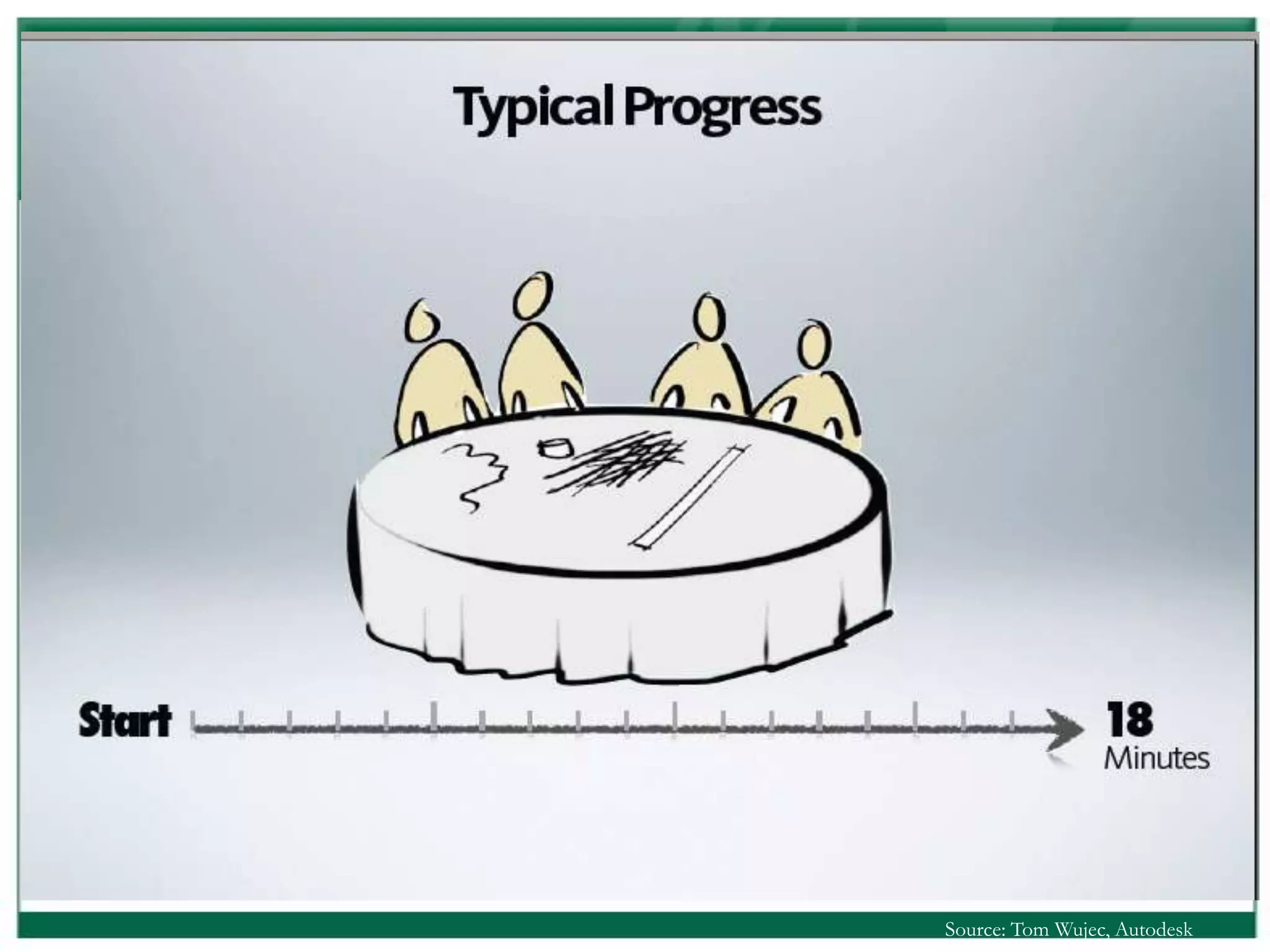
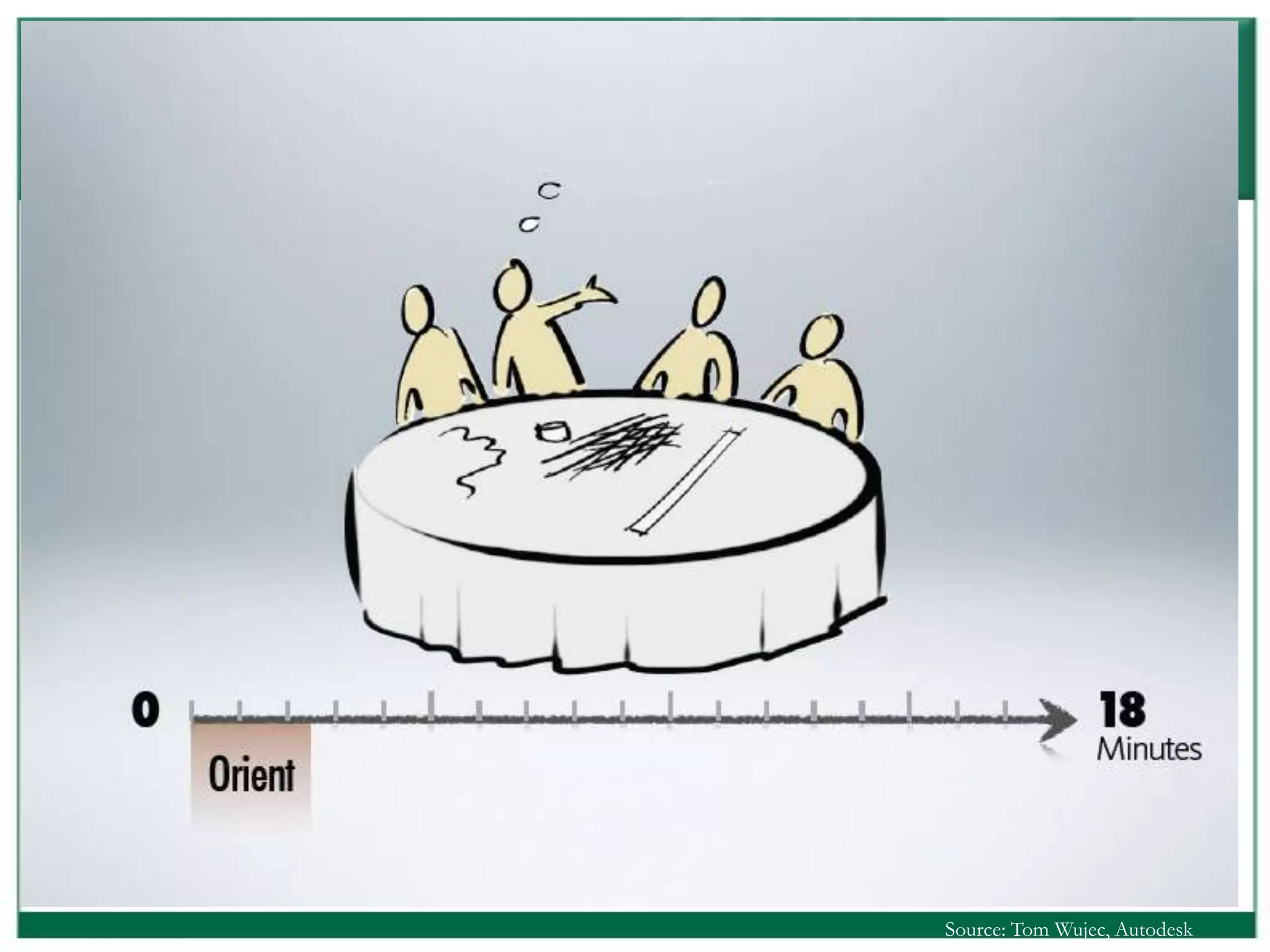
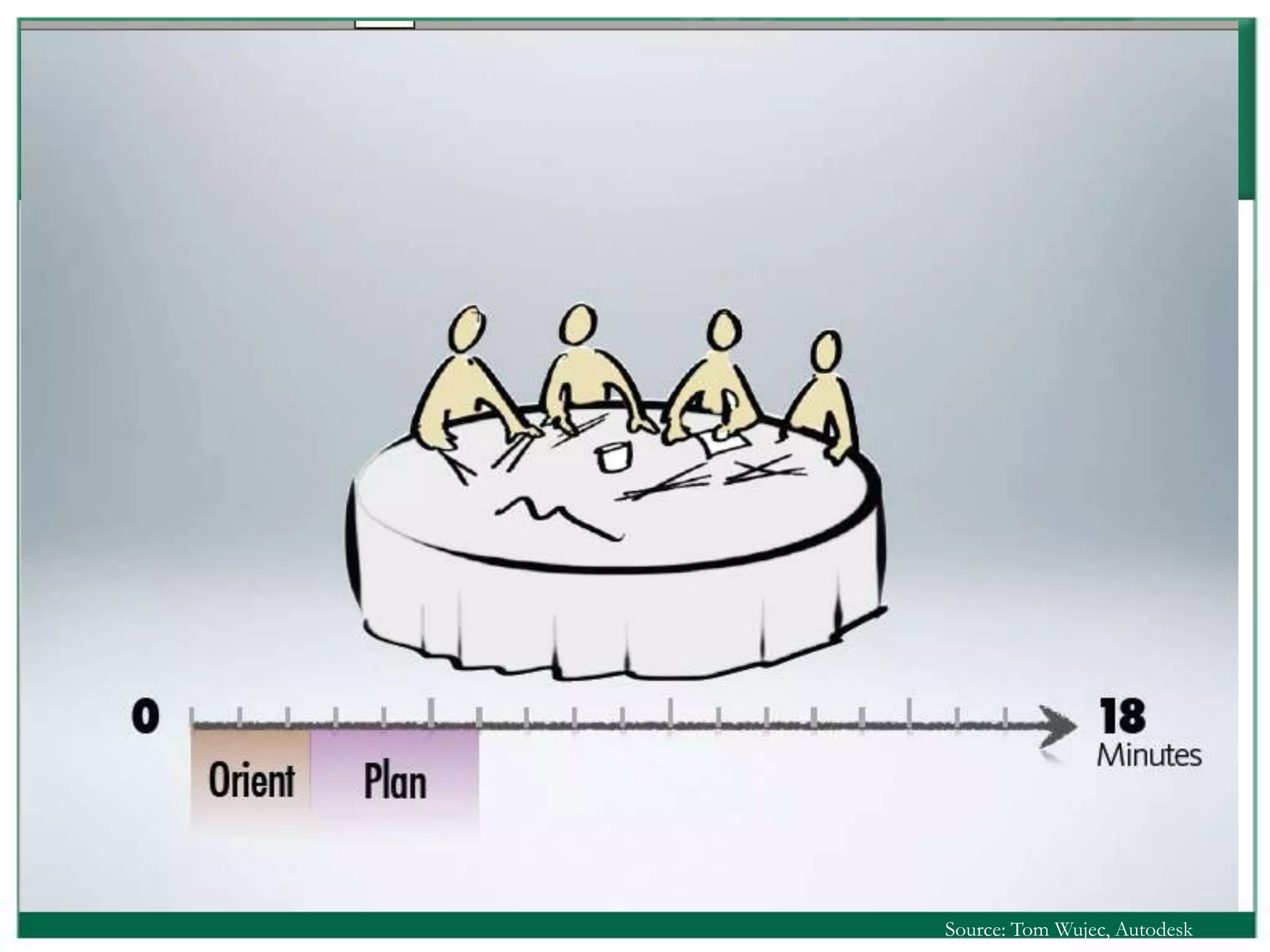
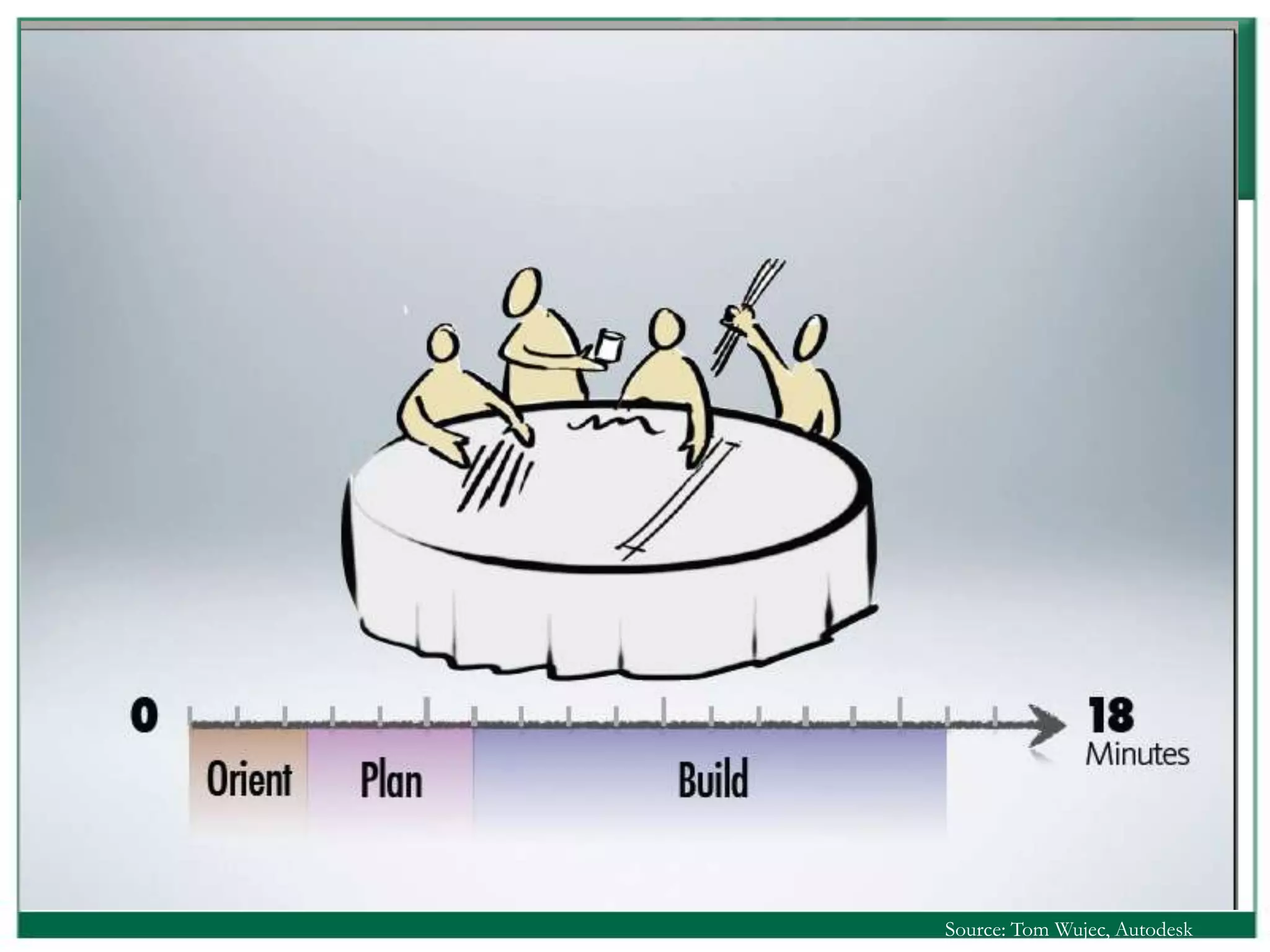
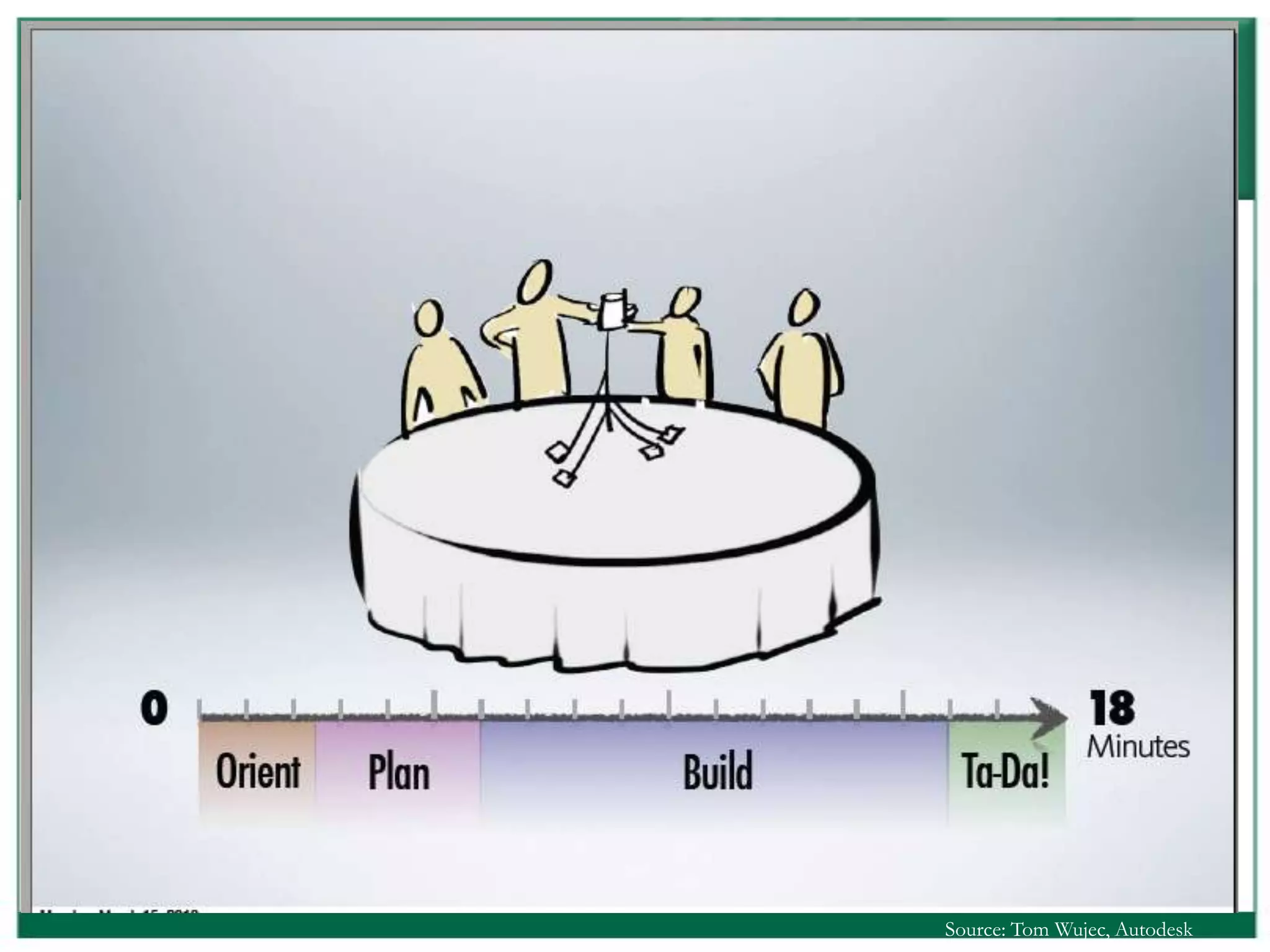
• The Challenge Lasts 18 minutes:
    – Teams cannot hold on to the structure when the time runs out.
    – Those touching or supporting the structure at the end of the exercise will be disqualified.
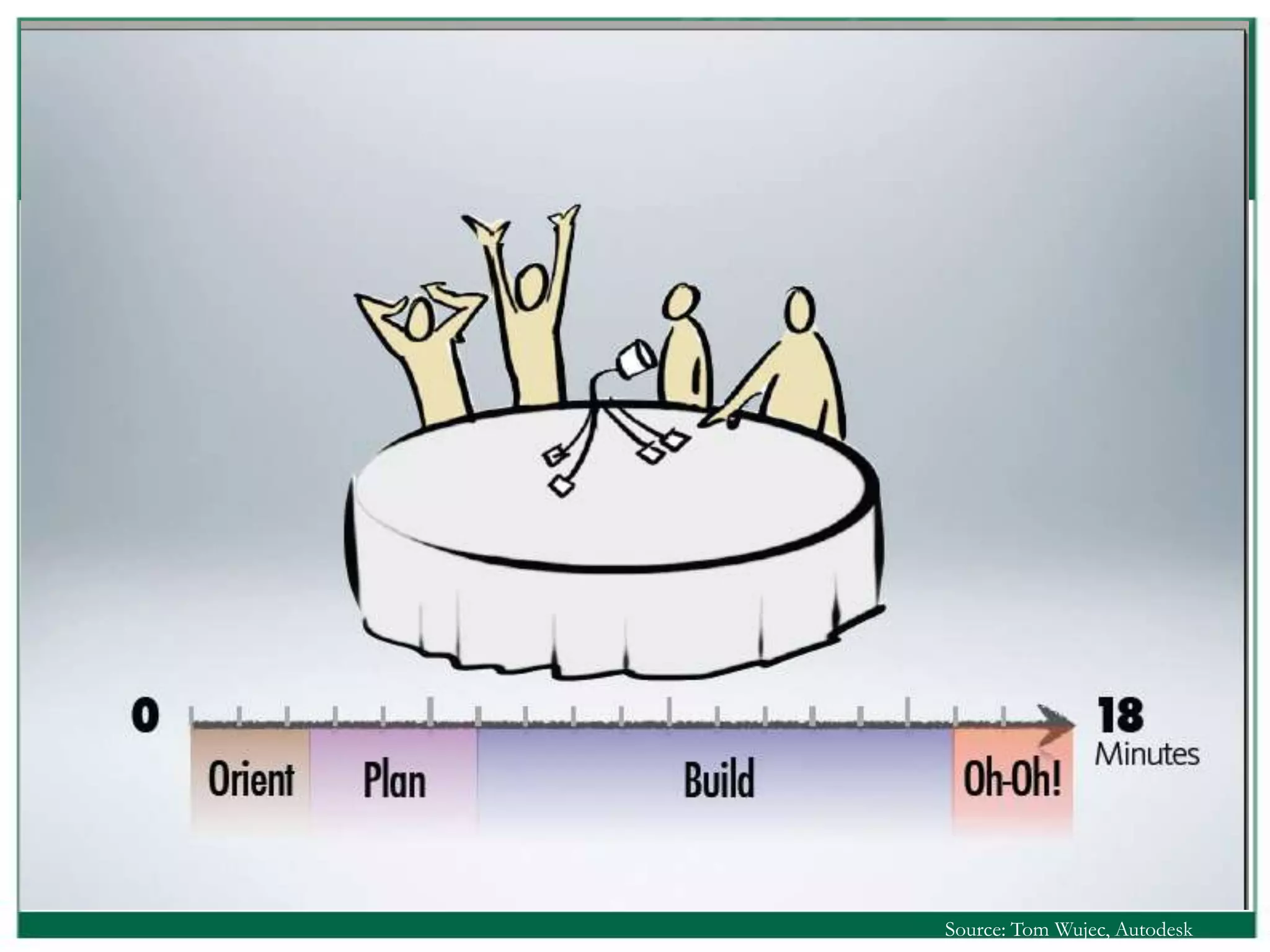
Game Summary
Source: Tom Wujec, Autodesk
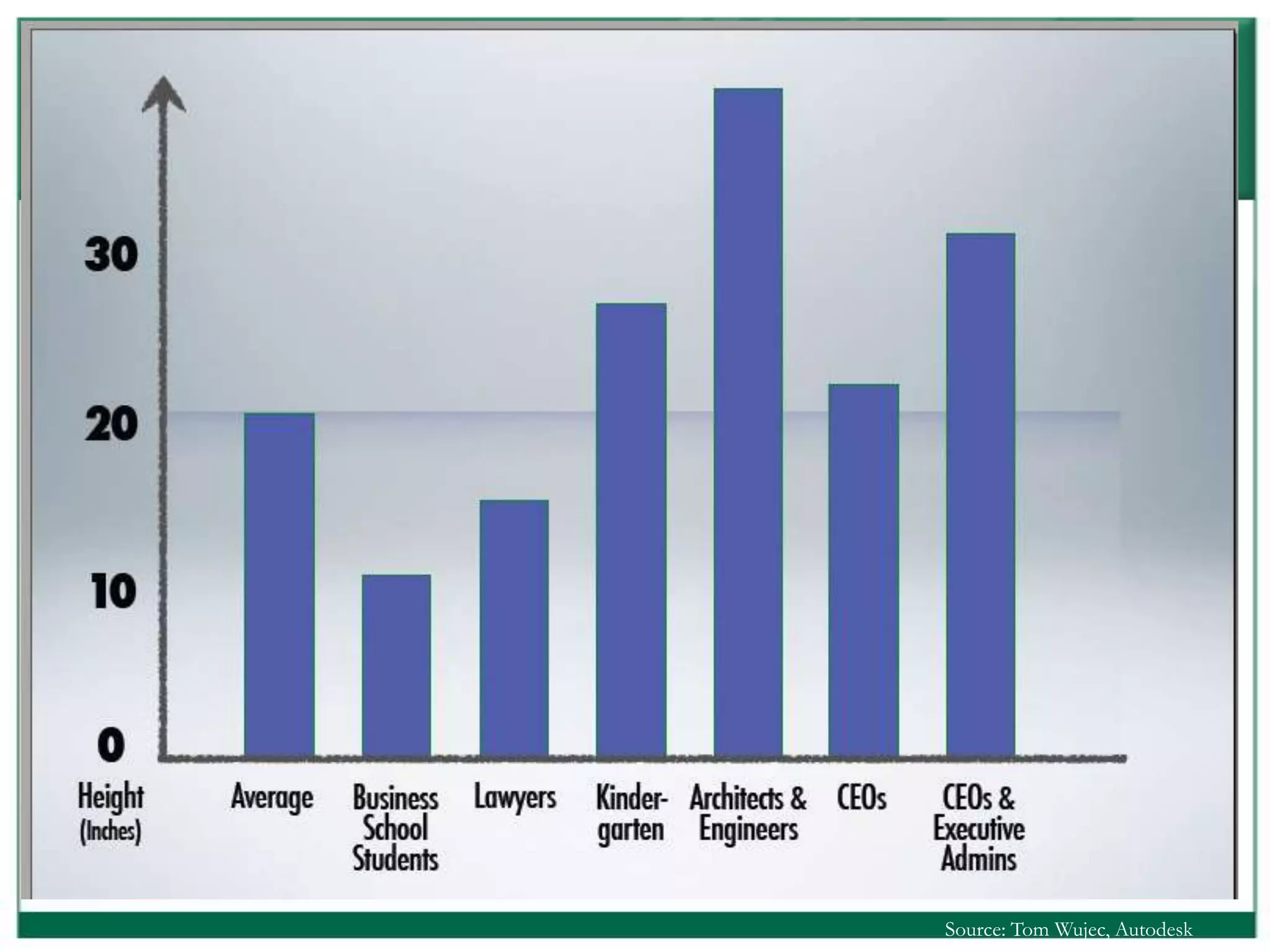
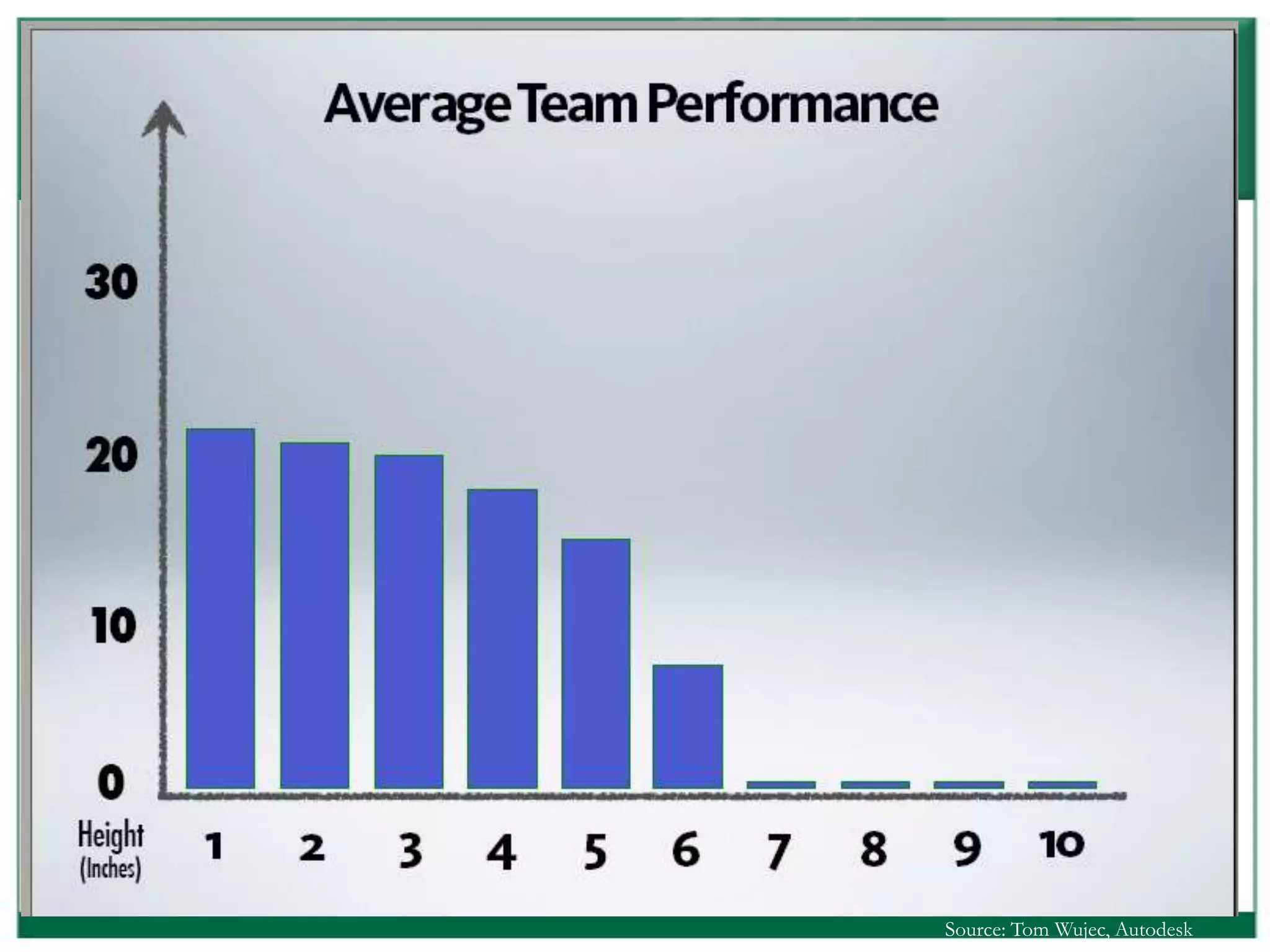
Who consistently performs poorly?


                        Source: Tom Wujec, Autodesk
Who consistently performs well?


                       Source: Tom Wujec, Autodesk
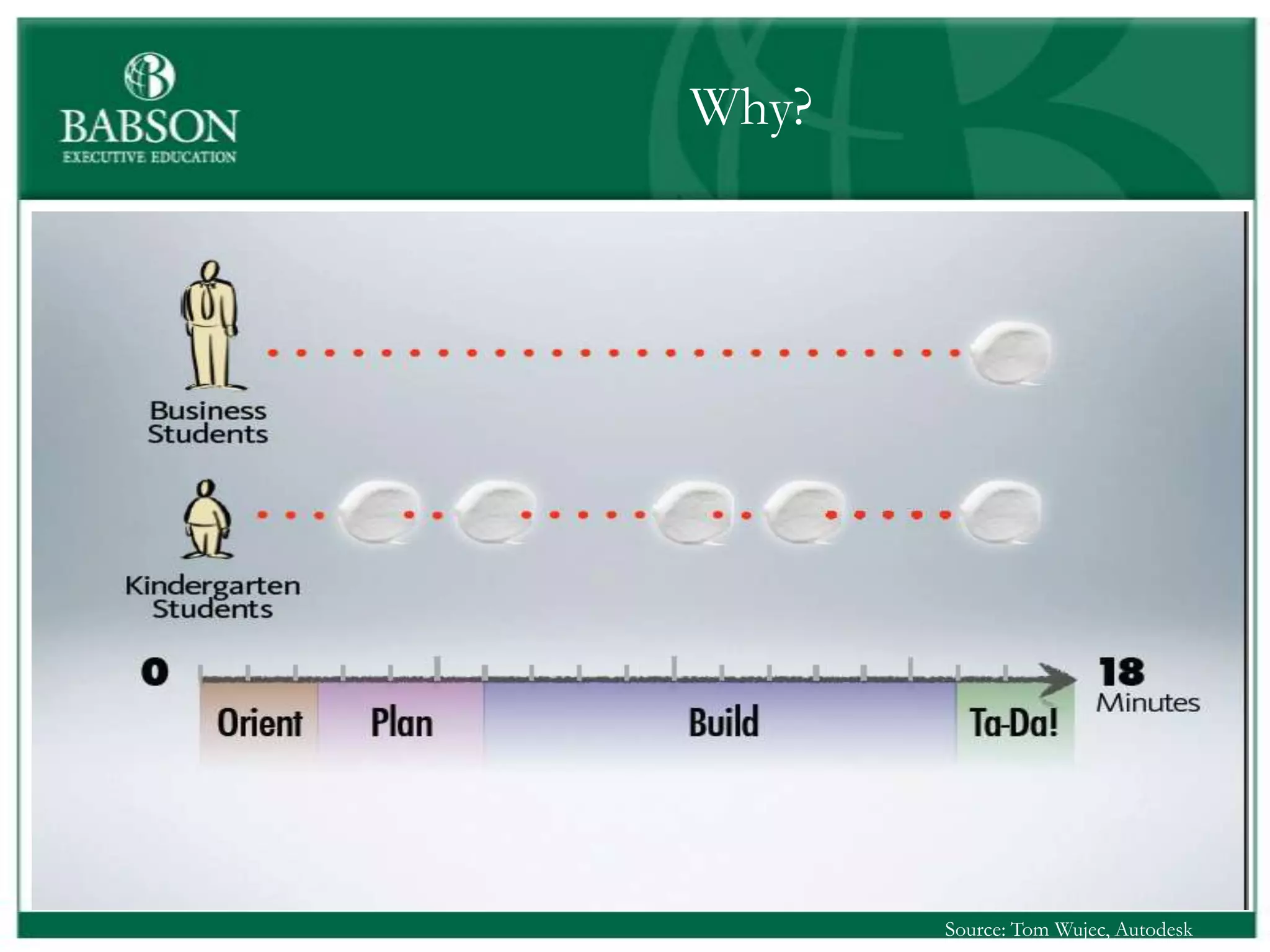
Why?


       Source: Tom Wujec, Autodesk
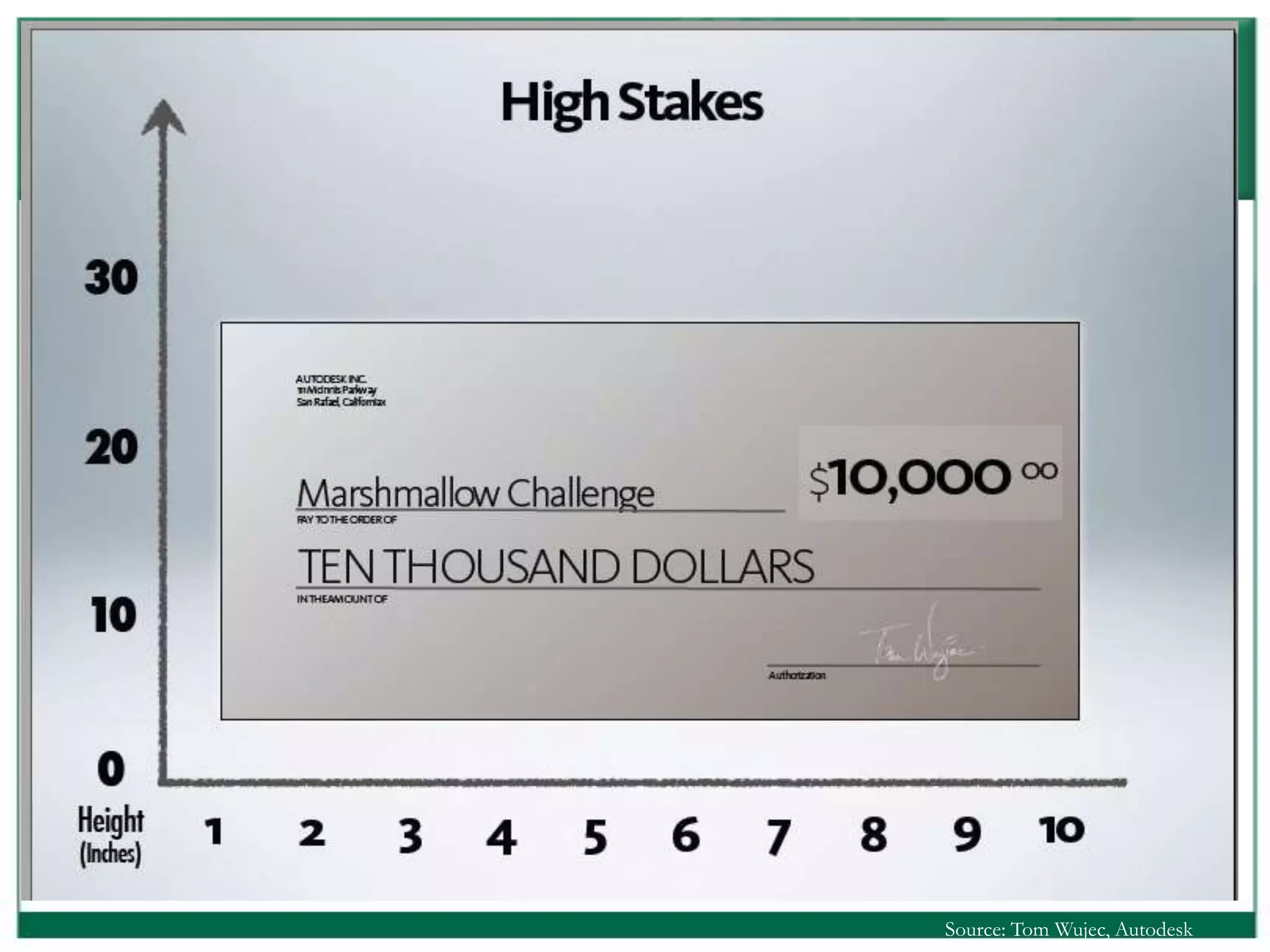
Source: Tom Wujec, Autodesk
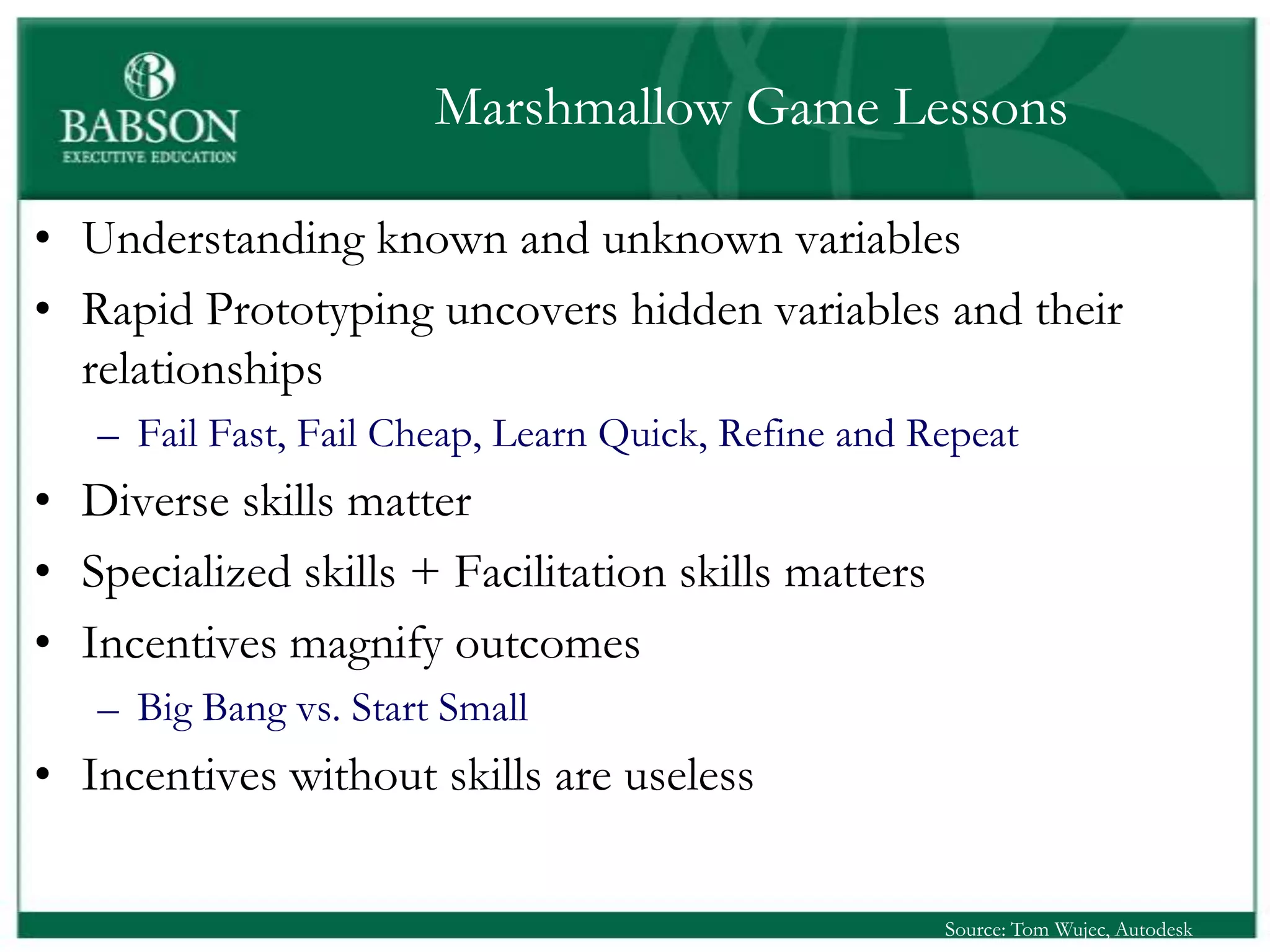
Marshmallow Game Lessons

• Understanding known and unknown variables
• Rapid Prototyping uncovers hidden variables and their
  relationships
   – Fail Fast, Fail Cheap, Learn Quick, Refine and Repeat
• Diverse skills matter
• Specialized skills + Facilitation skills matters
• Incentives magnify outcomes
   – Big Bang vs. Start Small
• Incentives without skills are useless

                                                     Source: Tom Wujec, Autodesk
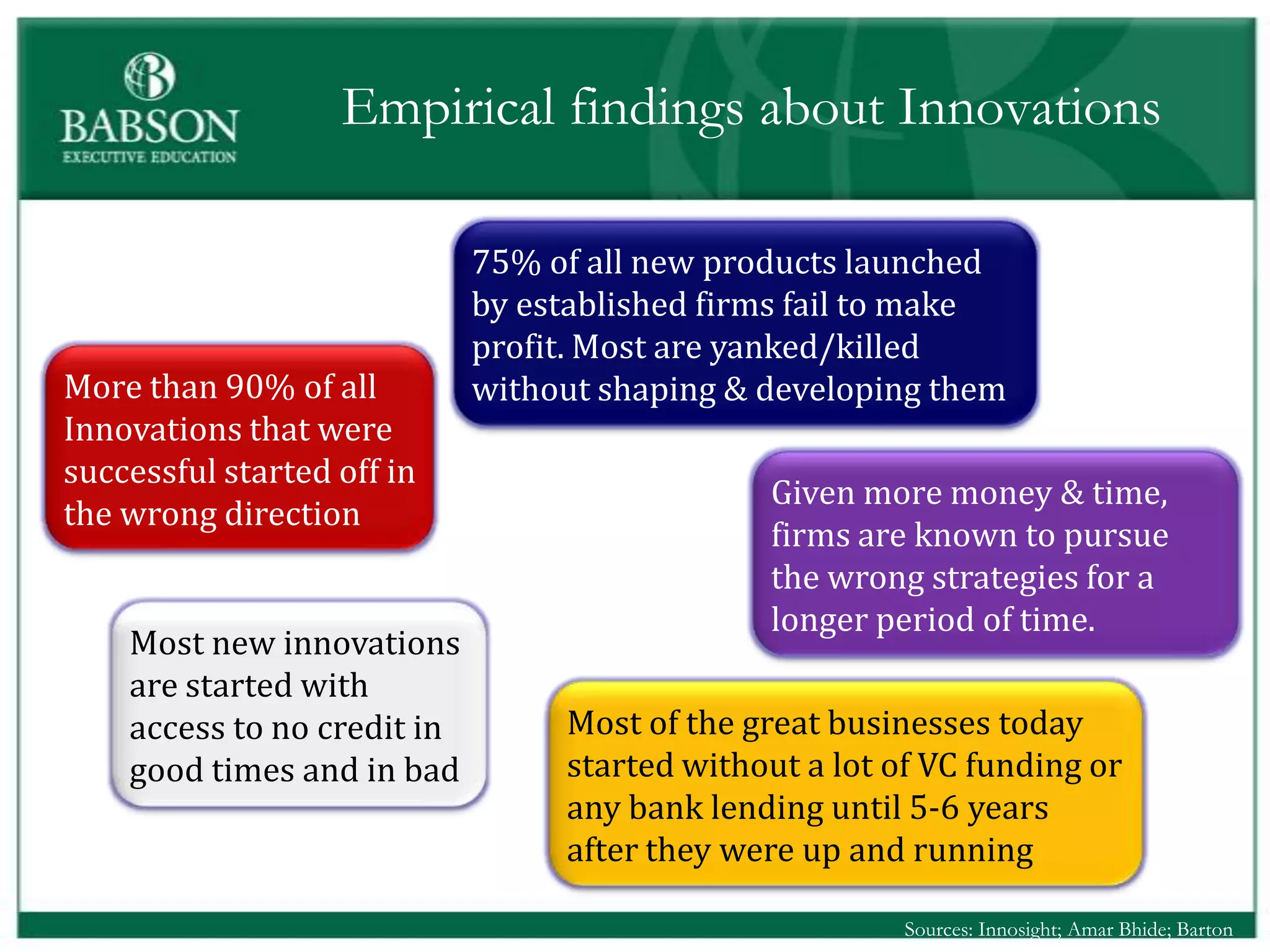
Empirical findings about Innovations

                             75% of all new products launched
                             by established firms fail to make
                             profit. Most are yanked/killed
More than 90% of all         without shaping & developing them
Innovations that were
successful started off in
                                               Given more money & time,
the wrong direction
                                               firms are known to pursue
                                               the wrong strategies for a
                                               longer period of time.
    Most new innovations
    are started with
    access to no credit in        Most of the great businesses today
    good times and in bad         started without a lot of VC funding or
                                  any bank lending until 5-6 years
                                  after they were up and running

                                                         Sources: Innosight; Amar Bhide; Barton
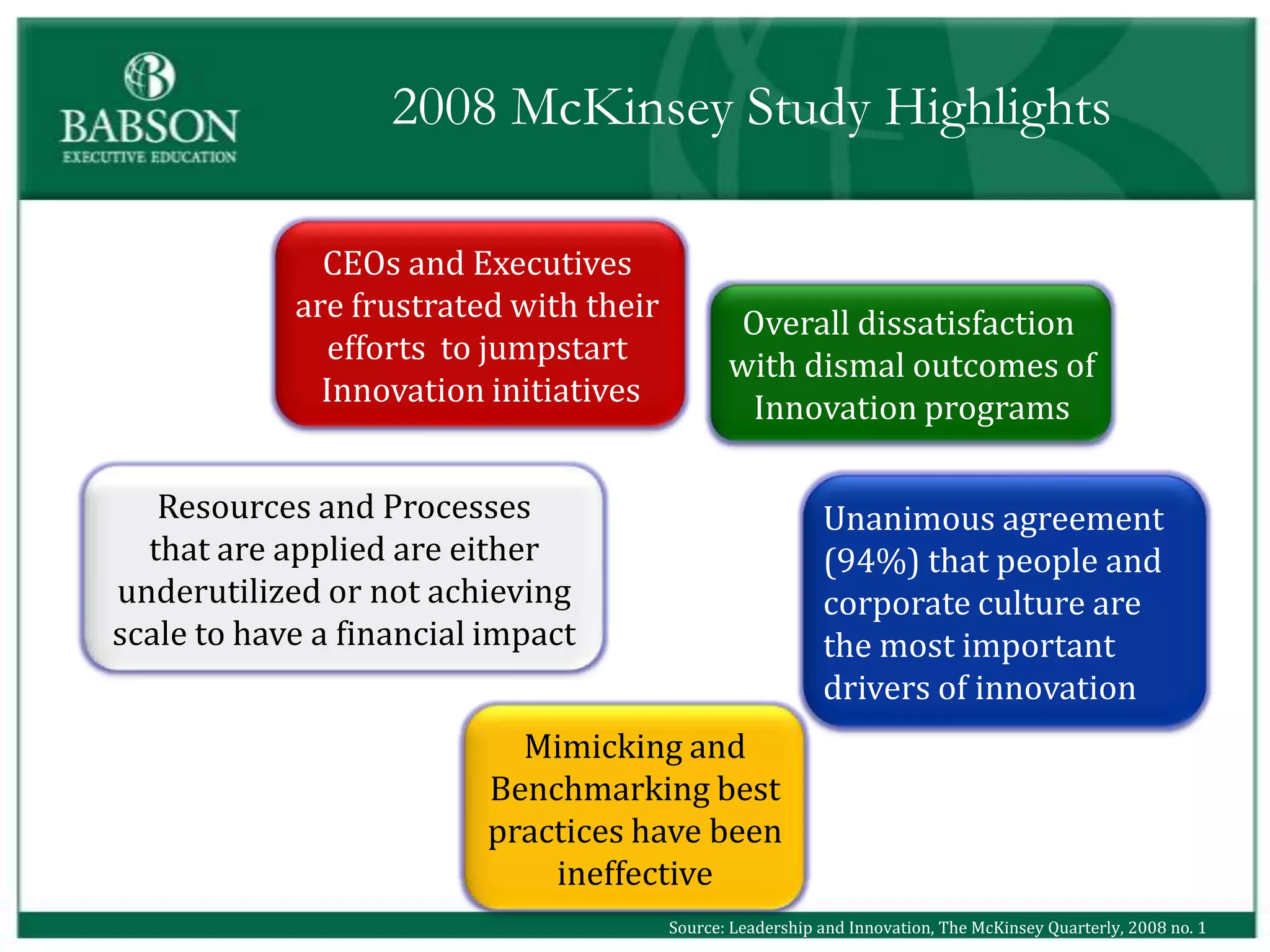
2008 McKinsey Study Highlights

              CEOs and Executives
            are frustrated with their           Overall dissatisfaction
              efforts to jumpstart             with dismal outcomes of
              Innovation initiatives            Innovation programs

   Resources and Processes                                 Unanimous agreement
  that are applied are either                              (94%) that people and
underutilized or not achieving                             corporate culture are
scale to have a financial impact                           the most important
                                                           drivers of innovation
                           Mimicking and
                         Benchmarking best
                         practices have been
                             ineffective
                                        Source: Leadership and Innovation, The McKinsey Quarterly, 2008 no. 1
Leading into the Future:
     Managing Innovation Projects

     Analytical and Emergent Strategies
      (Prediction and Creation Logic)


20
“The Future ain’t what it used to be.”

“It is tough to make predictions, especially
             about the future.”

                 Yogi Berra
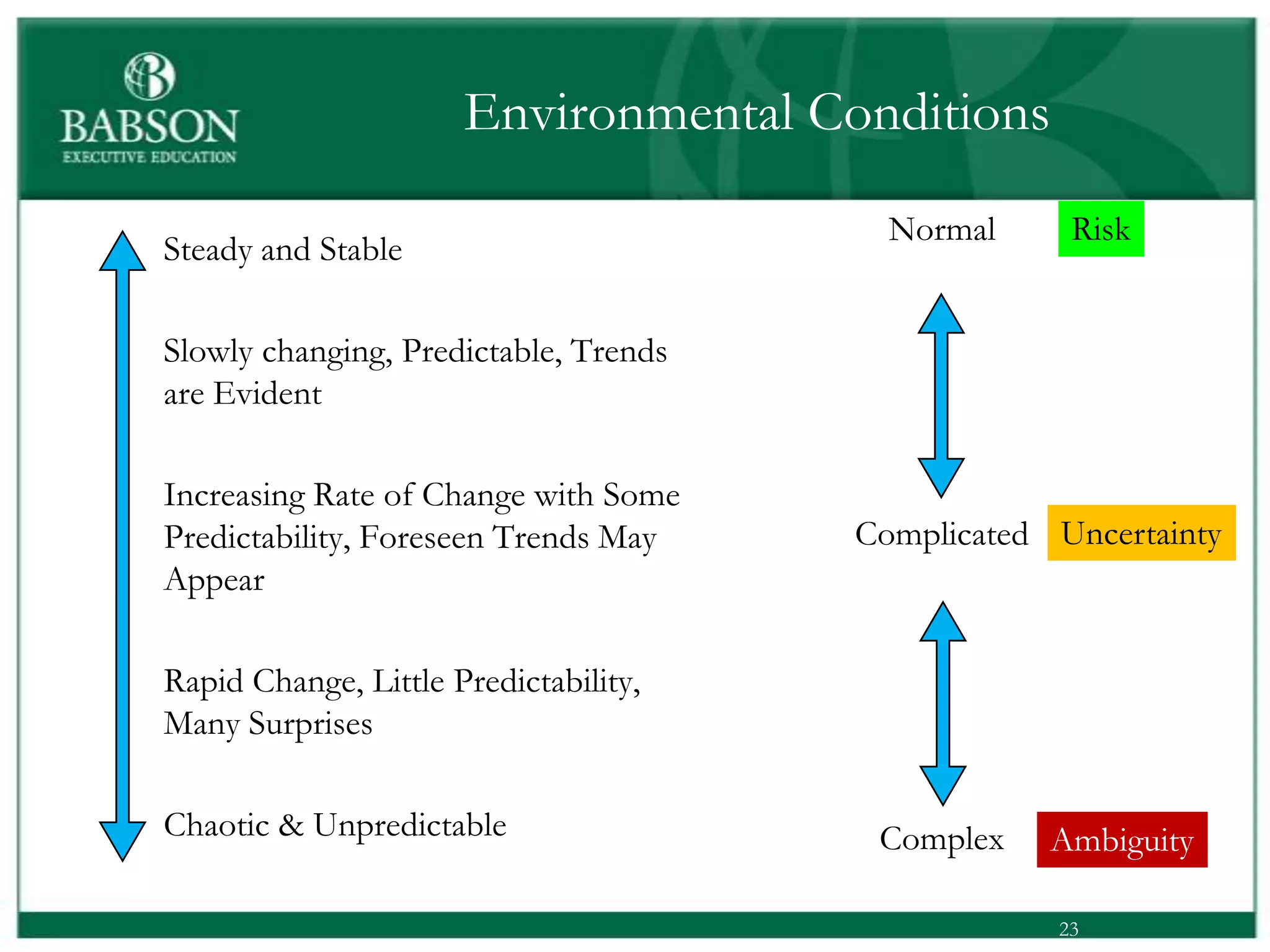
Environmental Conditions
                                           Normal     Risk
• Steady and Stable

• Slowly changing, Predictable, Trends
  are Evident

• Increasing Rate of Change with Some
  Predictability, Foreseen Trends May    Complicated Uncertainty
  Appear

• Rapid Change, Little Predictability,
  Many Surprises

• Chaotic & Unpredictable                 Complex    Ambiguity

                                                     23
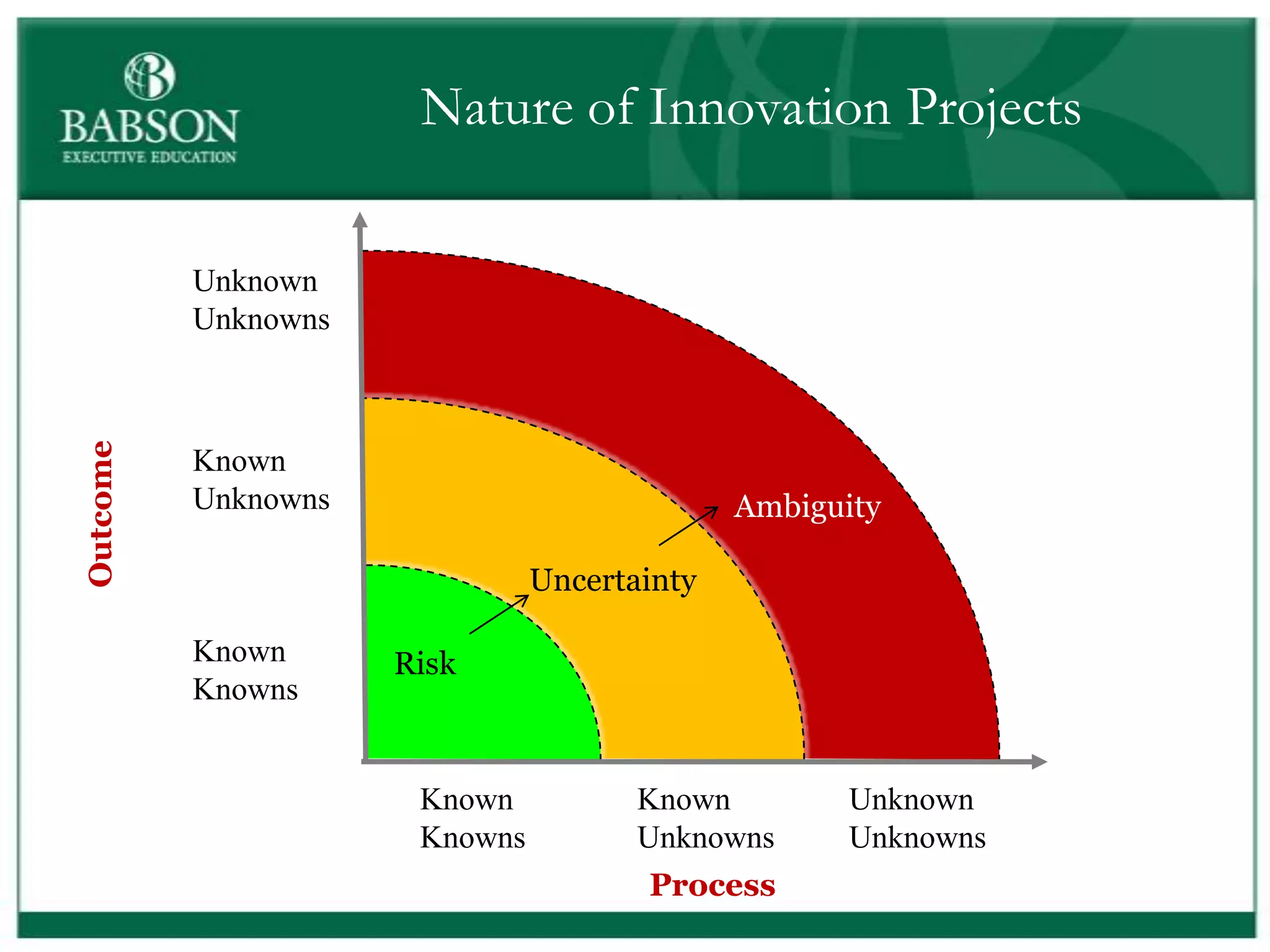
Nature of Innovation Projects

          Unknown
          Unknowns
Outcome


          Known
          Unknowns                           Ambiguity

                               Uncertainty

          Known      Risk
          Knowns


                      Known           Known         Unknown
                      Knowns          Unknowns      Unknowns
                                      Process
If you don't know where you are going, you
       might wind up someplace else.

                Yogi Berra
J. P. Guilford
    (Convergent & Divergent Thinking)

Selecting the most suitable bomber pilot
        candidates during WW II
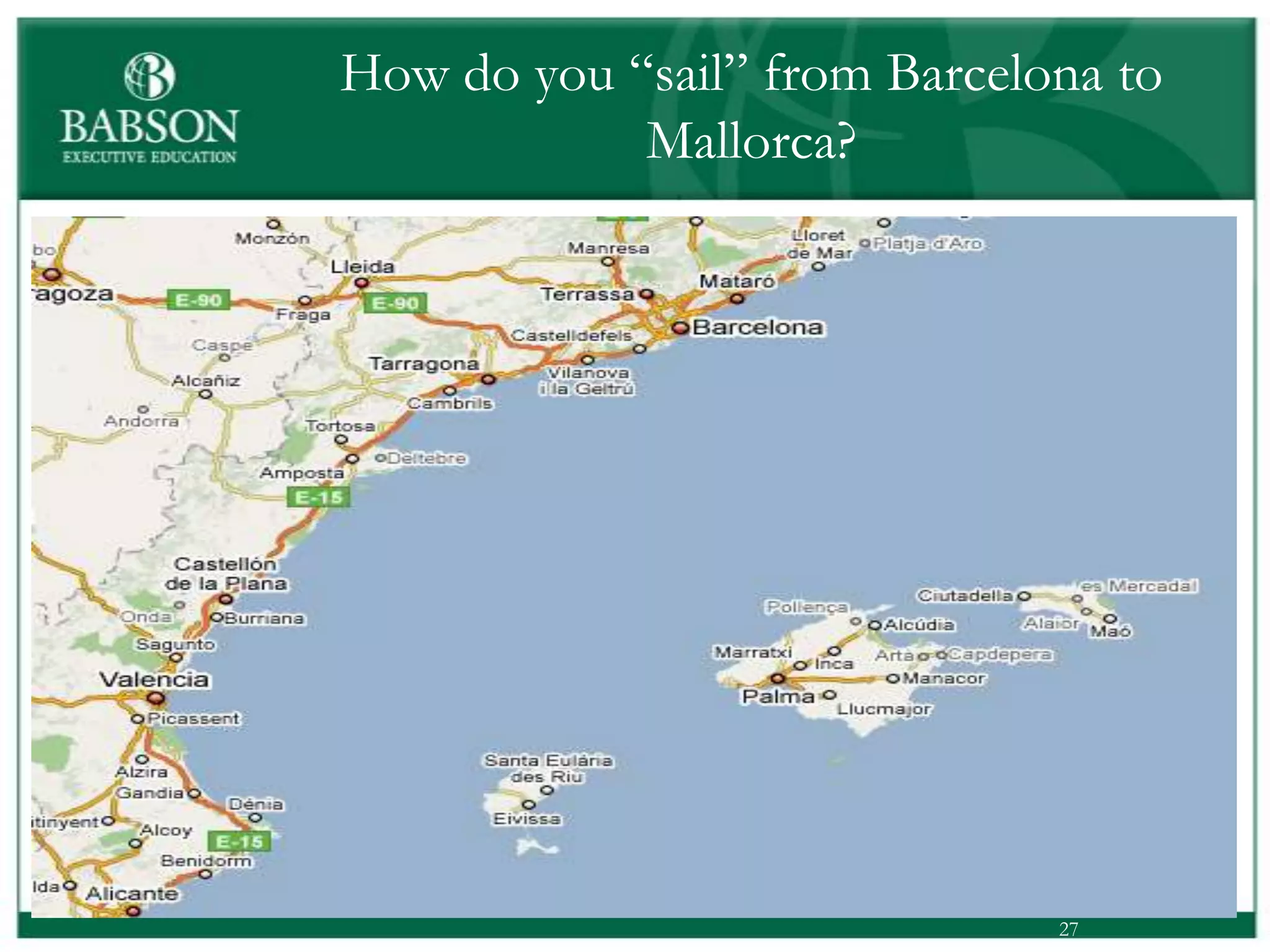
How do you “sail” from Barcelona to
            Mallorca?


                              27
Practice:
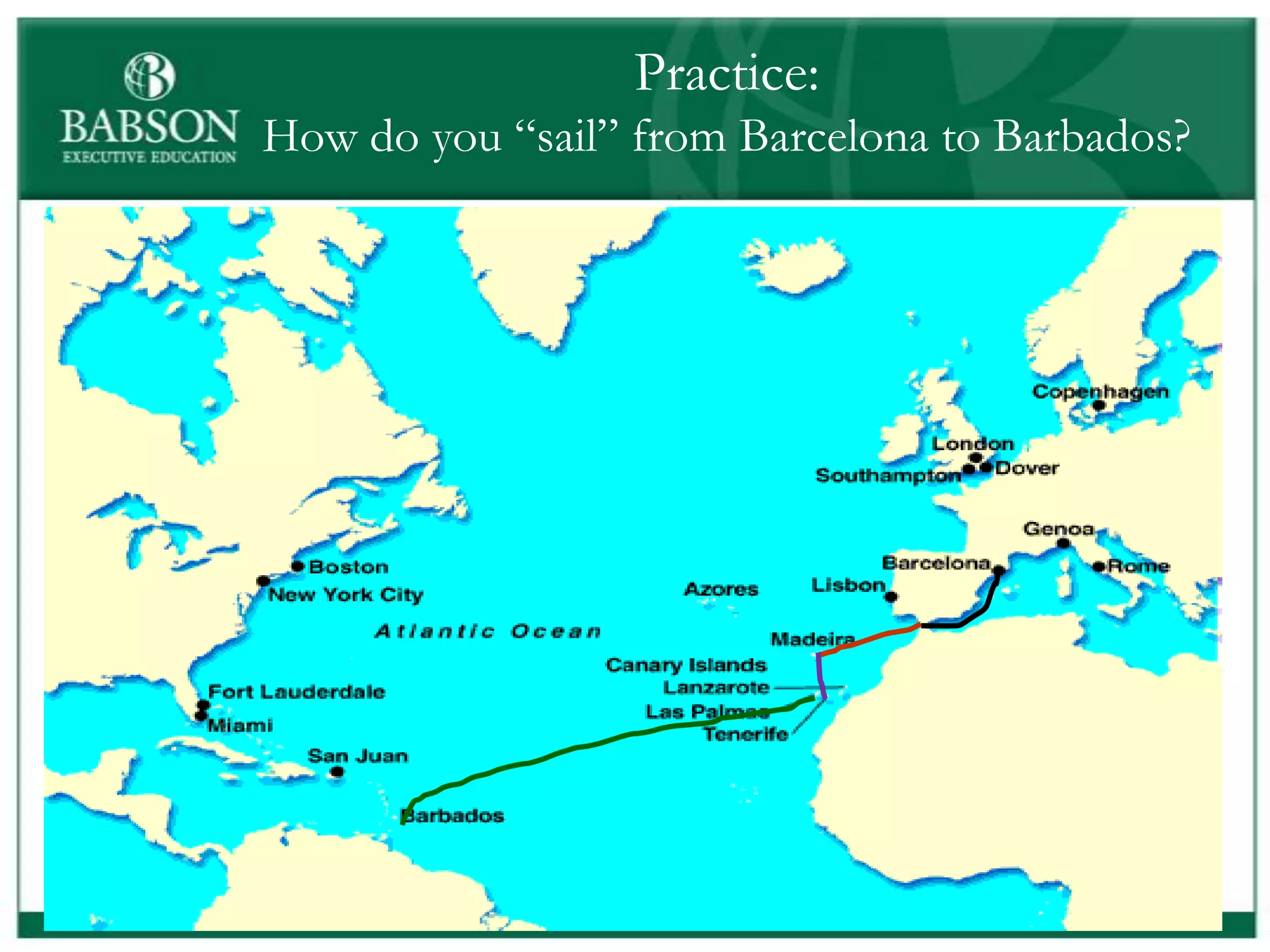
How do you “sail” from Barcelona to Barbados?
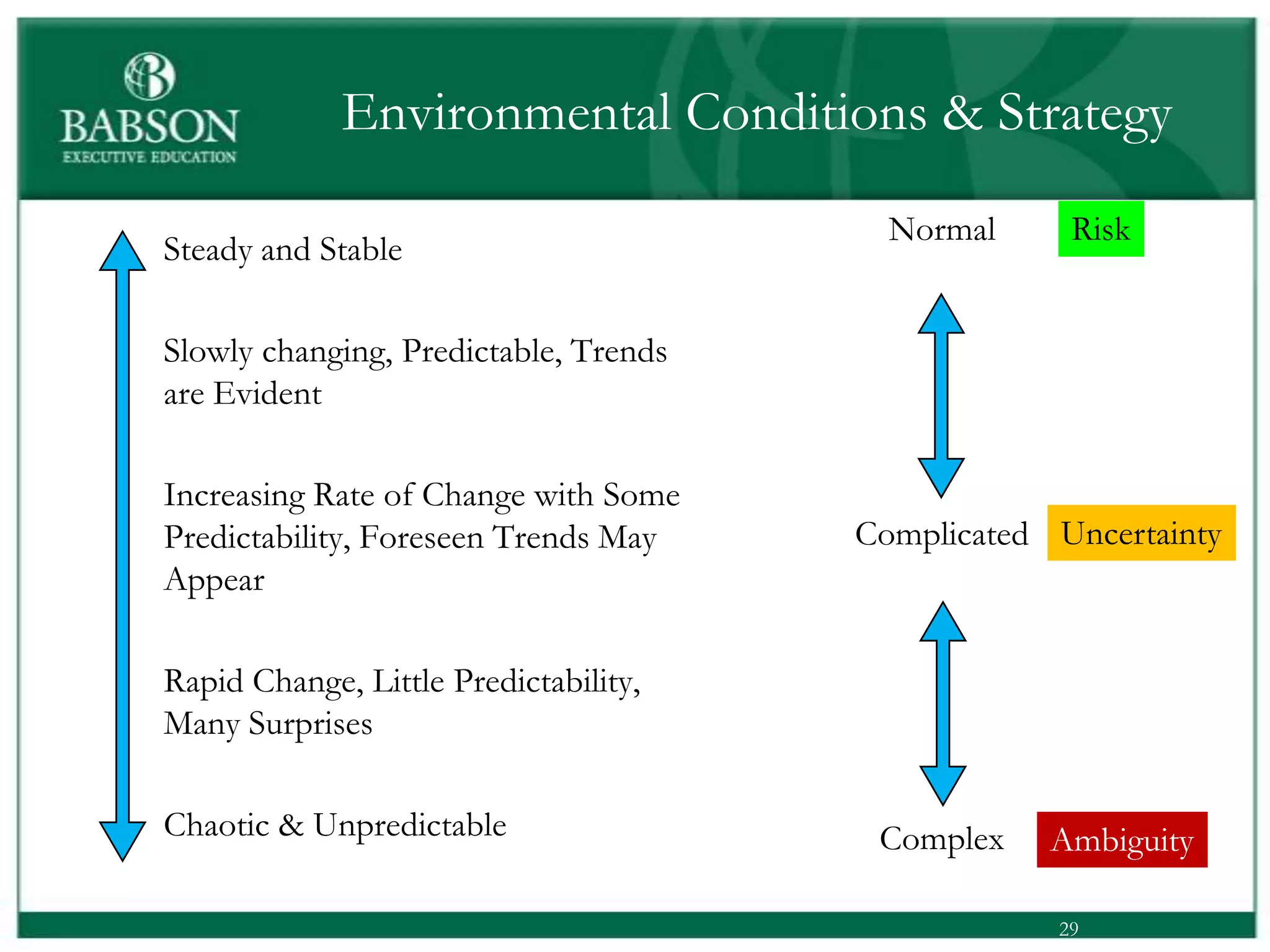
Environmental Conditions & Strategy
                                           Normal     Risk
• Steady and Stable

• Slowly changing, Predictable, Trends
  are Evident

• Increasing Rate of Change with Some
  Predictability, Foreseen Trends May    Complicated Uncertainty
  Appear

• Rapid Change, Little Predictability,
  Many Surprises

• Chaotic & Unpredictable                 Complex    Ambiguity

                                                     29
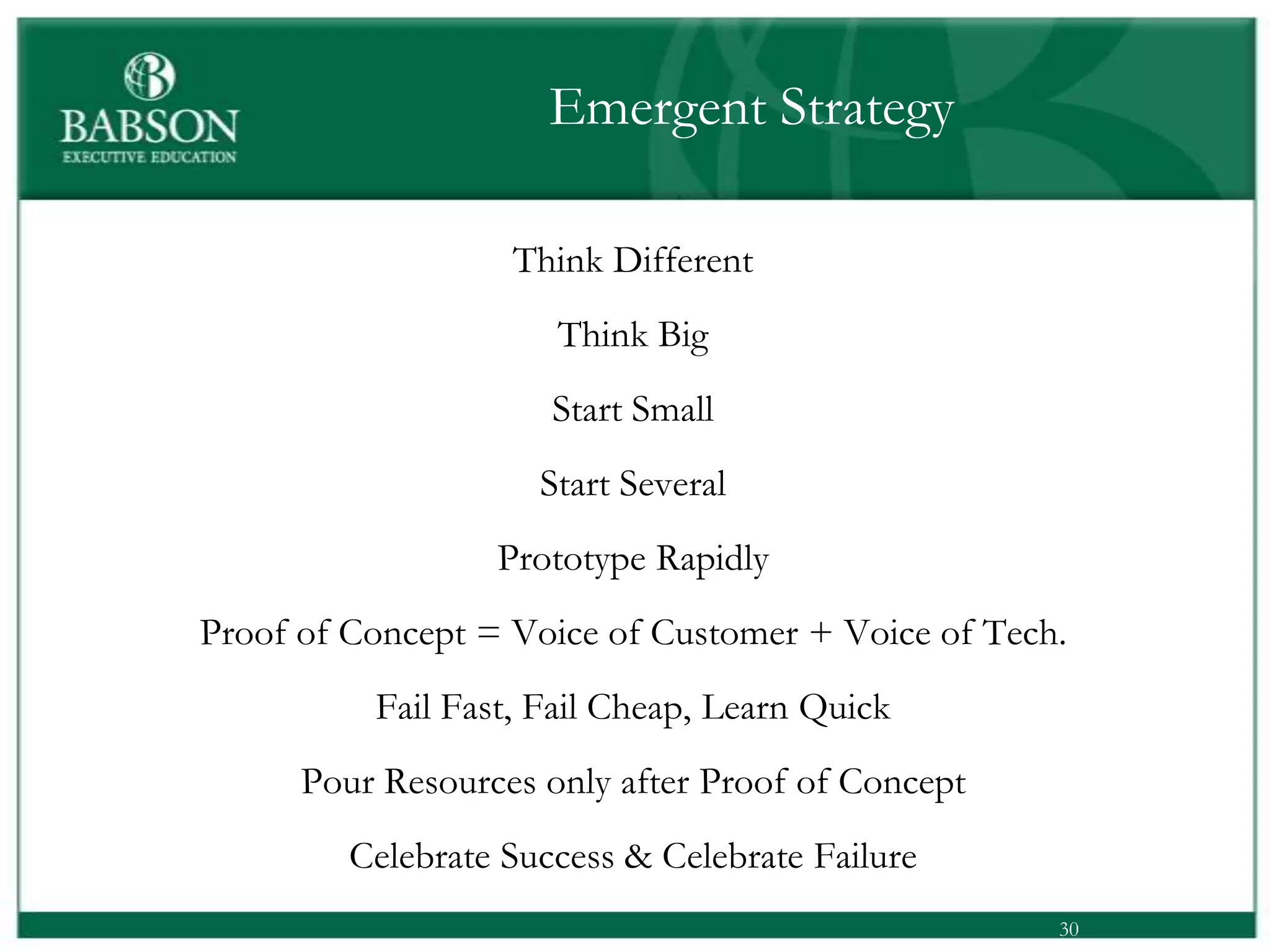
Emergent Strategy

                   Think Different
                      Think Big
                      Start Small
                     Start Several
                  Prototype Rapidly
Proof of Concept = Voice of Customer + Voice of Tech.
          Fail Fast, Fail Cheap, Learn Quick
      Pour Resources only after Proof of Concept
         Celebrate Success & Celebrate Failure
                                                    30
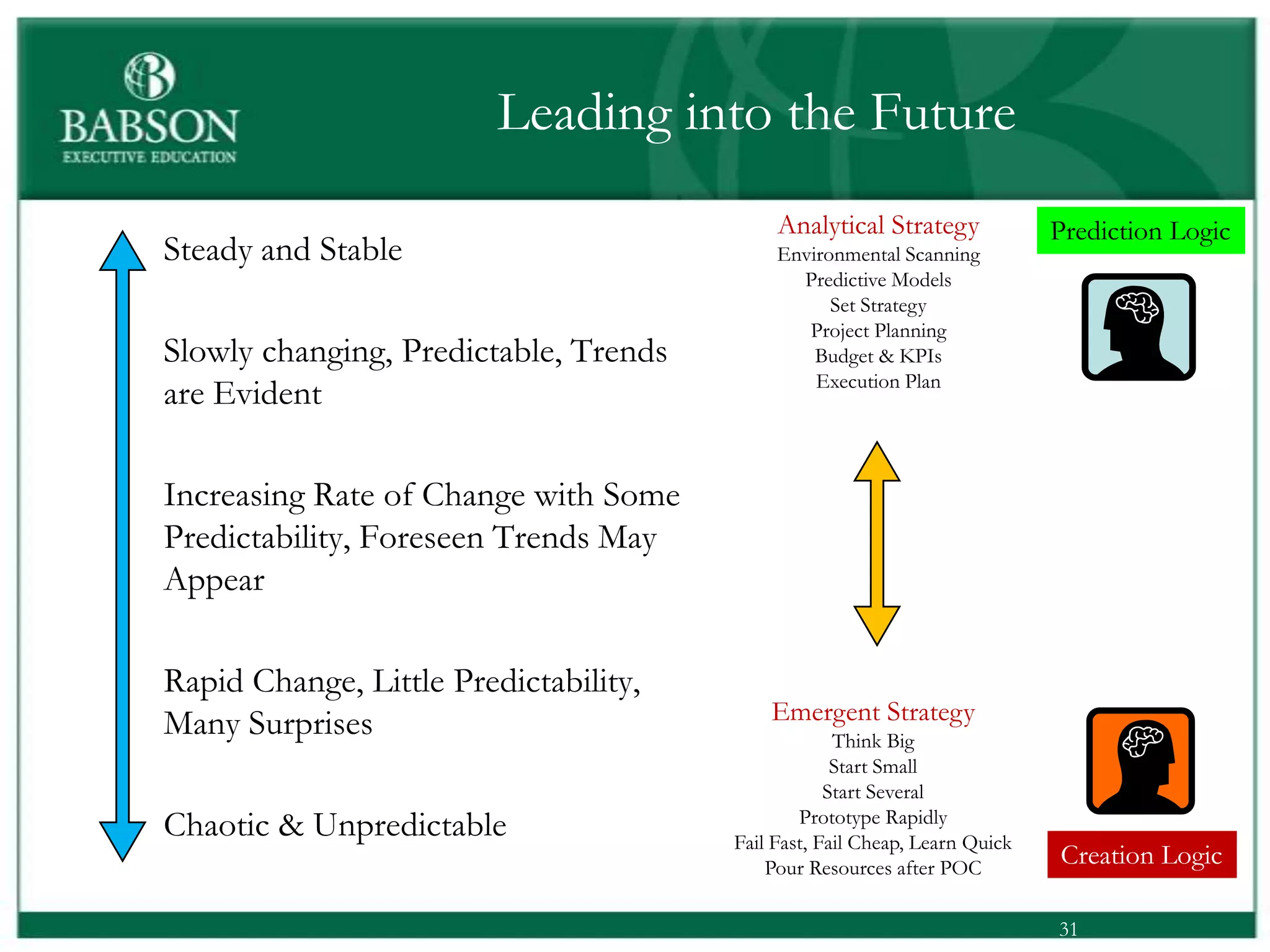
Leading into the Future
                                              Analytical Strategy             Prediction Logic
• Steady and Stable                           Environmental Scanning
                                                Predictive Models
                                                    Set Strategy
                                                 Project Planning
• Slowly changing, Predictable, Trends            Budget & KPIs
                                                  Execution Plan
  are Evident

• Increasing Rate of Change with Some
  Predictability, Foreseen Trends May
  Appear

• Rapid Change, Little Predictability,
  Many Surprises                             Emergent Strategy
                                                      Think Big
                                                      Start Small
                                                     Start Several
• Chaotic & Unpredictable                        Prototype Rapidly
                                         Fail Fast, Fail Cheap, Learn Quick
                                             Pour Resources after POC
                                                                              Creation Logic

                                                                              31
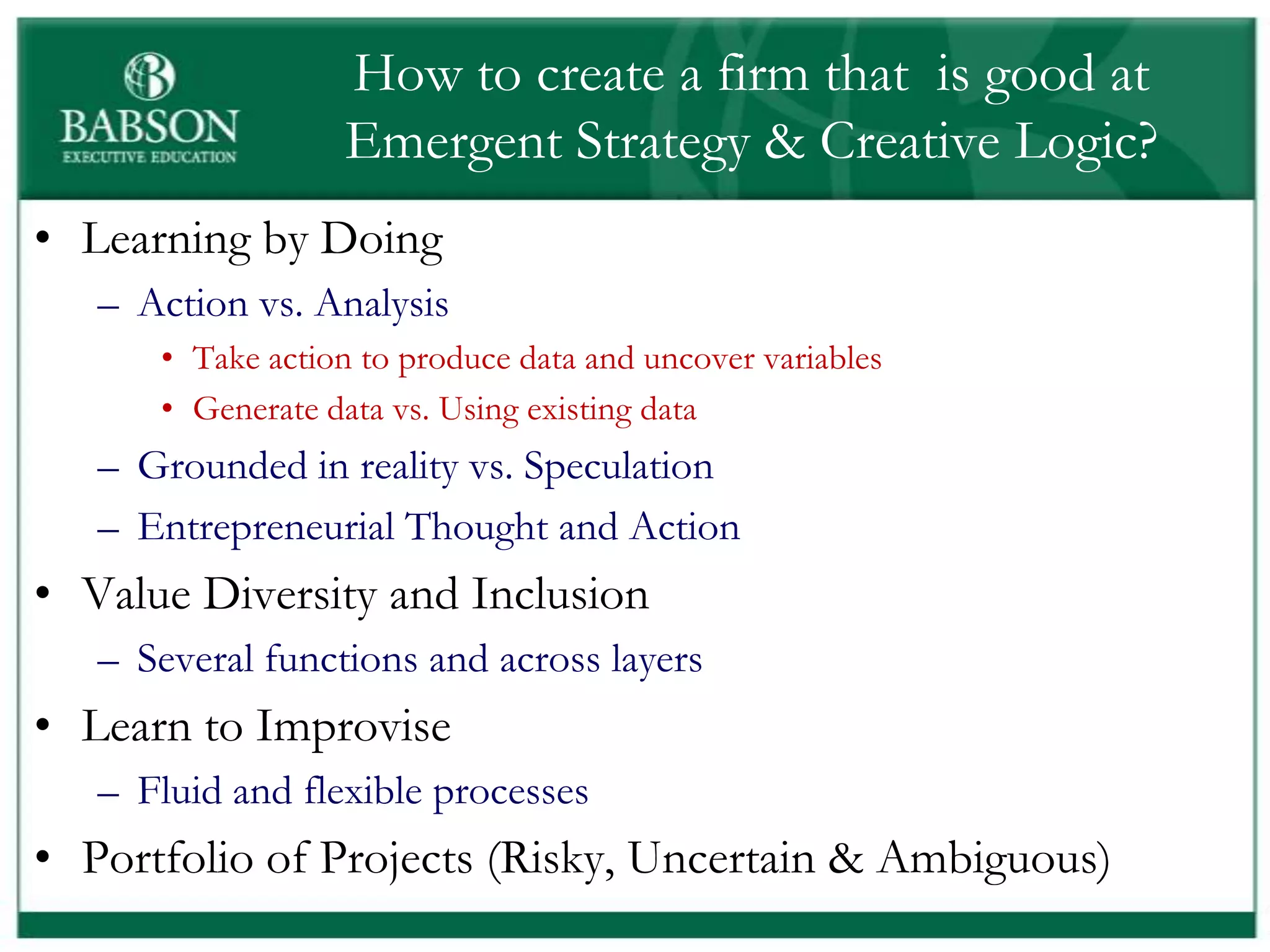
How to create a firm that is good at
                  Emergent Strategy & Creative Logic?
• Learning by Doing
   – Action vs. Analysis
      • Take action to produce data and uncover variables
      • Generate data vs. Using existing data
   – Grounded in reality vs. Speculation
   – Entrepreneurial Thought and Action
• Value Diversity and Inclusion
   – Several functions and across layers
• Learn to Improvise
   – Fluid and flexible processes
• Portfolio of Projects (Risky, Uncertain & Ambiguous)

JAY RAO_2 Marshmallow game + emergent strategies

  • 1.
    Marshmallow Tower Game Jay Rao Professor Babson
  • 2.
    Game Rules • Buildthe Tallest Freestanding Structure: – Tallest structure measured from the table top surface to the top of the marshmallow. – Structure cannot be suspended from a higher structure, like a chair, ceiling or chandelier. – Do not search the internet for answers. • The Entire Marshmallow Must be on Top: – Cutting or eating part of the marshmallow disqualifies the team. • Use as Much or as Little of the Kit – Spaghetti sticks, String and Tape: – The team cannot use the paper bag or scissors as part of their structure. • Break up the Spaghetti, String or Tape: – Teams are free to break the spaghetti, cut up the tape and string to create new structures. • The Challenge Lasts 18 minutes: – Teams cannot hold on to the structure when the time runs out. – Those touching or supporting the structure at the end of the exercise will be disqualified.
  • 3.
  • 4.
  • 5.
  • 6.
  • 7.
  • 8.
  • 9.
  • 10.
    Who consistently performspoorly? Source: Tom Wujec, Autodesk
  • 11.
    Who consistently performswell? Source: Tom Wujec, Autodesk
  • 12.
    Why? Source: Tom Wujec, Autodesk
  • 13.
  • 14.
  • 15.
  • 16.
  • 17.
    Marshmallow Game Lessons •Understanding known and unknown variables • Rapid Prototyping uncovers hidden variables and their relationships – Fail Fast, Fail Cheap, Learn Quick, Refine and Repeat • Diverse skills matter • Specialized skills + Facilitation skills matters • Incentives magnify outcomes – Big Bang vs. Start Small • Incentives without skills are useless Source: Tom Wujec, Autodesk
  • 18.
    Empirical findings aboutInnovations 75% of all new products launched by established firms fail to make profit. Most are yanked/killed More than 90% of all without shaping & developing them Innovations that were successful started off in Given more money & time, the wrong direction firms are known to pursue the wrong strategies for a longer period of time. Most new innovations are started with access to no credit in Most of the great businesses today good times and in bad started without a lot of VC funding or any bank lending until 5-6 years after they were up and running Sources: Innosight; Amar Bhide; Barton
  • 19.
    2008 McKinsey StudyHighlights CEOs and Executives are frustrated with their Overall dissatisfaction efforts to jumpstart with dismal outcomes of Innovation initiatives Innovation programs Resources and Processes Unanimous agreement that are applied are either (94%) that people and underutilized or not achieving corporate culture are scale to have a financial impact the most important drivers of innovation Mimicking and Benchmarking best practices have been ineffective Source: Leadership and Innovation, The McKinsey Quarterly, 2008 no. 1
  • 20.
    Leading into theFuture: Managing Innovation Projects Analytical and Emergent Strategies (Prediction and Creation Logic) 20
  • 21.
    “The Future ain’twhat it used to be.” “It is tough to make predictions, especially about the future.” Yogi Berra
  • 23.
    Environmental Conditions Normal Risk • Steady and Stable • Slowly changing, Predictable, Trends are Evident • Increasing Rate of Change with Some Predictability, Foreseen Trends May Complicated Uncertainty Appear • Rapid Change, Little Predictability, Many Surprises • Chaotic & Unpredictable Complex Ambiguity 23
  • 24.
    Nature of InnovationProjects Unknown Unknowns Outcome Known Unknowns Ambiguity Uncertainty Known Risk Knowns Known Known Unknown Knowns Unknowns Unknowns Process
  • 25.
    If you don'tknow where you are going, you might wind up someplace else. Yogi Berra
  • 26.
    J. P. Guilford (Convergent & Divergent Thinking) Selecting the most suitable bomber pilot candidates during WW II
  • 27.
    How do you“sail” from Barcelona to Mallorca? 27
  • 28.
    Practice: How do you“sail” from Barcelona to Barbados?
  • 29.
    Environmental Conditions &Strategy Normal Risk • Steady and Stable • Slowly changing, Predictable, Trends are Evident • Increasing Rate of Change with Some Predictability, Foreseen Trends May Complicated Uncertainty Appear • Rapid Change, Little Predictability, Many Surprises • Chaotic & Unpredictable Complex Ambiguity 29
  • 30.
    Emergent Strategy Think Different Think Big Start Small Start Several Prototype Rapidly Proof of Concept = Voice of Customer + Voice of Tech. Fail Fast, Fail Cheap, Learn Quick Pour Resources only after Proof of Concept Celebrate Success & Celebrate Failure 30
  • 31.
    Leading into theFuture Analytical Strategy Prediction Logic • Steady and Stable Environmental Scanning Predictive Models Set Strategy Project Planning • Slowly changing, Predictable, Trends Budget & KPIs Execution Plan are Evident • Increasing Rate of Change with Some Predictability, Foreseen Trends May Appear • Rapid Change, Little Predictability, Many Surprises Emergent Strategy Think Big Start Small Start Several • Chaotic & Unpredictable Prototype Rapidly Fail Fast, Fail Cheap, Learn Quick Pour Resources after POC Creation Logic 31
  • 32.
    How to createa firm that is good at Emergent Strategy & Creative Logic? • Learning by Doing – Action vs. Analysis • Take action to produce data and uncover variables • Generate data vs. Using existing data – Grounded in reality vs. Speculation – Entrepreneurial Thought and Action • Value Diversity and Inclusion – Several functions and across layers • Learn to Improvise – Fluid and flexible processes • Portfolio of Projects (Risky, Uncertain & Ambiguous)

Editor's Notes

  • #31 93% of all Innovations that ultimately become successful started off in the wrong direction.