





Welcome Sagar Agrawal Rajwin Patel Cheryl Fernandes Aaditya Ganjewar Monwanmi Dkhar Pratik Gandhi
Various Cultural Predispositions
Objectives The specific objectives  are: INTRODUCE   culture and its presence EXAMINE   the strategic dispositions that characterize responses to different cultures. DISCUSS   cross-cultural differences and similarities. REVIEW   cultural differences in select countries and regions.
Culture & its Relevance Latin Word  -- Cultura derived from Colere means to Cultivate Pattern of Human Activity and Symbols Arts, Literature, Costumes, Customs and Language
Characteristics of Culture Culture is Shared – by group of people Culture is Learned – ideals which shape Life No culture remains in an Isolation.
Hofstede’s Definition of Culture Geert Hofstede  defined culture as the  “ collective programming of the mind”  (Hofstede, 1980, p.16). This collective programming lies between the universal nature of each person and an  individual’s unique personality
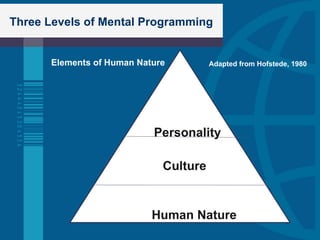
Three Levels of Mental Programming Culture Personality Human Nature Elements of Human Nature Adapted from Hofstede, 1980
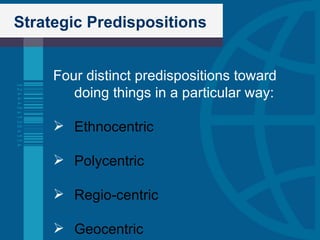
Strategic Predispositions Four distinct predispositions toward doing things in a particular way: Ethnocentric Polycentric Regio-centric Geocentric
  Ethnocentric predisposition A nationalistic philosophy of management whereby the values and interests of the parent company guide strategic decisions.
Polycentric predisposition A philosophy of management whereby strategic decisions are tailored to suit the cultures of the countries where the MNC operates
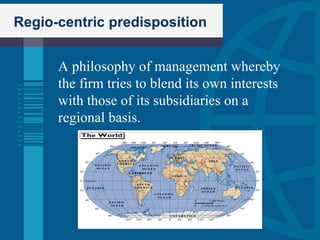
Regio-centric predisposition A philosophy of management whereby the firm tries to blend its own interests with those of its subsidiaries on a regional basis.
Geocentric predisposition A philosophy of management whereby the company tries to integrate a global systems approach to decision making.
Meeting the Challenge The Globalization perspective Belief that one worldwide approach to doing business is key to efficiency and effectiveness. Many factors facilitate the need to develop unique strategies for different cultures: Diversity of worldwide industry standards Continual demand by local customers for differentiated products Importance of being insider as in case of customer who prefers to “buy local”
Globalization vs.  National Responsiveness Advertising (for example) French Avoid reasoning or logic Advertising predominantly emotional, dramatic, symbolic Spots viewed as cultural events – art for sake of money – and reviewed as if they were literatures or films  British Value laughter above all else Typical broad,  British commercial amuses by mocking both advertiser and consumer Germans Want factual and rational advertising Typical German spot features standard family of 2 parents, two children, and grandmother
Globalization vs.  National Responsiveness How to add value to Marketing : Tailor advertising message to particular culture Stay abreast of local market conditions; don’t assume all markets basically same Know strengths and weaknesses of MNC subsidiaries; provide them assistance in addressing local demands
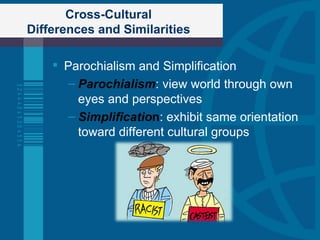
Cross-Cultural  Differences and Similarities  Parochialism and Simplification Parochialism : view world through own eyes and perspectives Simplificatio n : exhibit same orientation toward different cultural groups
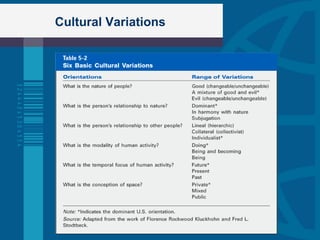
Cultural Variations
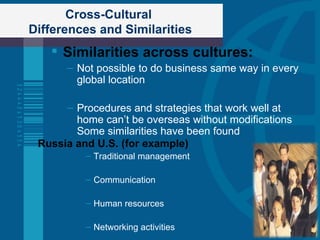
Cross-Cultural  Differences and Similarities Similarities across cultures: Not possible to do business same way in every global location Procedures and strategies that work well at home can’t be overseas without modifications Some similarities have been found Russia and U.S. (for example) Traditional management Communication Human resources Networking activities
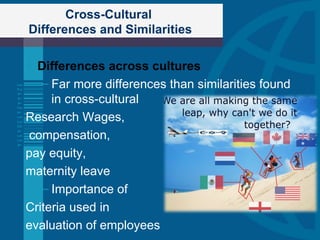
Cross-Cultural  Differences and Similarities Differences across cultures Far more differences than similarities found in cross-cultural  Research Wages,  compensation,  pay equity,  maternity leave Importance of  Criteria used in  evaluation of employees
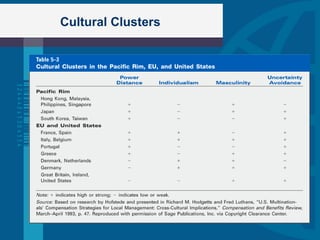
Cultural Clusters
Cultural Differences in Selected Countries and Regions Doing Business in  China The Chinese place values and principles above money and expediency. Business meetings typically start with pleasantries such as tea and general conversation about the guest’s trip to the country, local accommodations, and family.  The Chinese host will give the appropriate indication for when a meeting is to begin and when the meeting is over. Once the Chinese decide who and what is best, they tend to stick with these decisions. Although slow in formulating a plan of action, once they get started, they make fairly good progress.
Cultural Differences in Selected Countries and Regions:  China In negotiations, they expect some in return. Because negotiating can involve a loss of face, it is common to find Chinese carrying out the whole process through intermediaries. During negotiations, it is important not to show excessive emotion of any kind. Anger or frustration is viewed as antisocial and unseemly. Negotiations should be viewed with a long-term perspective. Those who will do best are the ones who realize they are investing in a long-term relationship.
Cultural Differences in Selected Countries and Regions Doing Business in  Russia Build personal relationships with partners. When there are contract disputes, there is little protection for the aggrieved party because of the time and effort needed to legally enforce the agreement. Use local consultants. Because the rules of business have changed so much in recent years, it pays to have a local Russian consultant working with the company. Ethical behavior in the United States is not always the same as in Russia. For example, it is traditional in Russia to give gifts to those with whom one wants to transact business. Be patient. In order to get something done in Russia, it often takes months of waiting.
Cultural Differences in Selected Countries and Regions: Russia Russians like exclusive arrangements and often negotiate with just one firm at a time. Russians like to do business face-to-face. So when they receive letters or faxes, they often put them on their desk but do not respond to them. Keep financial information personal. Russians wait until they know their partner well enough to feel comfortable before sharing financial data. Research the company. In dealing effectively with Russian partners, it is helpful to get information about this company, its management hierarchy, and how it typically does business.
Cultural Differences in Selected Countries and Regions:  Russia Stress mutual gain. The Western idea of  “ win – win ”  in negotiations also works well in Russia. Clarify terminology. The language of business is just getting transplanted in Russia so double-check and make sure that the other party clearly understands the proposal, knows what is expected and when, and is agreeable to the deal. Be careful about compromising or settling things too quickly because this is often seen as a sign of weakness. Russians view contracts as binding only if they continue to be mutually beneficial, so continually show them the benefits associated with sticking to the deal.
Cultural Differences in Selected Countries and Regions Doing business in  India It is important to be on time for meetings. Personal questions should not be asked unless the other individual is a friend or close associate. Titles are important, so people who are doctors or  professors should be addressed accordingly. Public displays of affection are considered to be  inappropriate, so one should refrain from  backslapping or touching others.
Cultural Differences in Selected Countries and Regions: India Beckoning is done with the palm turned down; pointing often is done with the chin. When eating or accepting things, use the right hand because the left is considered to be unclean. The  namaste  gesture can be used to greet people; it also is used to convey other messages, including a signal that one has had enough food. Bargaining for goods and services is common; this contrasts with Western traditions, where bargaining might be considered rude or abrasive.
Cultural Differences in Selected Countries and Regions Doing business in  France When shaking hands with a French person, use a quick shake with some pressure in the grip. It is extremely important to be on time for meetings and social occasions. Being  “ fashionably late ”  is frowned on. During a meal, it is acceptable to engage in pleasant conversation, but personal questions and the subject of money are never brought up.
France The French tend to be suspicious of early friendliness in the discussion and dislike first names, taking off jackets, or disclosure of personal or family details. In negotiations the French try to find out what all of the other side ’ s aims and demands are at the beginning, but they reveal their own hand only late in the negotiations. The French do not like being rushed into making a decision, and they rarely make important decisions inside the meeting.
Arab Countries Doing business in  Arab  countries It is important never to display feelings of superiority, because this makes the other party feel inferior. Let one’s action speak for itself and not brag or put on a show of self-importance. One should not take credit for joint efforts. A great deal of what is accomplished is a result of group work, and to indicate that one accomplished something alone is a mistake.  Much of what gets done is a result of going through administrative channels in the country. It often is difficult to sidestep a lot of this red tape, and efforts to do so can be regarded as disrespect for legal and governmental institutions.
Arab Countries Connections are extremely important in conducting business. Patience is critical to the success of business transactions. This time consideration should be built into all negotiations. Important decisions usually are made in person, not by correspondence or telephone.
Thank You!

Various Cultural Predisposition

  • 1.
    Welcome Sagar AgrawalRajwin Patel Cheryl Fernandes Aaditya Ganjewar Monwanmi Dkhar Pratik Gandhi
  • 2.
  • 3.
    Objectives The specificobjectives are: INTRODUCE culture and its presence EXAMINE the strategic dispositions that characterize responses to different cultures. DISCUSS cross-cultural differences and similarities. REVIEW cultural differences in select countries and regions.
  • 4.
    Culture & itsRelevance Latin Word -- Cultura derived from Colere means to Cultivate Pattern of Human Activity and Symbols Arts, Literature, Costumes, Customs and Language
  • 5.
    Characteristics of CultureCulture is Shared – by group of people Culture is Learned – ideals which shape Life No culture remains in an Isolation.
  • 6.
    Hofstede’s Definition ofCulture Geert Hofstede defined culture as the “ collective programming of the mind” (Hofstede, 1980, p.16). This collective programming lies between the universal nature of each person and an individual’s unique personality
  • 7.
    Three Levels ofMental Programming Culture Personality Human Nature Elements of Human Nature Adapted from Hofstede, 1980
  • 8.
    Strategic Predispositions Fourdistinct predispositions toward doing things in a particular way: Ethnocentric Polycentric Regio-centric Geocentric
  • 9.
    Ethnocentricpredisposition A nationalistic philosophy of management whereby the values and interests of the parent company guide strategic decisions.
  • 10.
    Polycentric predisposition Aphilosophy of management whereby strategic decisions are tailored to suit the cultures of the countries where the MNC operates
  • 11.
    Regio-centric predisposition Aphilosophy of management whereby the firm tries to blend its own interests with those of its subsidiaries on a regional basis.
  • 12.
    Geocentric predisposition Aphilosophy of management whereby the company tries to integrate a global systems approach to decision making.
  • 13.
    Meeting the ChallengeThe Globalization perspective Belief that one worldwide approach to doing business is key to efficiency and effectiveness. Many factors facilitate the need to develop unique strategies for different cultures: Diversity of worldwide industry standards Continual demand by local customers for differentiated products Importance of being insider as in case of customer who prefers to “buy local”
  • 14.
    Globalization vs. National Responsiveness Advertising (for example) French Avoid reasoning or logic Advertising predominantly emotional, dramatic, symbolic Spots viewed as cultural events – art for sake of money – and reviewed as if they were literatures or films British Value laughter above all else Typical broad, British commercial amuses by mocking both advertiser and consumer Germans Want factual and rational advertising Typical German spot features standard family of 2 parents, two children, and grandmother
  • 15.
    Globalization vs. National Responsiveness How to add value to Marketing : Tailor advertising message to particular culture Stay abreast of local market conditions; don’t assume all markets basically same Know strengths and weaknesses of MNC subsidiaries; provide them assistance in addressing local demands
  • 16.
    Cross-Cultural Differencesand Similarities Parochialism and Simplification Parochialism : view world through own eyes and perspectives Simplificatio n : exhibit same orientation toward different cultural groups
  • 17.
  • 18.
    Cross-Cultural Differencesand Similarities Similarities across cultures: Not possible to do business same way in every global location Procedures and strategies that work well at home can’t be overseas without modifications Some similarities have been found Russia and U.S. (for example) Traditional management Communication Human resources Networking activities
  • 19.
    Cross-Cultural Differencesand Similarities Differences across cultures Far more differences than similarities found in cross-cultural Research Wages, compensation, pay equity, maternity leave Importance of Criteria used in evaluation of employees
  • 20.
  • 21.
    Cultural Differences inSelected Countries and Regions Doing Business in China The Chinese place values and principles above money and expediency. Business meetings typically start with pleasantries such as tea and general conversation about the guest’s trip to the country, local accommodations, and family. The Chinese host will give the appropriate indication for when a meeting is to begin and when the meeting is over. Once the Chinese decide who and what is best, they tend to stick with these decisions. Although slow in formulating a plan of action, once they get started, they make fairly good progress.
  • 22.
    Cultural Differences inSelected Countries and Regions: China In negotiations, they expect some in return. Because negotiating can involve a loss of face, it is common to find Chinese carrying out the whole process through intermediaries. During negotiations, it is important not to show excessive emotion of any kind. Anger or frustration is viewed as antisocial and unseemly. Negotiations should be viewed with a long-term perspective. Those who will do best are the ones who realize they are investing in a long-term relationship.
  • 23.
    Cultural Differences inSelected Countries and Regions Doing Business in Russia Build personal relationships with partners. When there are contract disputes, there is little protection for the aggrieved party because of the time and effort needed to legally enforce the agreement. Use local consultants. Because the rules of business have changed so much in recent years, it pays to have a local Russian consultant working with the company. Ethical behavior in the United States is not always the same as in Russia. For example, it is traditional in Russia to give gifts to those with whom one wants to transact business. Be patient. In order to get something done in Russia, it often takes months of waiting.
  • 24.
    Cultural Differences inSelected Countries and Regions: Russia Russians like exclusive arrangements and often negotiate with just one firm at a time. Russians like to do business face-to-face. So when they receive letters or faxes, they often put them on their desk but do not respond to them. Keep financial information personal. Russians wait until they know their partner well enough to feel comfortable before sharing financial data. Research the company. In dealing effectively with Russian partners, it is helpful to get information about this company, its management hierarchy, and how it typically does business.
  • 25.
    Cultural Differences inSelected Countries and Regions: Russia Stress mutual gain. The Western idea of “ win – win ” in negotiations also works well in Russia. Clarify terminology. The language of business is just getting transplanted in Russia so double-check and make sure that the other party clearly understands the proposal, knows what is expected and when, and is agreeable to the deal. Be careful about compromising or settling things too quickly because this is often seen as a sign of weakness. Russians view contracts as binding only if they continue to be mutually beneficial, so continually show them the benefits associated with sticking to the deal.
  • 26.
    Cultural Differences inSelected Countries and Regions Doing business in India It is important to be on time for meetings. Personal questions should not be asked unless the other individual is a friend or close associate. Titles are important, so people who are doctors or professors should be addressed accordingly. Public displays of affection are considered to be inappropriate, so one should refrain from backslapping or touching others.
  • 27.
    Cultural Differences inSelected Countries and Regions: India Beckoning is done with the palm turned down; pointing often is done with the chin. When eating or accepting things, use the right hand because the left is considered to be unclean. The namaste gesture can be used to greet people; it also is used to convey other messages, including a signal that one has had enough food. Bargaining for goods and services is common; this contrasts with Western traditions, where bargaining might be considered rude or abrasive.
  • 28.
    Cultural Differences inSelected Countries and Regions Doing business in France When shaking hands with a French person, use a quick shake with some pressure in the grip. It is extremely important to be on time for meetings and social occasions. Being “ fashionably late ” is frowned on. During a meal, it is acceptable to engage in pleasant conversation, but personal questions and the subject of money are never brought up.
  • 29.
    France The Frenchtend to be suspicious of early friendliness in the discussion and dislike first names, taking off jackets, or disclosure of personal or family details. In negotiations the French try to find out what all of the other side ’ s aims and demands are at the beginning, but they reveal their own hand only late in the negotiations. The French do not like being rushed into making a decision, and they rarely make important decisions inside the meeting.
  • 30.
    Arab Countries Doingbusiness in Arab countries It is important never to display feelings of superiority, because this makes the other party feel inferior. Let one’s action speak for itself and not brag or put on a show of self-importance. One should not take credit for joint efforts. A great deal of what is accomplished is a result of group work, and to indicate that one accomplished something alone is a mistake. Much of what gets done is a result of going through administrative channels in the country. It often is difficult to sidestep a lot of this red tape, and efforts to do so can be regarded as disrespect for legal and governmental institutions.
  • 31.
    Arab Countries Connectionsare extremely important in conducting business. Patience is critical to the success of business transactions. This time consideration should be built into all negotiations. Important decisions usually are made in person, not by correspondence or telephone.
  • 32.