Think big, start small, move fast
Digital Strategy in a Changing World
NASA HQ Photo CC-BY-NC https://flic.kr/p/adDe8D
For Museum Making Experience
Randers, Denmark
August 24, 2015
Michael Peter Edson
@mpedson
NASA HQ Photo CC-BY-NC https://flic.kr/p/adDe8D
I love strategy, you need strategy,
but strategy is overrated.
Most strategies fail.
Strategy is not as important as
what you choose to work on,
or how you choose to work.
Let me explain…
NASA HQ Photo CC-BY-NC https://flic.kr/p/adDe8D
“Virtually all major for-profit
corporations, threatened with
rapid technological change
and mounting international
competition, develop strategic
plans.”
Michael M. Kaiser
Strategic Planning in the Arts , 1995
NASA HQ Photo CC-BY-NC https://flic.kr/p/adDe8D
"An organization chart is not a company,
nor a new strategy an automatic answer
to corporate grief. We all know this; but
like as not, when trouble lurks, we call for
a new strategy and probably reorganize
[…]
Eventually the old culture
will prevail.”
Tom Peters & Robert H. Waterman Jr.
In Search of Excellence, 1982
NASA HQ Photo CC-BY-NC https://flic.kr/p/adDe8D
“In real life, strategy is actually
very straightforward. You pick a
general direction and implement
like hell.”
Jack Welch, CEO of General Electric
Winning, 2005
The basic precepts of strategy
are compelling
1. The creation of a unique and valuable position
involving a set of activities
2. Requires trade-offs and choices
3. Creates a “fit” among an org’s activities
“Employees need guidance about how to deepen a
strategic position rather than broaden or compromise it”
via Michael E. Porter
What is strategy?
Harvard Business Review, 1996
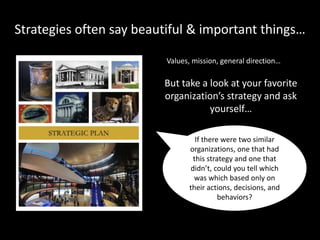
Strategies often say beautiful & important things…
But take a look at your
favorite organization’s
strategy and ask
yourself…
Values, mission,
general direction…
Image: Public Domain:
https://en.wikipedia.org/wiki/Horace_Trumbauer#/media/File:Philadephi
Image: Joe Ravi, CC-BY-SA 3.0
https://commons.wikimedia.org/wiki/File:Field_Museum_of_Natural_Hi
…Does the strategy really matter?
If there were two similar
organizations, one that
had this strategy and one
that didn’t, could you tell
which was which based
only on their actions,
decisions, and
behaviors?
Does the strategy
translate into
action?
Does the strategy
make a real
difference?
?
NASA HQ Photo CC-BY-NC https://flic.kr/p/adDe8D
Strategy is overrated
1. Strategy is over-glamorized
2. Strategy is too inward-looking
3. Strategy is too slow
4. Strategy is too static
5. Strategy overlooks crucial activities
6. Strategy is incomplete
7. Strategy has the wrong audience
8. Strategy is dishonest
9. Strategy fails to inspire
10. Strategy almost never succeeds
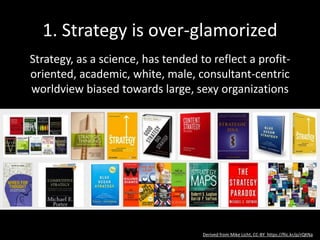
1. Strategy is over-glamorized
Strategy, as a science, has tended to reflect a profit-
oriented, academic, white, male, consultant-centric
worldview biased towards large, sexy organizations
Derived from Mike Licht, CC-BY https://flic.kr/p/rQKNa U
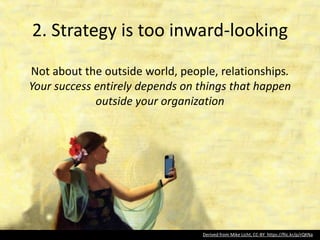
2. Strategy is too inward-looking
Not about the outside world, people, relationships.
Your success entirely depends on things that happen
outside your organization
Derived from Mike Licht, CC-BY https://flic.kr/p/rQKNa U
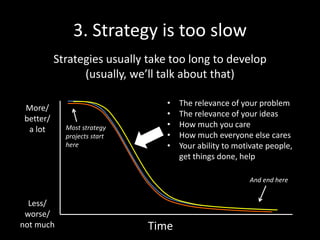
3. Strategy is too slow
Strategies usually take too long to develop
(usually, we’ll talk about that)
Time
More/
better/
a lot
Less/
worse/
not much
• The relevance of your problem
• The relevance of your ideas
• How much you care
• How much everyone else cares
• Your ability to motivate people,
get things done, help
Most strategy
projects start
here
And end here
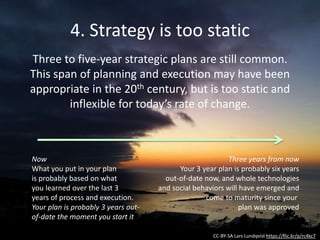
4. Strategy is too static
CC-BY-SA Lars Lundqvist https://flic.kr/p/rc4kc7
Three to five-year strategic plans are still common.
This span of planning and execution may have been
appropriate in the 20th century, but is too static and
inflexible for today’s rate of change.
Start of
Now
What you put in your plan
is probably based on what
you learned over the last 3
years of process and execution.
Your plan is probably 3 years out-
of-date the moment you start it
Three years from now
Your 3 year plan is probably six years
out-of-date now, and whole technologies
and social behaviors will have emerged and
come to maturity since your
plan was approved
Image: http://commons.wikimedia.org/wiki/File:Washing_Line,_Iceland.jpg Washing Line in Iceland CC-BY-SA
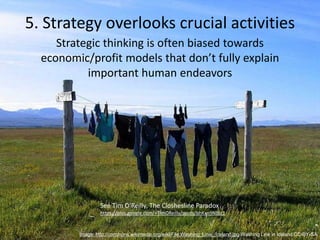
5. Strategy overlooks crucial activities
Strategic thinking is often biased towards
economic/profit models that don’t fully explain
important human endeavors
See Tim O’Reilly, The Closhesline Paradox
https://plus.google.com/+TimOReilly/posts/bhKxn9NbJz1
6. Strategy is incomplete
Only partially explains how
organizations succeed and fail
Tim McFarlane CC-BY-NC-ND (modified) https://flic.kr/p/4dxUme
“Changing your company’s strategy almost
always proves tougher than you thought it
would. But it’s inevitably easier than changing
your culture.”
The Lords of Strategy
Walter Kiechel III
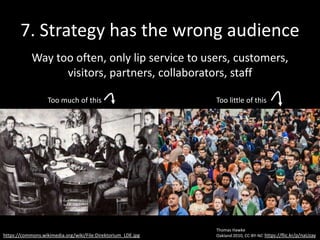
7. Strategy has the wrong audience
Way too often, only lip service to users, customers,
visitors, partners, collaborators, staff
https://commons.wikimedia.org/wiki/File:Direktorium_LDE.jpg https://flic.kr/p/naUzay
Thomas Hawke
Oakland 2010, CC-BY-NC
Too much of this Too little of this
8. Strategy is dishonest
Too much cheerleading and taking credit for existing
success. Rarely dives deep, exposes contradictions,
presents dilemmas, or clarifies choices.
“People don’t want to hear the truth
because they don’t want their illusions
destroyed.”
—Friedrich Nietzsche
9. Strategy fails to inspire
“At the end of the day, this strategy has to mean
something to the people who are actually going
to do the work.”
Paraphrase Leo Mullen, CEO, Navigation Arts
10. Strategy almost never succeeds
(see next slides)
“I had [this exchange] with every single
consulting firm I interviewed…”
Walter Kiechel III
Corporate Strategists Under Fire
Fortune magazine, December 27, 1982
"How many of your clients have
strategies?"
December 1982 Fortune “Corporate Strategists Under Fire.” Walter Keichel III
"If they're our client, they have a
strategy by now.”
December 1982 Fortune “Corporate Strategists Under Fire.” Walter Keichel III
"How many can effectively implement
those strategies?”
December 1982 Fortune “Corporate Strategists Under Fire.” Walter Keichel III
"Uhhh," long pause, much
visible reluctance. "This is not
for attribution, right?”
December 1982 Fortune “Corporate Strategists Under Fire.” Walter Keichel III
"Right. Is it fifty percent?”
December 1982 Fortune “Corporate Strategists Under Fire.” Walter Keichel III
"Oh no, not fifty percent.”
December 1982 Fortune “Corporate Strategists Under Fire.” Walter Keichel III
"Thirty percent?”
December 1982 Fortune “Corporate Strategists Under Fire.” Walter Keichel III
"Um, no."
December 1982 Fortune “Corporate Strategists Under Fire.” Walter Keichel III
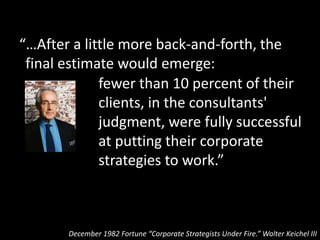
“…After a little more back-and-forth, the
final estimate would emerge:
December 1982 Fortune “Corporate Strategists Under Fire.” Walter Keichel III
fewer than 10 percent of their
clients, in the consultants'
judgment, were fully successful
at putting their corporate
strategies to work.”
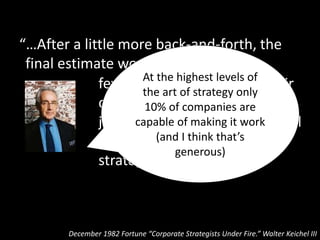
“…After a little more back-and-forth, the
final estimate would emerge:
December 1982 Fortune “Corporate Strategists Under Fire.” Walter Keichel III
fewer than 10 percent of their
clients, in the consultants'
judgment, were fully successful
at putting their corporate
strategies to work.”
At the highest levels of
the art of strategy only
10% of companies are
capable of making it work
(and I think that’s
generous)
"We could do what [the board of directors]
wanted and write a traditional business plan.
That would keep our board happy, but it would
not motivate or inspire our employees, it would
not help attract the new talent the company so
desperately needed, and it wouldn't address
the strategic dynamics of [our] brand-new
industry."
Eric Schmidt (Google chairman) and Jonathan Rosenberg
How Google Works
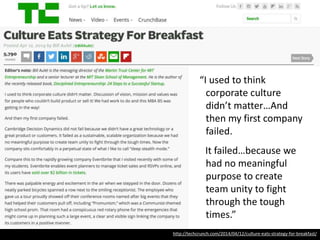
http://techcrunch.com/2014/04/12/culture-eats-strategy-for-breakfast/
“I used to think
corporate culture
didn’t matter…And
then my first company
failed.
It failed…because we
had no meaningful
purpose to create
team unity to fight
through the tough
times.”
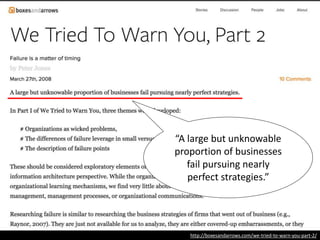
“A large but unknowable
proportion of businesses
fail pursuing nearly
perfect strategies.”
http://boxesandarrows.com/we-tried-to-warn-you-part-2/
Why would we invest so
much time and energy in
such a flawed paradigm?
There must be a better way.
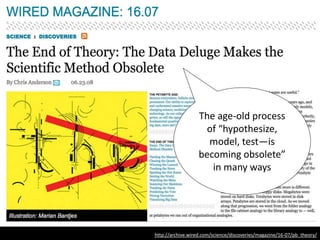
http://archive.wired.com/science/discoveries/magazine/16-07/pb_theory/
The age-old process
of “hypothesize,
model, test—is
becoming obsolete”
in many ways
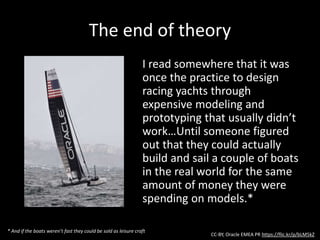
The end of theory
I read somewhere that it was
once the practice to design
racing yachts through
expensive modeling and
prototyping that usually didn’t
work…Until someone figured
out that they could actually
build and sail a couple of boats
in the real world for the same
amount of money they were
spending on models.*
CC-BY, Oracle EMEA PR https://flic.kr/p/bLM5kZ
* And if the boats weren’t fast they could be sold as leisure craft
The end of theory
Agile processes
(doing quickly to see results with real users)
beat long-term projections by experts
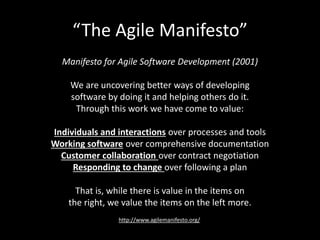
“The Agile Manifesto”
Manifesto for Agile Software Development (2001)
We are uncovering better ways of developing
software by doing it and helping others do it.
Through this work we have come to value:
Individuals and interactions over processes and tools
Working software over comprehensive documentation
Customer collaboration over contract negotiation
Responding to change over following a plan
That is, while there is value in the items on
the right, we value the items on the left more.
http://www.agilemanifesto.org/
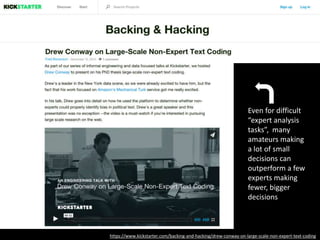
https://www.kickstarter.com/backing-and-hacking/drew-conway-on-large-scale-non-expert-text-coding
Even for difficult
“expert analysis
tasks”, many
amateurs making
a lot of small
decisions can
outperform a few
experts making
fewer, bigger
decisions
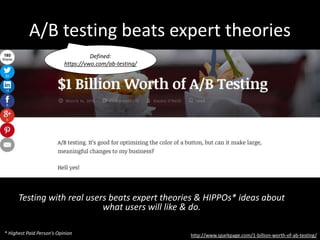
A/B testing beats expert theories
Testing with real users beats expert theories & HIPPOs* ideas about
what users will like & do.
* Highest Paid Person’s Opinion http://www.sparkpage.com/1-billion-worth-of-ab-testing/
Defined:
https://vwo.com/ab-testing/
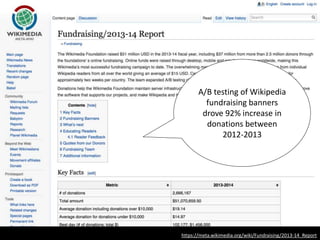
https://meta.wikimedia.org/wiki/Fundraising/2013-14_Report
A/B testing of
Wikipedia fundraising
banners drove 92%
increase in donations
between 2012-2013
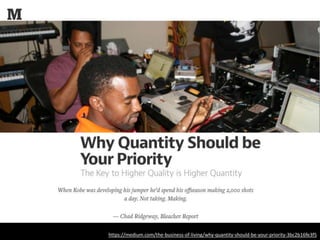
https://medium.com/the-business-of-living/why-quantity-should-be-your-priority-3bc2b16fe3f5
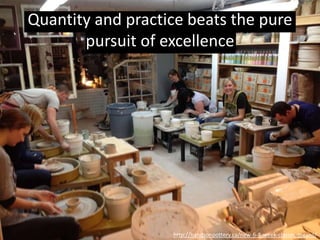
http://handsonpottery.ca/new-6-8-week-classes-means/
Quantity and practice beat the pure
pursuit of excellence
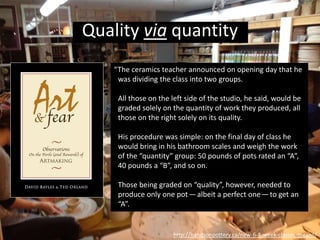
“The ceramics teacher announced on opening day that he
was dividing the class into two groups.
All those on the left side of the studio, he said, would be
graded solely on the quantity of work they produced, all
those on the right solely on its quality.
His procedure was simple: on the final day of class he
would bring in his bathroom scales and weigh the work
of the “quantity” group: 50 pounds of pots rated an “A”,
40 pounds a “B”, and so on.
Those being graded on “quality”, however, needed to
produce only one pot — albeit a perfect one — to get an
“A”.
http://handsonpottery.ca/new-6-8-week-classes-means/
Quality via quantity
“Well, came grading time and a curious fact
emerged: the works of highest quality were all
produced by the group being graded for quantity.
It seems that while the “quantity” group was
busily churning out piles of work—and learning
from their mistakes — the “quality” group had sat
theorizing about perfection, and in the end had
little more to show for their efforts than grandiose
theories and a pile of dead clay.”
http://handsonpottery.ca/new-6-8-week-classes-means/
Quality via quantity
Doing is SO MUCH EASIER NOW
https://youtu.be/nnWZP5hUVNo
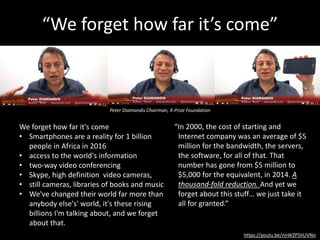
“We forget how far it’s come”
https://youtu.be/nnWZP5hUVNo
We forget how far it's come
• Smartphones are a reality for 1 billion
people in Africa in 2016
• access to the world's information
• two-way video conferencing
• Skype, high definition video cameras,
• still cameras, libraries of books and music
• We've changed their world far more than
anybody else's' world, it's these rising
billions I'm talking about, and we forget
about that.
“In 2000, the cost of starting and
Internet company was an average of $5
million for the bandwidth, the servers,
the software, for all of that. That
number has gone from $5 million to
$5,000 for the equivalent, in 2014. A
thousand-fold reduction. And yet we
forget about this stuff… we just take it
all for granted.”
Peter Diamandis Chairman, X-Prize Foundation
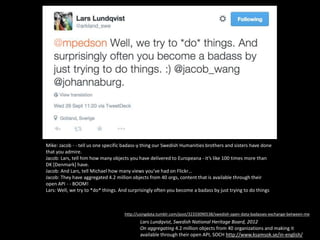
Lars Lundqvist, Swedish National Heritage Board, 2012
On aggregating 4.2 million objects from 40 organizations and making it
available through their open API, SOCH http://www.ksamsok.se/in-english/
http://usingdata.tumblr.com/post/32333090538/swedish-open-data-badasses-exchange-between-me
Mike: Jacob - - tell us one specific badass-y thing our Swedish Humanities brothers and sisters have done
that you admire.
Jacob: Lars, tell him how many objects you have delivered to Europeana - it’s like 100 times more than
DK [Denmark] have.
Jacob: And Lars, tell Michael how many views you’ve had on Flickr…
Jacob: They have aggregated 4.2 million objects from 40 orgs, content that is available through their
open API - - BOOM!
Lars: Well, we try to *do* things. And surprisingly often you become a badass by just trying to do things
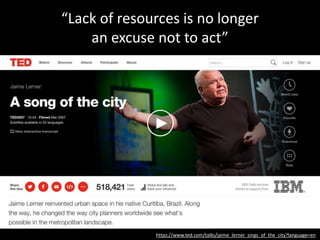
https://www.ted.com/talks/jaime_lerner_sings_of_the_city?language=en
“Lack of resources is no longer
an excuse not to act”
Jamie Lerner, as quoted in Tactical Urbanism
Derek Muller
“How to Make a YouTube Channel”
Muller makes science videos "addressing counter-intuitive
concepts in science, usually beginning by discussing ideas with
members of the public.”
2,873,219 subscribers • 207,753,005 views
https://www.youtube.com/user/1veritasium
Derek Muller
“How to Make a YouTube Channel”
“My advice sounds so simple: start making videos. So why don't we? Why does
everyone find it so difficult? Well, the answer is, you want to make something that's
good, that's popular, that everyone likes. You're worried that, what if you make it and
nobody does like it, or it's bad. And so rather than face that reality, you just don't
make anything.”
https://youtu.be/QLIKgT-OSLQ
“My advice sounds
so simple: start
making videos.”
“Real artists ship.”
—Attributed to Steve Jobs
https://commons.wikimedia.org/wiki/File:Steve_Jobs_Headshot_2010
-CROP.jpgMatthew Yohe, CC-BT-SA
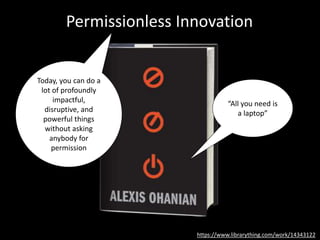
Permissionless Innovation
https://www.librarything.com/work/14343122
Today, you can do a
lot of profoundly
impactful,
disruptive, and
powerful things
without asking
anybody for
permission
“All you need is
a laptop”
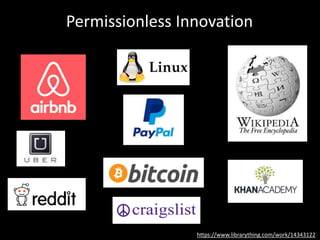
Permissionless Innovation
https://www.librarything.com/work/14343122
Permissionless Innovation
More info/slides on
Permissionless Innovation,
see:
http://www.slideshare.net/edson
m/dark-matter-the-dark-matter-
of-the-internet-is-open-social-
peertopeer-and-read-write/181
Think big, start small, move fast
I first started
using this
expression 5 years
ago, after I heard
it at the Clinton
Global Initiatives
summit
It has proven to be
an effective and
powerful way to
understand how to
get change started
Why?
What does it
really mean?
1. Think big
Thinking big is important
because there are so many
more possibilities than there
were a few years ago—and
there are enormous problems to
solve
3.1 billion people are online
And another 5 billion are likely to join them in
the next decade.
http://www.internetlivestats.com/internet-users/
“…global connectivity, immense computational power,
and access to all the world's knowledge amassed over
many centuries, in everyone’s hands. The world has
never, ever, been in that situation before…”
http://edge.org/response-detail/10646
Keith Devlin
Executive Director, H-STAR Institute,
Stanford University
There are immense and compelling
challenges to overcome
• Climate change
• Biodiversity
• Globalization
• Cultural tolerance
• Cultural enfranchisement
• Literacy (+ scientific)
• Education
• Human rights
• Monetary system reforms
http://globalchallenges.org/publications/globalrisks/about-the-project/
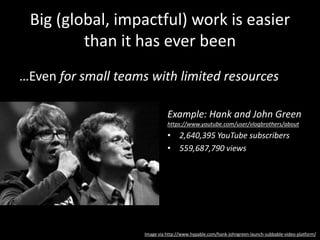
Big (global, impactful) work is easier
than it has ever been
…Even for small teams with limited resources
Example: Hank and John Green
https://www.youtube.com/user/vlogbrothers/about
• 2,640,395 YouTube subscribers
• 559,687,790 views
Image via http://www.hypable.com/hank-johngreen-launch-subbable-video-platform/
“Within anyone’s reach”
“If you are trying to do something big,
it’s not enough to just grow, you
need to scale… In the Internet
Century, this sort of global growth is
within anyone’s reach….It no longer
takes a phalanx of people and a
widespread network of offices to
create a company.”
Eric Schmidt & Jonathan Rosenberg
How Google Works
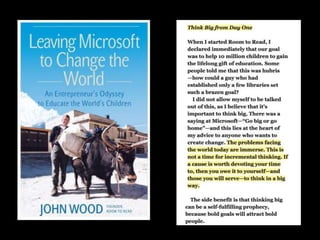
“Bold goals attract bold people”
http://www.roomtoread.org/
Room-to-Read
has distributed
10 million books
and built 17,000
libraries and
1,900 schools
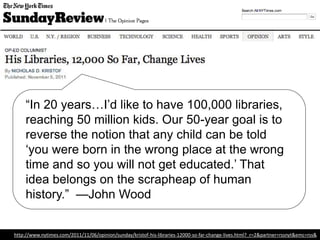
“In 20 years…I’d like to have 100,000 libraries,
reaching 50 million kids. Our 50-year goal is to
reverse the notion that any child can be told
‘you were born in the wrong place at the wrong
time and so you will not get educated.’ That
idea belongs on the scrapheap of human
history.” —John Wood, Founder, Room to
Read
http://www.nytimes.com/2011/11/06/opinion/sunday/kristof-his-libraries-12000-so-far-change-lives.html?_r=2&partner=rssnyt&emc=rss&
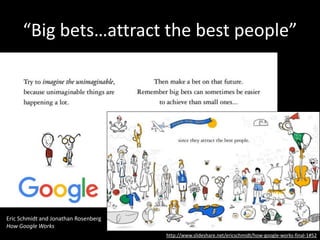
“Big bets…attract the best people”
http://www.slideshare.net/ericschmidt/how-google-works-final-1#52
Eric Schmidt and Jonathan Rosenberg
How Google Works
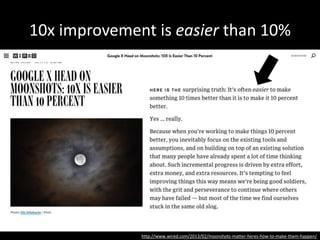
10x improvement is easier than 10%
http://www.wired.com/2013/02/moonshots-matter-heres-how-to-make-them-happen/
2. Starting small
Big change seems
daunting at first,
but small actions,
aligned with a big
goal, can add up
quickly
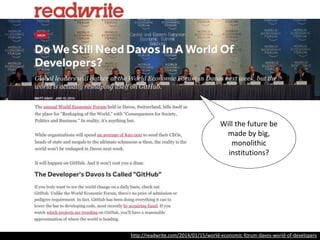
http://readwrite.com/2014/01/15/world-economic-forum-davos-world-of-developers
Will the future
be made by
big, monolithic
institutions?
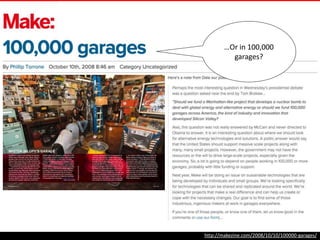
http://makezine.com/2008/10/10/100000-garages/
…Or in
100,000
garages?
CC-BY Ricardo Ricote, www.urbanity.es https://flic.kr/p/8u5MvX
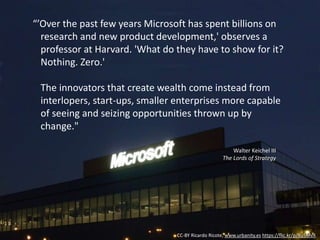
“’Over the past few years Microsoft has spent billions on
research and new product development,' observes a
professor at Harvard. 'What do they have to show for it?
Nothing. Zero.'
The innovators that create wealth come instead from
interlopers, start-ups, smaller enterprises more capable
of seeing and seizing opportunities thrown up by
change."
Walter Keichel III
The Lords of Strategy
“Start doing immediately”
“With time and thought, anyone can generate dozens of
ideas…that are relevant to a specific situation.
My advice: don’t try. A long list can be overwhelming. A sense
of being overwhelmed stops action instead of encouraging it.
A better strategy is to identify three or four ideas that will be
easy to implement, and start doing so immediately.”
John Kotter
A Sense of Urgency, 2008
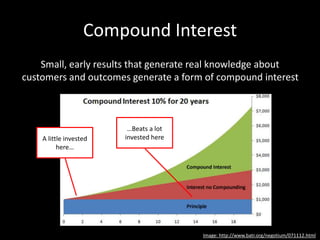
Compound Interest
Small, early results that generate real knowledge about
customers and outcomes generate a form of compound interest
Image: http://www.batr.org/negotium/071112.html
A little invested
here…
…Beats a lot
invested here
The Lean Startup
http://theleanstartup.com/principles
“A core component of Lean Startup
methodology is the build-measure-learn
feedback loop. The first step is figuring out the
problem that needs to be solved and then
developing a minimum viable product (MVP) to
begin the process of learning as quickly as
possible.”
“Technology animates the
lean start-up process. Free
open-source programming
tools and easily distributed
Web-based software drive
down the cost of
developing new products
and services. The early
companies embracing the
principles live largely on
the Web, which makes it
possible to measure and
track customer
behavior constantly
and to invite
suggestions and
criticism.”
http://dealbook.nytimes.com//2010/04/26/the-rise-of-the-fleet-footed-start-up/
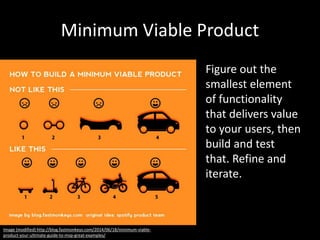
Minimum Viable Product
Figure out the
smallest element
of functionality
that delivers value
to your users, then
build and test
that. Refine and
iterate.
Image (modified) http://blog.fastmonkeys.com/2014/06/18/minimum-viable-
product-your-ultimate-guide-to-mvp-great-examples/
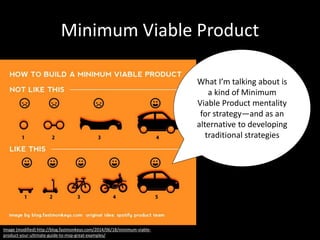
Minimum Viable Product
What I’m talking about is
a kind of Minimum
Viable Product mentality
for strategy—and as an
alternative to developing
traditional strategies
Image (modified) http://blog.fastmonkeys.com/2014/06/18/minimum-viable-
product-your-ultimate-guide-to-mvp-great-examples/
Short-term wins
"Real transformation takes time, and a renewal
effort risks losing momentum if there are no short-
term goals to meet and celebrate…Without short-
term wins, too many people give up or actively join
the ranks of those people who have been resisting
change. […] Commitments to produce short-term
wins help keep the urgency level up and force
detailed analytical thinking that can clarify or
revise visions.”
John Kotter
Leading Change: Why Transformation Efforts Fail
1995
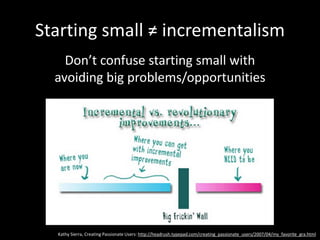
Starting small ≠ incrementalism
Don’t confuse starting small with
avoiding big problems/opportunities
Kathy Sierra, Creating Passionate Users: http://headrush.typepad.com/creating_passionate_users/2007/04/my_favorite_gra.html
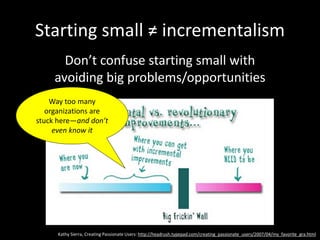
Starting small ≠ incrementalism
Don’t confuse starting small with
avoiding big problems/opportunities
Kathy Sierra, Creating Passionate Users: http://headrush.typepad.com/creating_passionate_users/2007/04/my_favorite_gra.html
Way too many
organizations are
stuck here—and don’t
even know it
What can you do today?
Take a stand.
Starting small and doing something useful for
real people forces you to make a public
commitment about what you believe in.
This accelerates learning.
The world is changing too quickly for any other
kind of work. Old models can’t keep up.
My rule of 1 year
Think about gathering together a year from now.
What two or three things must you accomplish
in the next year—things that are so basic and
important that if you don’t finish them you
should resign in shame.
Start working on those things today.
3. Moving fast
“Velocity matters,” but
time is the most difficult
dimension to understand
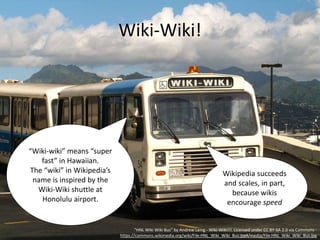
Wiki-Wiki!
"HNL Wiki Wiki Bus" by Andrew Laing - Wiki-Wiki!!!. Licensed under CC BY-SA 2.0 via Commons -
https://commons.wikimedia.org/wiki/File:HNL_Wiki_Wiki_Bus.jpg#/media/File:HNL_Wiki_Wiki_Bus.jpg
“Wiki-wiki” means “super
fast” in Hawaiian.
The “wiki” in Wikipedia’s
name is inspired by the
Wiki-Wiki shuttle at
Honolulu airport.
Wikipedia succeeds
and scales, in part,
because wikis
encourage speed
“We’re changing…maybe not fast enough.”
– Deputy director of US museum, on the results of their widely
acclaimed, award-winning museum transformation project
“Our next strategy will take three years to develop.
It’s too slow.”
– Director of Strategy at a major European national library
"I don’t know how to convince upper management that any
sort of change is necessary, or that any particular change is
worth making.”
– A program officer hired to institute change at one of America’s
largest foundations
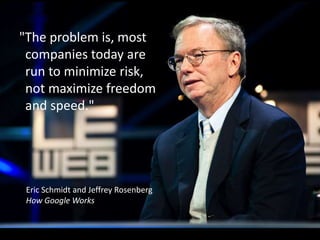
"The problem is, most
companies today are
run to minimize risk,
not maximize freedom
and speed."
Eric Schmidt and Jeffrey Rosenberg
How Google Works
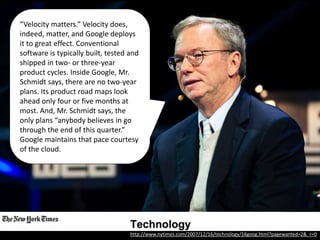
“Velocity matters.” Velocity does,
indeed, matter, and Google deploys
it to great effect. Conventional
software is typically built, tested and
shipped in two- or three-year
product cycles. Inside Google, Mr.
Schmidt says, there are no two-year
plans. Its product road maps look
ahead only four or five months at
most. And, Mr. Schmidt says, the
only plans “anybody believes in go
through the end of this quarter.”
Google maintains that pace courtesy
of the cloud.
http://www.nytimes.com/2007/12/16/technology/16goog.html?pagewanted=2&_r=0
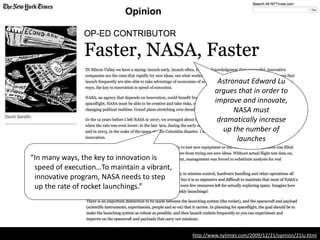
http://www.nytimes.com/2009/12/21/opinion/21lu.html
“In many ways, the key to
innovation is speed of
execution…To maintain a
vibrant, innovative program,
NASA needs to step up the
rate of rocket launchings.”
Astronaut Edward Lu
argues that in order to
improve and innovate,
NASA must
dramatically increase
the number of
launches
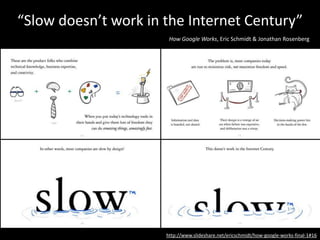
http://www.slideshare.net/ericschmidt/how-google-works-final-1#16
“Slow doesn’t work in the Internet Century”
How Google Works, Eric Schmidt & Jonathan Rosenberg
About slowness…
• Some things take time
• But behind many “slow” projects are a lot of
small, fast things
• Most organizations waste enormous amounts of
time in the initial “upstream” phases of their
projects (when they could be doing and learning)
Not everything needs to be fast,
but most work is way too slow, complacent.
Think big, start small, move fast
8 Examples
1. Tactical Urbanism
2. Khan Academy
3. NY Times Archive
4. Smithsonian Web Strategy
5. NPR Tiny Desk
6. Vlogbrothers
7. Wikipedia
8. TED
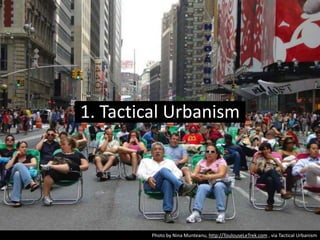
1. Tactical Urbanism
Photo by Nina Munteanu, http://ToulouseLeTrek.com , via Tactical Urbanism
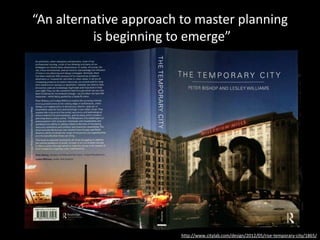
“An alternative approach to master planning
is beginning to emerge”
http://www.citylab.com/design/2012/05/rise-temporary-city/1865/
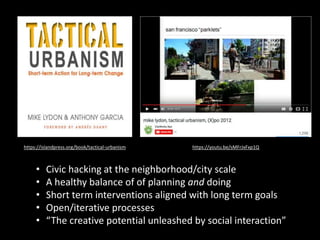
https://islandpress.org/book/tactical-urbanism https://youtu.be/sMFrJxFxp1Q
• Civic hacking at the neighborhood/city scale
• A healthy balance of of planning and doing
• Short term interventions aligned with long term goals
• Open/iterative processes
• “The creative potential unleashed by social interaction”
Photo via http://www.citylab.com/tech/2012/02/guerilla-wayfinding-raleigh/1139/
Fast/cheap (and illegal)
“Guerilla Wayfinding”
project in Raleigh, NC,
encouraged walking
and quickly lead to
new policies, funding,
and permanent change
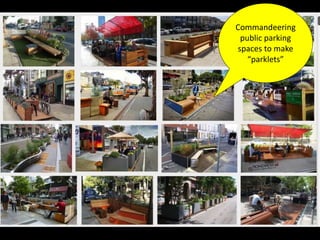
Commandeering
public parking
spaces to make
“parklets” shows
the hidden
potential of
forgotten urban
spaces
http://www.thenatureofcities.com/TNOC/wp-
content/uploads/2015/07/Crosswalk-861x560.png
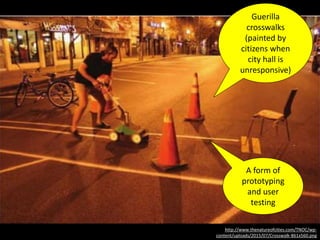
Guerilla
crosswalks
(painted by
citizens when
city hall is
unresponsive)
A form of
prototyping
and user
testing