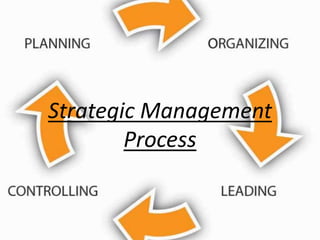
Strategic Management
Process
Strategic Management is continuous
process that consist of 9 steps:-
Develop a clear vision and translate it into a
meaningful mission statement
Assess the company’s strengths and
weaknesses
Scan the environment for significant
opportunities and threats facing the business
Identify the key factors for the success in the
business
Analyse the competition
Create company goals and
objectives
Formulate strategic options and
select the appropriate strategies
Translate strategic plans into
action plans
Establish accurate controls.
Step 1:-Develop Clear Vision and Translate
it into a meaningful Mission Statement
• Throughout history , the greatest political and business
leaders have been visionaries . Whether the vision is as
grand as Martin Luther King Jr.’s “I have a dream”
speech or as simple as Ray Kroc’s devotion to quality ,
service , cleanliness and value at McDonald’s , purpose
is the same to focus everyone’s attention on the same
target and to inspire them to reach to it . The vision is
future-oriented and touches everyone associated with
company –employees , investors , lenders , customers ,
and the community at large . It is an expression of what
employees stand for and believe in . Highly successful
entrepreneurs are able to communicate their vision and
their enthusiasm about the vision to those around
them .
• The vision is the result of an entrepreneur’s dream
of something that does not exist yet the ability to
paint a compelling picture of that dream for
everyone to see . It answers the question “Where
we are going?” A clearly defined vision helps a
company in 3 ways-
Vision provides direction : Entrepreneurs who spell
out the vision for their company focus everyone’s
attention on the future and determine the path the
business will take to get there.
Vision determines decisions : The vision influences
the decision , no matter how big or small , that
owner is , manager and the employees make every
day in a business.
Vision motivates people-A clear vision excites and
ignites people to action . People want to work for a
company that sets its sights high.
Vision is based on an entrepreneur’s value
Basically the entrepreneur’s values are the nucleus
around which a company grows.
Successful entrepreneurs build their businesses
around a set of 3 to 6 core values which might range
from respect for the individuals and innovation to
creating satisfied customers and making the world a
better place to live.
Mission Statement
• The mission statement addresses another
basic question of any business venture
“What business are we in ? ” Establishing
the purpose of the business in writing
must come 1st in order to give the
company a sense of direction . “If you
reduce it to paper then it forces you to
think about what you are doing.
Tips to write effective mission statement
Keep it short
Keep it simple
Take a broad view
Get everyone involved
Keep it current
Make sure that your mission statement
reflects the values and beliefs you hold dear.
Keep the tone of the statement positive and
upbeat
Consider using your mission statement to
lay an ethical foundation for your
company
Look at other companies’ mission
statements to generate ideas of your
own.
Make sure that your mission statement is
appropriate for your company’s culture
Make sure that your statement should
reflect a concern for the future.
Elements of Mission Statement
• A sound mission statement need not be lengthy to
be effective .3 key issues entrepreneurs and their
employees should address as they develop a
mission statement for their businesses include the
following:
1) The purpose of the company : What are we in
business to accomplish
2) The business we are in : How are we going to
accomplish that purpose
3) The value of the company : What principles and
beliefs form the foundation of the way we do
business?
• A company’s mission statement may be most essential
and basic communications that puts forward. If the
people on the plant , retail, or warehouse floor don’t
know what a company’s mission is , then , for all
practical purposes , it does not have one!
• The mission statement expresses a company’s
character , identity and scope of operations , but
writing it is only half the battle, at best . The most
difficult part is living that mission every day . That’s
how the employees decide what really matters.
• A mission statement must become a natural part of the
organization , embodied in the mind , habits , attitudes
, and decisions of everyone in the company every day.
• A company may have a powerful competitive
advantage , but it is wasted unless-
The owner communicates that advantage to
workers , who in turn , work hard to communicate it
to customers and potential customers and
Customers recommend the company to their friends
because they understand the benefits they are
getting from it that they cannot get elsewhere.
That’s the real power of mission statement
Step-2 -: Assess the company’s Strengths
and Weaknesses
• After laying down defined vision and mission
statement for the company , an entrepreneur can
turn his or her attention to assessing company
strength and weaknesses . Building a successful
competitive strategy requires a business requires to
magnify its strengths and overcome or compensate
for its weaknesses.
• Strengths are positive internal factors that a
company can use to accomplish its mission , goals
and objectives.
• This might include any special skill or knowledge , a
positive public image , an experienced sales force ,
an established base of loyal customers and other
factors .
• Weaknesses are the negative internal factors that
inhibits the accomplishment of a company’s mission
, goals and objectives.
• It can be either lack of capital , a shortage of skilled
workers , the inability to master technology and an
inferior location.
Identifying strength and weaknesses help the
business help owners to understand their businesses.
Step-3 -:Scan the Environment for Significant
Opportunities and Threats Facing the Business
• Opportunities are nothing but the external options
that a firm can exploit to accomplish its mission , goals
and objectives.
Since there is no end for these opportunities . So the
entrepreneur needs to analyse only those factors that
are most significant to the business.
The key here is to focus on the most promising
opportunities that fit most closely with the company’s
strength s and core competencies.
• Threats are the negative internal factors that inhibits
a company’s ability to achieve its mission , goal and
objectives.
 They can take a variety of forms such as-
 Competitor entering into the local market.
 Govt. mandate regulating a business activity
 An economic recession
 Rising interest rates
 Technological advances
Example-
a) Whatsapp has become a major threat for telecom
companies(text messaging services)
b) Tablets have become a major threat for laptops
c) AAP has become a serious threat for BJP in Delhi to
form a new government.
• Although you may not be able to control the
external threats but then you must prepare a plan
to shield your businesses form these threats.
Step-4 -: Identify the Key Factors for the
Success in the business
• Every business is characterized by controllable variables
that can be identified and manipulated so as to gain a
competitive advantage . By focusing efforts to maximise
their companies’ performance on these key success
factors , entrepreneurs can achieve dramatic market
advantages over their competitors . Companies that
understand these key success factors tend to be lenders
of the pack.
• KSF’s (Key Success Factors) come in a variety of
different patterns depending on the industry . Simply
stated , they are the factors that determine a
company’s ability to compete successfully in an
industry . Every company must understand in an
industry must understand the key success factors
driving the industry
Step-5 –: Analyse the Competition
• Whenever you ask any businessmen about the
greatest challenge he faces in today’s time-
THERE WILL CERTAINLY BE ONLY 1 ANSWER i.e
Challenge form their competitors
Generally small business owners believe they operate
in a highly competitive environment and that the
level of competition is increasing like anything!!!!!
• The World Wide Web(www) and the e-commerce
have increased the ferocity and the scope of the
competition entrepreneurs face as well have forced
many business owners to reshape completely the
ways in which they do business.
The Competitive Strategies that small business rely on most heavily to
compete with their rivals
• Competitive Intelligence program-:
It is a program that could help business owners to
keep a tab on rival’s movement . As per this program
“Business is a battlefield and if you want to win the
war then you need to know who are up against ”. The
primary goals of this program is includes the
following-
Avoiding surprises from the existing competitor’s
new strategies and tactics
Identifying potential new competitors
Improving reaction time to competitors’ actions
Anticipating rivals’ next strategic moves.
Competitor Analysis
• Sizing up the competition gives the business a more
realistic view of the market and his or her
company’s position in it . Yet not every competitor
warrants the same level of attention in the strategic
plan.
• There are broadly 3 types of competitors namely-
Direct Competitors
Significant Competitors
Indirect Competitors
• Now we can also use competitive profile matrix to
evaluate the firm vis-à-vis their competitors.
Now each KSF is provided with weights based on their
relative importance in the business in order to get a
more realistic idea about each and every aspect of
business.
• Unfortunately , many small businesses fails to
gather the competitive intelligence because their
owners mistakenly assume that it is either too
costly or simply unnecessary.
• The main key is to learn how can we manage the
information and knowledge that company
accumulates.
Knowledge Management is the practice of gathering ,
organizing and disseminating the collective wisdom
and experience of a company’s employees for the
purpose of strengthening its competitive position. “It
allows you to determine the explicit knowledge that is
somewhere in your organisation and that you can
leverage rather than having to re-invent the wheel.”

Strategic Management Process

  • 1.
  • 2.
    Strategic Management iscontinuous process that consist of 9 steps:- Develop a clear vision and translate it into a meaningful mission statement Assess the company’s strengths and weaknesses Scan the environment for significant opportunities and threats facing the business Identify the key factors for the success in the business
  • 3.
    Analyse the competition Createcompany goals and objectives Formulate strategic options and select the appropriate strategies Translate strategic plans into action plans Establish accurate controls.
  • 4.
    Step 1:-Develop ClearVision and Translate it into a meaningful Mission Statement • Throughout history , the greatest political and business leaders have been visionaries . Whether the vision is as grand as Martin Luther King Jr.’s “I have a dream” speech or as simple as Ray Kroc’s devotion to quality , service , cleanliness and value at McDonald’s , purpose is the same to focus everyone’s attention on the same target and to inspire them to reach to it . The vision is future-oriented and touches everyone associated with company –employees , investors , lenders , customers , and the community at large . It is an expression of what employees stand for and believe in . Highly successful entrepreneurs are able to communicate their vision and their enthusiasm about the vision to those around them .
  • 5.
    • The visionis the result of an entrepreneur’s dream of something that does not exist yet the ability to paint a compelling picture of that dream for everyone to see . It answers the question “Where we are going?” A clearly defined vision helps a company in 3 ways- Vision provides direction : Entrepreneurs who spell out the vision for their company focus everyone’s attention on the future and determine the path the business will take to get there. Vision determines decisions : The vision influences the decision , no matter how big or small , that owner is , manager and the employees make every day in a business.
  • 6.
    Vision motivates people-Aclear vision excites and ignites people to action . People want to work for a company that sets its sights high. Vision is based on an entrepreneur’s value Basically the entrepreneur’s values are the nucleus around which a company grows. Successful entrepreneurs build their businesses around a set of 3 to 6 core values which might range from respect for the individuals and innovation to creating satisfied customers and making the world a better place to live.
  • 8.
    Mission Statement • Themission statement addresses another basic question of any business venture “What business are we in ? ” Establishing the purpose of the business in writing must come 1st in order to give the company a sense of direction . “If you reduce it to paper then it forces you to think about what you are doing.
  • 9.
    Tips to writeeffective mission statement Keep it short Keep it simple Take a broad view Get everyone involved Keep it current Make sure that your mission statement reflects the values and beliefs you hold dear. Keep the tone of the statement positive and upbeat
  • 10.
    Consider using yourmission statement to lay an ethical foundation for your company Look at other companies’ mission statements to generate ideas of your own. Make sure that your mission statement is appropriate for your company’s culture Make sure that your statement should reflect a concern for the future.
  • 11.
    Elements of MissionStatement • A sound mission statement need not be lengthy to be effective .3 key issues entrepreneurs and their employees should address as they develop a mission statement for their businesses include the following: 1) The purpose of the company : What are we in business to accomplish 2) The business we are in : How are we going to accomplish that purpose 3) The value of the company : What principles and beliefs form the foundation of the way we do business?
  • 12.
    • A company’smission statement may be most essential and basic communications that puts forward. If the people on the plant , retail, or warehouse floor don’t know what a company’s mission is , then , for all practical purposes , it does not have one! • The mission statement expresses a company’s character , identity and scope of operations , but writing it is only half the battle, at best . The most difficult part is living that mission every day . That’s how the employees decide what really matters. • A mission statement must become a natural part of the organization , embodied in the mind , habits , attitudes , and decisions of everyone in the company every day.
  • 13.
    • A companymay have a powerful competitive advantage , but it is wasted unless- The owner communicates that advantage to workers , who in turn , work hard to communicate it to customers and potential customers and Customers recommend the company to their friends because they understand the benefits they are getting from it that they cannot get elsewhere. That’s the real power of mission statement
  • 14.
    Step-2 -: Assessthe company’s Strengths and Weaknesses • After laying down defined vision and mission statement for the company , an entrepreneur can turn his or her attention to assessing company strength and weaknesses . Building a successful competitive strategy requires a business requires to magnify its strengths and overcome or compensate for its weaknesses. • Strengths are positive internal factors that a company can use to accomplish its mission , goals and objectives.
  • 15.
    • This mightinclude any special skill or knowledge , a positive public image , an experienced sales force , an established base of loyal customers and other factors . • Weaknesses are the negative internal factors that inhibits the accomplishment of a company’s mission , goals and objectives. • It can be either lack of capital , a shortage of skilled workers , the inability to master technology and an inferior location. Identifying strength and weaknesses help the business help owners to understand their businesses.
  • 16.
    Step-3 -:Scan theEnvironment for Significant Opportunities and Threats Facing the Business • Opportunities are nothing but the external options that a firm can exploit to accomplish its mission , goals and objectives. Since there is no end for these opportunities . So the entrepreneur needs to analyse only those factors that are most significant to the business. The key here is to focus on the most promising opportunities that fit most closely with the company’s strength s and core competencies. • Threats are the negative internal factors that inhibits a company’s ability to achieve its mission , goal and objectives.
  • 17.
     They cantake a variety of forms such as-  Competitor entering into the local market.  Govt. mandate regulating a business activity  An economic recession  Rising interest rates  Technological advances Example- a) Whatsapp has become a major threat for telecom companies(text messaging services) b) Tablets have become a major threat for laptops c) AAP has become a serious threat for BJP in Delhi to form a new government.
  • 18.
    • Although youmay not be able to control the external threats but then you must prepare a plan to shield your businesses form these threats.
  • 19.
    Step-4 -: Identifythe Key Factors for the Success in the business • Every business is characterized by controllable variables that can be identified and manipulated so as to gain a competitive advantage . By focusing efforts to maximise their companies’ performance on these key success factors , entrepreneurs can achieve dramatic market advantages over their competitors . Companies that understand these key success factors tend to be lenders of the pack. • KSF’s (Key Success Factors) come in a variety of different patterns depending on the industry . Simply stated , they are the factors that determine a company’s ability to compete successfully in an industry . Every company must understand in an industry must understand the key success factors driving the industry
  • 22.
    Step-5 –: Analysethe Competition • Whenever you ask any businessmen about the greatest challenge he faces in today’s time- THERE WILL CERTAINLY BE ONLY 1 ANSWER i.e Challenge form their competitors Generally small business owners believe they operate in a highly competitive environment and that the level of competition is increasing like anything!!!!!
  • 23.
    • The WorldWide Web(www) and the e-commerce have increased the ferocity and the scope of the competition entrepreneurs face as well have forced many business owners to reshape completely the ways in which they do business.
  • 24.
    The Competitive Strategiesthat small business rely on most heavily to compete with their rivals
  • 25.
    • Competitive Intelligenceprogram-: It is a program that could help business owners to keep a tab on rival’s movement . As per this program “Business is a battlefield and if you want to win the war then you need to know who are up against ”. The primary goals of this program is includes the following- Avoiding surprises from the existing competitor’s new strategies and tactics Identifying potential new competitors Improving reaction time to competitors’ actions Anticipating rivals’ next strategic moves.
  • 26.
    Competitor Analysis • Sizingup the competition gives the business a more realistic view of the market and his or her company’s position in it . Yet not every competitor warrants the same level of attention in the strategic plan. • There are broadly 3 types of competitors namely- Direct Competitors Significant Competitors Indirect Competitors
  • 27.
    • Now wecan also use competitive profile matrix to evaluate the firm vis-à-vis their competitors. Now each KSF is provided with weights based on their relative importance in the business in order to get a more realistic idea about each and every aspect of business.
  • 28.
    • Unfortunately ,many small businesses fails to gather the competitive intelligence because their owners mistakenly assume that it is either too costly or simply unnecessary. • The main key is to learn how can we manage the information and knowledge that company accumulates. Knowledge Management is the practice of gathering , organizing and disseminating the collective wisdom and experience of a company’s employees for the purpose of strengthening its competitive position. “It allows you to determine the explicit knowledge that is somewhere in your organisation and that you can leverage rather than having to re-invent the wheel.”