B Y O V I D I J U S J U R E V I C I U S
A T S T R A T E G I C M A N A G E M E N T I N S I G H T
Strategic Management
& Strategic Planning
Contents
 Definition
 What is strategic management?
 Key terms
 Difference between strategic management and
strategic planning
 Basic strategic planning process
 Different models of strategic management
 Importance of strategic planning
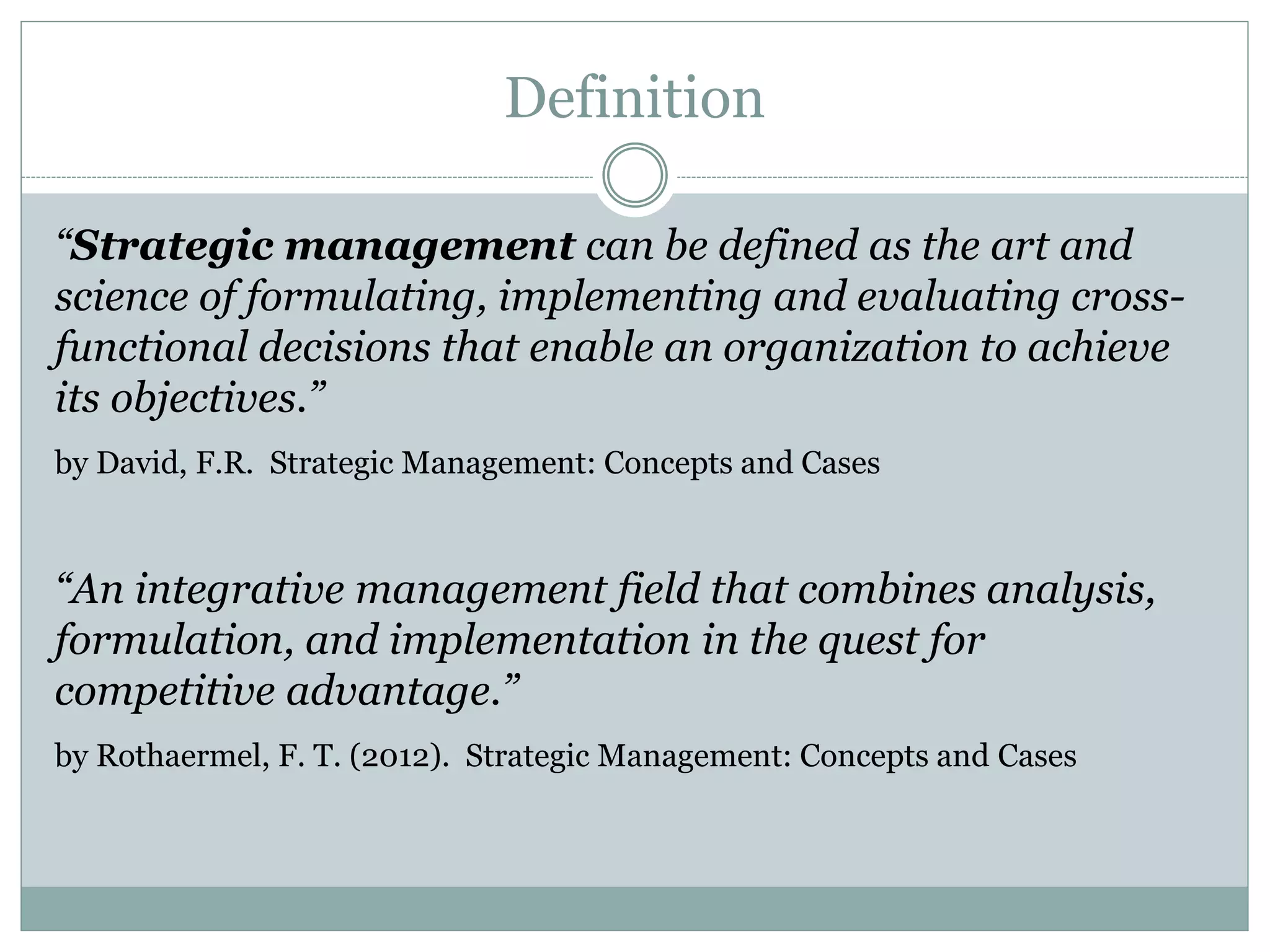
Contents (continued)
 Why some firms do not do strategic management
 Key benefits
 Limitations
 Guidelines for successful strategic planning
Definition
“Strategic management can be defined as the art and
science of formulating, implementing and evaluating cross-
functional decisions that enable an organization to achieve
its objectives.”
by David, F.R. Strategic Management: Concepts and Cases
“An integrative management field that combines analysis,
formulation, and implementation in the quest for
competitive advantage.”
by Rothaermel, F. T. (2012). Strategic Management: Concepts and Cases
Definition (cont.)
“Strategic planning is defined as the process by which
managers of the firm analyze the internal and external
environments for the purpose of formulating strategies and
allocating resources to develop a competitive advantage in
an industry that allows for the successful achievement of
organizational goals.”
by Cox, Daspit, McLaughlin and Jones (2012)
“Strategic management includes understanding the
strategic position of an organisation, making strategic
choices for the future and managing strategy in action.”
by Johnson, Scholes and Whittington (2008)
What is Strategic Management?
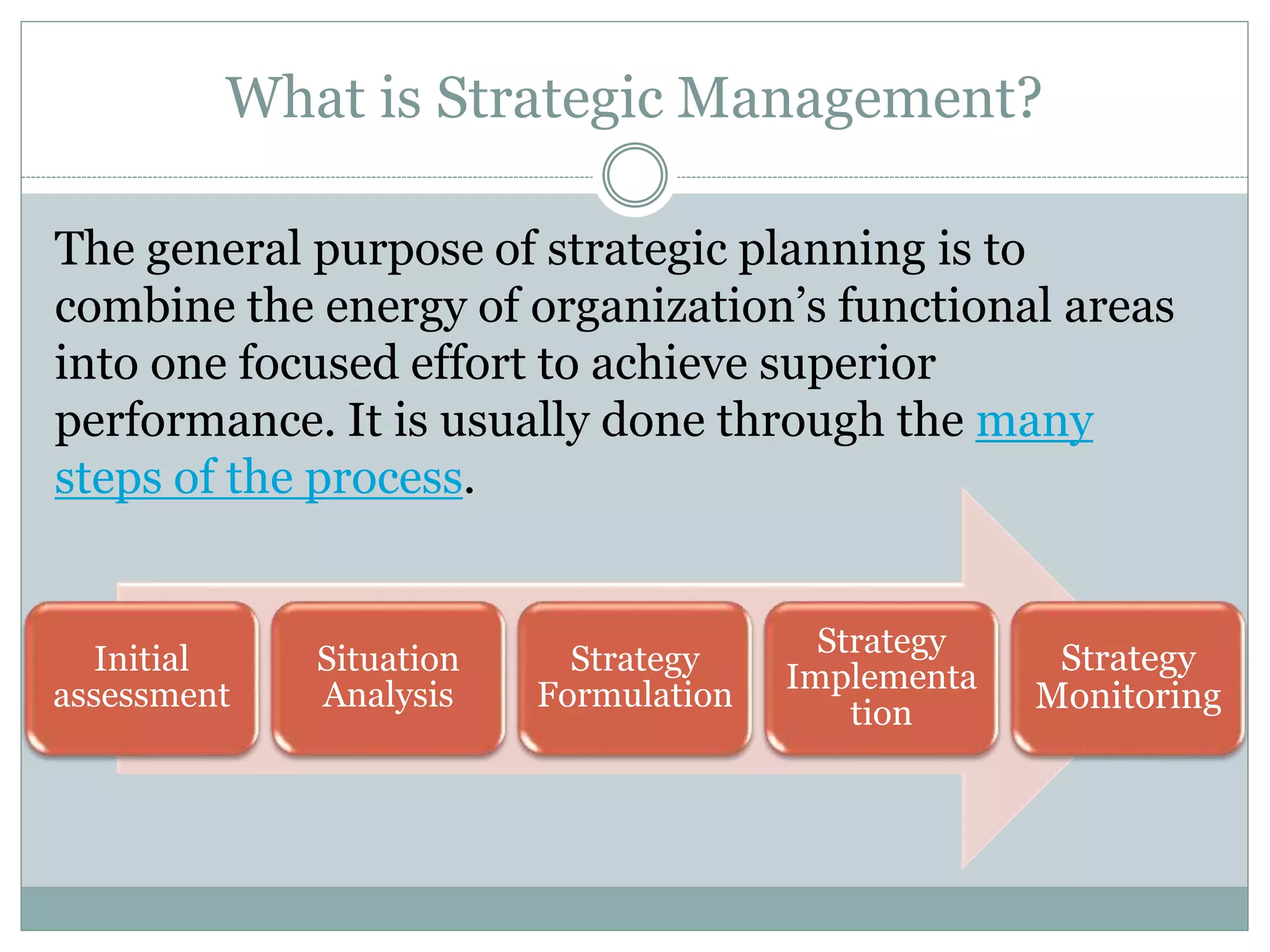
The general purpose of strategic planning is to
combine the energy of organization’s functional areas
into one focused effort to achieve superior
performance. It is usually done through the many
steps of the process.
Initial
assessment
Situation
Analysis
Strategy
Formulation
Strategy
Implementa
tion
Strategy
Monitoring
What is Strategic Management? (continued)
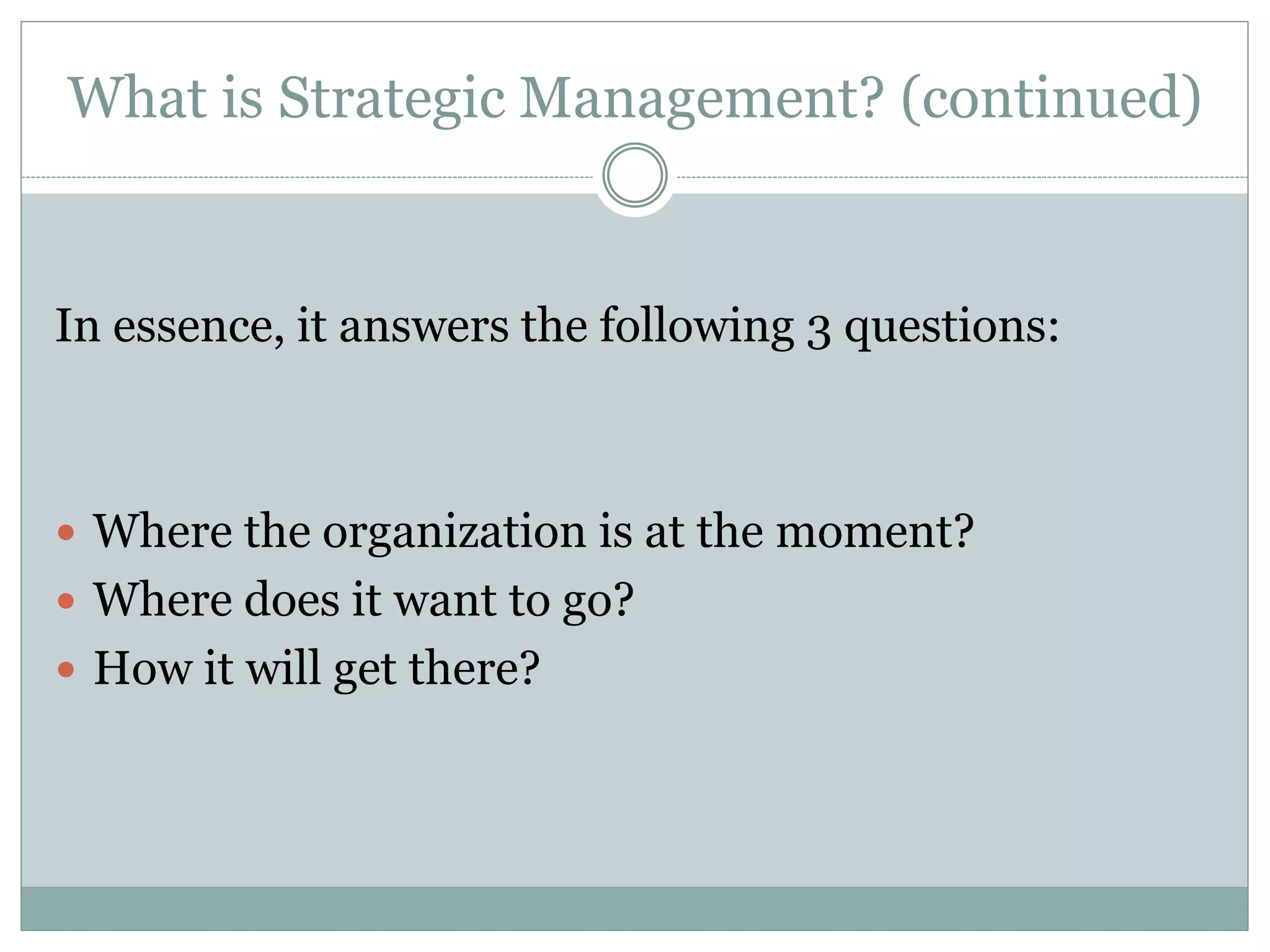
In essence, it answers the following 3 questions:
 Where the organization is at the moment?
 Where does it want to go?
 How it will get there?
Key terms
Competitive advantage
Key terms (cont.)
Strategists
The people who craft strategies and execute them in an organization.
Key terms (cont.)
Vision and mission statements
Vision – what do we
want to become?
Mission – what is our
business?
Key terms (cont.)
SWOT Matrix
S – Strengths
W – Weaknesses
O – Opportunities
T - Threats
Key terms (cont.)
External forces
Key terms (cont.)
Internal forces
Core competencies
CapabilitiesManagement
Assets
OperationsMarketing
Finances
R&D
Human resources
Organizational cultureValue chain activities
Firm
Key terms (cont.)
Objectives
Objectives – the goals that organization wants to
achieve in short or long-term
Key terms (cont.)
Policies
Policies – are the tools used
to achieve objectives. They
include guidelines, rules
and procedures.
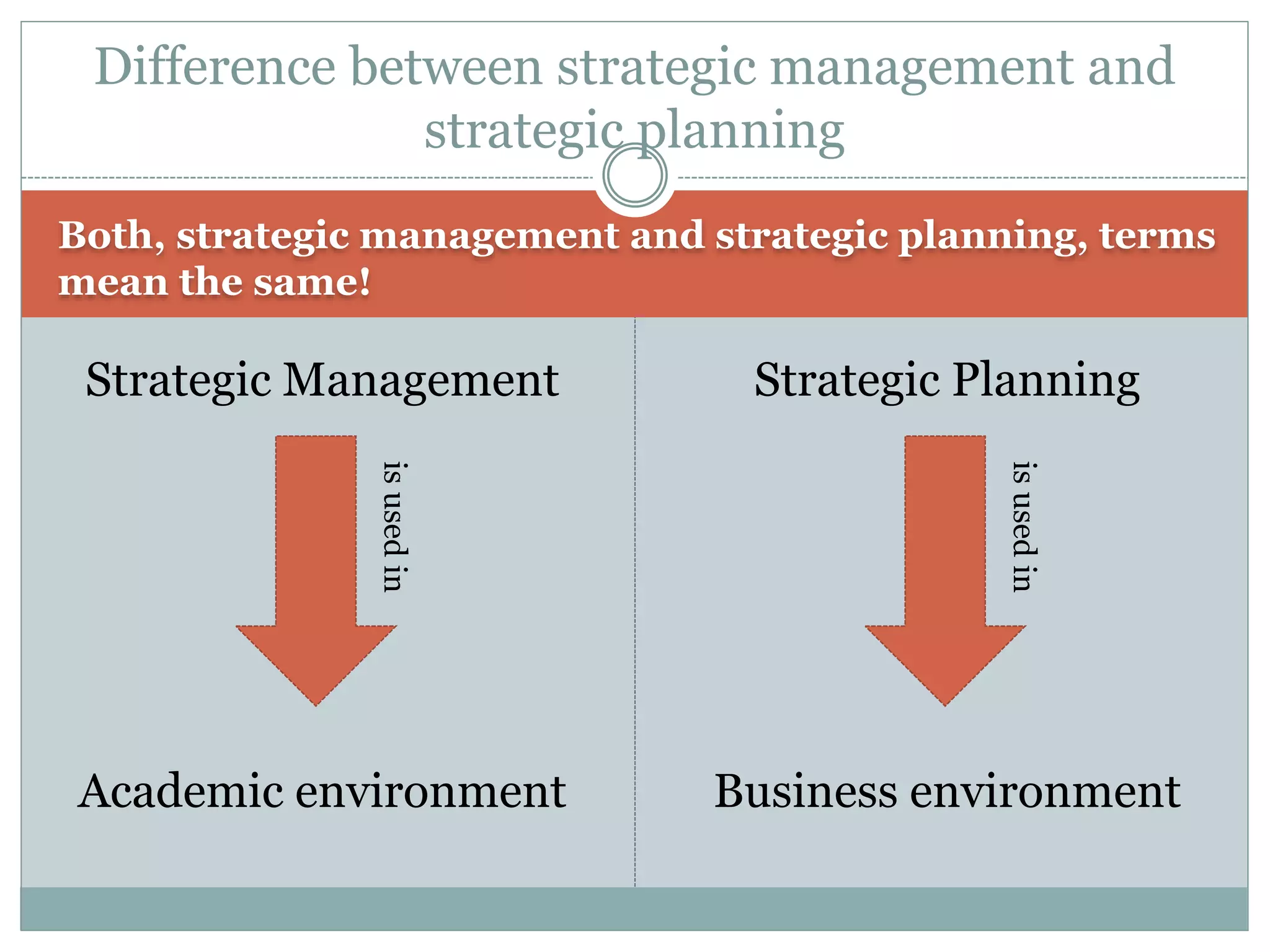
Both, strategic management and strategic planning, terms
mean the same!
Strategic Management
Academic environment
Strategic Planning
Business environment
Difference between strategic management and
strategic planning
isusedin
isusedin
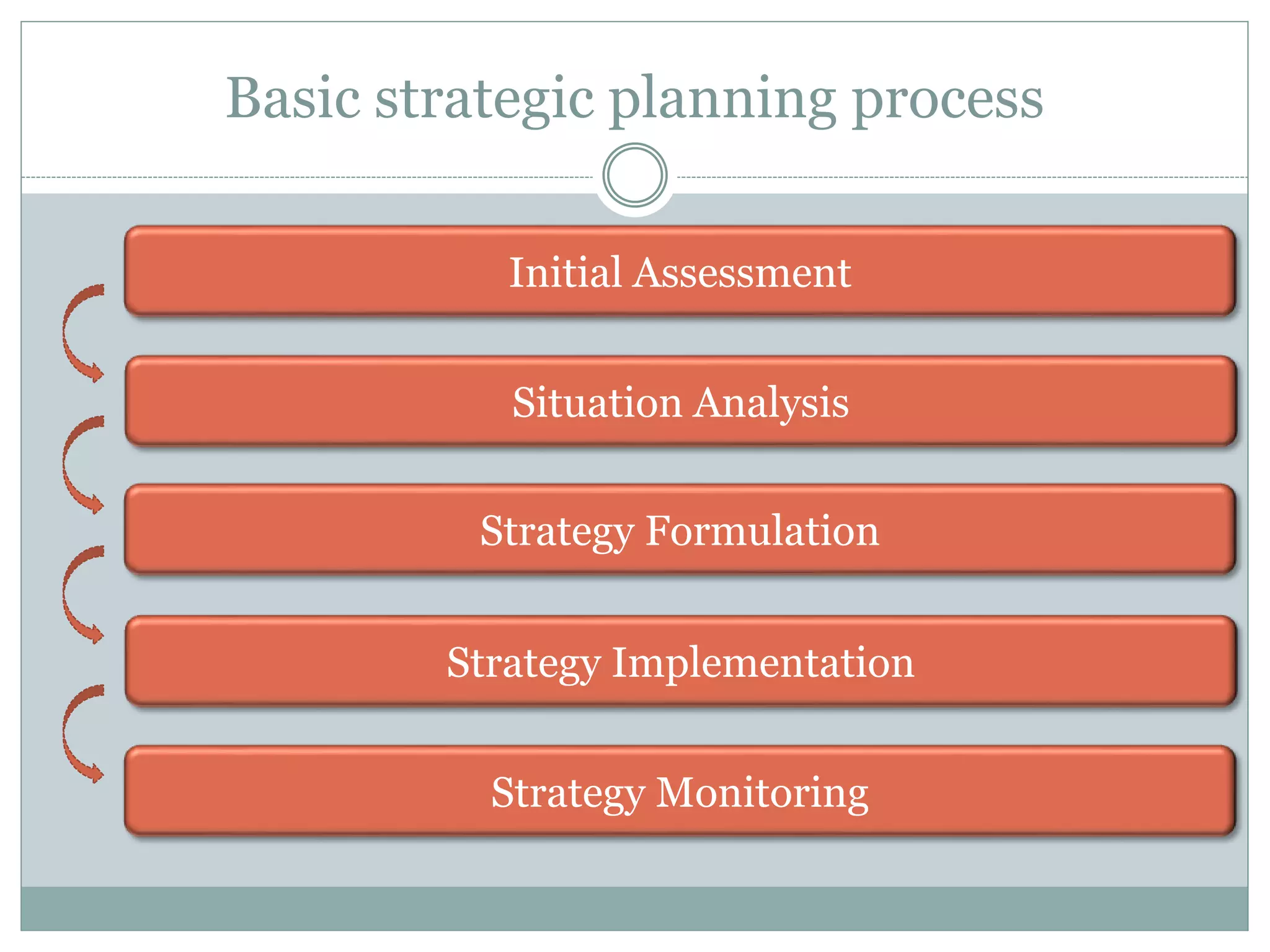
Basic strategic planning process
Initial Assessment
Situation Analysis
Strategy Formulation
Strategy Implementation
Strategy Monitoring
Different models of strategic management
David’s model
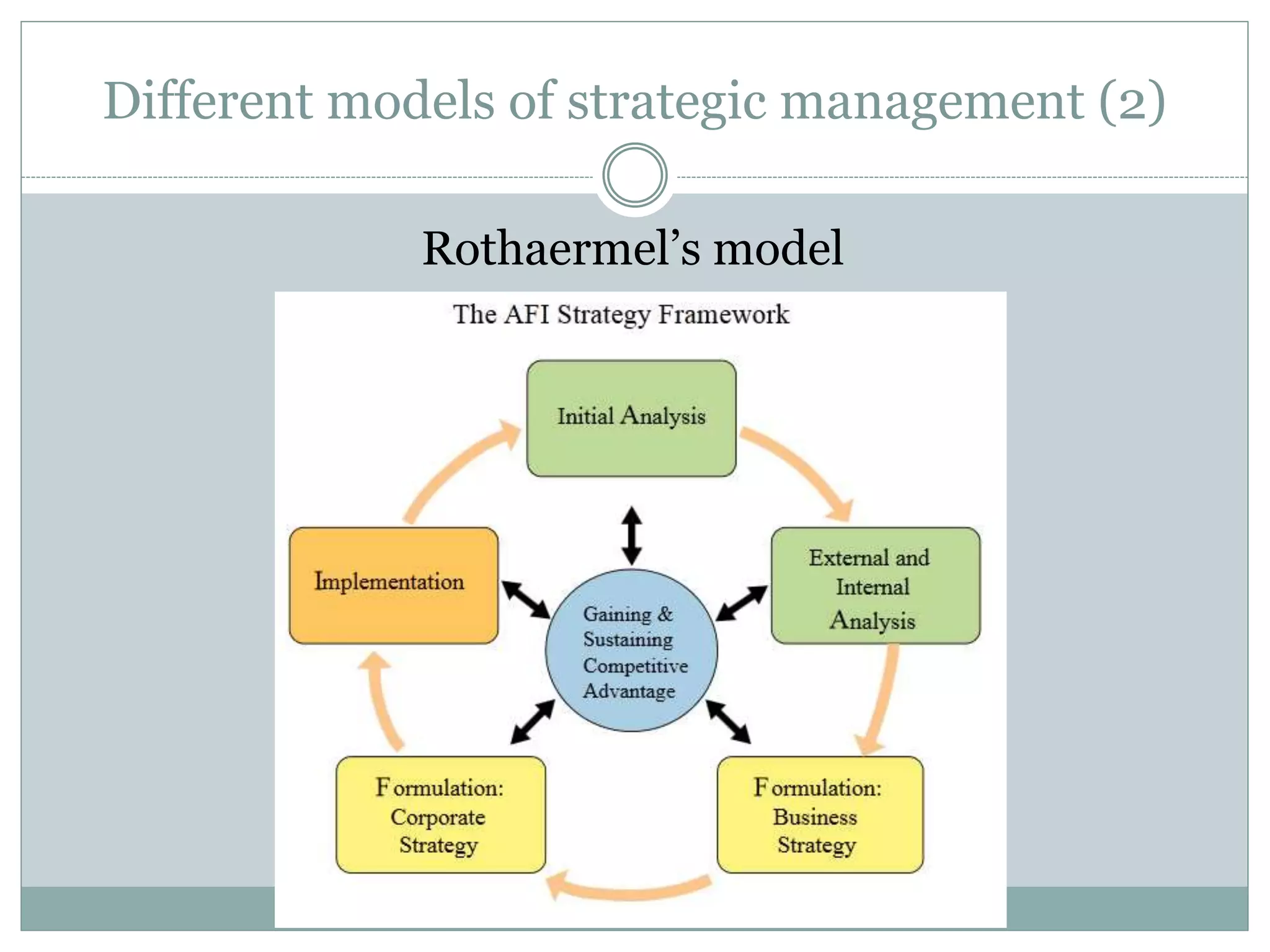
Different models of strategic management (2)
Rothaermel’s model
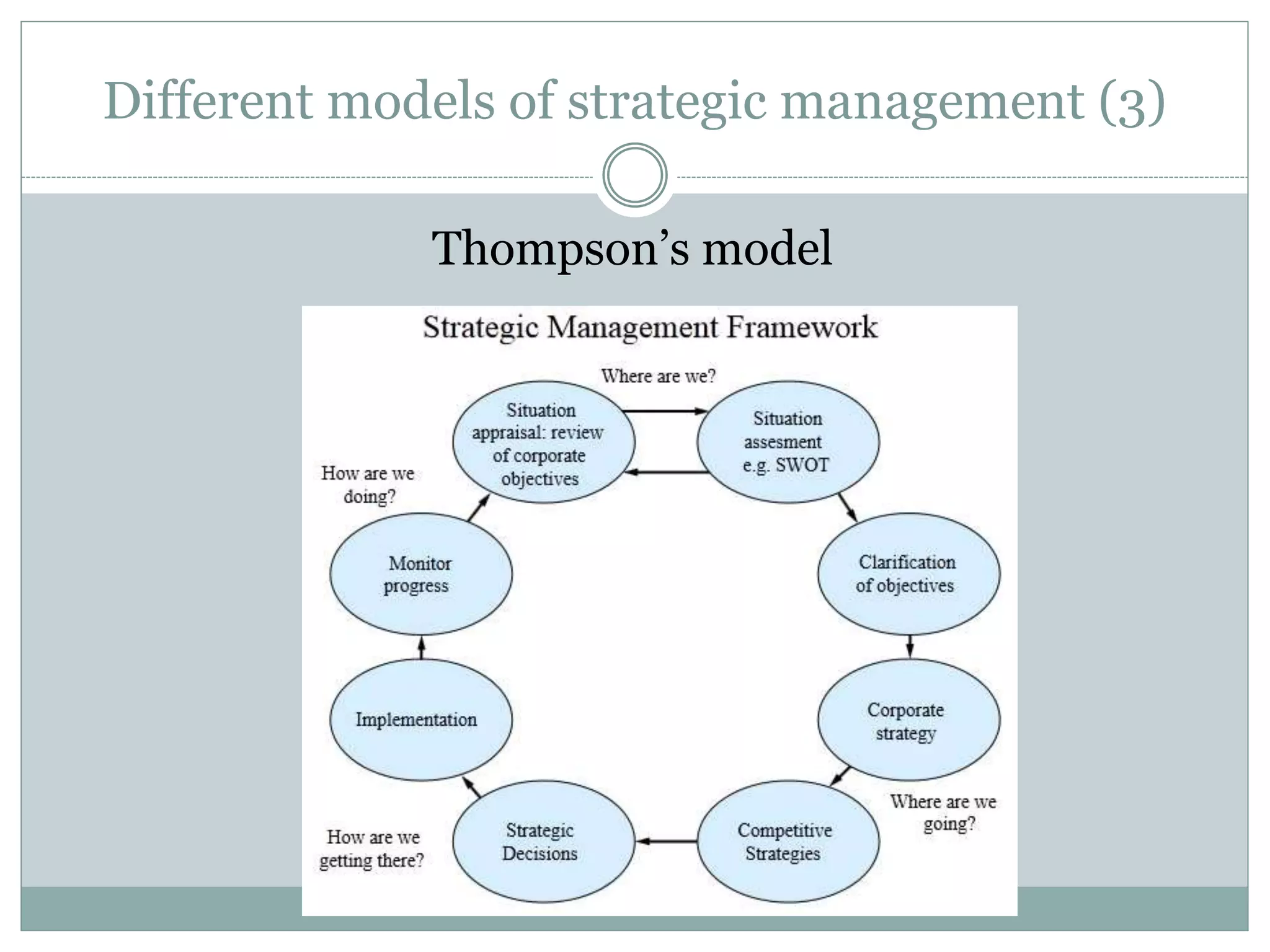
Different models of strategic management (3)
Thompson’s model
Importance of strategic planning
 Requirement for sustained competitive advantage
 Views things from broader perspective
 Facilitates collaboration
Importance of strategic planning (cont.)
Requirement for sustained competitive advantage
Some companies may achieve competitive advantage
without thorough strategic planning but for the most
businesses out there it is vital to plan strategically, i.e.
analyze, create, implement and monitor their strategy,
and do this continuously.
Importance of strategic planning (cont.)
Views things from broader perspective
The other reason why the organizations don’t simply
rely on their finances, marketing or operations
functional areas to bring the competitive advantage is
that managers of each area often view things only from
their own specific angle, which is too narrow view for
the whole organization to rely upon.
Only the managers (e.g. CEOs or strategic planners)
who see the whole picture of the company and its
surrounding environments can make the decisions
that bring the competitive advantage.
Importance of strategic planning (cont.)
Facilitates collaboration
Nowadays, most companies involve middle managers
of functional areas into the process of formulating
strategic plan. Middle managers are the people who
implement the strategies set out in a plan and if they
aren’t involved in making the plan, then they aren’t so
committed to support it.
Why some firms do not do strategic management
 Poor reward
structures
 Waste of time
 Too expensive
 Laziness
 Fear of failure
 Overconfidence
 Prior bad experience
 Difference in opinions
Key benefits
1. Defines company’s vision, mission and future goals.
2. Identifies the suitable strategies to achieve the
goals.
3. Improves awareness of the external and internal
environments, and clearly identifies the
competitive advantage.
4. Increases managers’ commitment to achieving the
company’s objectives.
5. Improves coordination of the activities and more
efficient allocation of company’s resources.
Key benefits (cont.)
6. Better communication between managers of the
different levels and functional areas.
7. Reduces resistance to change by informing the
employees of the changes and the consequences of
them.
8. Strengthens the firm’s performance.
9. On average, companies using strategic management
are more successful than the companies that don’t.
10. Strategic planning allows the organization to
become more proactive than reactive.
Limitations
 The costs of engaging in strategic management are
huge.
 The process is complex.
 Success is not guaranteed.
Guidelines for successful strategic planning
 It should be implemented in the organization rather
than left on paper.
 Managers and employees must understand the
process and be involved in it.
 It cannot become too bureaucratic, formal and too
rigid process
 Managers involved in strategic management must
know all the required information as soon as possible
and use it to strengthen firm’s strategic efforts.
Thank you for reading
 To download this presentation visit our website:
http://www.strategicmanagementinsight.com/strate
gic-management/strategic-management-and-
strategic-planning.html
 For more on strategic management process:
http://www.strategicmanagementinsight.com/strate
gic-management/strategic-management-and-
strategic-planning-process.html
 More of our slideshows can be found in our profile!

Strategic management and strategic planning

  • 1.
    B Y OV I D I J U S J U R E V I C I U S A T S T R A T E G I C M A N A G E M E N T I N S I G H T Strategic Management & Strategic Planning
  • 2.
    Contents  Definition  Whatis strategic management?  Key terms  Difference between strategic management and strategic planning  Basic strategic planning process  Different models of strategic management  Importance of strategic planning
  • 3.
    Contents (continued)  Whysome firms do not do strategic management  Key benefits  Limitations  Guidelines for successful strategic planning
  • 4.
    Definition “Strategic management canbe defined as the art and science of formulating, implementing and evaluating cross- functional decisions that enable an organization to achieve its objectives.” by David, F.R. Strategic Management: Concepts and Cases “An integrative management field that combines analysis, formulation, and implementation in the quest for competitive advantage.” by Rothaermel, F. T. (2012). Strategic Management: Concepts and Cases
  • 5.
    Definition (cont.) “Strategic planningis defined as the process by which managers of the firm analyze the internal and external environments for the purpose of formulating strategies and allocating resources to develop a competitive advantage in an industry that allows for the successful achievement of organizational goals.” by Cox, Daspit, McLaughlin and Jones (2012) “Strategic management includes understanding the strategic position of an organisation, making strategic choices for the future and managing strategy in action.” by Johnson, Scholes and Whittington (2008)
  • 6.
    What is StrategicManagement? The general purpose of strategic planning is to combine the energy of organization’s functional areas into one focused effort to achieve superior performance. It is usually done through the many steps of the process. Initial assessment Situation Analysis Strategy Formulation Strategy Implementa tion Strategy Monitoring
  • 7.
    What is StrategicManagement? (continued) In essence, it answers the following 3 questions:  Where the organization is at the moment?  Where does it want to go?  How it will get there?
  • 8.
  • 9.
    Key terms (cont.) Strategists Thepeople who craft strategies and execute them in an organization.
  • 10.
    Key terms (cont.) Visionand mission statements Vision – what do we want to become? Mission – what is our business?
  • 11.
    Key terms (cont.) SWOTMatrix S – Strengths W – Weaknesses O – Opportunities T - Threats
  • 12.
  • 13.
    Key terms (cont.) Internalforces Core competencies CapabilitiesManagement Assets OperationsMarketing Finances R&D Human resources Organizational cultureValue chain activities Firm
  • 14.
    Key terms (cont.) Objectives Objectives– the goals that organization wants to achieve in short or long-term
  • 15.
    Key terms (cont.) Policies Policies– are the tools used to achieve objectives. They include guidelines, rules and procedures.
  • 16.
    Both, strategic managementand strategic planning, terms mean the same! Strategic Management Academic environment Strategic Planning Business environment Difference between strategic management and strategic planning isusedin isusedin
  • 17.
    Basic strategic planningprocess Initial Assessment Situation Analysis Strategy Formulation Strategy Implementation Strategy Monitoring
  • 18.
    Different models ofstrategic management David’s model
  • 19.
    Different models ofstrategic management (2) Rothaermel’s model
  • 20.
    Different models ofstrategic management (3) Thompson’s model
  • 21.
    Importance of strategicplanning  Requirement for sustained competitive advantage  Views things from broader perspective  Facilitates collaboration
  • 22.
    Importance of strategicplanning (cont.) Requirement for sustained competitive advantage Some companies may achieve competitive advantage without thorough strategic planning but for the most businesses out there it is vital to plan strategically, i.e. analyze, create, implement and monitor their strategy, and do this continuously.
  • 23.
    Importance of strategicplanning (cont.) Views things from broader perspective The other reason why the organizations don’t simply rely on their finances, marketing or operations functional areas to bring the competitive advantage is that managers of each area often view things only from their own specific angle, which is too narrow view for the whole organization to rely upon. Only the managers (e.g. CEOs or strategic planners) who see the whole picture of the company and its surrounding environments can make the decisions that bring the competitive advantage.
  • 24.
    Importance of strategicplanning (cont.) Facilitates collaboration Nowadays, most companies involve middle managers of functional areas into the process of formulating strategic plan. Middle managers are the people who implement the strategies set out in a plan and if they aren’t involved in making the plan, then they aren’t so committed to support it.
  • 25.
    Why some firmsdo not do strategic management  Poor reward structures  Waste of time  Too expensive  Laziness  Fear of failure  Overconfidence  Prior bad experience  Difference in opinions
  • 26.
    Key benefits 1. Definescompany’s vision, mission and future goals. 2. Identifies the suitable strategies to achieve the goals. 3. Improves awareness of the external and internal environments, and clearly identifies the competitive advantage. 4. Increases managers’ commitment to achieving the company’s objectives. 5. Improves coordination of the activities and more efficient allocation of company’s resources.
  • 27.
    Key benefits (cont.) 6.Better communication between managers of the different levels and functional areas. 7. Reduces resistance to change by informing the employees of the changes and the consequences of them. 8. Strengthens the firm’s performance. 9. On average, companies using strategic management are more successful than the companies that don’t. 10. Strategic planning allows the organization to become more proactive than reactive.
  • 28.
    Limitations  The costsof engaging in strategic management are huge.  The process is complex.  Success is not guaranteed.
  • 29.
    Guidelines for successfulstrategic planning  It should be implemented in the organization rather than left on paper.  Managers and employees must understand the process and be involved in it.  It cannot become too bureaucratic, formal and too rigid process  Managers involved in strategic management must know all the required information as soon as possible and use it to strengthen firm’s strategic efforts.
  • 30.
    Thank you forreading  To download this presentation visit our website: http://www.strategicmanagementinsight.com/strate gic-management/strategic-management-and- strategic-planning.html  For more on strategic management process: http://www.strategicmanagementinsight.com/strate gic-management/strategic-management-and- strategic-planning-process.html  More of our slideshows can be found in our profile!