Strategic Management and the Entrepreneur
A Major Shift . . . . . . From financial capital to intellectual capital. Human Structural Customer
Strategic Management Is crucial to building a successful business.  Involves developing a game plan to guide a company as it strives to accomplish its mission, goals , and objectives, and to keep it on its desired course.
Is Strategic Planning Really That Important? Study of 500 small companies: One of the most significant factors in distinguishing growing companies from those in decline: use of a written business plan. Another study: Only 12% of small companies had a long-range plan in writing.
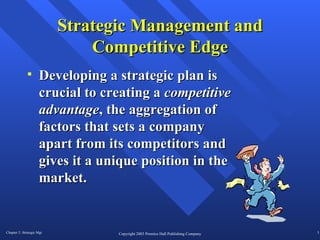
Strategic Management and Competitive Edge Developing a strategic plan is crucial to creating a  competitive advantage , the aggregation of factors that sets a company apart from its competitors and gives it a unique position in the market.
Key: Core Competencies Unique set of capabilities a company develops in key areas, such as superior quality, customer service, innovation, team-building, flexibility, responsiveness, and others that allow it to vault past competitors.  They are what a company does best.  Best to rely on a  natural advantage  (often linked to a company’s smallness).
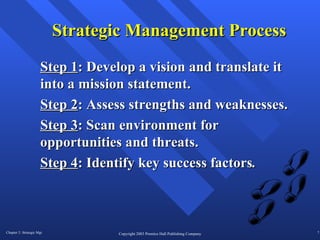
Strategic Management Process Step 1 : Develop a vision and translate it into a mission statement. Step 2 : Assess strengths and weaknesses. Step 3 : Scan environment for opportunities and threats. Step 4 : Identify key success factors .
Strategic Management Process ... Step 5 : Analyze competition . Step 6 : Create goals & objectives. Step 7 : Formulate strategies . Step 8 : Translate plans into actions . Step 9 : Establish accurate controls . (continued)
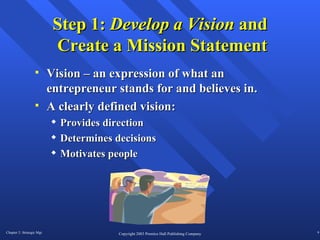
Step 1:  Develop a Vision  and  Create a Mission Statement Vision – an expression of what an entrepreneur stands for and believes in.  A clearly defined vision: Provides direction Determines decisions Motivates people
Step 1: Develop a Vision and   Create a Mission Statement Mission - addresses question:"What business are we in?” A written expression of how the company will reflect the owner’s values, beliefs, and vision. Sets the tone for the entire company and guides the decisions people make.  Example: Fetzer Vineyards  http://www.fetzer.com/
Step 2: Assess Company Strengths  and Weaknesses Strengths Positive internal factors that contribute to accomplishing the mission, goals, and objectives. Weaknesses Negative  internal factors that inhibit the accomplishment of the mission, goals, and objectives.
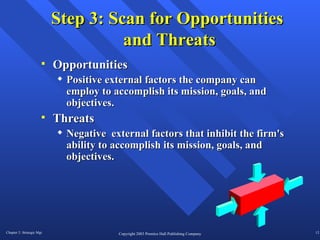
Step 3: Scan for Opportunities  and Threats Opportunities Positive external factors the company can employ to accomplish its mission, goals, and objectives. Threats Negative  external factors that inhibit the firm's ability to accomplish its mission, goals, and objectives.
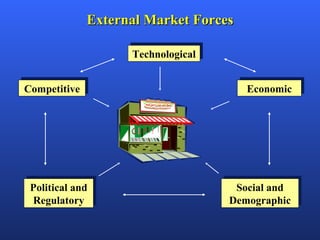
External Market Forces Competitive Economic Political and Regulatory Technological Social and Demographic
Step 4: Identify Key Success Factors Key success factors: relationships between a controllable variable and a critical factor that influence a company’s ability to compete in the market. The keys to unlocking the secrets of competing successfully in a particular market segment.
Step 5: Analyze Competitors Analyzing key competitors allows an entrepreneur to: avoid surprises from existing competitors’ new strategies and tactics. identify potential new competitors and the threats they pose. improve reaction time to competitors’ actions. anticipating rivals’ next strategic moves.
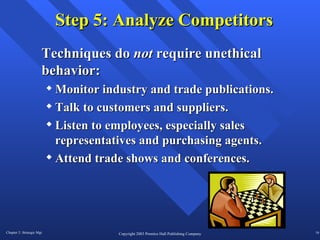
Step 5: Analyze Competitors Techniques do  not  require unethical behavior: Monitor industry and trade publications. Talk to customers and suppliers. Listen to employees, especially sales representatives and purchasing agents. Attend trade shows and conferences.
Step 5: Analyze Competitors Techniques do  not  require unethical behavior: Study competitors' literature and "benchmark" their products and services. Get competitors' credit reports. Check out the local library. Use the World Wide Web to learn more about competitors. Visit competing businesses to observe their operations.
Knowledge Management The practice of gathering, organizing, and disseminating the collective wisdom and experience of a company’s employees for the purpose of strengthening its competitive position.  Knowledge management involves: Taking inventory of the special knowledge the people in the company possess.  Organizing that knowledge and disseminating it to those who need it.
Step 6: Create Company Goals and Objectives Goals - broad, long-range attributes to be accomplished. Objectives - more detailed, specific targets of performance that are S.M.A.R.T. S pecific M easurable A ssignable R ealistic (yet challenging) T imely
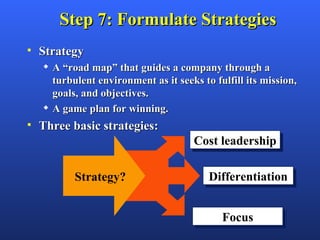
Step 7: Formulate Strategies Strategy A “road map” that guides a company through a turbulent environment as it seeks to fulfill its mission, goals, and objectives.  A game plan for winning. Three basic strategies: Strategy? Cost leadership Differentiation Focus
Cost Leadership Goal: to be  the  low-cost producer in the industry or market segment. Advantages:  reaching buyers who buy on the basis of price. power to set the industry’s price floor. Works well when: buyers are sensitive to price changes. when competing firms sell the same commodity products. when a company can benefit from economies of scale.
Differentiation Company seeks to build customer loyalty by positioning its goods or services in a unique or different fashion. Idea is to be unique at something customers value. Key: Build basis for differentiation on a core competency, those things that the small company is uniquely good at doing in comparison to its competitors.  Example: East Bank Club
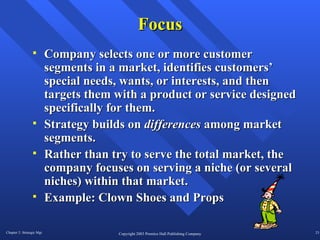
Focus Company selects one or more customer segments in a market, identifies customers’ special needs, wants, or interests, and then targets them with a product or service designed specifically for them. Strategy builds on  differences  among market segments. Rather than try to serve the total market, the company focuses on serving a niche (or several niches) within that market.  Example: Clown Shoes and Props
Step 9: Translate Strategies  into Action Plans Create projects by defining: Purpose Scope Contribution Resource requirements Timing
Step 10: Establish Accurate Controls The plan establishes the standards against which actual performance is measured.  Entrepreneur must: identify and track key performance indicators. Take corrective action.

SME Chapter 2

  • 1.
    Strategic Management andthe Entrepreneur
  • 2.
    A Major Shift. . . . . . From financial capital to intellectual capital. Human Structural Customer
  • 3.
    Strategic Management Iscrucial to building a successful business. Involves developing a game plan to guide a company as it strives to accomplish its mission, goals , and objectives, and to keep it on its desired course.
  • 4.
    Is Strategic PlanningReally That Important? Study of 500 small companies: One of the most significant factors in distinguishing growing companies from those in decline: use of a written business plan. Another study: Only 12% of small companies had a long-range plan in writing.
  • 5.
    Strategic Management andCompetitive Edge Developing a strategic plan is crucial to creating a competitive advantage , the aggregation of factors that sets a company apart from its competitors and gives it a unique position in the market.
  • 6.
    Key: Core CompetenciesUnique set of capabilities a company develops in key areas, such as superior quality, customer service, innovation, team-building, flexibility, responsiveness, and others that allow it to vault past competitors. They are what a company does best. Best to rely on a natural advantage (often linked to a company’s smallness).
  • 7.
    Strategic Management ProcessStep 1 : Develop a vision and translate it into a mission statement. Step 2 : Assess strengths and weaknesses. Step 3 : Scan environment for opportunities and threats. Step 4 : Identify key success factors .
  • 8.
    Strategic Management Process... Step 5 : Analyze competition . Step 6 : Create goals & objectives. Step 7 : Formulate strategies . Step 8 : Translate plans into actions . Step 9 : Establish accurate controls . (continued)
  • 9.
    Step 1: Develop a Vision and Create a Mission Statement Vision – an expression of what an entrepreneur stands for and believes in. A clearly defined vision: Provides direction Determines decisions Motivates people
  • 10.
    Step 1: Developa Vision and Create a Mission Statement Mission - addresses question:"What business are we in?” A written expression of how the company will reflect the owner’s values, beliefs, and vision. Sets the tone for the entire company and guides the decisions people make. Example: Fetzer Vineyards http://www.fetzer.com/
  • 11.
    Step 2: AssessCompany Strengths and Weaknesses Strengths Positive internal factors that contribute to accomplishing the mission, goals, and objectives. Weaknesses Negative internal factors that inhibit the accomplishment of the mission, goals, and objectives.
  • 12.
    Step 3: Scanfor Opportunities and Threats Opportunities Positive external factors the company can employ to accomplish its mission, goals, and objectives. Threats Negative external factors that inhibit the firm's ability to accomplish its mission, goals, and objectives.
  • 13.
    External Market ForcesCompetitive Economic Political and Regulatory Technological Social and Demographic
  • 14.
    Step 4: IdentifyKey Success Factors Key success factors: relationships between a controllable variable and a critical factor that influence a company’s ability to compete in the market. The keys to unlocking the secrets of competing successfully in a particular market segment.
  • 15.
    Step 5: AnalyzeCompetitors Analyzing key competitors allows an entrepreneur to: avoid surprises from existing competitors’ new strategies and tactics. identify potential new competitors and the threats they pose. improve reaction time to competitors’ actions. anticipating rivals’ next strategic moves.
  • 16.
    Step 5: AnalyzeCompetitors Techniques do not require unethical behavior: Monitor industry and trade publications. Talk to customers and suppliers. Listen to employees, especially sales representatives and purchasing agents. Attend trade shows and conferences.
  • 17.
    Step 5: AnalyzeCompetitors Techniques do not require unethical behavior: Study competitors' literature and "benchmark" their products and services. Get competitors' credit reports. Check out the local library. Use the World Wide Web to learn more about competitors. Visit competing businesses to observe their operations.
  • 18.
    Knowledge Management Thepractice of gathering, organizing, and disseminating the collective wisdom and experience of a company’s employees for the purpose of strengthening its competitive position. Knowledge management involves: Taking inventory of the special knowledge the people in the company possess. Organizing that knowledge and disseminating it to those who need it.
  • 19.
    Step 6: CreateCompany Goals and Objectives Goals - broad, long-range attributes to be accomplished. Objectives - more detailed, specific targets of performance that are S.M.A.R.T. S pecific M easurable A ssignable R ealistic (yet challenging) T imely
  • 20.
    Step 7: FormulateStrategies Strategy A “road map” that guides a company through a turbulent environment as it seeks to fulfill its mission, goals, and objectives. A game plan for winning. Three basic strategies: Strategy? Cost leadership Differentiation Focus
  • 21.
    Cost Leadership Goal:to be the low-cost producer in the industry or market segment. Advantages: reaching buyers who buy on the basis of price. power to set the industry’s price floor. Works well when: buyers are sensitive to price changes. when competing firms sell the same commodity products. when a company can benefit from economies of scale.
  • 22.
    Differentiation Company seeksto build customer loyalty by positioning its goods or services in a unique or different fashion. Idea is to be unique at something customers value. Key: Build basis for differentiation on a core competency, those things that the small company is uniquely good at doing in comparison to its competitors. Example: East Bank Club
  • 23.
    Focus Company selectsone or more customer segments in a market, identifies customers’ special needs, wants, or interests, and then targets them with a product or service designed specifically for them. Strategy builds on differences among market segments. Rather than try to serve the total market, the company focuses on serving a niche (or several niches) within that market. Example: Clown Shoes and Props
  • 24.
    Step 9: TranslateStrategies into Action Plans Create projects by defining: Purpose Scope Contribution Resource requirements Timing
  • 25.
    Step 10: EstablishAccurate Controls The plan establishes the standards against which actual performance is measured. Entrepreneur must: identify and track key performance indicators. Take corrective action.

Editor's Notes

  • #2 This "Deco" border was drawn on the Slide master using PowerPoint's Rectangle and Line tools. A smaller version was placed on the Notes Master by selecting all of the elements (using Select All from the Edit menu), deselecting the unwanted elements such as the Title (holding down the Shift key and clicking on the unwanted elements), and then using Paste as Picture from the Edit menu to place the border on the Notes Master. After pasting as a picture, we used the resize handles (with Shift to maintain the proportions) to reduce it to the size you see. Be sure to delete this word processing box before using this template for your own presentation.