THE
STRATEGIC
MANAGEMENT
PROCESS
The heart and soul of managing a
business lies in the crafting,
implementing and executing
the chosen strategy.
Strategy is the game plan that management
is going to use to stake out a market
position, conduct its operations, attract and
please customers, compete successfully as
well as achieve organizational objectives
• A strategy entails managerial choices
among alternatives and signals organizational
commitment to specific markets, competitive
approaches and ways of operating.
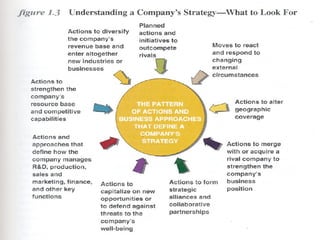
• Strategy relates to a company’s competitive
initiatives and business approaches.
Why Strategic Management
1. Managers need to proactively shape
how the company’s business will be
conducted.
 Exert strategic leadership and commit
the enterprise to going about its
business.
 Prescriptions for doing business, road
map to competitive advantage, plan for
pleasing customers or achieving good
performance.
2. Managers need to mould the efforts and
decisions of the different divisions,
departments, managers and groups into a
coordinated, compatible whole.
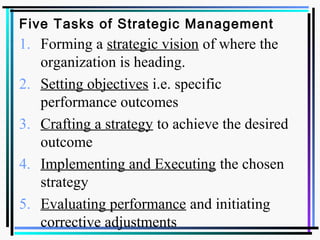
Five Tasks of Strategic Management
1. Forming a strategic vision of where the
organization is heading.
2. Setting objectives i.e. specific
performance outcomes
3. Crafting a strategy to achieve the desired
outcome
4. Implementing and Executing the chosen
strategy
5. Evaluating performance and initiating
corrective adjustments
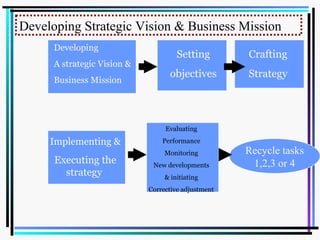
Recycle tasks
1,2,3 or 4
Crafting
Strategy
Implementing
& Executing the
strategy
Evaluating
Performance
Monitoring
New developments
& initiating
Corrective adjustment
Developing
A strategic Vision &
Business Mission
Setting
objectives
Crafting
Strategy
Implementing &
Executing the
strategy
Developing Strategic Vision & Business Mission
Developing a Strategic Vision
 What is our vision for the company
 Where should the company headed
 What should its future focus be
 What kind of enterprise should we become
 What industry standing do we want to
achieve
INTEL
“ Getting to a billion connected
computers worldwide millions
of servers and trillions of
dollars”
Strategic Vision
• Management’s views and conclusions to
the long-term direction and future
business scope.
• Management’s aspirations for the
organization and its business providing a
view of “ where we are going ”.
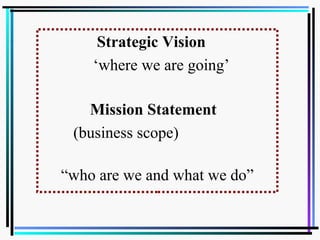
Strategic Vision Vs Mission
StatementStrategic Vision
‘where we are going’
Mission Statement
(business scope)
“who are we and what we do”
Mission Statement
• The corporate philosophy, identity,
character and image.
• Describes an organization’s present
capabilities, customer focus, activities
and make up.
Why a Strategic Vision
• Strategic vision has greater direction setting
and strategy making sense.
• Managers are compelled to look beyond
today and think strategically.
Setting Objectives
• Objectives are set to convert strategic vision
and mission into specific performance targets.
(the results and outcomes the organization
wants to achieve)
• By setting objectives and then reassuring
them, managers are able to track the
organization's progress.
• Objective setting should be done by all
managers because every unit in a
company needs concrete, measurable
performance targets that contribute
towards achieving company vision.
• The need for both good financial and
strategic performance calls for
management to set financial and strategic
objectives.
Crafting Strategy
Strategy reflects managerial choices among
alternatives and signals organisational
commitment to particular products, markets
competitive approaches and ways of
operating the business.
Fundamental Business Questions
• Whether to concentrate on a single business
or build a diversified group of business
• Whether to cater for a broad range of
customers or a particular market niche
• Whether to develop a wide or narrow product
line
• Whether to pursue a competitive advantage
based on low cost or product superiority etc
Strategy making brings into play the
critical managerial issues of how to
achieve the targeted results in light of
the organisation’s situation and
prospects.
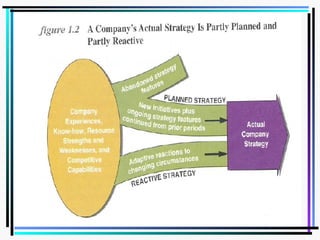
Strategy
 Deliberate & purposeful action
 Reactions to developments, market
conditions & competitive pressures
Collective learning of the organisation
over time
• Strategy is something managers shape and
reshape as events transpire out side the
company
• Strategy is both pro-active (intended) and
reactive (adaptive).
Characteristics of strategy
Company strategies address how
• To grow the business
• To satisfy customers
• To out compete rivals
• To respond to market conditions
• To manage functions of the business
• To develop organisational capabilities
• To achieve strategic and financial objectives
• The strategy tends to be company specific,
customised to suit its situation and objectives.
• Strategy content thus has to be fairly detailed in
order to portray the defining characteristics of the
authors.
• Strategy is a blend of holdover approaches, fresh
actions and reactions with some about to be
launched moves and changes.
• It is partly visible and partly hidden to the outside
view.
Strategy making is fundamentally a market driven
and customer driven entrepreneurial activity, the
essential qualities being;
• talent for capitalising an emerging market
opportunities and evolving customer needs
• bias for innovation and creativity,
• appetite for prudent risk-taking
• a strong sense of what needs to be done to grow and
strengthen the business
Implementing & Executing the Strategy
This involves
• assessing what it will take to develop the
needed organisational capabilities to reach
the targeted objectives.
• Figuring out what must be done to put the
strategy in place to carry out and produce
good results.
Strategy Implementing
managerial exercise of putting a freshly
chosen strategy in place
Strategy Execution
the managerial exercise of supervising the on
going pursuit of strategy, making it work,
improving competence with which it is
executed and showing measurable progress
in achieving targeted results.
Managing the strategy execution process includes
• Building an organisation capable of carrying out
strategy
• Allocating company resources
• Establishing strategy supportive policies and
operating procedures
• Motivating people
• Tying the reward structures to achieving of
targeted results
• Creating conducive company culture and
work climate
• Installing information, communication and
operating systems that support the strategy
• Installing best practices and programmes
for continuous improvement
• Exerting internal strategic leadership
• Good strategy execution will involve
creating a strong “fit” with above
aspects
• Strategy execution cuts across all
facets of managing and must be
initiated from all units inside the
organisation
Evaluating Performance, Monitoring New
developments and Initiating corrective
Adjustments
Management needs to stay on top of the
company’s situation deciding whether
things are going on well internally and
monitoring outside developments
closely.
Managerial actions that may be taken to hasten
implementation or improve executing of strategy
include
• Revision of budget
• Changing policies
• Reorganising, changing personnel
• Building new competencies and capabilities
• Revamping activities and work processes
• Changing culture
• Revising compensation practices
Strategy executing is always a product of
organisational learning it is achieved
unevenly coming quickly in some areas and
late in others.
‘Strategic management is not a box of tricks
or a bundle of techniques. It is analytical
thinking and commitment of resources to
action’
Peter Drucker
END

Strategic management process

  • 1.
  • 2.
    The heart andsoul of managing a business lies in the crafting, implementing and executing the chosen strategy.
  • 3.
    Strategy is thegame plan that management is going to use to stake out a market position, conduct its operations, attract and please customers, compete successfully as well as achieve organizational objectives
  • 4.
    • A strategyentails managerial choices among alternatives and signals organizational commitment to specific markets, competitive approaches and ways of operating. • Strategy relates to a company’s competitive initiatives and business approaches.
  • 5.
    Why Strategic Management 1.Managers need to proactively shape how the company’s business will be conducted.  Exert strategic leadership and commit the enterprise to going about its business.  Prescriptions for doing business, road map to competitive advantage, plan for pleasing customers or achieving good performance.
  • 6.
    2. Managers needto mould the efforts and decisions of the different divisions, departments, managers and groups into a coordinated, compatible whole.
  • 7.
    Five Tasks ofStrategic Management 1. Forming a strategic vision of where the organization is heading. 2. Setting objectives i.e. specific performance outcomes 3. Crafting a strategy to achieve the desired outcome 4. Implementing and Executing the chosen strategy 5. Evaluating performance and initiating corrective adjustments
  • 8.
    Recycle tasks 1,2,3 or4 Crafting Strategy Implementing & Executing the strategy Evaluating Performance Monitoring New developments & initiating Corrective adjustment Developing A strategic Vision & Business Mission Setting objectives Crafting Strategy Implementing & Executing the strategy Developing Strategic Vision & Business Mission
  • 9.
    Developing a StrategicVision  What is our vision for the company  Where should the company headed  What should its future focus be  What kind of enterprise should we become  What industry standing do we want to achieve
  • 10.
    INTEL “ Getting toa billion connected computers worldwide millions of servers and trillions of dollars”
  • 11.
    Strategic Vision • Management’sviews and conclusions to the long-term direction and future business scope. • Management’s aspirations for the organization and its business providing a view of “ where we are going ”.
  • 12.
    Strategic Vision VsMission StatementStrategic Vision ‘where we are going’ Mission Statement (business scope) “who are we and what we do”
  • 13.
    Mission Statement • Thecorporate philosophy, identity, character and image. • Describes an organization’s present capabilities, customer focus, activities and make up.
  • 14.
    Why a StrategicVision • Strategic vision has greater direction setting and strategy making sense. • Managers are compelled to look beyond today and think strategically.
  • 15.
    Setting Objectives • Objectivesare set to convert strategic vision and mission into specific performance targets. (the results and outcomes the organization wants to achieve) • By setting objectives and then reassuring them, managers are able to track the organization's progress.
  • 16.
    • Objective settingshould be done by all managers because every unit in a company needs concrete, measurable performance targets that contribute towards achieving company vision. • The need for both good financial and strategic performance calls for management to set financial and strategic objectives.
  • 17.
    Crafting Strategy Strategy reflectsmanagerial choices among alternatives and signals organisational commitment to particular products, markets competitive approaches and ways of operating the business.
  • 18.
    Fundamental Business Questions •Whether to concentrate on a single business or build a diversified group of business • Whether to cater for a broad range of customers or a particular market niche • Whether to develop a wide or narrow product line • Whether to pursue a competitive advantage based on low cost or product superiority etc
  • 19.
    Strategy making bringsinto play the critical managerial issues of how to achieve the targeted results in light of the organisation’s situation and prospects.
  • 20.
    Strategy  Deliberate &purposeful action  Reactions to developments, market conditions & competitive pressures Collective learning of the organisation over time
  • 21.
    • Strategy issomething managers shape and reshape as events transpire out side the company • Strategy is both pro-active (intended) and reactive (adaptive).
  • 23.
    Characteristics of strategy Companystrategies address how • To grow the business • To satisfy customers • To out compete rivals • To respond to market conditions • To manage functions of the business • To develop organisational capabilities • To achieve strategic and financial objectives
  • 24.
    • The strategytends to be company specific, customised to suit its situation and objectives. • Strategy content thus has to be fairly detailed in order to portray the defining characteristics of the authors. • Strategy is a blend of holdover approaches, fresh actions and reactions with some about to be launched moves and changes. • It is partly visible and partly hidden to the outside view.
  • 26.
    Strategy making isfundamentally a market driven and customer driven entrepreneurial activity, the essential qualities being; • talent for capitalising an emerging market opportunities and evolving customer needs • bias for innovation and creativity, • appetite for prudent risk-taking • a strong sense of what needs to be done to grow and strengthen the business
  • 27.
    Implementing & Executingthe Strategy This involves • assessing what it will take to develop the needed organisational capabilities to reach the targeted objectives. • Figuring out what must be done to put the strategy in place to carry out and produce good results.
  • 28.
    Strategy Implementing managerial exerciseof putting a freshly chosen strategy in place Strategy Execution the managerial exercise of supervising the on going pursuit of strategy, making it work, improving competence with which it is executed and showing measurable progress in achieving targeted results.
  • 29.
    Managing the strategyexecution process includes • Building an organisation capable of carrying out strategy • Allocating company resources • Establishing strategy supportive policies and operating procedures • Motivating people • Tying the reward structures to achieving of targeted results
  • 30.
    • Creating conducivecompany culture and work climate • Installing information, communication and operating systems that support the strategy • Installing best practices and programmes for continuous improvement • Exerting internal strategic leadership
  • 31.
    • Good strategyexecution will involve creating a strong “fit” with above aspects • Strategy execution cuts across all facets of managing and must be initiated from all units inside the organisation
  • 32.
    Evaluating Performance, MonitoringNew developments and Initiating corrective Adjustments Management needs to stay on top of the company’s situation deciding whether things are going on well internally and monitoring outside developments closely.
  • 33.
    Managerial actions thatmay be taken to hasten implementation or improve executing of strategy include • Revision of budget • Changing policies • Reorganising, changing personnel • Building new competencies and capabilities • Revamping activities and work processes • Changing culture • Revising compensation practices
  • 34.
    Strategy executing isalways a product of organisational learning it is achieved unevenly coming quickly in some areas and late in others.
  • 35.
    ‘Strategic management isnot a box of tricks or a bundle of techniques. It is analytical thinking and commitment of resources to action’ Peter Drucker
  • 36.

Editor's Notes

  • #5 Therefore crafting a strategy are top priority managerial tasks Therefore crafting a strategy are top priority managerial tasks
  • #7 The functions being undertaken in the different parts of the business need to be mutually supportive
  • #12 It spells out along term business purpose and moulds organizational identity.
  • #13 Strategic Vision has much greater direction setting and strategic making value Managers cannot succeed as organization leaders or as strategy makers without first drawing soundly reasoned conclusions about the wind of change and then making fundamental choices about which strategic paths to take
  • #15 about the impact of new technology, changes in customer needs and expectations, competition, market opportunities and all other external and internal factors.